Investment Banking Analyst Cover Letter Example (2026)
By FindAJobAI team Updated How we built this page
Banking cover letters get read fast and most say the same thing: hardworking, detail-oriented, strong technical skills. What separates applicants is naming a deal or model you actually worked on, the hours it took, and what you did when a number didn't tie out. That's what a staffer or VP is trying to picture.
Investment Banking Analyst cover letter template
This letter as a one-page template: an opening that names the job and your strongest fact, proof that answers the ad, a reason for this employer and a short close.
After you sign up, FindAJobAI drafts your own letter for a real job from your CV in this format, and you edit it before you send it.
Example 1 · Experienced
First-year analyst applying to a larger bank's M&A group
Owen is a first-year analyst at a boutique advisory firm. The ad asks for live deal experience and strong modeling.
Example letter · fictional
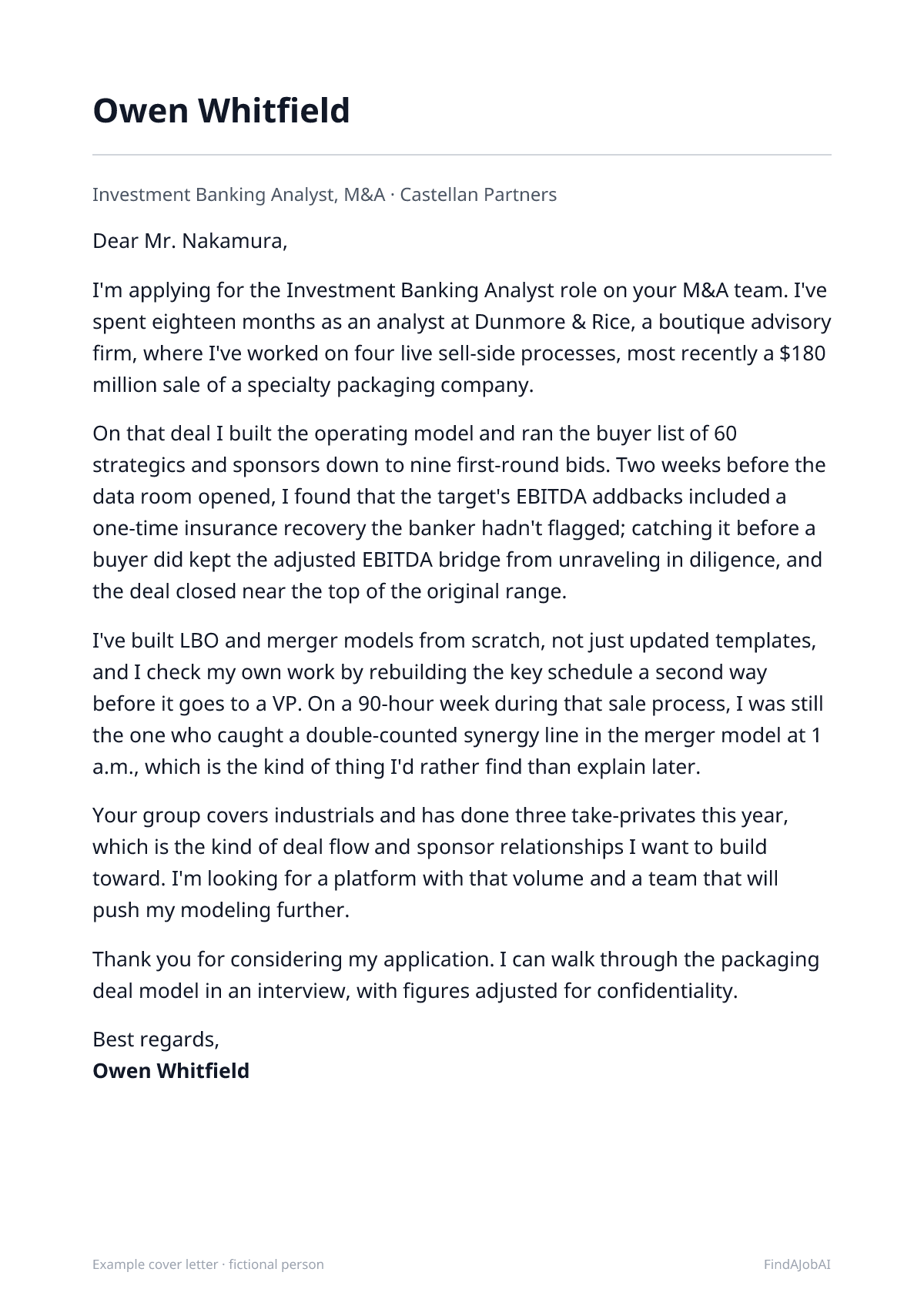
Dear Mr. Nakamura,
I'm applying for the Investment Banking Analyst role on your M&A team. I've spent eighteen months as an analyst at Dunmore & Rice, a boutique advisory firm, where I've worked on four live sell-side processes, most recently a $180 million sale of a specialty packaging company.
On that deal I built the operating model and ran the buyer list of 60 strategics and sponsors down to nine first-round bids. Two weeks before the data room opened, I found that the target's EBITDA addbacks included a one-time insurance recovery the banker hadn't flagged; catching it before a buyer did kept the adjusted EBITDA bridge from unraveling in diligence, and the deal closed near the top of the original range.
I've built LBO and merger models from scratch, not just updated templates, and I check my own work by rebuilding the key schedule a second way before it goes to a VP. On a 90-hour week during that sale process, I was still the one who caught a double-counted synergy line in the merger model at 1 a.m., which is the kind of thing I'd rather find than explain later.
Your group covers industrials and has done three take-privates this year, which is the kind of deal flow and sponsor relationships I want to build toward. I'm looking for a platform with that volume and a team that will push my modeling further.
Thank you for considering my application. I can walk through the packaging deal model in an interview, with figures adjusted for confidentiality.
Best regards,
Owen Whitfield
Example 2 · Career changer
Public accountant moving into investment banking
Dana built transaction models during audit engagements before she had a banking title. The ad mentions a lean team and client-ready output.
Example letter · fictional
Dear Hiring Manager,
I'm applying for the Investment Banking Analyst role at Hargrove Capital. For three years I've worked in transaction advisory at a mid-sized accounting firm, and I'm now looking to move from reviewing deals to helping run them.
On a carve-out audit last year, the client's management model didn't account for stranded corporate overhead after the sale, which would have overstated standalone EBITDA by about 12%. I rebuilt the model in Excel, laid out the adjustments by line item, and presented it to the deal team, who used my version in the final information memorandum. That work is what made me want to be on the banking side of the table.
I passed the CFA Level II exam this spring, and outside of client work I've built full three-statement and LBO models on two public companies to practice the mechanics bankers use day to day: debt schedules, circular references, and sensitivity tables. I'm fast in Excel and comfortable under a deadline; our busy season runs 70-hour weeks for two months straight.
Your posting mentions a lean six-person team where analysts own real modeling work early. That's the environment I want, and the diligence and adjustment work I already do would transfer directly to the models your team builds. I'd also keep a running list of every adjustment I make and why, so a reviewer can check my work in minutes instead of redoing it.
Thank you for your time. I'd welcome the chance to discuss the carve-out model or any technical questions directly.
Sincerely,
Dana Pacheco
Example 3 · Senior or lead
VP applying to build a new industrials coverage group
Grace is a VP at a large bank asked to staff and run a new three-person coverage group from scratch at a smaller firm.
Example letter · fictional
Dear Mr. Castellano,
I'm applying for the Vice President role leading your new industrials coverage group. I've spent seven years in investment banking, the last two as a VP at Dunmore & Rice, where I run deal execution for a team of two associates and three analysts and have closed eleven transactions totaling about $2.1 billion.
Your firm is building this group from one senior hire, which is close to what I did at Dunmore & Rice two years ago when our industrials coverage was a single partner and a rotating analyst pool. I wrote the sector's first pitch deck library, built relationships with three private equity sponsors who now call us first on carve-outs, and the group has gone from zero live mandates to four in that time.
On our largest closed deal, a $340 million sale of an auto parts manufacturer, the buyer's financing fell through nine days before signing. I restructured the deal as a rollover-plus-seller-note structure overnight with the client's counsel, which kept the transaction alive and closed within three weeks of the original date. The client referred us to two portfolio companies afterward.
I've staffed and trained analysts but haven't hired a VP-level hire or built a group's junior bench from zero; at Sable & Finch I'd want your input early on how you want analyst and associate recruiting run, since that's a decision better made together than assumed.
A conversation about which sponsor relationships you want this group to own in its first year, and how deal flow is currently split across your existing groups, would be a useful place to start.
Sincerely,
Grace Okonjo
All three letters, and the short version below, are fictional: the people, employers and numbers are invented. Borrow the structure, never the facts.
- Prefer to write it yourself? Use the free cover letter template.
- Check your CV against the job first: the free CV score shows the missing keywords.
Why the first letter works, paragraph by paragraph
Paragraph 1: Opening
Names the group applied to and the writer's current deal volume (four live processes, one $180 million sale). Banking hires on deal reps, so this is the first thing a staffer checks.
Paragraph 2: The deal and the catch
One specific find, the mistaken EBITDA addback, stated plainly with what it protected. Catching an error before a buyer does is exactly the judgment a VP is screening for.
Paragraph 3: Technical range and hours
Distinguishes building models from updating templates, and the double-counted synergy line shows attention to detail under real fatigue, not a claimed work ethic.
Paragraph 4: Why this group
Mirrors the ad's sector focus and deal type (take-privates) and states what the writer wants from the move, which reads as intentional rather than a lateral jump for its own sake.
Paragraph 5: Close
Offers to walk through the model in an interview, which is the natural next step in banking recruiting and signals the work is real.
What the career changer's letter does differently
The career changer's letter opens from a specific modeling catch made during an audit engagement, the stranded overhead adjustment, with its percentage effect on EBITDA, before mentioning the CFA exam or practice models. It names the hours and deadline pressure of her current job to show she already works at banking's pace, and ties the ad's 'lean team' detail to what she wants next.
What the senior letter does differently
A VP-level letter reports a team's growth and a firm's own numbers: zero mandates to four, a pitch deck library that became the sector's reference, eleven closed deals near $2.1 billion. The deal story shows judgment under real deal risk (financing falling through nine days out), and the gap, building a bench from scratch, is named directly rather than implied.
Short investment banking analyst cover letter: an email-ready version
Many applications arrive as an email or a small text box, and a full page doesn't fit. This version runs 120 to 150 words and keeps only what a reader needs to decide whether to reply. An analyst answers a boutique firm's 'why this role' application field by email after a referral introduction fell through on timing.
Short version · email · fictional132 words
Subject: Investment Banking Analyst application – M&A modeling background – Mateo Reyes
Hello Ms. Sorenson,
I'm applying for the Investment Banking Analyst role at Alderwood Securities. I'm a first-year analyst at a regional bank, where I've built models on two closed sell-side deals, most recently a $95 million sale of a regional logistics company.
On that deal I found a working capital adjustment the seller's model had left out, which would have cost them about $400,000 at closing. Flagging it before the buyer's diligence team did kept that money in our client's pocket and gave the banker a cleaner story to tell.
Your firm's size and deal pace are what drew me to apply; I want more direct deal exposure than a larger bank gives a first-year. My resume is attached, and I can walk through the adjustment in an interview.
Best,
Mateo Reyes
A short application field forces one deal and one dollar figure instead of a resume recap, so the version keeps the working capital catch and its exact value. It still names the firm's size as the reason for applying, since fit between bank size and career goals gets asked about directly.
Opening lines that work for investment banking analyst cover letters
The first sentence decides whether the second gets read. Here are six openings, one for each situation you might be in. Pick the one that matches yours and swap in your own facts: every name and number below is invented.
1. You have a standout result
On a $95 million sell-side deal last quarter, I caught a working capital adjustment the seller's model had missed, worth about $400,000 at closing. I'd like to bring that kind of attention to detail to your group.
2. The ad names a problem you've solved
Your ad asks for an analyst who can build models from scratch, not just update templates. I've built three LBO models from a blank workbook in the past year, including one on a live $180 million sale.
3. Someone referred you
Your associate, Daniel Brooks, staffed me on a joint pitch last spring and suggested I apply directly, which is what prompted this letter.
4. You admire what they build
I've followed three of your firm's recent industrials deals in the trade press, and the sponsor relationships behind them are the kind of deal flow I want to help build on.
5. You're new to the field or switching into it
I've spent three years in audit on transaction engagements, building the models bankers use downstream, and I'm ready to be on the other side of that handoff.
6. You have senior scope or a specialism
As a VP running deal execution for a five-person team, I've closed eleven transactions worth about $2.1 billion. I'm looking for a role building a coverage group from its earliest stage.
How to write an investment banking analyst cover letter
Five steps, in the order you'd write them. The shape stays the same for every job (a short opening, proof, a reason for this employer, a close), and what goes into each part is what changes with the role.
Lead with a deal, not a resume summary
Name one transaction you worked on, its approximate size, and your specific task: built the model, ran the buyer list, prepared the data room. A staffer reading dozens of these letters is looking for proof of real deal time, not adjectives.
Describe one catch or build, with the number it affected
Pick the moment you found an error, built something from scratch, or solved a problem under deadline. State what it was worth or what it protected, in dollars or percentage terms, rounded if the deal is still sensitive.
Name your technical range inside that story
Work LBO, merger model, DCF or comps into the sentence describing what you built, not as a separate skills list. A reader trusts 'I built the debt schedule and ran the sensitivity table' more than 'proficient in financial modeling.'
Show you can handle the hours without saying so
Mention one long week or late night and what you caught or delivered during it. This demonstrates stamina through evidence instead of the overused claim of thriving under pressure, which every applicant writes. Keep it to one sentence of detail.
Give a specific reason for this bank or group
Name the group's sector, a recent deal, or its size relative to where you are now, and say what you want from that specific environment. Vague interest in 'the opportunity' reads as a letter sent everywhere.
Investment Banking Analyst cover letter do's and don'ts
Do
- Name one deal or model, your specific role on it (built the model, ran the buyer list, found an error), and the dollar size or outcome.
- Mention a technical skill, LBO, merger model, DCF, inside a story, not as a bullet list.
- Show you can handle the hours by naming one, with what you caught or delivered during it, not by stating you 'work well under pressure.'
Don't
- Don't claim deal credit you didn't have; naming your actual task (built the model, not 'led the deal') is more credible and checkable in an interview.
- Don't disclose a live deal's name, client or exact terms; describe the situation and round or redact the figures.
- Don't list every technical skill from the job posting; pick the one or two the ad emphasizes and show them in use.
Common investment banking analyst cover letter mistakes
Each one is easy to make and quick to fix before you send the letter.
Claiming deal leadership a first-year analyst wouldn't have
'Led the sale of a $200 million company' invites a hard follow-up question in an interview. Say what you actually did, built the model, managed the data room, and let the deal size speak for itself.
Naming the client, exact terms, or confidential figures
Even a closed deal often carries confidentiality obligations. Round dollar figures, drop the company name, and say 'a specialty packaging company' instead, which is standard practice and protects you too.
Writing a generic 'passion for finance' opening
It says nothing a resume doesn't already imply. Open with the deal or model instead, and save any personal interest in markets for a single line later in the letter, if at all.
Listing every technical skill from the job posting
A row of LBO, DCF, comps, M&A, and capital markets suggests none were used deeply. Pick the one or two the ad emphasizes and show them inside one real example.
Framing long hours as the main selling point
Every applicant claims to work hard. Name one specific long week and what you delivered or caught during it, which proves the claim instead of repeating it.
Email subject lines for investment banking analyst applications
Applying by email? Put the job title, any reference number and your name in the subject line.
- Investment Banking Analyst, M&A application – Owen Whitfield
- Investment Banking Analyst – accountant with transaction advisory background – Dana Pacheco
- Application: Analyst, Industrials Coverage (Req. 2284) – Owen Whitfield
Everything for Investment Banking Analysts
- Investment Banking Analyst resume exampleA full resume, plus bullet and summary examples
- Investment Banking Analyst interview questions30 questions with sample answers
- Investment Banking Analyst job descriptionDuties, skills and requirements
- Career change cover letter: template + examples
Other cover letter examples
Investment Banking Analyst cover letter FAQ
What should I write in an investment banking analyst cover letter?
One deal or model you worked on, your specific task on it, and a concrete result or catch, something you found, built or fixed. Add one line on why this group or sector, and keep the whole letter under a page; bankers read fast.
How do I write an investment banking cover letter with no deal experience?
Use the closest real work you have, audit engagements, equity research, a finance internship, or self-built models on public companies, and name the specific modeling task and what you found. Mention any relevant exam, like CFA Level I or II, in passing, not as the headline.
Should I mention hours or workload in a banking cover letter?
Only to show you already operate at that pace, by naming a specific long week and what you delivered or caught during it. Don't frame long hours as the selling point on their own.
How we built this page
The FindAJobAI team wrote the three example letters, the short email version, the opening lines and the advice for investment banking analyst roles. The people, employers and numbers in the letters are invented; the structure, the kind of evidence and the order of the paragraphs are the parts to copy.
Once we track enough live investment banking analyst job ads, this page also shows the skills they ask for most, counted the same way as our in-demand skills report.
Last reviewed on November 1, 2026.