Locomotive Engineer Cover Letter Example (2026)
By FindAJobAI Team Updated How we built this page
Railroad hiring managers read locomotive engineer cover letters for one thing first: can this person run trains safely, by the rules, on territory like ours. A strong letter names your certification, the trains and tonnage you handle, your safety record and one moment that shows your judgment at the throttle. It should sound like a steady professional, not a fan of trains.
Locomotive Engineer cover letter template
This letter as a one-page template: an opening that names the job and your strongest fact, proof that answers the ad, a reason for this employer and a short close.
After you sign up, FindAJobAI drafts your own letter for a real job from your CV in this format, and you edit it before you send it.
Example 1 · Experienced
Freight engineer applying to a commuter rail operator
Horatio runs manifest and coal trains for a freight railroad. The ad is for a passenger locomotive engineer at a regional commuter rail service.
Example letter · fictional
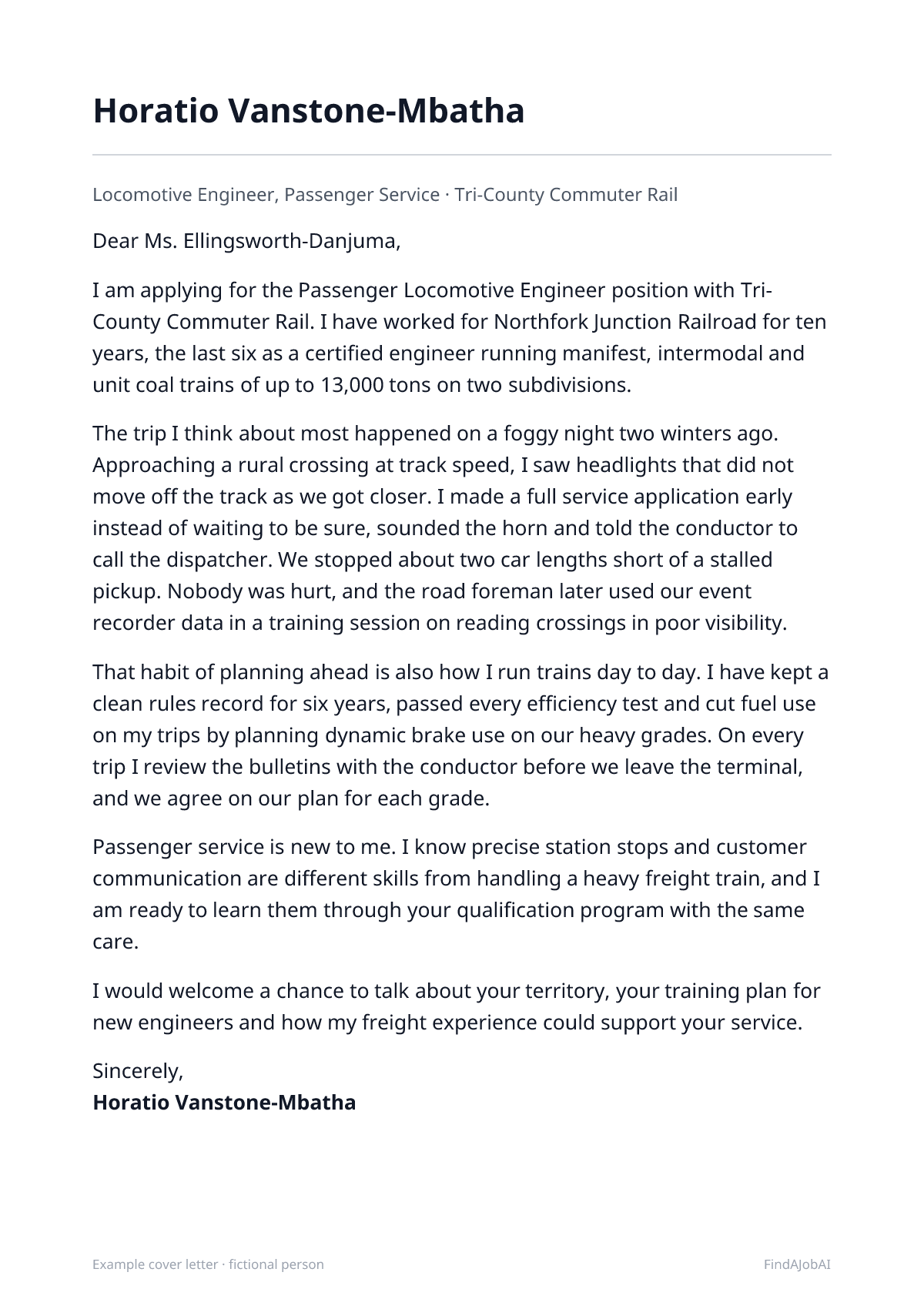
Dear Ms. Ellingsworth-Danjuma,
I am applying for the Passenger Locomotive Engineer position with Tri-County Commuter Rail. I have worked for Northfork Junction Railroad for ten years, the last six as a certified engineer running manifest, intermodal and unit coal trains of up to 13,000 tons on two subdivisions.
The trip I think about most happened on a foggy night two winters ago. Approaching a rural crossing at track speed, I saw headlights that did not move off the track as we got closer. I made a full service application early instead of waiting to be sure, sounded the horn and told the conductor to call the dispatcher. We stopped about two car lengths short of a stalled pickup. Nobody was hurt, and the road foreman later used our event recorder data in a training session on reading crossings in poor visibility.
That habit of planning ahead is also how I run trains day to day. I have kept a clean rules record for six years, passed every efficiency test and cut fuel use on my trips by planning dynamic brake use on our heavy grades. On every trip I review the bulletins with the conductor before we leave the terminal, and we agree on our plan for each grade.
Passenger service is new to me. I know precise station stops and customer communication are different skills from handling a heavy freight train, and I am ready to learn them through your qualification program with the same care.
I would welcome a chance to talk about your territory, your training plan for new engineers and how my freight experience could support your service.
Sincerely,
Horatio Vanstone-Mbatha
Example 2 · Entry level
Conductor applying for a first engineer position
Delphine spent four years as a freight conductor and just finished engineer training. The ad is for an entry-level engineer at a short line railroad.
Example letter · fictional
Dear Mr. Abernathy-Mwangi,
I am applying for the Locomotive Engineer opening at Wildcat Creek Short Line. For four years I have worked as a conductor for Cardinal Valley Rail, and this fall I completed its six-month engineer training program and earned my FRA certification.
During training I ran about ninety supervised trips on local and manifest trains. Early on, my engineer instructor noticed that I braked too late on one long descent, which caused rough slack action in the middle of the train. He had me study the grade profile and the event recorder data from that trip, and we practiced starting dynamic braking earlier and in smaller steps. By the end of training my trips on that hill were smooth, and I passed my check ride on the first attempt. I still keep those notes in my grip.
As a conductor I learned the work that keeps a train safe before it moves: air brake tests, switching, hazmat paperwork and clear job briefings. I have kept a clean safety and rules record for all four years and switched dozens of industries each week. My trainmaster has noted my careful paperwork in two of my yearly reviews.
A short line suits me because engineers and conductors work closely with customers and with each other. I am comfortable with both jobs and ready to help wherever the railroad needs me most. I am also ready to cover early starts, weekends and extra board calls.
I would be glad to meet your team and learn more about your territory and the customers you serve. I can provide my training records and check ride results on request.
Best regards,
Delphine Okoro-Rasmussen
Example 3 · Senior or lead
Senior engineer applying to become a road foreman of engines
Percival has eighteen years in rail, eleven as an engineer and peer trainer. The ad is for a road foreman of engines at a Class I railroad terminal.
Example letter · fictional
Dear Mr. Kettleborough-Whitby,
I am writing to apply for the Road Foreman of Engines position with Great Basin Northern Railway. I have worked in rail for eighteen years, including eleven as a locomotive engineer on heavy unit and intermodal trains for Prairie Meridian Rail, where I also serve as a designated peer trainer.
Over the last four years I have coached fourteen student engineers. Early on I saw that most trainees struggled with the same thing: controlling slack on our long descents. Rather than repeat advice on every trip, I started reviewing event recorder data with each trainee after their runs and marking exactly where braking should begin on each grade. All fourteen passed their check rides on the first attempt, and the road foreman asked me to share the method with other trainers.
I have also kept a clean safety record for eleven years and served two terms on our terminal safety committee, where we studied close calls and changed several yard procedures. That work taught me that crews follow rules best when they understand the reason behind them. We also started sharing short close-call summaries at every crew meeting.
Great Basin Northern runs heavy trains over mountain grades much like ours. I would start by riding with your engineers, learning their concerns and building a coaching plan around the grades and trains that cause the most problems. I would also ask your engineers which bulletins and grades worry them most.
I would welcome a conversation about the terminal's safety and fuel goals and how I could support your engineers. I am glad to share the coaching notes I use with trainees.
Kind regards,
Percival Achterberg-Lindo
All three letters, and the short version below, are fictional: the people, employers and numbers are invented. Borrow the structure, never the facts.
- Prefer to write it yourself? Use the free cover letter template.
- Check your CV against the job first: the free CV score shows the missing keywords.
Why the first letter works, paragraph by paragraph
Paragraph 1: Opening
Names the role, the current railroad, years at the throttle, train types and tonnage, which answers a hiring manager's first questions about experience.
Paragraph 2: The crossing story
Shows judgment in one real moment: an early decision to stop, clear communication and a safe outcome that was later used for training.
Paragraph 3: Daily habits
Connects the story to a steady record of rules compliance, efficiency tests and fuel-saving train handling.
Paragraph 4: The passenger gap
Admits that passenger service is new and names the specific skills the writer still needs to learn.
Paragraph 5: Close
Asks about territory and training, which keeps the focus on how the writer will qualify safely.
What the entry-level letter does differently
The new engineer's letter turns a training mistake into a learning story: rough slack action, event recorder review, a changed technique and a first-time check ride pass. It also shows the conductor work that underpins safe operation.
What the senior letter does differently
A senior letter shows leadership on the railroad: coaching results, event recorder reviews, a safety committee and a plan that starts by riding with crews.
Short locomotive engineer cover letter: an email-ready version
Many applications arrive as an email or a small text box, and a full page doesn't fit. This version runs 120 to 150 words and keeps only what a reader needs to decide whether to reply. A freight engineer replies by email to a tourist railroad that posted an opening for a seasonal steam and diesel engineer.
Short version · email · fictional125 words
Subject: Locomotive Engineer – 9 years freight, clean record – Seraphine Kowalczyk-Adebayo
Hi Mr. Delacourt-Ferreira,
I am writing about the Locomotive Engineer opening at Silver Hollow Scenic Railway. I have nine years in freight rail, six as an FRA-certified engineer, running manifest and local trains with a clean rules and safety record.
I am interested in passenger work at a slower pace, where smooth starts and stops matter for every rider. I have run older diesel units on local jobs and enjoy careful train handling on steep, curving track. I also helped two newer engineers learn our steepest hill, and both now run it smoothly.
I can start for the coming season, my certification and medical checks are current, and I would be happy to talk whenever suits you. My resume is attached.
Thank you,
Seraphine Kowalczyk-Adebayo
The short email leads with certification, years and safety record, then explains why the slower passenger work fits. A heritage railroad manager can judge fit in under a minute.
Opening lines that work for locomotive engineer cover letters
The first sentence decides whether the second gets read. Here are six openings, one for each situation you might be in. Pick the one that matches yours and swap in your own facts: every name and number below is invented.
1. You have a standout result
I have run freight trains of up to 13,000 tons for six years with a clean rules record, and I would like to bring that care to your passenger service.
2. The ad names a problem you've solved
Your posting asks for an engineer who plans ahead, and my most important trip ended two car lengths short of a stalled truck.
3. Someone referred you
After four years as a conductor and six months of engineer training, I am ready to take the throttle on your short line.
4. You admire what they build
Your road foreman, Lysander Okafor-Brightwell, suggested I apply after we met at a regional rail safety meeting last month.
5. You're new to the field or switching into it
Every trip I run starts with a full job briefing and a plan for each grade, which is how I have kept a clean record for six years.
6. You have senior scope or a specialism
As a peer trainer who has coached fourteen student engineers, I have learned that most train handling problems come down to braking too late.
How to write a locomotive engineer cover letter
Five steps, in the order you'd write them. The shape stays the same for every job (a short opening, proof, a reason for this employer, a close), and what goes into each part is what changes with the role.
Open with certification and experience
In the first two sentences, give your FRA certification, years at the throttle, train types and tonnage. A hiring manager checks these before anything else, because they decide how much training you will need on the new railroad and territory.
Tell one judgment story
Pick a moment such as an obstruction, an equipment failure or a hard grade in bad weather. Explain what you saw, what you did early and how it ended. One calm, specific story shows safety judgment far better than calling yourself safety-minded.
Give your record in numbers
State years or miles without reportable incidents, your rules record and efficiency test results. Railroads can check these, so accurate numbers build trust quickly and set you apart from letters that only promise to follow the rules.
Explain how you would qualify
If the job means new territory, passenger service or different equipment, say so and explain how you will learn it. Mention qualification trips, studying timetables or similar territory you have run, so the manager sees a realistic plan.
Close on the railroad's needs
End by linking your experience to the railroad's territory, train types or safety goals. Offer a conversation and keep the close short so the reader finishes with your record in mind. A short close also signals that you respect the reader's time on a busy desk.
Locomotive Engineer cover letter do's and don'ts
Do
- Name your FRA certification, train types, tonnage and territory in the first paragraph.
- Tell one short story that shows safety judgment at the throttle.
- Give your rules record and efficiency test results in plain numbers.
Don't
- Don't spend the letter on a childhood love of trains; managers want safe, reliable operators.
- Don't hide gaps such as passenger service or a new territory; explain how you would qualify.
- Don't exaggerate your safety record; railroads can check it.
Common locomotive engineer cover letter mistakes
Each one is easy to make and quick to fix before you send the letter.
Writing about loving trains
Keep enthusiasm to one line and spend the letter on certification, safety record and train handling.
Not stating your FRA certificate
Name your FRA certification and its status so the reader knows you can work right away.
Claiming a perfect record without proof
Give years, miles and test results that a railroad could verify instead of general claims.
Ignoring the new territory
Show you understand that every railroad requires qualification and explain how you would prepare.
Email subject lines for locomotive engineer applications
Applying by email? Put the job title, any reference number and your name in the subject line.
- Passenger Locomotive Engineer – 6 years certified freight engineer – Horatio Vanstone-Mbatha
- Locomotive Engineer – newly certified, 4 years conductor – Delphine Okoro-Rasmussen
- Road Foreman of Engines – 18 years rail, 11 as engineer – Percival Achterberg-Lindo
Everything for Locomotive Engineers
- Locomotive Engineer resume exampleA full resume, plus bullet and summary examples
- Locomotive Engineer interview questions30 questions with sample answers
- Locomotive Engineer job descriptionDuties, skills and requirements
- Cover letter with no experience: templates
Other cover letter examples
Locomotive Engineer cover letter FAQ
What should a locomotive engineer cover letter include?
Your FRA certification, years at the throttle, train types and territory, your safety and rules record, one short story that shows judgment and why this railroad interests you. Keep it to one page.
How do I write a locomotive engineer cover letter as a conductor?
Lead with your conductor years and any engineer training you completed. Describe supervised trips, one thing you learned about train handling and the safety habits you built as a conductor.
Should a locomotive engineer cover letter mention fuel savings?
Yes, briefly. A line about how you plan throttle and braking to save fuel shows skill in train handling, which railroads track closely.
How we built this page
The FindAJobAI team wrote the three example letters, the short email version, the opening lines and the advice for locomotive engineer roles. The people, employers and numbers in the letters are invented; the structure, the kind of evidence and the order of the paragraphs are the parts to copy.
Once we track enough live locomotive engineer job ads, this page also shows the skills they ask for most, counted the same way as our in-demand skills report.
Last reviewed on November 1, 2026.