Medical Records Clerk Cover Letter Example (2026)
By FindAJobAI Team Updated How we built this page
Hospitals and clinics often fill records jobs through an online application, and a short letter helps when dozens of people apply. Use it to name the record system you know, the volume you handle, how accurate your filing is and how carefully you treat patient privacy when releasing information.
Medical Records Clerk cover letter template
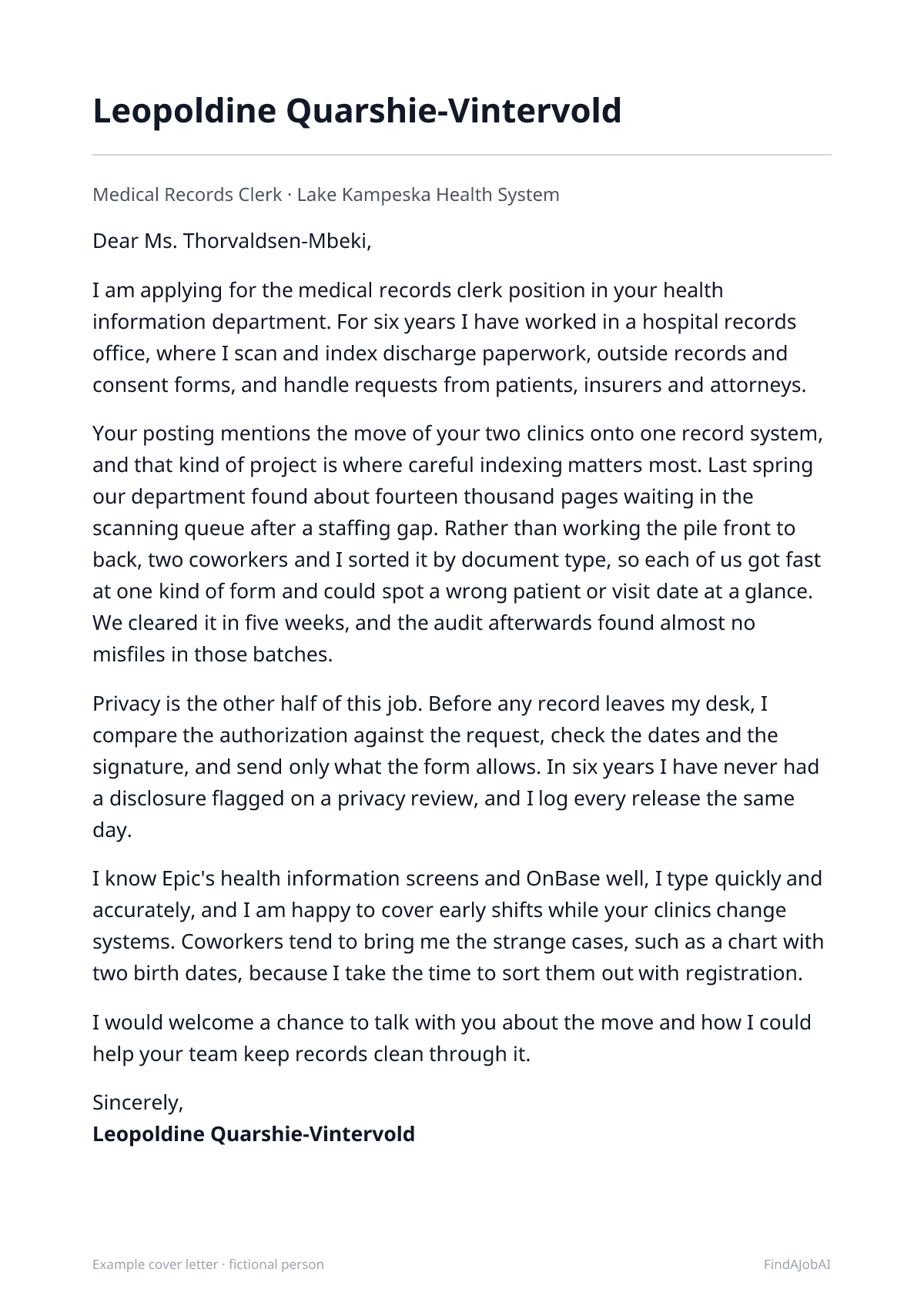
This letter as a one-page template: an opening that names the job and your strongest fact, proof that answers the ad, a reason for this employer and a short close.
After you sign up, FindAJobAI drafts your own letter for a real job from your CV in this format, and you edit it before you send it.
Example 1 · Experienced
Hospital records clerk applying to a larger health system
Leopoldine has six years in a hospital records office. The health system is merging two record systems and needs clerks who index accurately.
Example letter · fictional
Dear Ms. Thorvaldsen-Mbeki,
I am applying for the medical records clerk position in your health information department. For six years I have worked in a hospital records office, where I scan and index discharge paperwork, outside records and consent forms, and handle requests from patients, insurers and attorneys.
Your posting mentions the move of your two clinics onto one record system, and that kind of project is where careful indexing matters most. Last spring our department found about fourteen thousand pages waiting in the scanning queue after a staffing gap. Rather than working the pile front to back, two coworkers and I sorted it by document type, so each of us got fast at one kind of form and could spot a wrong patient or visit date at a glance. We cleared it in five weeks, and the audit afterwards found almost no misfiles in those batches.
Privacy is the other half of this job. Before any record leaves my desk, I compare the authorization against the request, check the dates and the signature, and send only what the form allows. In six years I have never had a disclosure flagged on a privacy review, and I log every release the same day.
I know Epic's health information screens and OnBase well, I type quickly and accurately, and I am happy to cover early shifts while your clinics change systems. Coworkers tend to bring me the strange cases, such as a chart with two birth dates, because I take the time to sort them out with registration.
I would welcome a chance to talk with you about the move and how I could help your team keep records clean through it.
Sincerely,
Leopoldine Quarshie-Vintervold
Example 2 · Entry level
Health information graduate applying for a first records job
Fitzgerald just finished a health information certificate with a hospital practicum. He is applying for an entry-level records clerk job.
Example letter · fictional
Dear Mr. Pellegrino-Stenberg,
I am writing to apply for the entry-level medical records clerk opening at Yankton Bluffs Hospital. This spring I completed a health information support certificate, including a practicum in a hospital records department, and I am ready for my first full-time role in the field.
During the practicum I worked beside a senior clerk who checked everything I did. I prepped and scanned discharge records, indexed about twelve hundred documents and logged two dozen requests for copies of records. She found three indexing errors in my work, and each time I asked her to walk me through how she had spotted it. By the last two weeks, she was sending my batches through without a second look, and she offered to serve as a reference for this application.
Before school I spent two years filing and entering data in a small insurance office. It was not health care, but it taught me to keep two filing rooms in order, type at a steady fifty-five words a minute and answer callers who were often frustrated. I also learned that a misplaced page can cost someone a whole afternoon, which is why I check twice.
I have completed HIPAA privacy training and a medical terminology certificate, so the forms and abbreviations in a chart are already familiar. I can work any shift, including weekends and holidays, I live fifteen minutes from the hospital, and I could begin as soon as your onboarding and background check are complete.
I would be grateful for the chance to meet you and show you how I work through a stack of records.
Respectfully,
Fitzgerald Okonjo-Haverkamp
Example 3 · Senior or lead
Records supervisor applying to lead a hospital release of information team
Cordelia has supervised a records team for six years. A regional hospital wants a supervisor to fix slow turnaround on records requests.
Example letter · fictional
Dear Dr. Kowalczuk-Ashby,
Please consider me for the health information supervisor role at Missouri Breaks Regional Health. I have thirteen years in hospital records, the last six leading a team of eight clerks who handle scanning, chart completion and release of information for a three-hundred-bed hospital.
Your posting is frank that requests are taking too long and that complaints have reached the patient advocate. I inherited the same problem in 2019, when our average request took eleven days and a few slipped past the thirty-day federal limit. I started a short triage each morning, sorting requests into patient, continuing care, legal and insurance, and gave each clerk one queue to own. We also built a shared log so anyone could answer a caller about where their request stood. Within two quarters the average fell to four days, and none has passed the limit since.
I take privacy as seriously as speed. My team checks every authorization against a written list, and I review a sample of releases each week. We have come through three accreditation surveys and two state privacy reviews without a records finding.
I also enjoy building people. I write plain training guides for each task, sit with new clerks during their first month and pair them with an experienced colleague who reviews their batches until both of them are confident. Two clerks I trained now hold the RHIT and work as coders.
I would be glad to meet with you and your compliance officer to share what I would look at in my first ninety days, starting with the oldest open requests.
With appreciation,
Cordelia Ravensworth-Abara
All three letters, and the short version below, are fictional: the people, employers and numbers are invented. Borrow the structure, never the facts.
- Prefer to write it yourself? Use the free cover letter template.
- Check your CV against the job first: the free CV score shows the missing keywords.
Why the first letter works, paragraph by paragraph
Paragraph 1: Opening
States the years, the setting and the daily tasks, so the supervisor can see the fit straight away.
Paragraph 2: The backlog story
Answers the posting's system move with a real backlog, a clear method and a result checked by audit.
Paragraph 3: Privacy habits
Describes the exact checks made before release, which is what a health information manager screens for.
Paragraph 4: Systems and shifts
Names the software and offers flexible hours during a busy change, both practical hiring points.
Paragraph 5: Close
Asks for a conversation tied to the employer's project rather than a generic interview request.
What the entry-level letter does differently
The graduate letter turns a short practicum into evidence: a counted volume, errors found and fixed and a supervisor's growing trust. An office job outside health care still shows filing, typing speed and patience on the phone.
What the senior letter does differently
The supervisor letter answers the hospital's turnaround problem with a past fix that has clear before and after numbers. Weekly release sampling and clean surveys show compliance, and the clerks who moved up prove the writer develops staff.
Short medical records clerk cover letter: an email-ready version
Many applications arrive as an email or a small text box, and a full page doesn't fit. This version runs 120 to 150 words and keeps only what a reader needs to decide whether to reply. An outpatient records clerk replies by email to a clinic's listing on a local job board that asked for a short note and a resume.
Short version · email · fictional127 words
Subject: Medical Records Clerk – 4 yrs outpatient records and scanning – Benedikt Amoako-Frisby
Hi Ms. Brennaman-Iwu,
I saw your opening for a medical records clerk at Watertown Lakes Orthopedic Clinic and have attached my resume. I have spent four years in a busy family practice, scanning outside records, filing imaging reports, handling copy requests and merging duplicate charts.
Orthopedic clinics receive a steady stream of imaging and surgical notes from other providers, and I am used to matching each one to the right patient and visit on the same day it arrives. My last two quarterly audits showed no misfiles, and I keep the release log current every afternoon.
I can start two weeks after an offer and am open to early or late shifts. Would you have time for a short call later this week?
Many thanks,
Benedikt Amoako-Frisby
Clinic managers reading email want the setting, the tasks and the start date at a glance. These three paragraphs cover outpatient records work, same-day indexing, audit results and availability, then ask for a short call.
Opening lines that work for medical records clerk cover letters
The first sentence decides whether the second gets read. Here are six openings, one for each situation you might be in. Pick the one that matches yours and swap in your own facts: every name and number below is invented.
1. You have a standout result
For six years I have scanned, indexed and released hospital records, and your system move is exactly the kind of work I want to help with.
2. The ad names a problem you've solved
Your posting puts accuracy first, which is the part of records work I measure myself on every quarter.
3. Someone referred you
A hospital practicum this spring confirmed that I want to build a career in health information, starting at your records desk.
4. You admire what they build
After leading a records team through three accreditation surveys, I would like to bring that steady approach to your department.
5. You're new to the field or switching into it
Your health information manager, Ottoline Brascombe-Udeh, suggested I apply after we worked together on a records conversion.
6. You have senior scope or a specialism
I have released thousands of records without a privacy complaint, because I check every authorization the same way.
How to write a medical records clerk cover letter
Five steps, in the order you'd write them. The shape stays the same for every job (a short opening, proof, a reason for this employer, a close), and what goes into each part is what changes with the role.
Open with your setting and system
Say whether you work in a hospital, clinic or other setting, how many years you have and which record system you use. Health information departments train on specific software, so naming Epic, Cerner or OnBase tells the reader how fast you could start.
Show accuracy with one example
Describe a backlog you cleared, an audit result or an error you caught before it caused harm. Give the volume and the outcome, such as pages indexed in a set number of weeks or a misfile rate on a quarterly audit.
Explain how you protect privacy
Write two or three sentences on what you check before releasing information, such as signatures, dates and what the authorization allows. A supervisor reading this wants to see habits you follow on every request, not just the word HIPAA.
Cover the practical points
Mention typing speed, shifts you can work and how soon you can start. Records departments often need cover for early mornings, weekends or a system change, so flexibility can move your application up the list.
Close with a clear next step
Ask for a short conversation or offer to complete a filing or indexing test. Keep the closing to one or two lines, and make sure your phone number and email are easy to find in the letter heading.
Medical Records Clerk cover letter do's and don'ts
Do
- Name the record and imaging systems you have used.
- Describe the checks you make before releasing a record.
- Give a daily or weekly volume for your main tasks.
Don't
- Don't describe a real patient's chart, even with the name removed.
- Don't call yourself detail oriented without an example.
- Don't send the same letter to a clinic and a hospital without changing it.
Common medical records clerk cover letter mistakes
Each one is easy to make and quick to fix before you send the letter.
Describing a real patient's case
Keep every example general, with no names, dates of birth or conditions, even if you think it is harmless.
Listing duties with no volume
Add pages, requests or charts per day or week so the reader can judge your pace.
Mentioning HIPAA without any habit
Name the checks you make before release, such as matching dates and signatures on the authorization.
Skipping the record system
Name the software you know and be honest about which modules you have used.
Ending without availability
Say which shifts you can work and when you could start, since records teams often need quick cover.
Email subject lines for medical records clerk applications
Applying by email? Put the job title, any reference number and your name in the subject line.
- Medical Records Clerk – 6 yrs hospital HIM, Epic and OnBase – Leopoldine Quarshie-Vintervold
- Entry-Level Records Clerk – HIS certificate, hospital practicum – Fitzgerald Okonjo-Haverkamp
- Health Information Supervisor – 13 yrs, release of information lead – Cordelia Ravensworth-Abara
Everything for Medical Records Clerks
- Medical Records Clerk resume exampleA full resume, plus bullet and summary examples
- Medical Records Clerk interview questions30 questions with sample answers
- Medical Records Clerk job descriptionDuties, skills and requirements
- Cover letter with no experience: templates
Other cover letter examples
Medical Records Clerk cover letter FAQ
Do medical records clerks need a cover letter?
Many hospital systems make it optional, but a short letter helps when the opening draws many applicants. It lets you name your record system, show accuracy and explain how you protect patient privacy.
How do I write a medical records clerk cover letter with no experience?
Lead with a health information course or practicum, medical terminology and HIPAA training. Add any filing, data entry or front desk work, and give one example of catching or fixing an error.
How long should a medical records clerk cover letter be?
About 260 to 330 words. Cover your setting and system, one example of accuracy or a cleared backlog, your privacy habits and your availability.
How we built this page
The FindAJobAI team wrote the three example letters, the short email version, the opening lines and the advice for medical records clerk roles. The people, employers and numbers in the letters are invented; the structure, the kind of evidence and the order of the paragraphs are the parts to copy.
Once we track enough live medical records clerk job ads, this page also shows the skills they ask for most, counted the same way as our in-demand skills report.
Last reviewed on November 1, 2026.