Medical Scribe Cover Letter Example (2026)
By FindAJobAI Team Updated How we built this page
Physicians and scribe program managers read medical scribe cover letters for pace, accuracy and discretion. Give your setting and encounters per shift, add an audit score or a result for the providers you support, and describe one shift that shows how you stay focused. If you plan to study medicine, mention it briefly without making it the whole letter.
Medical Scribe cover letter template
This letter as a one-page template: an opening that names the job and your strongest fact, proof that answers the ad, a reason for this employer and a short close.
After you sign up, FindAJobAI drafts your own letter for a real job from your CV in this format, and you edit it before you send it.
Example 1 · Experienced
Emergency department scribe applying to a cardiology practice
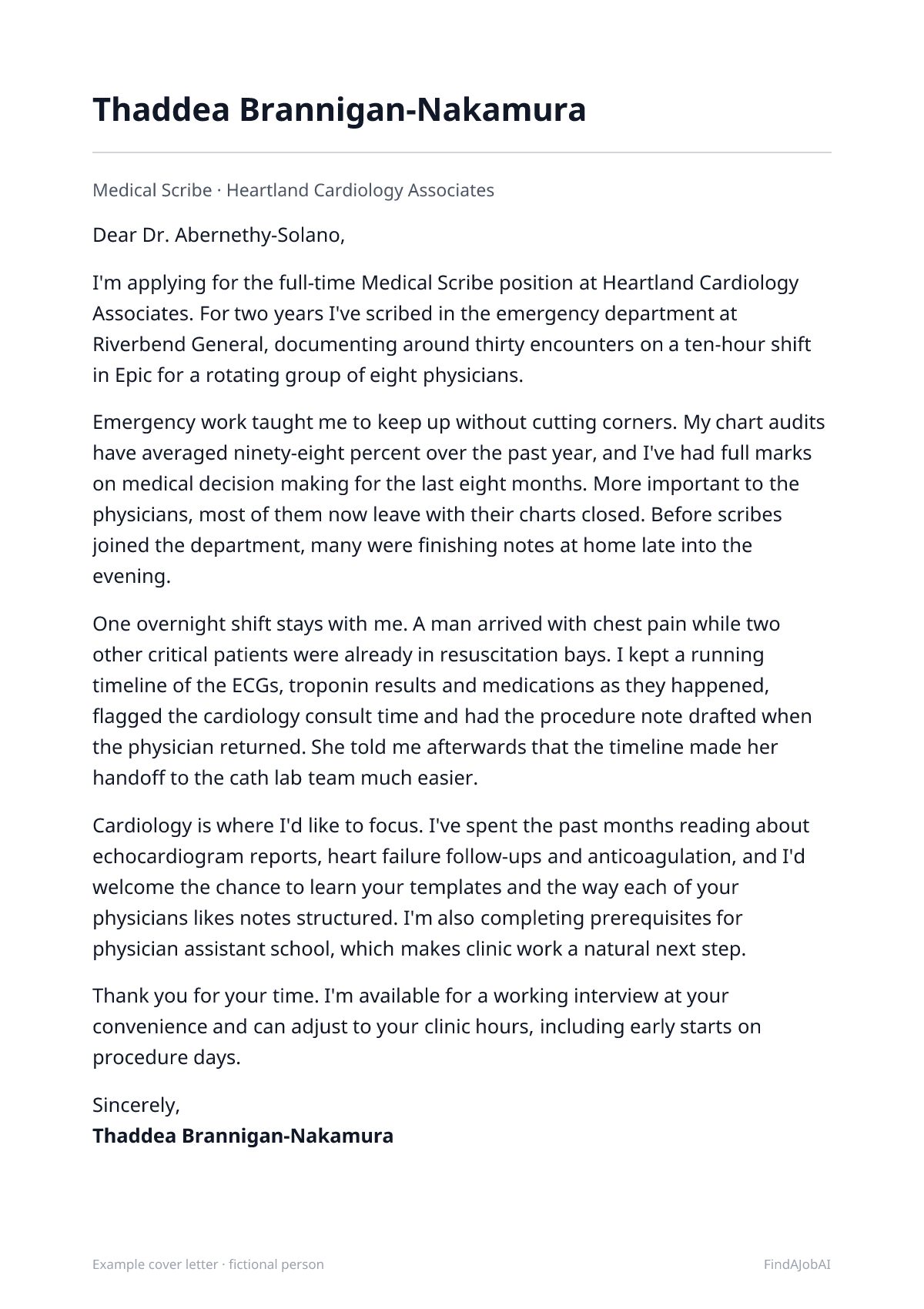
Thaddea has two years scribing in a busy emergency department. The ad is for a full-time scribe at a cardiology group with three physicians.
Example letter · fictional
Dear Dr. Abernethy-Solano,
I'm applying for the full-time Medical Scribe position at Heartland Cardiology Associates. For two years I've scribed in the emergency department at Riverbend General, documenting around thirty encounters on a ten-hour shift in Epic for a rotating group of eight physicians.
Emergency work taught me to keep up without cutting corners. My chart audits have averaged ninety-eight percent over the past year, and I've had full marks on medical decision making for the last eight months. More important to the physicians, most of them now leave with their charts closed. Before scribes joined the department, many were finishing notes at home late into the evening.
One overnight shift stays with me. A man arrived with chest pain while two other critical patients were already in resuscitation bays. I kept a running timeline of the ECGs, troponin results and medications as they happened, flagged the cardiology consult time and had the procedure note drafted when the physician returned. She told me afterwards that the timeline made her handoff to the cath lab team much easier.
Cardiology is where I'd like to focus. I've spent the past months reading about echocardiogram reports, heart failure follow-ups and anticoagulation, and I'd welcome the chance to learn your templates and the way each of your physicians likes notes structured. I'm also completing prerequisites for physician assistant school, which makes clinic work a natural next step.
Thank you for your time. I'm available for a working interview at your convenience and can adjust to your clinic hours, including early starts on procedure days.
Sincerely,
Thaddea Brannigan-Nakamura
Example 2 · Career changer
Court stenographer moving into medical scribing
Cornelius worked five years as a court reporter. The ad is for a remote medical scribe at a telehealth company that trains new scribes.
Example letter · fictional
Dear Clearline Scribe Program Team,
I'd like to apply for the Remote Medical Scribe role at Clearline Telehealth. For five years I worked as a court reporter in Hamilton County, producing verbatim transcripts of hearings and depositions, often with several people speaking at once and technical vocabulary I'd never heard before.
Court reporting and scribing share more than people expect. Both depend on listening closely, typing fast and accurately, and staying invisible in the room while something important is happening. My realtime writing speed is well above two hundred words a minute, and my transcripts were rarely returned with corrections. I'm used to proofreading carefully before anything is filed, because errors in a legal record can matter a great deal.
Medical language is the part I'm still building. Over the past six months I completed a medical terminology course at our community college and a forty-hour scribe training program, where I documented mock visits in an EHR training environment. I also transcribed many medical malpractice depositions, so I've heard physicians explain diagnoses and procedures in detail.
Telehealth suits my experience. I already work comfortably from a quiet home office with professional equipment, and I'm disciplined about confidentiality, which court reporters treat as seriously as clinicians do. I'd expect a learning curve on your templates and on structuring a note for clinical readers rather than lawyers, and I'd welcome feedback during your training period.
Thank you for looking at an application from outside healthcare. I'd be glad to complete any typing or terminology assessment you use.
Best regards,
Cornelius Ferreira-Blackwood
Example 3 · Senior or lead
Lead scribe applying for a chief scribe role
Philippina has five years scribing and leads a small team at an urgent care chain. The ad is for chief scribe across two hospital emergency departments.
Example letter · fictional
Dear Dr. Whitcombe-Adeyemi,
I'm applying for the Chief Medical Scribe position covering Lakeshore Regional's two emergency departments. I've worked as a scribe for five years, and for the past two I've been lead scribe at Prairie Point Urgent Care, coordinating six scribes across three clinics while still working my own shifts.
The first thing I changed as lead was how we handled audits. Scribes received a monthly score with little explanation, and the same errors kept appearing. I switched to reviewing two charts per scribe every week and sending short, specific notes on what to fix. Within a year our team average rose from the high eighties to ninety-six percent, and providers noticeably reduced their edits.
I also rebuilt onboarding. New scribes used to shadow for a few days and then work alone, and many left within their first month. They now follow a three-week plan with graded mock charts, shadowing on different shift types and a check-in with me at the end of each week. First-month turnover dropped by about half.
Leading eighteen scribes across two hospitals would be a significant step from six in urgent care, and emergency department scheduling is more complex. I'd spend my first weeks working shifts at both sites, meeting each medical director and listening to scribes about what slows them down before proposing changes, and I'd keep the parts of each site's routine that already work well.
Many thanks for reading. I'd welcome a conversation about the program, its current audit results and your goals for it over the next year.
Sincerely,
Philippina Mbatha-Kerrigan
All three letters, and the short version below, are fictional: the people, employers and numbers are invented. Borrow the structure, never the facts.
- Prefer to write it yourself? Use the free cover letter template.
- Check your CV against the job first: the free CV score shows the missing keywords.
Why the first letter works, paragraph by paragraph
Paragraph 1: Opening
States setting, years, encounters per shift and the EHR in two sentences, the core facts a physician wants about a scribe.
Paragraph 2: Accuracy and impact
Pairs a measured audit record with the result physicians care about most, charts closed before they go home.
Paragraph 3: Overnight story
Shows focus and anticipation during a critical case with specific actions and a physician's reaction, without identifying the patient.
Paragraph 4: Why cardiology
Explains the move with preparation already done and a career goal mentioned briefly, keeping attention on the job itself.
Paragraph 5: Close
Offers a working interview, which many practices use to test scribes on real shifts.
What the career changer's letter does differently
The career changer's letter links court reporting to scribing through listening, speed, accuracy and discretion. It is honest about medical vocabulary still developing and shows concrete steps taken: a terminology course, scribe training and exposure through depositions.
What the senior letter does differently
A chief scribe letter shifts from documenting visits to running a program: weekly audit feedback, structured onboarding and lower turnover. It honestly names the jump in scale and offers a grounded first step.
Short medical scribe cover letter: an email-ready version
Many applications arrive as an email or a small text box, and a full page doesn't fit. This version runs 120 to 150 words and keeps only what a reader needs to decide whether to reply. A medical scribe replies by email to a clinic manager who posted a part-time opening and asked for a brief note.
Short version · email · fictional127 words
Subject: Part-Time Medical Scribe – 1 year family medicine, athenahealth – Ignatius Okonkwo-Fairley
Dear Ms. Rutherford-Achebe,
I'm writing about the part-time Medical Scribe opening at Willowbrook Pediatrics. I've scribed for a year at a family medicine clinic, documenting about twenty-two visits a day in athenahealth with an audit average of ninety-seven percent.
Many of our patients are children, so I've learned to capture growth charts, vaccine histories and parent concerns quickly while staying out of the way during exams. Our physicians now finish most notes before they leave the clinic each evening, which they tell me has made a real difference to their family time.
I'm available Monday, Wednesday and Friday, and could start within two weeks. My resume is attached, and I'd be happy to come in for a working interview whenever it suits you.
Kind regards,
Ignatius Okonkwo-Fairley
The short version fits a clinic manager's inbox: setting, volume and audit score first, one pediatric-specific detail, then clear availability for a part-time role.
Opening lines that work for medical scribe cover letters
The first sentence decides whether the second gets read. Here are six openings, one for each situation you might be in. Pick the one that matches yours and swap in your own facts: every name and number below is invented.
1. You have a standout result
For two years I've documented about thirty emergency encounters a shift in Epic, and my chart audits have averaged ninety-eight percent.
2. The ad names a problem you've solved
Your posting mentions physicians finishing charts late at home. Helping providers close notes before they leave is what I'm proudest of as a scribe.
3. Someone referred you
Dr. Esperanza Lindqvist, one of your cardiologists, suggested I apply after I shadowed her clinic as part of my physician assistant preparation.
4. You admire what they build
I was a patient at your clinic during college, and the attentive care I received there is part of why I chose to work in healthcare.
5. You're new to the field or switching into it
After five years as a court reporter capturing every word of complex hearings, I'm ready to bring that accuracy to medical documentation.
6. You have senior scope or a specialism
As lead scribe for six colleagues, I've raised audit scores and rebuilt onboarding, and I'm ready to lead a larger hospital scribe program.
How to write a medical scribe cover letter
Five steps, in the order you'd write them. The shape stays the same for every job (a short opening, proof, a reason for this employer, a close), and what goes into each part is what changes with the role.
Open with setting and pace
Say where you scribe, for how long and how many encounters you document per shift, then name the EHR. A physician or program manager can immediately see whether you can keep up with their clinic or department.
Prove accuracy with numbers
Give your audit average and the period it covers, and add a result for providers such as charts closed before shift end or less evening charting. These two facts together show you are both precise and genuinely useful.
Describe one demanding shift
Choose a busy or critical shift and explain what you did to keep documentation complete, such as running a timeline or pre-drafting a note. Keep every detail general enough that no patient could be identified from your story.
Explain your interest in this setting
If you are moving specialties, show preparation such as reading about common conditions or learning their templates. Mention any health career goal in one sentence, then return to how you would support their providers today, which is what the reader is hiring for.
Finish with the shifts you can cover
Scribe schedules vary widely, from overnight emergency shifts to clinic hours. State the days and shifts you can work and how soon you can start, and offer a working interview, which many practices use to see you in action.
Medical Scribe cover letter do's and don'ts
Do
- Give your setting and encounters per shift, plus the EHR you use.
- Mention an audit score or a result for providers, such as charts closed before shift end.
- Tell one short story about a busy shift without any patient details.
Don't
- Don't describe yourself as making clinical decisions; scribes document.
- Don't make the letter mainly about your plans for medical school.
- Don't include anything that could identify a patient, even indirectly.
Common medical scribe cover letter mistakes
Each one is easy to make and quick to fix before you send the letter.
Overstating your clinical role
Scribes document what providers say and do. Describe your work accurately and never suggest you diagnosed or treated patients.
Writing mostly about future plans
A letter centered on medical school makes managers worry you will leave soon. Focus on current skills and commitment to the role.
Telling a story that could identify a patient
Even an age, date and condition together can identify someone. Keep stories general and focus on your actions.
Forgetting the EHR
Providers want scribes who need little training. Name the systems you know in the first paragraph.
Email subject lines for medical scribe applications
Applying by email? Put the job title, any reference number and your name in the subject line.
- Medical Scribe – 2 years emergency department, Epic – Thaddea Brannigan-Nakamura
- Remote Medical Scribe – court reporter with scribe training – Cornelius Ferreira-Blackwood
- Chief Scribe application – team lead across two sites – Philippina Mbatha-Kerrigan
Everything for Medical Scribes
- Medical Scribe resume exampleA full resume, plus bullet and summary examples
- Medical Scribe interview questions30 questions with sample answers
- Medical Scribe job descriptionDuties, skills and requirements
- Career change cover letter: template + examples
Other cover letter examples
Medical Scribe cover letter FAQ
What should a medical scribe cover letter include?
Your setting, encounters per shift, EHR experience, an accuracy measure such as audit scores, a short story about a busy shift, and your availability. Mention health career goals briefly if relevant.
How do I write a medical scribe cover letter with no experience?
Highlight typing speed, medical terminology from coursework, healthcare volunteering and any scribe training. Show that you stay calm and focused in busy settings and can protect patient privacy.
Should I mention medical school in a scribe cover letter?
Briefly, yes. Many scribe programs welcome pre-health applicants. Keep it to one sentence and spend the rest of the letter on how you will support providers now.
How we built this page
The FindAJobAI team wrote the three example letters, the short email version, the opening lines and the advice for medical scribe roles. The people, employers and numbers in the letters are invented; the structure, the kind of evidence and the order of the paragraphs are the parts to copy.
Once we track enough live medical scribe job ads, this page also shows the skills they ask for most, counted the same way as our in-demand skills report.
Last reviewed on November 1, 2026.