MLOps Engineer Cover Letter Example (2026)
By FindAJobAI Team Updated How we built this page
MLOps roles usually open when models pile up in notebooks, releases take weeks, or a model quietly loses accuracy and nobody notices for a month. A strong MLOps engineer cover letter shows one system you built to close that gap, how many models and data scientists relied on it, and what changed in release speed, reliability or cost.
MLOps Engineer cover letter template
This letter as a one-page template: an opening that names the job and your strongest fact, proof that answers the ad, a reason for this employer and a short close.
After you sign up, FindAJobAI drafts your own letter for a real job from your CV in this format, and you edit it before you send it.
Example 1 · Experienced
ML platform engineer applying to an insurance technology company
Marguerite built the model deployment platform at an online lender. The ad asks for Kubeflow, model monitoring and work with data scientists.
Example letter · fictional
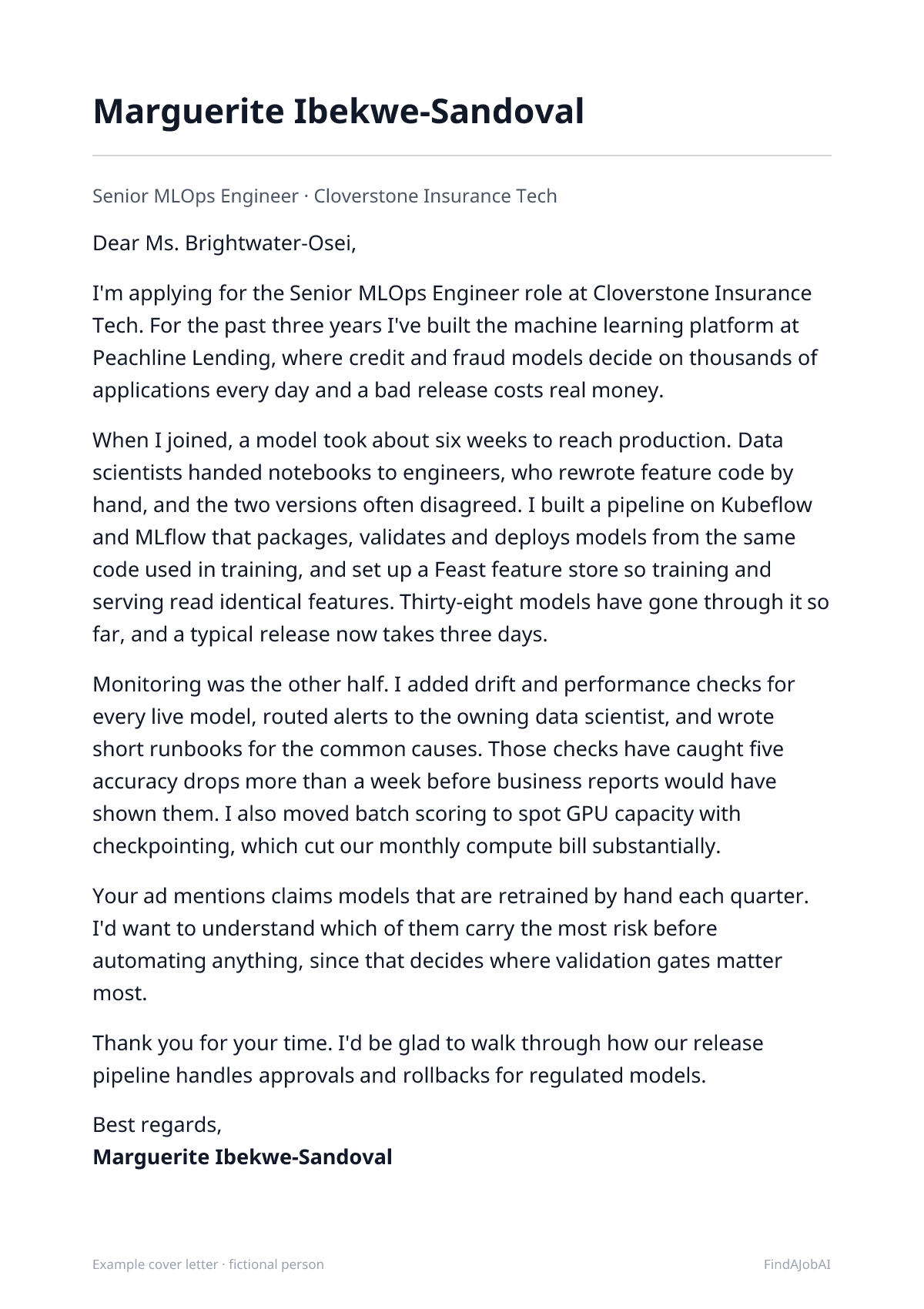
Dear Ms. Brightwater-Osei,
I'm applying for the Senior MLOps Engineer role at Cloverstone Insurance Tech. For the past three years I've built the machine learning platform at Peachline Lending, where credit and fraud models decide on thousands of applications every day and a bad release costs real money.
When I joined, a model took about six weeks to reach production. Data scientists handed notebooks to engineers, who rewrote feature code by hand, and the two versions often disagreed. I built a pipeline on Kubeflow and MLflow that packages, validates and deploys models from the same code used in training, and set up a Feast feature store so training and serving read identical features. Thirty-eight models have gone through it so far, and a typical release now takes three days.
Monitoring was the other half. I added drift and performance checks for every live model, routed alerts to the owning data scientist, and wrote short runbooks for the common causes. Those checks have caught five accuracy drops more than a week before business reports would have shown them. I also moved batch scoring to spot GPU capacity with checkpointing, which cut our monthly compute bill substantially.
Your ad mentions claims models that are retrained by hand each quarter. I'd want to understand which of them carry the most risk before automating anything, since that decides where validation gates matter most.
Thank you for your time. I'd be glad to walk through how our release pipeline handles approvals and rollbacks for regulated models.
Best regards,
Marguerite Ibekwe-Sandoval
Example 2 · Career changer
DevOps engineer moving into MLOps
Caspian has been a DevOps engineer for six years and recently supported his company's first production models. The ad is for an MLOps engineer.
Example letter · fictional
Dear Brightfern Hiring Team,
The MLOps Engineer opening at Brightfern Health AI fits the work I have grown into over the past eighteen months. I've been a DevOps engineer at a retail software company for six years, running Kubernetes clusters, Terraform and delivery pipelines for about forty services.
Last year our data science team was ready to ship its first demand-forecasting models, and nobody knew how to run them. I volunteered. I learned how they trained and evaluated their models, containerized the first three, and served them on our existing clusters with Seldon. Then I built an Airflow pipeline to retrain them weekly and a simple check that blocks a new model if its holdout error is worse than the current one. Retraining used to take an analyst three days a month; it now runs on its own.
Since then I've completed a machine learning course so I understand the metrics data scientists care about, set up MLflow for experiment tracking, and started learning how drift monitoring works with Evidently. I know model evaluation and feature engineering are areas where I am still building depth.
Your ad says the team needs someone who can make models as dependable as the rest of the platform. That is the reliability habit I bring from six years of on-call, and I'd like to apply it to models full time.
My GitHub has the retraining pipeline and the validation check, and I'd be happy to walk through either on a call at any time that suits you.
Kind regards,
Caspian Mahlangu-Eriksen
Example 3 · Senior or lead
ML platform lead applying to build a new platform team
Philomena leads an ML platform team at a health insurer. The ad is for a head of ML platform at a company scaling from a few models to dozens.
Example letter · fictional
Dear Mr. Nakagawa-Burke,
I'm applying for the Head of ML Platform role at Larkfield Benefits. For the past four years I've led the ML platform team at Constitution Health Partners, where we run about 120 production models for claims, risk and member outreach, supported by a team of six engineers.
Your ad describes a company with a handful of models in production and plans for many more. We were in that position when I started. Instead of building every component at once, I asked data science leads which step slowed them most, and the answer was approvals: compliance reviews happened over email and took weeks. We built lineage tracking, approval gates and audit logs into the release pipeline first. Reviews dropped to days, and we passed three regulatory reviews without findings. Serving, feature stores and monitoring followed later, in the order teams asked for them.
I also own ML compute spend. GPU sharing, autoscaling and better job scheduling cut it by about thirty percent, and those savings paid for a shared serving layer for our first large language model use cases, with cost tracking for every team that uses it.
I haven't worked with benefits administration data, and I'd expect its structure and privacy rules to shape the platform's design in ways I would need to learn early.
I'd welcome a conversation about which models matter most to the business today, and where your data scientists feel the most friction when they try to ship a new model.
Sincerely,
Philomena Oyenuga-Strand
All three letters, and the short version below, are fictional: the people, employers and numbers are invented. Borrow the structure, never the facts.
- Prefer to write it yourself? Use the free cover letter template.
- Check your CV against the job first: the free CV score shows the missing keywords.
Why the first letter works, paragraph by paragraph
Paragraph 1: Opening
Explains why bad releases are costly in lending, which tells an insurance reader the writer understands risk in production models.
Paragraph 2: The platform story
Starts from a six-week handoff problem, explains pipeline and feature store choices, and ends with model count and release time.
Paragraph 3: Monitoring paragraph
Drift checks with alerts to owners and an early-detection record show the writer cares about models after launch, plus a cost result.
Paragraph 4: Why this company
Engages with the ad's manual retraining and puts risk assessment before automation.
Paragraph 5: Close
Offers to discuss approvals and rollbacks, which matters to a regulated employer.
What the career changer's letter does differently
The career changer turns a volunteered project into MLOps evidence: three models served, weekly retraining and a validation gate. Learning steps are specific, the gap in evaluation depth is admitted, and on-call experience is framed as a strength for a team that wants dependable models.
What the senior letter does differently
This leadership letter shows sequencing: fix the slowest step first, which in a regulated company was approvals. Compute savings that funded new capabilities show business sense, and the gap on benefits data is stated plainly.
Short MLOps engineer cover letter: an email-ready version
Many applications arrive as an email or a small text box, and a full page doesn't fit. This version runs 120 to 150 words and keeps only what a reader needs to decide whether to reply. An MLOps engineer emails a head of data science who shared the opening on a machine learning community board and asked for direct replies.
Short version · email · fictional123 words
Subject: MLOps Engineer – Airflow retraining and Seldon serving for 15 models – Benedetta Oduya-Halloran
Hi Dr. Achebe,
Your post on the machine learning community board about an MLOps opening at Sproutline caught my attention. For three years I've run the model platform at a retail analytics company, mostly forecasting models served to about nine hundred store clients.
My main project was moving fifteen demand models from manual monthly retraining to weekly Airflow pipelines with automatic validation, then serving them on Kubernetes with Seldon at steady latency. Analysts got back about three days a month, and no worse model has reached production since.
You mentioned forecasts that drift after holidays, which is exactly the problem those validation checks were built for. My resume is attached, and I'm free for a call most mornings this week.
Thanks,
Benedetta Oduya-Halloran
A data science leader skimming replies wants proof that models will run reliably. This email offers one platform with model count, retraining cadence and a clear result, then ties it to the holiday drift mentioned in the post.
Opening lines that work for MLOps engineer cover letters
The first sentence decides whether the second gets read. Here are six openings, one for each situation you might be in. Pick the one that matches yours and swap in your own facts: every name and number below is invented.
1. You have a standout result
Releasing a model at my company used to take six weeks. The platform I built cut that to three days across 38 models, and I'd like to do the same for your team.
2. The ad names a problem you've solved
Your ad says your claims models are retrained by hand each quarter. I automated retraining and validation for a similar set of models at a lender.
3. Someone referred you
Ines Carvalho on your data science team and I worked together on model monitoring for two years. She told me your platform team is growing.
4. You admire what they build
We use your open-source feature validation library in our pipelines, and I contributed a patch for its schema checks last year.
5. You're new to the field or switching into it
After six years running Kubernetes and pipelines, I deployed my company's first production models. I want to do MLOps full time.
6. You have senior scope or a specialism
I've led an ML platform team running 120 production models, and I'm looking to build a platform team from its first hire.
How to write a MLOps engineer cover letter
Five steps, in the order you'd write them. The shape stays the same for every job (a short opening, proof, a reason for this employer, a close), and what goes into each part is what changes with the role.
Spot where models get stuck
MLOps roles exist because models stall somewhere between notebook and production, or degrade once they are live. Read the ad for clues such as slow releases, manual retraining or monitoring gaps, and choose the system of yours that fixed the same bottleneck for a team you can name.
Describe the handoff problem you solved
Open the main paragraph with how models moved to production before your work, such as notebooks rewritten by hand or releases waiting weeks for review. A clear before picture helps both technical and non-technical readers see the value of your platform.
Count models, teams and release time
MLOps impact is easy to quantify. Say how many models went through your system, how many data scientists used it, and how long a release took before and after. Those three numbers tell a hiring manager most of what they need to know.
Show what happens after launch
Add a sentence on monitoring: drift checks, performance tracking or alerts to model owners, and one problem they caught early. Hiring managers know that the hardest part of production machine learning starts after deployment, so evidence here carries real weight.
Close with governance or cost
If the employer is regulated, mention approval gates or lineage; otherwise mention compute savings with a figure. Finish by naming one model or workflow you would want to understand first, which gives the interviewer a natural question to start with.
MLOps Engineer cover letter do's and don'ts
Do
- Count the models and data scientists your systems served and show the release-time change.
- Describe monitoring that caught a real problem, not just the tool you installed.
- Mention validation or approval steps if the ad involves regulated data.
Don't
- Don't spend the letter on model architecture; focus on the systems around models.
- Don't list every ML tool you have tried.
- Don't skip how data scientists adopted what you built.
Common MLOps engineer cover letter mistakes
Each one is easy to make and quick to fix before you send the letter.
Writing a data scientist's letter
Model accuracy and architectures belong in a data science application. Focus on pipelines, serving, monitoring and the people who used them.
Naming tools without adoption
Kubeflow and MLflow on their own prove little. Say how many models and teams ran on what you built.
Stopping at deployment
Models degrade over time. A letter without monitoring or retraining misses half of the job.
Ignoring compute cost
GPU bills worry every ML leader. One figure on savings and the method behind it shows business awareness.
Promising to automate everything at once
Hiring managers prefer engineers who assess risk first. Say what you would learn before building.
Email subject lines for MLOps engineer applications
Applying by email? Put the job title, any reference number and your name in the subject line.
- Senior MLOps Engineer application – Kubeflow platform for 38 models – Marguerite Ibekwe-Sandoval
- MLOps Engineer – DevOps engineer with production model pipelines – Caspian Mahlangu-Eriksen
- Application: MLOps Engineer, ML Platform (Req. 3857) – Marguerite Ibekwe-Sandoval
Everything for MLOps Engineers
- MLOps Engineer resume exampleA full resume, plus bullet and summary examples
- MLOps Engineer interview questions30 questions with sample answers
- MLOps Engineer job descriptionDuties, skills and requirements
- Career change cover letter: template + examples
Other cover letter examples
MLOps Engineer cover letter FAQ
What should I write in an MLOps engineer cover letter?
Describe one pipeline, serving system or monitoring setup you built, how many models and data scientists used it, and the result in release time, reliability or cost. Then connect it to the models or problems described in the ad.
How do I write an MLOps cover letter coming from DevOps?
Lead with any model you helped deploy or automate, even a small one, and explain what you built around it. Show you understand the data science side through courses or collaboration, and present your reliability experience as an advantage.
Should an MLOps cover letter mention large language models?
Mention them if the ad does and you have served or evaluated them in practice. Keep the focus on systems such as serving, cost control and monitoring rather than on prompting or model features.
How we built this page
The FindAJobAI team wrote the three example letters, the short email version, the opening lines and the advice for MLOps engineer roles. The people, employers and numbers in the letters are invented; the structure, the kind of evidence and the order of the paragraphs are the parts to copy.
Once we track enough live MLOps engineer job ads, this page also shows the skills they ask for most, counted the same way as our in-demand skills report.
Last reviewed on November 1, 2026.