AI Engineer Cover Letter Example (2026)
By FindAJobAI team Updated How we built this page
AI engineer ads now blend model work with plain backend engineering, and most applicants lean too hard on one side. The cover letter is where you show both: a system you built or shipped around a model, the tradeoffs you made, and what happened once it was in front of real users.
AI Engineer cover letter template
This letter as a one-page template: an opening that names the job and your strongest fact, proof that answers the ad, a reason for this employer and a short close.
After you sign up, FindAJobAI drafts your own letter for a real job from your CV in this format, and you edit it before you send it.
Example 1 · Experienced
LLM platform engineer applying to a legal tech company
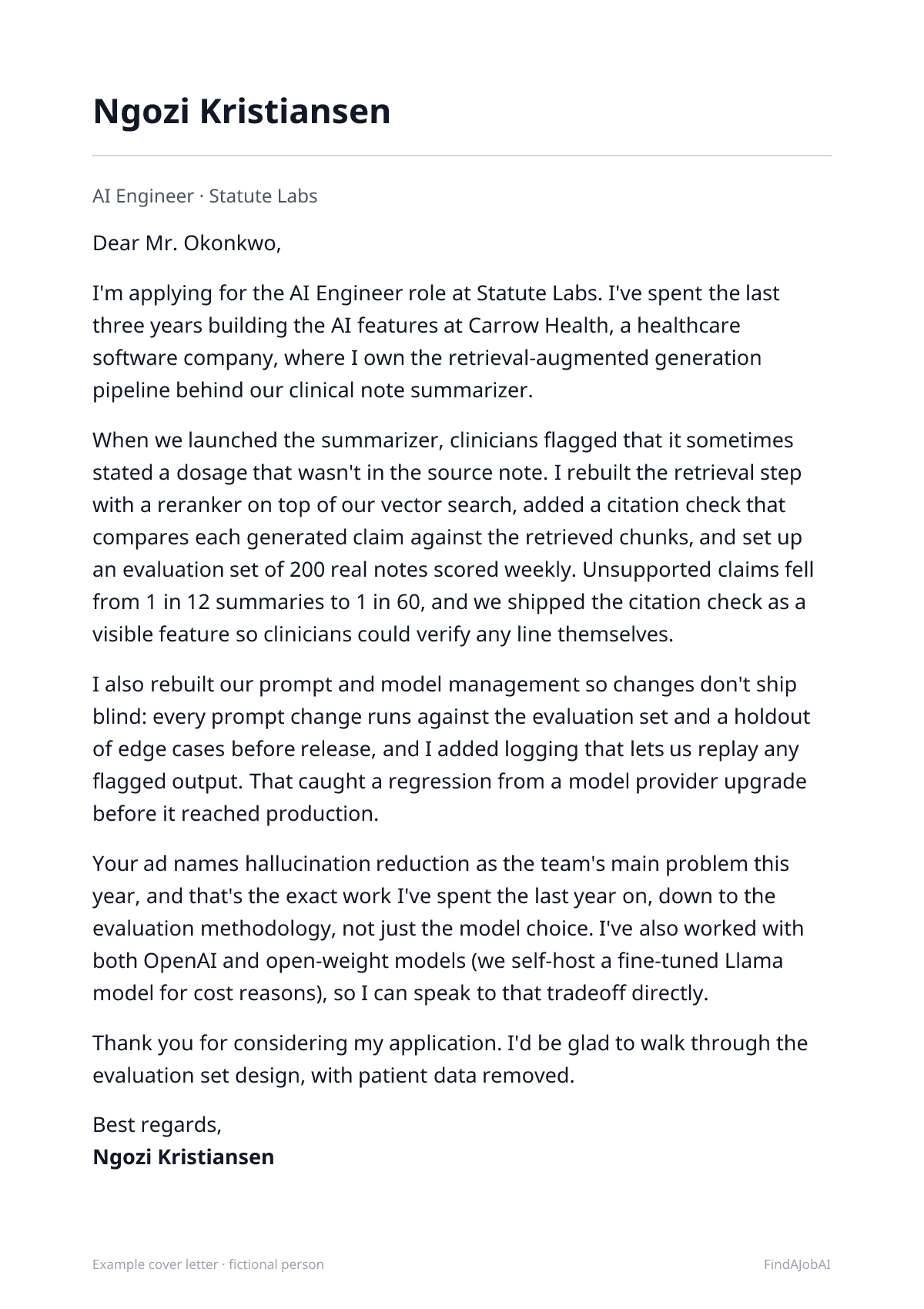
Ngozi built the retrieval and evaluation pipeline behind her company's document assistant. The ad asks for production LLM work and fewer hallucinations.
Example letter · fictional
Dear Mr. Okonkwo,
I'm applying for the AI Engineer role at Statute Labs. I've spent the last three years building the AI features at Carrow Health, a healthcare software company, where I own the retrieval-augmented generation pipeline behind our clinical note summarizer.
When we launched the summarizer, clinicians flagged that it sometimes stated a dosage that wasn't in the source note. I rebuilt the retrieval step with a reranker on top of our vector search, added a citation check that compares each generated claim against the retrieved chunks, and set up an evaluation set of 200 real notes scored weekly. Unsupported claims fell from 1 in 12 summaries to 1 in 60, and we shipped the citation check as a visible feature so clinicians could verify any line themselves.
I also rebuilt our prompt and model management so changes don't ship blind: every prompt change runs against the evaluation set and a holdout of edge cases before release, and I added logging that lets us replay any flagged output. That caught a regression from a model provider upgrade before it reached production.
Your ad names hallucination reduction as the team's main problem this year, and that's the exact work I've spent the last year on, down to the evaluation methodology, not just the model choice. I've also worked with both OpenAI and open-weight models (we self-host a fine-tuned Llama model for cost reasons), so I can speak to that tradeoff directly.
Thank you for considering my application. I'd be glad to walk through the evaluation set design, with patient data removed.
Best regards,
Ngozi Kristiansen
Example 2 · Career changer
Backend developer moving into AI engineering
Amit added a RAG feature to his company's support tool before any title changed. The ad mentions shipping LLM features into an existing product.
Example letter · fictional
Dear Hiring Manager,
I'm applying for the AI Engineer role at Fenwick Logistics. I've worked as a backend developer for six years, most recently on the support tooling team at Driftline Software, and over the past year I moved most of my work onto our first LLM features.
Our support agents were spending too long searching old tickets for how a prior issue was resolved. I built a retrieval system over three years of closed tickets using embeddings stored in Postgres with pgvector, added a summarization step with GPT-4o-mini to keep costs down, and wired it into our existing ticket UI so agents saw suggested past resolutions inline. Average ticket handling time dropped from 14 minutes to 9 minutes, and I own the system end to end, including the nightly reindexing job and a monthly cost review.
I've since completed DeepLearning.AI's LLM application courses and built two side projects: a document Q&A tool over my own PDFs and a small agent that drafts calendar invites from email threads, both using LangChain. I'm comfortable with Python, FastAPI and the usual vector store options, and I'm learning more about fine-tuning versus prompting tradeoffs on smaller open models.
Your posting asks for someone who can ship an LLM feature into a production codebase without a model research team behind them, which is exactly the gap I've already closed once at Driftline. Logistics data is messier and more structured than support tickets, and I'd like to apply the same approach there.
Thank you for your time. I'd welcome the chance to talk through the ticket retrieval system in more detail.
Kind regards,
Amit Winters
Example 3 · Senior or lead
ML team lead applying to build a company's first applied AI team
Hana leads four engineers at a travel company. The ad is for a lead to set evaluation standards, own model deployment and hire two people on a new team.
Example letter · fictional
Dear Mr. Castellano,
I'm applying for the Lead AI Engineer role at Northbound Travel. For the past two years I've led a team of four AI engineers at Ferro Retail, where we built and now run the personalization and support-chat systems, and before that I spent five years as a senior ML engineer.
Your ad says the company has three LLM prototypes stuck in testing because nobody can say whether they're safe to ship. Ferro had the same stall. I introduced a release gate: every model or prompt change has to clear an evaluation suite covering accuracy, refusal behavior and cost per request, scored against a labeled set we rebuild quarterly. Of our six stalled prototypes, four shipped within the following two quarters, and the gate is now a required step in our deployment pipeline, not a suggestion.
The clearest result came from our support chatbot: it was handing off 42% of conversations to a human agent, mostly on refund questions. I traced it to a retrieval gap, our policy documents weren't chunked well for edge cases, rebuilt the chunking and added a fallback that asks a clarifying question instead of guessing. Handoff rate dropped to 24%, and customer satisfaction on resolved chats held steady.
I've hired two of my four engineers and run a biweekly review where the team presents failures, not just wins, which has caught two production issues early. I haven't built a team from zero or owned a GPU budget directly, and at Northbound I'd want to work closely with your infrastructure lead to size that correctly before committing to a roadmap.
I'd welcome a conversation about which of your three prototypes you'd want shipped first, and what's blocking each one today.
Sincerely,
Hana Kobayashi
All three letters, and the short version below, are fictional: the people, employers and numbers are invented. Borrow the structure, never the facts.
- Prefer to write it yourself? Use the free cover letter template.
- Check your CV against the job first: the free CV score shows the missing keywords.
Why the first letter works, paragraph by paragraph
Paragraph 1: Opening
States the current ownership (a RAG pipeline for a clinical summarizer) and the company's domain, so the reader knows this isn't a generic model dabbler but someone who owns a production system.
Paragraph 2: The problem that mattered
Names a real failure mode (an unsupported dosage claim), the specific fix (reranker, citation check, weekly evaluation set) and the measured result, in the unit clinicians would recognize.
Paragraph 3: Operational maturity
Shows the writer treats prompts and models like code that needs testing and rollback, which is the part of AI engineering that separates it from a demo.
Paragraph 4: Why this company
Mirrors the ad's stated priority (hallucination reduction) and adds a relevant detail (self-hosting an open-weight model) that a generic applicant wouldn't know to mention.
Paragraph 5: Close
Offers a concrete next step, the evaluation set design, while respecting patient data confidentiality.
What the career changer's letter does differently
The career changer's letter starts from a feature built inside an existing backend role before any AI title existed, with a measured result (handling time down from 14 to 9 minutes) and ownership of the unglamorous parts, like reindexing and cost review. Courses and side projects show the study is active, and the letter names the specific gap, shipping without a research team, that the ad is trying to fill.
What the senior letter does differently
A lead AI engineer letter reports organizational habits, not just technical ones: a release gate that unstuck four of six prototypes, a biweekly failure review, and a named gap (never having built a team from zero) that's honestly scoped. The chatbot example shows the writer diagnosing a system problem, not just tuning a model.
Short AI engineer cover letter: an email-ready version
Many applications arrive as an email or a small text box, and a full page doesn't fit. This version runs 120 to 150 words and keeps only what a reader needs to decide whether to reply. An AI engineer answers a fintech company's short-answer application field, sent as an email after a recruiter asked for a quick note alongside the resume.
Short version · email · fictional143 words
Subject: AI Engineer (RAG, fraud review) – Owen Blackwell
Hello Ms. Farrow,
I'm applying for the AI Engineer role at Ledgerly Finance. I have three years of experience building LLM-based tools on a risk team at an online lender, most recently a system that drafts fraud case summaries for human reviewers.
My most useful project was cutting review time on flagged transactions: I built a retrieval pipeline that pulls a customer's relevant history and summarizes it with GPT-4o, with every claim linked to its source record. Average review time per case fell from 11 minutes to 6, and reviewers can still check any summary line against the original data.
Fraud review is high-stakes in the way I find most interesting, where a wrong or unsupported claim has a real cost. My resume is attached, and I can share the evaluation approach we used to test the summaries before launch.
Best,
Owen Blackwell
A short-answer field forces one project, so the short version keeps the result (11 to 6 minutes) and the detail that matters most in finance, that every claim traces back to a source record. The offer to share the evaluation approach substitutes for a portfolio link.
Opening lines that work for AI engineer cover letters
The first sentence decides whether the second gets read. Here are six openings, one for each situation you might be in. Pick the one that matches yours and swap in your own facts: every name and number below is invented.
1. You have a standout result
A retrieval pipeline I built last year cut fraud case review time from 11 minutes to 6, with every summary line traceable to a source record. I'd like to bring that same approach to your risk team.
2. The ad names a problem you've solved
Your ad says three LLM prototypes have stalled in testing, according to the posting. At my current company I built an evaluation gate that unstuck four of six stalled prototypes within two quarters.
3. Someone referred you
Your engineering manager, Teodor Lindqvist, and I worked together on a retrieval project for a year before he moved to your company. He mentioned you need someone who can take a prototype to production, which prompted this application.
4. You admire what they build
I've used your trip-planning app for two years, and the way its itinerary assistant handles changed flights made me curious about the system behind it; I'd like to help build the next version of it.
5. You're new to the field or switching into it
I spent six years as a backend developer, then built a retrieval system over three years of support tickets on my own initiative. AI engineering is where I'd like to keep solving problems like that full time.
6. You have senior scope or a specialism
As the engineer who built our hallucination evaluation suite from scratch, I'm now looking for a role where I can set that standard for a whole team rather than one product.
How to write an AI engineer cover letter
Five steps, in the order you'd write them. The shape stays the same for every job (a short opening, proof, a reason for this employer, a close), and what goes into each part is what changes with the role.
Identify what kind of AI engineer this ad wants
Some ads want a model and research focus, others want someone who ships LLM features into an existing product. Read for words like 'production', 'evaluation' or 'research' to tell which. Then pick a project of yours that matches that specific balance of model work and engineering.
Open with the problem the system solved, not the architecture
Say what was broken or slow and what changed, in one or two sentences, before naming RAG, fine-tuning or agents. A reader who sees a real outcome in your first paragraph trusts the technical details that follow.
Quantify reliability or cost, not just capability
AI engineering hiring managers care about hallucination rate, latency, cost per request and handoff rate as much as accuracy. Give one number that moved and the baseline it moved from. If you can't measure the end result, describe what changed in how people used the system.
Name your stack inside a specific decision
Mention the model provider, vector store or framework the ad names, but attach it to a choice you made and why, such as a smaller model for cost or a reranker for accuracy. A tool named without a reason reads as a keyword match.
Show you treat models like production systems
One sentence on evaluation, monitoring or rollback: a labeled test set, a logging setup, a release gate. Close by naming a specific problem in their product you'd want to look at first, so the reader sees a plan, not just enthusiasm.
AI Engineer cover letter do's and don'ts
Do
- Name the failure mode you fixed (hallucinations, latency, cost, stale retrieval) and the specific technique, not just 'I used LLMs.'
- Mention the stack the ad names (LangChain, pgvector, specific model providers) inside a real example, not as a bare list.
- Show you treat prompts and models as things that need evaluation and monitoring, with one concrete method.
Don't
- Don't claim you "built an AI model" when you fine-tuned or prompted an existing one; say which, precisely.
- Don't list every model and framework you've tried; show depth on the one or two that match this ad.
- Don't share proprietary prompts, training data or system details from a current employer; describe methods, not the exact prompt text.
Common AI engineer cover letter mistakes
Each one is easy to make and quick to fix before you send the letter.
Describing model capability, not system behavior
'Used GPT-4 to build a chatbot' tells the reader almost nothing. Say what the chatbot did wrong before your fix, what you changed (retrieval, prompting, guardrails), and what it does now, with a number attached.
Treating a demo or side project like a shipped system
A weekend project is fine to mention, but say plainly whether it's live, used by real people, or a personal exercise. Overstating a prototype as production work is easy to catch in an interview and costs trust.
Naming every framework and model you've touched
A list of LangChain, LlamaIndex, five model providers and three vector stores suggests shallow use of each. Name the one or two the ad actually uses and show depth with a real example.
Skipping reliability and cost entirely
A letter that only discusses what a model can do, without mentioning hallucination rate, latency or cost per call, misses what most production AI roles actually manage day to day. Add one sentence on how you measured or controlled one of these.
Writing 'passionate about AI' as the motivation
Nearly every applicant writes this. Replace it with a specific problem in the company's product you'd want to work on, or a result from a similar system you've already built.
Email subject lines for AI engineer applications
Applying by email? Put the job title, any reference number and your name in the subject line.
- AI Engineer application – RAG and hallucination reduction – Ngozi Kristiansen
- AI Engineer – backend developer with production LLM feature – Amit Winters
- Application: AI Engineer, Platform Team (Req. 2240) – Ngozi Kristiansen
Everything for AI Engineers
- AI Engineer resume exampleA full resume, plus bullet and summary examples
- AI Engineer interview questions30 questions with sample answers
- AI Engineer job descriptionDuties, skills and requirements
- Career change cover letter: template + examples
Other cover letter examples
AI Engineer cover letter FAQ
What should I write in an AI engineer cover letter?
One system you built around a model: the problem, the technique (retrieval, fine-tuning, evaluation, prompting), and the measured result. Then a sentence on how you monitor or test it once it's live. Your model and framework list belongs on your resume.
How do I write an AI engineer cover letter with no AI job experience?
Use an AI feature you built inside another role, or a side project with a dataset you chose yourself. Name the specific technique and tools, a real result or limitation you found, and a course or certificate that formalizes the skill.
Should I mention which specific models or frameworks I've used?
Yes, but inside a story, not a list. Say which model or framework you used for a specific problem and why, such as a smaller open-weight model for cost or an embedding store for retrieval speed.
How we built this page
The FindAJobAI team wrote the three example letters, the short email version, the opening lines and the advice for AI engineer roles. The people, employers and numbers in the letters are invented; the structure, the kind of evidence and the order of the paragraphs are the parts to copy.
Once we track enough live AI engineer job ads, this page also shows the skills they ask for most, counted the same way as our in-demand skills report.
Last reviewed on November 1, 2026.