Nuclear Medicine Technologist Cover Letter Example (2026)
By FindAJobAI Team Updated How we built this page
Nuclear medicine postings ask for the same credentials and modalities, so most letters read alike. The one a chief technologist remembers describes a real day in the department: a patient who needed reassurance, a dose that had to be right, a quality check that caught a problem, and the numbers that show how carefully you work.
Nuclear Medicine Technologist cover letter template
This letter as a one-page template: an opening that names the job and your strongest fact, proof that answers the ad, a reason for this employer and a short close.
After you sign up, FindAJobAI drafts your own letter for a real job from your CV in this format, and you edit it before you send it.
Example 1 · Experienced
PET/CT nuclear medicine technologist applying to a cancer centre
Benedikt performs PET/CT and cardiac studies at a teaching hospital. The ad is for a PET/CT technologist at a busy outpatient cancer centre.
Example letter · fictional
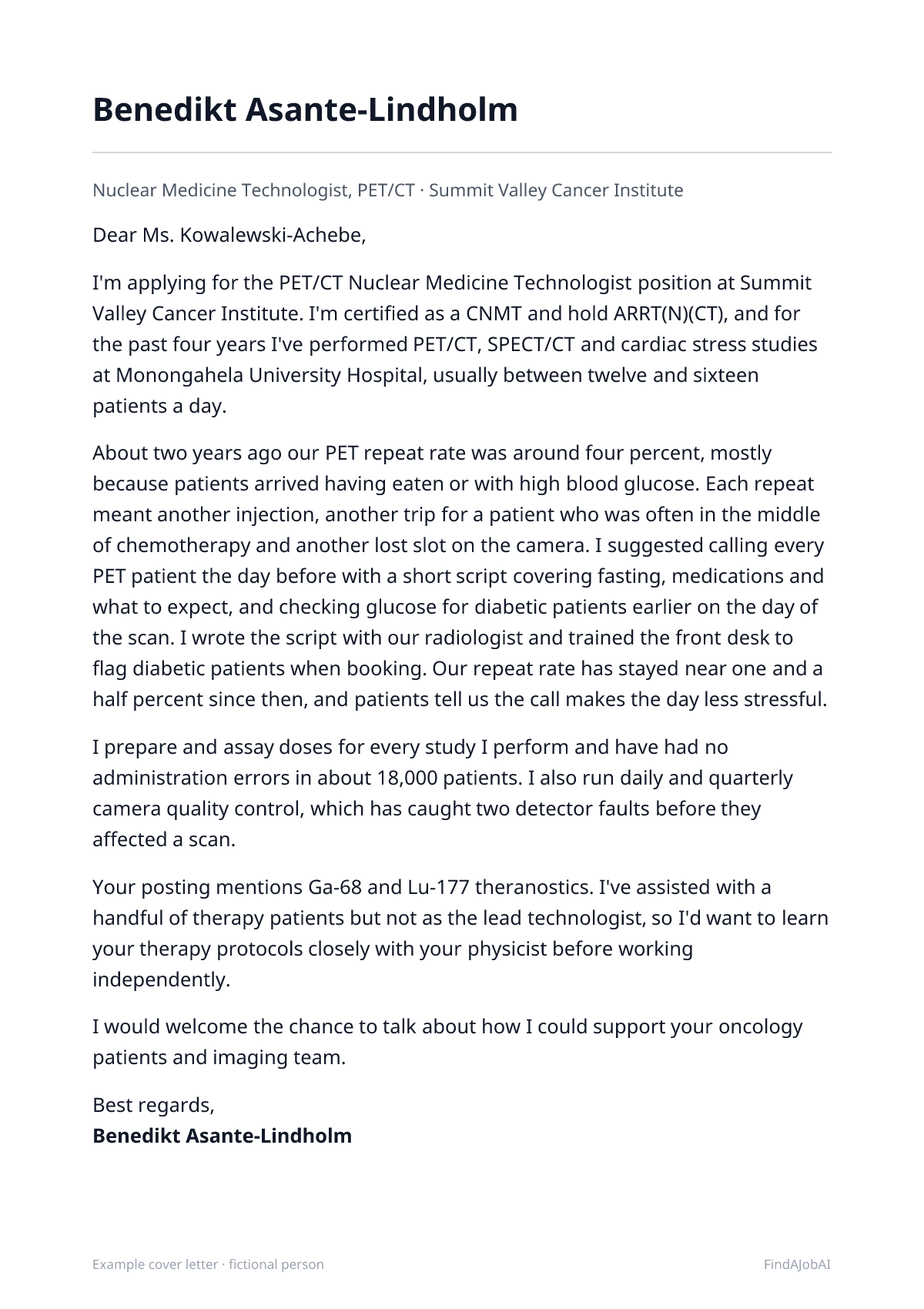
Dear Ms. Kowalewski-Achebe,
I'm applying for the PET/CT Nuclear Medicine Technologist position at Summit Valley Cancer Institute. I'm certified as a CNMT and hold ARRT(N)(CT), and for the past four years I've performed PET/CT, SPECT/CT and cardiac stress studies at Monongahela University Hospital, usually between twelve and sixteen patients a day.
About two years ago our PET repeat rate was around four percent, mostly because patients arrived having eaten or with high blood glucose. Each repeat meant another injection, another trip for a patient who was often in the middle of chemotherapy and another lost slot on the camera. I suggested calling every PET patient the day before with a short script covering fasting, medications and what to expect, and checking glucose for diabetic patients earlier on the day of the scan. I wrote the script with our radiologist and trained the front desk to flag diabetic patients when booking. Our repeat rate has stayed near one and a half percent since then, and patients tell us the call makes the day less stressful.
I prepare and assay doses for every study I perform and have had no administration errors in about 18,000 patients. I also run daily and quarterly camera quality control, which has caught two detector faults before they affected a scan.
Your posting mentions Ga-68 and Lu-177 theranostics. I've assisted with a handful of therapy patients but not as the lead technologist, so I'd want to learn your therapy protocols closely with your physicist before working independently.
I would welcome the chance to talk about how I could support your oncology patients and imaging team.
Best regards,
Benedikt Asante-Lindholm
Example 2 · Entry level
Newly certified graduate applying for an entry-level nuclear medicine role
Annika passed her CNMT exam this summer after rotations in a hospital and a PET centre. The ad is for a staff technologist at a community hospital.
Example letter · fictional
Dear Mr. Pettersen-Obi,
I'm applying for the Staff Nuclear Medicine Technologist position at Bluff Country Community Hospital. I completed my degree in nuclear medicine technology in May and passed the CNMT exam in July, after about 1,400 clinical hours at a regional hospital and an outpatient PET centre.
During my hospital rotation I assisted with roughly 450 studies, including bone scans, myocardial perfusion, renal and thyroid imaging. I drew up and assayed more than 300 doses under supervision, always checking them against the prescription with my preceptor, and we never found a discrepancy. One morning a patient arrived for a bone scan visibly frightened about the radiation. I sat with her, explained how small the dose was compared with what she feared, and showed her the camera before the injection. She completed the study, and my preceptor later asked me to help write a short patient handout based on what I'd told her.
At the PET centre I helped with about 150 oncology scans, mostly patient preparation and glucose checks, and I suggested changes to the preparation handout that the centre adopted for two kinds of studies.
Your posting mentions on-call duty for lung and hepatobiliary studies. I've performed those only with a supervisor present, so I'd ask to shadow a few on-call shifts before taking them alone. I'm also planning to start CT training next year, because most of the cameras I trained on were hybrid systems and I want to run the CT part with confidence.
Thank you for your time, and I'd be glad to meet you and your team.
Sincerely,
Annika Okwuosa-Haldane
Example 3 · Referral or internal move
Chief nuclear medicine technologist referred by a radiologist for a department lead role
Valentina manages technologists at two hospitals. A radiologist who now works at the hiring system referred her for a chief technologist opening.
Example letter · fictional
Dear Ms. Arrington-Sole,
Dr. Leopold Ingersoll, who read our PET/CT studies for six years before joining Lakewood Regional Health, suggested I apply for your Chief Nuclear Medicine Technologist role. He mentioned that you plan to start a theranostics service next year, and that is work I have done before.
I currently manage eleven technologists across two hospitals and a PET centre at Rappahannock Health, where we perform about 14,000 studies a year. Three years ago our radiation oncology team wanted to offer Lu-177 therapy. I worked with the radiation safety officer, physicists and oncologists to write the procedures, plan room shielding and waste handling, and train four technologists. We treated our first patients nine months later, and the service now cares for about 300 patients a year. Our state inspection that year, like the two before it, found no issues.
I also care about wait times. Oncology patients were waiting about twelve days for PET/CT, which is a long time when treatment decisions depend on the scan. I added an evening session and cross-trained three staff to cover it, and the wait fell to around five days without overtime becoming routine. Staff turnover in the PET team has also been the lowest in the imaging department for two years, which I put down to fair rotas and regular training time.
I haven't worked with the camera vendor your department uses, so I'd plan to spend time with your senior technologists and applications specialist before suggesting any changes to protocols.
I'd be grateful for a conversation about your plans for the department.
Kind regards,
Valentina Brekke-Nwachukwu
All three letters, and the short version below, are fictional: the people, employers and numbers are invented. Borrow the structure, never the facts.
- Prefer to write it yourself? Use the free cover letter template.
- Check your CV against the job first: the free CV score shows the missing keywords.
Why the first letter works, paragraph by paragraph
Paragraph 1: Opening
Credentials, modalities, setting and daily volume appear in two sentences, which answers the screening questions before the reader asks them.
Paragraph 2: The repeat scan story
Explains why repeats hurt patients and the department, then gives the specific fix and the rate before and after. It shows care for patients and the workflow.
Paragraph 3: Dose and QC record
Zero dose errors across a large patient count and QC that caught real faults speak to the most serious risks in the job.
Paragraph 4: Honest gap
Admits he hasn't led therapy patients and proposes a safe way to learn, which suits a field built on careful procedure.
Paragraph 5: Close
Brings the focus back to oncology patients, which matches a cancer centre's priorities.
What the entry-level letter does differently
The graduate's letter gives clinical hours and study counts, then a single patient moment that shows calm and clear explanation. Saying she would shadow on-call shifts before working alone turns limited experience into a sign of good judgment.
What the referral letter does differently
The referral letter names the radiologist and the plan he mentioned, then proves fit with one directly matching project: a theranostics launch with partners, training, patient numbers and a clean inspection. The wait-time story adds evidence of patient focus.
Short nuclear medicine technologist cover letter: an email-ready version
Many applications arrive as an email or a small text box, and a full page doesn't fit. This version runs 120 to 150 words and keeps only what a reader needs to decide whether to reply. A nuclear medicine technologist answers a recruiter's message about a travel contract at a cardiac imaging centre and keeps it brief.
Short version · email · fictional124 words
Subject: Travel NM Technologist – cardiac stress, CNMT, January start – Rafferty Olumide-Sandberg
Hi Ms. Valdés-Monroe,
Thanks for contacting me about the 13-week nuclear medicine contract at Harborview Heart Imaging. I'm a CNMT with five years in cardiology practices, performing about ten myocardial perfusion studies a day with treadmill and pharmacologic stress.
At my current practice, rest-stress patients spent about four and a half hours with us. I reworked the injection and camera schedule with the cardiologist so waiting times overlapped less, and the average visit dropped to about three and a half hours. I also keep my own dosimeter readings well below a fifth of the annual limit.
I can start in early January and hold licences in two states, with a third in progress. I'm happy to talk any time this week.
Thanks,
Rafferty Olumide-Sandberg
The short version gives credentials, cardiac volume and one patient-time result, then answers the practical questions a travel recruiter has: start date and licences.
Opening lines that work for nuclear medicine technologist cover letters
The first sentence decides whether the second gets read. Here are six openings, one for each situation you might be in. Pick the one that matches yours and swap in your own facts: every name and number below is invented.
1. You have a standout result
Two years ago, four percent of our PET patients needed a repeat scan; after we started calling every patient the day before, that number is close to one and a half.
2. The ad names a problem you've solved
I've prepared and given doses to about 18,000 patients without a single administration error, and I'd like to bring that care to your PET/CT team.
3. Someone referred you
Dr. Leopold Ingersoll told me you are starting a theranostics service, and I helped launch one that now treats about 300 patients a year.
4. You admire what they build
A frightened patient during my first clinical rotation taught me that explaining a bone scan well matters as much as acquiring it.
5. You're new to the field or switching into it
Your posting asks for a CNMT with CT and cardiac experience, which describes the last four years of my work at a teaching hospital.
6. You have senior scope or a specialism
I cut the average rest-stress visit at our practice by an hour, and I'd like to do the same for your cardiac patients.
How to write a nuclear medicine technologist cover letter
Five steps, in the order you'd write them. The shape stays the same for every job (a short opening, proof, a reason for this employer, a close), and what goes into each part is what changes with the role.
Start with credentials and modalities
Put your CNMT or ARRT(N), CT credential and state licence in the first lines, then the studies you perform and how many patients you see a day. Chief technologists screen for these first, and stating them clearly saves the reader from searching your resume.
Tell one patient or workflow story
Choose a moment that shows care and judgment: reassuring a nervous patient, reducing repeat scans or shortening visits. Describe what you noticed, what you changed and a number before and after, so the reader sees how you think during a busy clinical day.
Prove your dose and radiation safety record
Give concrete evidence of careful work with radioactive material: dose error records, quality control that caught problems, dosimeter readings or inspection results. Safety is the core of the role, so specific facts are worth more than general promises about following procedure.
Be honest about therapies and equipment
If the posting mentions therapies, studies or cameras you haven't used independently, say what you have done and how you'd learn. Departments value technologists who ask before acting, and an honest statement fits the culture of the field.
Close with availability or a link to their patients
End by connecting to the patients the department serves, such as oncology or cardiac patients, or by giving your start date and licence status for contract roles. It gives the reader a clear next step and keeps the focus on their needs.
Nuclear Medicine Technologist cover letter do's and don'ts
Do
- Put your credentials and the modalities you perform in the first paragraph.
- Tell one patient or quality story with a number before and after.
- Show your dose accuracy and radiation safety record in concrete terms.
Don't
- Don't list every study type without saying how many you perform.
- Don't describe radiation safety only with the word ALARA; show what you do.
- Don't claim independent experience with therapies or studies you've only observed.
Common nuclear medicine technologist cover letter mistakes
Each one is easy to make and quick to fix before you send the letter.
Credentials hidden in the last paragraph
Put certifications and licences at the start, where screeners look for them first.
Generic patient care claims
Replace 'I provide compassionate care' with one specific patient moment and what you did.
A letter without a single figure
Add daily volume, repeat rates, dose records or wait times so the reader can judge your experience.
Overstating therapy experience
Say whether you led or assisted with therapy patients. Departments will check, and safety depends on accuracy.
Email subject lines for nuclear medicine technologist applications
Applying by email? Put the job title, any reference number and your name in the subject line.
- PET/CT Nuclear Medicine Technologist – CNMT, ARRT(N)(CT), 4 years – Benedikt Asante-Lindholm
- Staff Nuclear Medicine Technologist – new CNMT, 1,400 clinical hours – Annika Okwuosa-Haldane
- Chief Nuclear Medicine Technologist, referred by Dr. Ingersoll – Valentina Brekke-Nwachukwu
Everything for Nuclear Medicine Technologists
- Nuclear Medicine Technologist resume exampleA full resume, plus bullet and summary examples
- Nuclear Medicine Technologist interview questions30 questions with sample answers
- Nuclear Medicine Technologist job descriptionDuties, skills and requirements
- Cover letter with no experience: templates
Other cover letter examples
Nuclear Medicine Technologist cover letter FAQ
What should a nuclear medicine technologist cover letter include?
Your credentials and licences, the modalities and daily volume you handle, one patient care or quality story with numbers, your safety record and any honest gap against the posting.
How do I write a nuclear medicine cover letter as a new graduate?
Lead with your certification and clinical hours, give the number and types of studies you assisted with, and add one patient moment that shows how you communicate. Mention any skills you're still building.
Should I mention CT certification in a nuclear medicine cover letter?
Yes. Most PET and SPECT systems include CT, so a CT credential is valuable. If you're working toward it, say when you expect to finish.
How we built this page
The FindAJobAI team wrote the three example letters, the short email version, the opening lines and the advice for nuclear medicine technologist roles. The people, employers and numbers in the letters are invented; the structure, the kind of evidence and the order of the paragraphs are the parts to copy.
Once we track enough live nuclear medicine technologist job ads, this page also shows the skills they ask for most, counted the same way as our in-demand skills report.
Last reviewed on November 1, 2026.