Radiologic Technologist Cover Letter Example (2026)
By FindAJobAI team Updated How we built this page
Radiologic technologist ads mostly confirm your license and the modalities you're certified in, which the resume already covers. The cover letter is where you show how you work under pressure, with patients, and with the radiologists and techs who depend on your images being usable the first time.
Radiologic Technologist cover letter template
This letter as a one-page template: an opening that names the job and your strongest fact, proof that answers the ad, a reason for this employer and a short close.
After you sign up, FindAJobAI drafts your own letter for a real job from your CV in this format, and you edit it before you send it.
Example 1 · Experienced
Trauma center radiographer applying to a level II trauma hospital
Soraya works nights in a busy emergency department. The ad asks for someone comfortable with portable films and trauma protocols.
Example letter · fictional
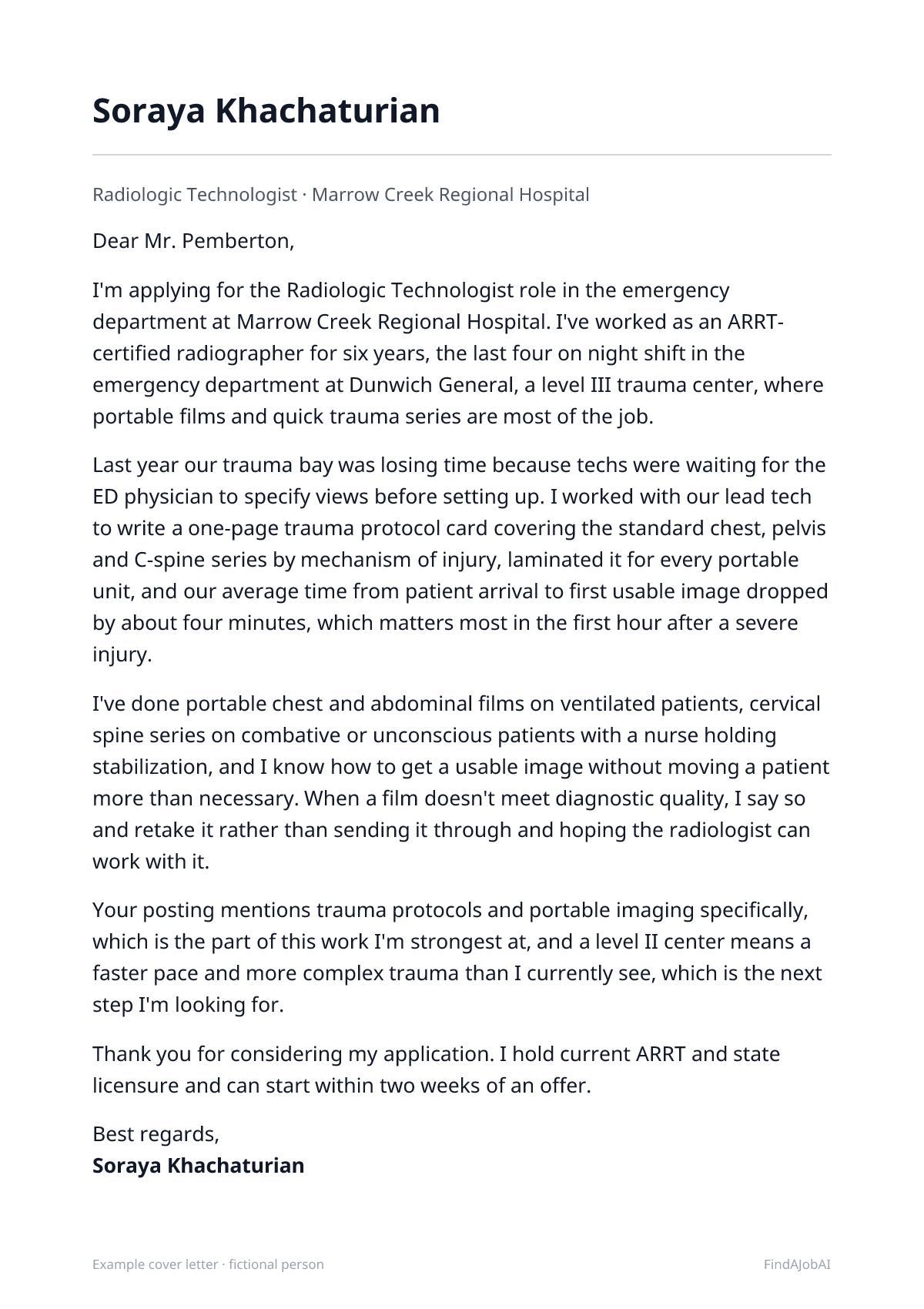
Dear Mr. Pemberton,
I'm applying for the Radiologic Technologist role in the emergency department at Marrow Creek Regional Hospital. I've worked as an ARRT-certified radiographer for six years, the last four on night shift in the emergency department at Dunwich General, a level III trauma center, where portable films and quick trauma series are most of the job.
Last year our trauma bay was losing time because techs were waiting for the ED physician to specify views before setting up. I worked with our lead tech to write a one-page trauma protocol card covering the standard chest, pelvis and C-spine series by mechanism of injury, laminated it for every portable unit, and our average time from patient arrival to first usable image dropped by about four minutes, which matters most in the first hour after a severe injury.
I've done portable chest and abdominal films on ventilated patients, cervical spine series on combative or unconscious patients with a nurse holding stabilization, and I know how to get a usable image without moving a patient more than necessary. When a film doesn't meet diagnostic quality, I say so and retake it rather than sending it through and hoping the radiologist can work with it.
Your posting mentions trauma protocols and portable imaging specifically, which is the part of this work I'm strongest at, and a level II center means a faster pace and more complex trauma than I currently see, which is the next step I'm looking for.
Thank you for considering my application. I hold current ARRT and state licensure and can start within two weeks of an offer.
Best regards,
Soraya Khachaturian
Example 2 · Career changer
Phlebotomist completing radiography school and moving into imaging
Walid worked as a phlebotomist while finishing an accredited radiography program. The ad is an entry-level posting at an outpatient imaging center.
Example letter · fictional
Dear Hiring Manager,
I'm applying for the Radiologic Technologist role at Thistlewood Imaging Partners. I recently completed an accredited radiography program and passed my ARRT certification exam, and for the past three years I worked as a phlebotomist at an outpatient lab while finishing the program at night.
During my clinical rotations I completed over 400 supervised exams across general radiography, including a six-week rotation in an orthopedic clinic where I took most of the extremity films for a high-volume fracture clinic. My preceptor had me independently positioning for routine chest and extremity exams by the end of the rotation, and I passed my clinical competencies on the first attempt in every required category.
Phlebotomy taught me something a classroom can't: how to keep a nervous or in-pain patient calm while doing something uncomfortable to them, quickly and without making them feel rushed. I drew blood from several hundred patients a week, many of them anxious about needles, and that same calm, clear explanation is what I bring to positioning a patient for an exam.
Your posting is for a high-volume outpatient site, and the pace and patient-facing demands are close to what I already managed in phlebotomy, now paired with the imaging training I've just completed. I'm comfortable with general radiography and am continuing toward a CT certification this year.
Thank you for your time. I'd welcome the chance to discuss my clinical rotations and how quickly I could be fully independent on your equipment.
Kind regards,
Walid Fennimore
Example 3 · Senior or lead
Lead technologist applying to run imaging at a new outpatient campus
Granger supervises nine techs at a hospital imaging department. The ad is for a lead tech opening a new outpatient campus's imaging department.
Example letter · fictional
Dear Dr. Suvari,
I'm applying for the Lead Radiologic Technologist role at Felbridge Diagnostic Center. For the past three years I've supervised a team of nine technologists across general radiography and CT at a community hospital, and before that I spent eight years as a staff tech. I'd like to help open an outpatient campus's imaging department from its first week.
Your posting mentions building scheduling and quality processes before the campus opens rather than inheriting them. At my hospital, I rebuilt our repeat-exam tracking after noticing nobody reviewed why films were retaken; once we logged a reason for every repeat, we found that nearly a third came from one CT protocol's contrast timing, not technologist error as assumed, and fixing the protocol cut our repeat rate substantially within two months.
Leadership in imaging shows up most in the exams nobody wants to do alone. When we started taking combative behavioral health patients for portable chest films, I built a two-person positioning protocol with our security team and trained the department on it; our incident rate on those exams dropped from roughly one per week to almost none, and that protocol is now used hospital-wide.
I've hired four of my nine techs and run monthly case reviews where we discuss difficult positioning or patient scenarios as a team. I haven't opened a new site from scratch, choosing equipment vendors, building initial scheduling templates, and at Felbridge I'd expect to lean on your operations director for that part early on.
A conversation about which exam types you expect the highest volume of in the first year, and what quality process you want in place before the first patient arrives, would be a good place to start.
Sincerely,
Granger Oyelowo
All three letters, and the short version below, are fictional: the people, employers and numbers are invented. Borrow the structure, never the facts.
- Prefer to write it yourself? Use the free cover letter template.
- Check your CV against the job first: the free CV score shows the missing keywords.
Why the first letter works, paragraph by paragraph
Paragraph 1: Opening
Names the specific setting (night shift, emergency department, level III trauma) so the reader knows the pace and conditions the writer already works in, not just the job title.
Paragraph 2: The problem solved under pressure
A real bottleneck, the fix (a one-page protocol card), and a measured result (about four minutes) tied to the thing that matters clinically, not just operationally.
Paragraph 3: Patient handling and image quality
Names specific difficult scenarios (ventilated, combative, unconscious patients) and states a quality standard, retaking rather than sending through, that trauma and ED hiring managers specifically screen for.
Paragraph 4: Why this employer
Mirrors the ad's own language (trauma protocols, portable imaging) and names the honest reason for applying: a step up in acuity.
Paragraph 5: Close
States license status and availability plainly, which matters in clinical hiring where start dates and credentials are often the deciding factor between two similar candidates.
What the career changer's letter does differently
The career changer's letter leads with the credential (program completed, ARRT passed) since that's the gate for any imaging job, then uses the clinical rotation numbers to show real hands-on volume rather than just coursework. It converts the previous job, phlebotomy, into a direct, specific patient-handling skill rather than treating it as unrelated experience to apologize for.
What the senior letter does differently
A lead technologist letter reports department-wide habits, not just one exam: a repeat-exam tracking system, a hospital-wide safety protocol, monthly case reviews. The decision example shows the writer fixing a systemic problem rather than an individual mistake, and the gap, opening a brand-new site rather than inheriting one, is named directly.
Short radiologic technologist cover letter: an email-ready version
Many applications arrive as an email or a small text box, and a full page doesn't fit. This version runs 120 to 150 words and keeps only what a reader needs to decide whether to reply. A radiologic technologist answers an urgent care chain's short application form, sent as an email because the online form had a broken upload field.
Short version · email · fictional135 words
Subject: Radiologic Technologist (general x-ray, float pool) – Nadira Okonjo
Hello Mr. Castellano,
I'm applying for the Radiologic Technologist role at Haverbrook Urgent Care Group. I'm ARRT-certified in general radiography with four years of experience across two urgent care clinics, where I'm usually the only tech on shift.
Working alone taught me to manage the whole exam myself, patient history, positioning, image review, charting, without leaning on a second tech to catch something I missed. At my current clinic I also cross-trained the front desk staff on basic radiation safety signage and positioning for walk-in ankle and wrist injuries, which cut our average wait before imaging by several minutes on busy days.
Your posting mentions floating between two locations, which is close to how I already work. My resume is attached, and I hold current ARRT and state licensure with no restrictions.
Best,
Nadira Okonjo
A short application keeps to one theme, working independently, since that's what a single-tech urgent care site actually needs, and closes with license status since that's the fastest disqualifier in clinical hiring. Everything else from the longer letter format is cut.
Opening lines that work for radiologic technologist cover letters
The first sentence decides whether the second gets read. Here are six openings, one for each situation you might be in. Pick the one that matches yours and swap in your own facts: every name and number below is invented.
1. You have a standout result
A repeat-exam tracking system I built last year found that a third of our CT retakes came from one protocol's contrast timing, not technologist error. I'd like to bring that kind of process thinking to your imaging department.
2. The ad names a problem you've solved
Your posting says techs currently wait on physicians to specify trauma views before setting up. At my current ED, a one-page protocol card I wrote with our lead tech cut several minutes off our average time to first image.
3. Someone referred you
Your charge nurse, Fennimore Achebe, has worked alongside me on trauma cases for two years from the ED side. He mentioned you need a tech who stays calm when a bay gets chaotic, which is what prompted this application.
4. You admire what they build
I had an X-ray at your clinic last year for a sports injury, and the tech's explanation of what she was doing and why made a stressful visit easier; I'd like to bring that same approach to your team.
5. You're new to the field or switching into it
I worked as a phlebotomist for three years before finishing radiography school, and calming anxious patients through something uncomfortable is a skill I carried straight into imaging.
6. You have senior scope or a specialism
As a lead technologist supervising nine techs for three years, I built the repeat-exam and safety protocols my department still uses. I'm looking for a role that lets me build those systems for a new site from the ground up.
How to write a radiologic technologist cover letter
Five steps, in the order you'd write them. The shape stays the same for every job (a short opening, proof, a reason for this employer, a close), and what goes into each part is what changes with the role.
Identify the setting and pace the ad describes
Imaging jobs vary enormously by setting, trauma ED, outpatient clinic, mobile imaging, urgent care, and each expects different pressures. Read the ad for the pace, equipment, and patient population, then pick a past example from a similar setting, not just a similar modality.
State your license and certification status early
Many imaging hiring managers screen out unlicensed applicants before reading further. Name your ARRT certification and state license status in the first or last paragraph, plainly and without elaboration, so there's no doubt before they reach your examples.
Open with a patient or workflow problem, not a modality list
Say what was going wrong, a slow trauma workflow, a confusing protocol, a difficult patient population, and how you fixed it, in one or two sentences before naming your tools. A reader who sees a real problem solved keeps reading past the first line.
Quantify the result where you honestly can
Tie one example to a real change: minutes saved before first image, a repeat rate that dropped, an incident rate that fell. If you can't measure it precisely, describe what changed in practice, fewer retakes, calmer patients, faster throughput, rather than inventing a number.
Show how you handle the hardest patients and images
Name one specific difficult scenario, combative, pediatric, claustrophobic, ventilated, and how you got a usable image without compromising patient safety or comfort. Close by naming the setting or exam type you'd want to grow into next, so the reader sees where you're headed.
Radiologic Technologist cover letter do's and don'ts
Do
- State your license and certification status plainly and early; hiring managers in imaging screen for this first.
- Describe one specific difficult patient scenario you've handled (combative, pediatric, ventilated, claustrophobic) and how.
- Name the modality or setting the ad specifies (portable, fluoroscopy, mammography, outpatient) and match your example to it.
Don't
- Don't just restate your resume's exam list; show how you handle one hard case instead of how many exam types you know.
- Don't downplay a non-imaging job like phlebotomy or CNA work if it taught you direct patient handling; name the specific skill it built.
- Don't promise availability or a start date you can't actually confirm with your current employer's notice requirements.
Common radiologic technologist cover letter mistakes
Each one is easy to make and quick to fix before you send the letter.
Restating the resume's exam and modality list
A paragraph repeating chest, extremity, C-spine, and portable exams tells the reader nothing new. Pick one and show how you handled a genuinely hard version of it instead.
Leaving out license or certification standing
Many departments screen for ARRT and state licensure before reading further. State your status plainly in the letter itself rather than assuming the resume covers it clearly enough.
Downplaying non-imaging patient care experience
Phlebotomy, CNA work, or EMT experience often builds the exact calm, direct patient-handling skill imaging needs. Name the specific skill rather than treating that job as something to explain away.
Describing volume instead of difficulty
'Performed thousands of exams' says little about skill. Describe one genuinely difficult exam, a combative patient, a tight positioning call, and how you handled it safely.
Promising a start date without checking notice requirements
Stating you can start immediately, then needing two weeks' notice at your current job, costs credibility. Confirm your actual availability before committing to a date in writing.
Email subject lines for radiologic technologist applications
Applying by email? Put the job title, any reference number and your name in the subject line.
- Radiologic Technologist application – ED and trauma portable imaging – Soraya Khachaturian
- Radiologic Technologist – new ARRT grad, phlebotomy background – Walid Fennimore
- Application: Radiologic Technologist, Outpatient Imaging (Req. 3391) – Walid Fennimore
Everything for Radiologic Technologists
- Radiologic Technologist resume exampleA full resume, plus bullet and summary examples
- Radiologic Technologist interview questions30 questions with sample answers
- Radiologic Technologist job descriptionDuties, skills and requirements
- Career change cover letter: template + examples
Other cover letter examples
Radiologic Technologist cover letter FAQ
What should I write in a radiologic technologist cover letter?
One example of handling a difficult patient or a workflow problem, plus your license and certification status stated plainly. Your exam list and modalities belong on the resume; use the letter for the part a checklist can't show.
How do I write a radiologic technologist cover letter as a new graduate?
Lead with your credential status (program completed, ARRT passed or scheduled), then use specific numbers from your clinical rotations, exam counts, competencies passed, a rotation specialty. If you're changing careers, name the direct patient-handling skill your old job gave you.
Should I mention which modalities I'm certified in in the cover letter if they're on my resume?
Only the one the ad specifically asks about, and only inside an example of using it. Repeating your full modality list in prose adds nothing the resume hasn't already said.
How important is mentioning license and certification status in the letter itself?
Very. Many imaging departments screen out unlicensed applicants before reading further, so stating your ARRT and state license status in the first or last paragraph removes any doubt early.
How we built this page
The FindAJobAI team wrote the three example letters, the short email version, the opening lines and the advice for radiologic technologist roles. The people, employers and numbers in the letters are invented; the structure, the kind of evidence and the order of the paragraphs are the parts to copy.
Once we track enough live radiologic technologist job ads, this page also shows the skills they ask for most, counted the same way as our in-demand skills report.
Last reviewed on November 1, 2026.