Ophthalmic Technician Cover Letter Example (2026)
By FindAJobAI Team Updated How we built this page
Ophthalmologists hiring a technician want to know two things: will your measurements be right, and will the clinic run on time with you in it. A list of tests does not answer either question. The cover letter examples below each tell one short story from the exam lane, about an image retaken, a reading checked twice or a patient calmed down, that shows both accuracy and pace.
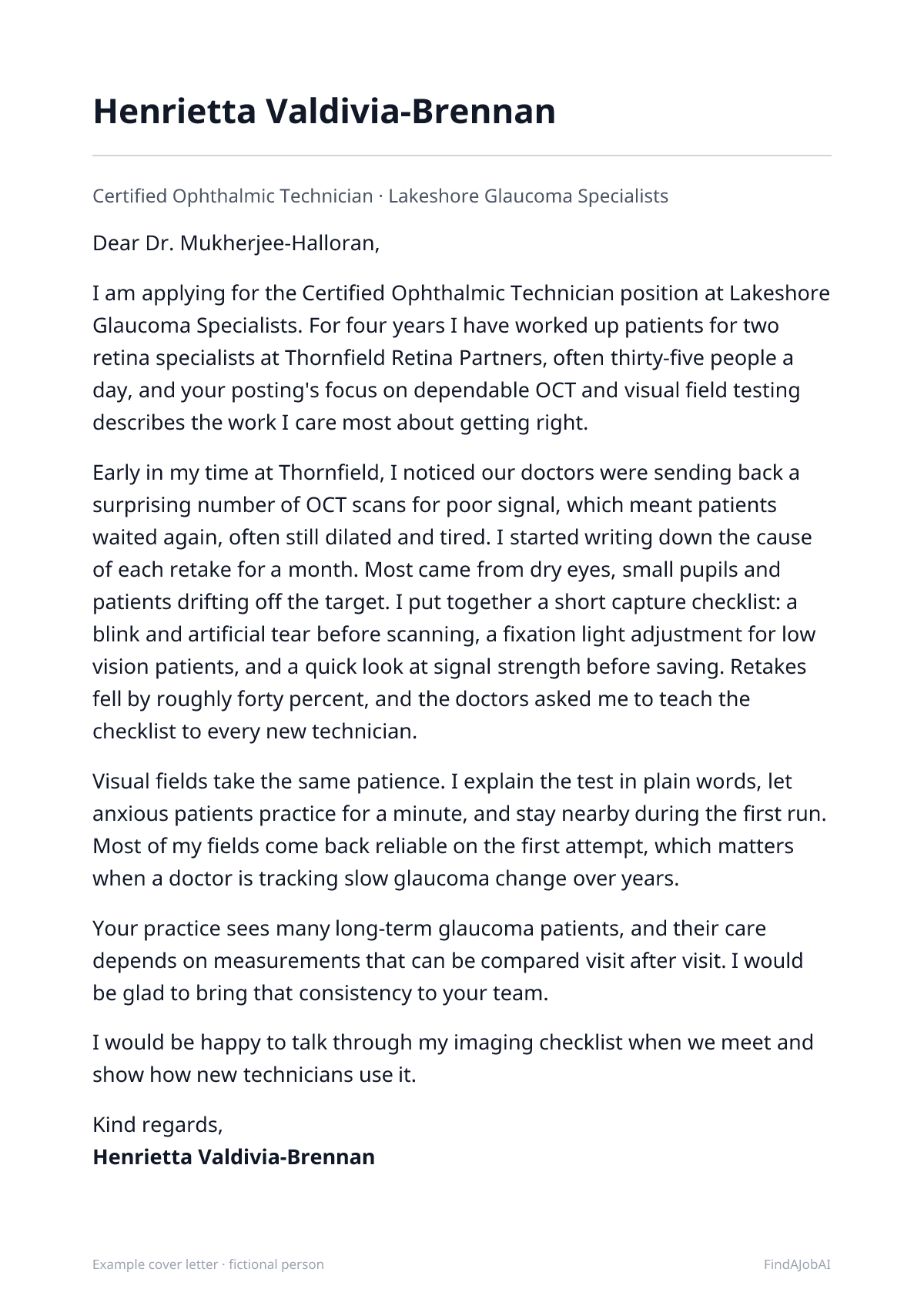
Ophthalmic Technician cover letter template
This letter as a one-page template: an opening that names the job and your strongest fact, proof that answers the ad, a reason for this employer and a short close.
After you sign up, FindAJobAI drafts your own letter for a real job from your CV in this format, and you edit it before you send it.
Example 1 · Experienced
Certified technician applying to a busy glaucoma practice
Henrietta is a COT in a retina practice. The ad asks for strong OCT and visual field skills and comfort with forty-patient clinic days.
Example letter · fictional
Dear Dr. Mukherjee-Halloran,
I am applying for the Certified Ophthalmic Technician position at Lakeshore Glaucoma Specialists. For four years I have worked up patients for two retina specialists at Thornfield Retina Partners, often thirty-five people a day, and your posting's focus on dependable OCT and visual field testing describes the work I care most about getting right.
Early in my time at Thornfield, I noticed our doctors were sending back a surprising number of OCT scans for poor signal, which meant patients waited again, often still dilated and tired. I started writing down the cause of each retake for a month. Most came from dry eyes, small pupils and patients drifting off the target. I put together a short capture checklist: a blink and artificial tear before scanning, a fixation light adjustment for low vision patients, and a quick look at signal strength before saving. Retakes fell by roughly forty percent, and the doctors asked me to teach the checklist to every new technician.
Visual fields take the same patience. I explain the test in plain words, let anxious patients practice for a minute, and stay nearby during the first run. Most of my fields come back reliable on the first attempt, which matters when a doctor is tracking slow glaucoma change over years.
Your practice sees many long-term glaucoma patients, and their care depends on measurements that can be compared visit after visit. I would be glad to bring that consistency to your team.
I would be happy to talk through my imaging checklist when we meet and show how new technicians use it.
Kind regards,
Henrietta Valdivia-Brennan
Example 2 · Career changer
Optical shop associate moving into a first ophthalmic technician role
Augustin has worked in an optical store for three years and just earned a COA after an evening course. The ad is for a technician at a general eye clinic.
Example letter · fictional
Dear Ms. Delacourt-Haynes,
I would like to apply for the Ophthalmic Technician role at Prairie View Eye Clinic. For three years I have worked at Kestrel Optical, fitting frames, taking measurements and checking new lenses against prescriptions, and this summer I passed the COA exam after an evening course at Wichita Area Technical College.
The part of my current job I enjoy most is the careful checking. Every new pair of glasses goes on the lensometer before a customer collects it. Last winter I found that several lenses from one lab batch had the axis of astigmatism set ten degrees off. I flagged them, the lab remade the order, and I set up a habit of rechecking every lens from that lab for the next month. Customers never knew there had been a problem, which is exactly how it should be.
During my course clinicals I worked up around fifteen patients a day under supervision, taking histories, acuities and pressure readings, and ran my first visual fields and OCT scans. I am still slow on refraction and have not yet assisted with procedures, so I would expect to ask many questions in my first months and to follow your clinic's protocols closely while I build speed.
Your posting mentions many older patients and a large number of first-time cataract evaluations. After three years of helping nervous customers choose their first progressive lenses, I am comfortable taking the time to explain each step.
I would welcome a chance to meet, and I am glad to complete a supervised workup in one of your lanes if that helps.
Sincerely,
Augustin Mwangi-Fairbairn
Example 3 · Senior or lead
Lead technician applying to run the technician team at a growing eye center
Cornelius is a COMT who supervises six technicians. The ad is for a technician supervisor at a practice opening two new locations.
Example letter · fictional
Dear Dr. Szabo-Whitlock,
Your posting for an Ophthalmic Technician Supervisor at Brightwater Eye Center mentions two new clinics opening next year and a need for consistent technician training across all sites. At Cedarbrook Eye Associates I have spent the last five years leading a team of six technicians through a similar expansion, from one clinic to three.
When we opened our second site, the doctors quickly noticed that test results looked different depending on where a patient was seen. Fields were run on different settings, OCT protocols varied and some technicians dilated every patient while others waited for the doctor. I wrote a single testing standard for each subspecialty, agreed it with the physicians, and built a training checklist of twenty competencies that every technician completes before working alone. Within a year, repeat testing across our sites fell by about a third and the doctors stopped asking which clinic a scan came from.
Scheduling has been the other half of the job. I build the weekly technician schedule around each doctor's clinic type, so a retina day gets our strongest imagers and a cataract day gets our most careful biometry staff. Overtime fell noticeably after the second site settled, and no clinic has opened late because a technician was missing.
I have not managed a budget for new equipment, which your ad mentions, and I would want to learn that side from your practice administrator. I am confident about the clinical and training side of a multi-site technician team.
I would welcome a conversation about your plans for the new locations.
Respectfully,
Cornelius Abernethy-Osuji
All three letters, and the short version below, are fictional: the people, employers and numbers are invented. Borrow the structure, never the facts.
- Prefer to write it yourself? Use the free cover letter template.
- Check your CV against the job first: the free CV score shows the missing keywords.
Why the first letter works, paragraph by paragraph
Paragraph 1: Opening
Gives daily volume and subspecialty, then connects directly to the ad's two priorities, OCT and visual fields.
Paragraph 2: The retake story
Shows the writer noticing a problem, logging causes for a month and fixing it with a checklist that other technicians adopted.
Paragraph 3: Visual fields
Adds patient coaching skills and explains why reliable fields matter for long-term glaucoma monitoring.
Paragraph 4: Why this practice
Ties the practice's long-term glaucoma patients to measurement consistency, the theme of the whole letter.
Paragraph 5: Close
Offers a specific topic to discuss, which makes the request for an interview feel natural.
What the career changer's letter does differently
The optical associate's letter is credible because it builds on a real overlap between optical retail and ophthalmic work: precise lens checking. It adds the new COA, counts clinical patients from the course, and is honest about slow refraction and no procedure experience, which reassures a clinic that training needs are understood.
What the senior letter does differently
A supervisor's letter is judged on how a whole team performs. The single testing standard shows clinical leadership, the twenty-competency checklist shows how training was carried out, and the scheduling paragraph shows daily operations. Admitting no equipment budget experience keeps the rest believable.
Short ophthalmic technician cover letter: an email-ready version
Many applications arrive as an email or a small text box, and a full page doesn't fit. This version runs 120 to 150 words and keeps only what a reader needs to decide whether to reply. A technician answers a practice's request to email a short introduction instead of filling in an online form.
Short version · email · fictional134 words
Subject: Ophthalmic Technician (COT) – cataract biometry and workups – Seraphina Kowalczyk-Adeyemi
Dear Ms. Oyelowo-Grant,
I am applying for the Ophthalmic Technician opening at Harborview Eye Surgeons. I am a COT with three years at a cataract surgery center, where I work up about thirty patients a day and take biometry for most of our surgical evaluations.
Last year I noticed two IOLMaster readings for the same patient that were much further apart than usual. I repeated the scan, then asked the surgeon to review it, and the patient turned out to have an early corneal problem that changed the lens plan before surgery was booked.
Your practice performs many premium lens surgeries, where measurement accuracy matters even more. My resume is attached, and I am available to interview any weekday afternoon or to complete a short skills check in your clinic.
Best regards,
Seraphina Kowalczyk-Adeyemi
A short email needs one memorable example, so this one tells the biometry story that shows care with surgical measurements. It closes by linking that care to the practice's premium lens work and giving clear availability.
Opening lines that work for ophthalmic technician cover letters
The first sentence decides whether the second gets read. Here are six openings, one for each situation you might be in. Pick the one that matches yours and swap in your own facts: every name and number below is invented.
1. You have a standout result
Our doctors used to send back about one OCT scan in eight for poor signal. A simple capture checklist cut those retakes by roughly forty percent.
2. The ad names a problem you've solved
Your posting asks for dependable visual field testing. Most of my fields come back reliable on the first attempt because I let anxious patients practice before the real test.
3. Someone referred you
Dr. Ingrid Vasilakis, who joined your retina team last year, trained me during my externship and encouraged me to apply when this technician role opened.
4. You admire what they build
For three years I have checked every new pair of glasses on a lensometer before a customer collects it. I would like to bring that precision into an eye clinic.
5. You're new to the field or switching into it
When our practice grew from one clinic to three, I wrote a single testing standard and training checklist so results looked the same at every site.
6. You have senior scope or a specialism
Two biometry readings that did not agree led me to repeat a scan and alert the surgeon, which changed a patient's lens plan before surgery.
How to write an ophthalmic technician cover letter
Five steps, in the order you'd write them. The shape stays the same for every job (a short opening, proof, a reason for this employer, a close), and what goes into each part is what changes with the role.
Match the subspecialty
Glaucoma, retina, cataract and general practices value different strengths. Read the ad for clues, such as injections, fields or biometry, and choose an example from your own work that fits that type of practice, so the doctor reading it can picture you in their clinic.
Show accuracy with a real moment
Describe a time you retook an image, rechecked a reading or noticed something unusual and told the doctor. Say what happened next, such as a changed plan or fewer retakes, because ophthalmologists hire technicians whose numbers they can trust without repeating them.
Add pace and clinic flow
Mention how many patients you work up in a day and anything you did to keep clinics on time, such as dilating at check-in or preparing charts the afternoon before. Busy practices need technicians who are both careful and quick, and numbers make that clear.
Include patient care
Many patients are older, anxious or worried about losing sight. A sentence on how you explain tests, coach patients through fields or calm them before injections shows the doctor how you will represent the practice in the exam lane.
Be honest about skills in progress
If you are still building speed in refraction or have not assisted with procedures, say so briefly and explain how you are learning. Clinics expect some training, and a clear, honest picture helps them plan rather than discover gaps after hiring.
Ophthalmic Technician cover letter do's and don'ts
Do
- Tell one story that shows measurement accuracy and its effect on patients or the doctor.
- Mention your credential, subspecialty and daily patient volume early.
- Name the instruments you use confidently, such as Spectralis or Humphrey.
Don't
- Don't list every test you have ever run without a single example.
- Don't describe a patient in enough detail that a colleague could recognize them.
- Don't claim procedure or refraction skills you would need help with.
Common ophthalmic technician cover letter mistakes
Each one is easy to make and quick to fix before you send the letter.
Repeating the instrument list from the resume
The resume already lists tests and instruments. Use the letter to show one of them in action with a result.
Forgetting the credential
Mention your COA, COT or COMT in the first paragraph, since many practices filter on it.
Telling a story with patient details
Ages, names or rare conditions can identify someone. Keep stories general enough to protect privacy.
Only talking about tests
Practices also need help with clinic flow and nervous patients. Include at least one sentence on each.
Sending the same letter to every practice
A retina clinic and a cataract center look for different strengths. Mention the practice's focus and connect your example to it.
Email subject lines for ophthalmic technician applications
Applying by email? Put the job title, any reference number and your name in the subject line.
- COT application – OCT and visual field testing – Henrietta Valdivia-Brennan
- Ophthalmic Technician – optical background, COA certified – Augustin Mwangi-Fairbairn
- Application: COT, Glaucoma Clinic (Posting 3318) – Henrietta Valdivia-Brennan
Everything for Ophthalmic Technicians
- Ophthalmic Technician resume exampleA full resume, plus bullet and summary examples
- Ophthalmic Technician interview questions30 questions with sample answers
- Ophthalmic Technician job descriptionDuties, skills and requirements
- Career change cover letter: template + examples
Other cover letter examples
Ophthalmic Technician cover letter FAQ
What should an ophthalmic technician cover letter include?
Your credential, subspecialty and patients per day, one story that shows accurate testing or smooth clinic flow, the instruments you use and a link to the type of practice you are applying to.
How do I write an ophthalmic technician cover letter without clinic experience?
Use optical, medical assistant or other patient care work and focus on measurement and patient communication. Add your training program, clinical hours and any COA credential, and be honest about skills still developing.
Should I mention specific instruments?
Yes, especially if the ad names them. Mention them inside an example, such as reducing OCT retakes on a Spectralis, rather than as a bare list.
How long should an ophthalmic technician cover letter be?
About 250 to 350 words: an opening tied to the ad, one exam lane story, a note on patient care, a sentence about the practice and a short close.
How we built this page
The FindAJobAI team wrote the three example letters, the short email version, the opening lines and the advice for ophthalmic technician roles. The people, employers and numbers in the letters are invented; the structure, the kind of evidence and the order of the paragraphs are the parts to copy.
Once we track enough live ophthalmic technician job ads, this page also shows the skills they ask for most, counted the same way as our in-demand skills report.
Last reviewed on November 1, 2026.