Preschool Teacher Cover Letter Example (2026)
By FindAJobAI team Updated How we built this page
Preschool teacher ads mostly ask for a certification and a few years with young children, so most applicants look similar on paper. The letter is where you show how a classroom actually runs under you: a routine you built, a child you helped, and how you talk to parents about both.
Preschool Teacher cover letter template
This letter as a one-page template: an opening that names the job and your strongest fact, proof that answers the ad, a reason for this employer and a short close.
After you sign up, FindAJobAI drafts your own letter for a real job from your CV in this format, and you edit it before you send it.
Example 1 · Experienced
Lead preschool teacher applying to a play-based center
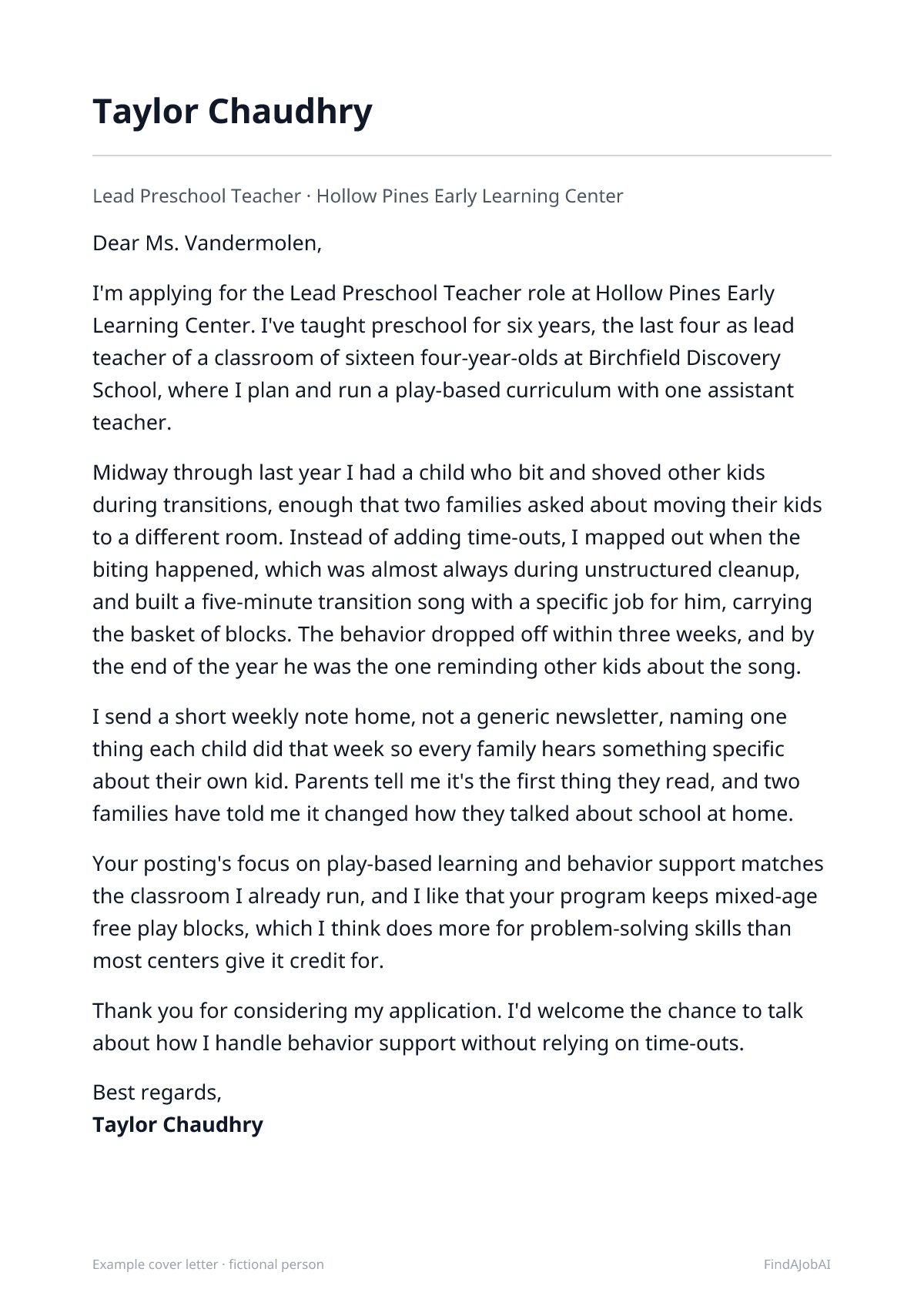
Taylor runs a classroom of sixteen four-year-olds. The ad asks for experience with play-based curriculum and behavior support.
Example letter · fictional
Dear Ms. Vandermolen,
I'm applying for the Lead Preschool Teacher role at Hollow Pines Early Learning Center. I've taught preschool for six years, the last four as lead teacher of a classroom of sixteen four-year-olds at Birchfield Discovery School, where I plan and run a play-based curriculum with one assistant teacher.
Midway through last year I had a child who bit and shoved other kids during transitions, enough that two families asked about moving their kids to a different room. Instead of adding time-outs, I mapped out when the biting happened, which was almost always during unstructured cleanup, and built a five-minute transition song with a specific job for him, carrying the basket of blocks. The behavior dropped off within three weeks, and by the end of the year he was the one reminding other kids about the song.
I send a short weekly note home, not a generic newsletter, naming one thing each child did that week so every family hears something specific about their own kid. Parents tell me it's the first thing they read, and two families have told me it changed how they talked about school at home.
Your posting's focus on play-based learning and behavior support matches the classroom I already run, and I like that your program keeps mixed-age free play blocks, which I think does more for problem-solving skills than most centers give it credit for.
Thank you for considering my application. I'd welcome the chance to talk about how I handle behavior support without relying on time-outs.
Best regards,
Taylor Chaudhry
Example 2 · Career changer
Pediatric dental hygienist moving into preschool teaching
Desmond ran a weekly story time at his dental office for anxious kids before deciding to teach full time. The ad wants CDA coursework in progress.
Example letter · fictional
Dear Hiring Manager,
I'm applying for the Preschool Teacher role at Juniper Row Children's Center. I've worked as a pediatric dental hygienist for six years, and the part of that job I kept building on my own time, calming anxious kids and keeping a room of four-year-olds engaged during long waits, is what pushed me to train as a teacher.
At my office I started a ten-minute story time before appointments for kids who'd had a hard visit the time before. I noticed the loudest, most anxious kids calmed down fastest when they had a job, holding the book, picking the next page, so I built that into every session. A few parents started arriving early just for story time, and one mother told me her daughter stopped crying in the parking lot once she knew the routine.
I'm currently finishing my CDA coursework through Alderbrook Community College, with my practicum hours scheduled for this spring, and I've completed CPR and pediatric first aid certification. I've spent real hours managing a room of young kids through fear, boredom, and long waits, which is a skill the credential doesn't fully capture on its own.
Your ad's mention of CDA coursework in progress fits exactly where I am, and six years of reading what calms or engages an anxious four-year-old is something I'd bring into a classroom from day one rather than learning on the job.
Thank you for your time. I'd welcome the chance to discuss my story time program and my CDA timeline.
Sincerely,
Desmond Okafor-Lindqvist
Example 3 · Senior or lead
Center director applicant moving from lead teacher to administration
Fennimore has led a preschool classroom for eight years and trained four new teachers. The ad is for a director who'll also oversee curriculum.
Example letter · fictional
Dear Mrs. Oyelaran,
I'm applying for the Center Director role at Larkspur Hollow Preschool. I've taught preschool for eight years, the last three also serving as lead mentor teacher at Copperfield Early Learning, where I trained four new hires and helped set classroom routines across three rooms. I'd like to move fully into leading a program rather than only running my own classroom.
Your ad mentions inconsistent daily schedules across classrooms, which was the exact problem I was asked to fix at Copperfield two years ago. Each teacher ran drop-off, circle time, and transitions differently, which confused kids who moved between rooms during the day and made substitute coverage harder. I built a shared daily framework with room for each teacher's own activities inside it, trained the staff on it over two sessions, and our director told me substitute call-outs went from a daily scramble to a non-issue within a term.
The piece I'm proudest of is mentoring a first-year teacher through a boy who refused to nap and disrupted the whole rest period. I observed her room twice, helped her try a quieter wind-down routine with dim lights and a specific mat spot, and within a month he was napping most days without a fight. She still uses that routine with new kids each year.
I haven't managed a center's budget, licensing renewals, or enrollment directly, only classroom staffing and training, and at Larkspur Hollow I'd want to learn that side closely from whoever currently handles it.
I'd welcome a conversation about which classroom or staffing issues feel hardest to solve right now, and where a director with a strong classroom background could help first.
Sincerely,
Fennimore Adeyemi-Clarke
All three letters, and the short version below, are fictional: the people, employers and numbers are invented. Borrow the structure, never the facts.
- Prefer to write it yourself? Use the free cover letter template.
- Check your CV against the job first: the free CV score shows the missing keywords.
Why the first letter works, paragraph by paragraph
Paragraph 1: Opening
States years of experience, classroom size, and the specific curriculum style (play-based), which tells the reader the classroom will transfer directly.
Paragraph 2: The behavior case
A real problem (biting during transitions), a specific fix (a transition song with a job), and a result measured in weeks, not a claim of being 'good with kids.'
Paragraph 3: Parent communication as a second skill
The weekly note detail is a concrete habit, not a general claim of 'strong communication,' and shows awareness that parents judge a classroom partly through what they hear at home.
Paragraph 4: Why this center
Connects the ad's named priorities (play-based learning, behavior support) to a specific program detail (mixed-age free play) rather than restating the ad's language back at it.
Paragraph 5: Close
Offers to discuss the specific behavior-support method by name, which signals real practice rather than a general willingness to talk.
What the career changer's letter does differently
This letter leads with the story time program the writer started at a pediatric dental office for anxious kids, which shows classroom instincts before any formal training, then states CDA coursework and practicum timing plainly instead of hiding the missing classroom title. Six years in a different field becomes an asset: real practice calming and engaging young kids, not a gap to apologize for.
What the senior letter does differently
A director-track letter reports on staff and systems rather than one child: a shared daily framework that fixed substitute coverage, a mentoring case where the writer's coaching produced another teacher's lasting routine, and a plainly named gap, budget and licensing, rather than a vague claim of readiness to lead.
Short preschool teacher cover letter: an email-ready version
Many applications arrive as an email or a small text box, and a full page doesn't fit. This version runs 120 to 150 words and keeps only what a reader needs to decide whether to reply. A preschool teacher answers a small center's short online application question after seeing the posting shared by a former coworker.
Short version · email · fictional128 words
Subject: Preschool Teacher – pre-K experience, CDA certified – Rosalind Mbeki-Thorsen
Hello Ms. Castellanos,
I'm applying for the Preschool Teacher role at Firbank Meadow Preschool. I've taught pre-K for three years at a center with a similar play-based approach, and I'm CDA certified with current CPR and first aid.
A change I'm proud of was turning a chaotic cleanup time into a five-minute song with assigned jobs for each child. A boy who used to hide under the table during cleanup started asking to be first in line for his job within a few weeks.
I'd like to bring that kind of small, specific fix to your classroom. My resume is attached, and I'm glad to share more about how I handle transitions. I can also visit for a morning session if that suits your team.
Best,
Rosalind Mbeki-Thorsen
The short version keeps one concrete classroom fix with a clear before-and-after for a specific child, and leads with certification status since small centers often screen for CDA and CPR first. It drops the parent-communication detail entirely to stay inside a tight word count.
Opening lines that work for preschool teacher cover letters
The first sentence decides whether the second gets read. Here are six openings, one for each situation you might be in. Pick the one that matches yours and swap in your own facts: every name and number below is invented.
1. You have a standout result
A cleanup-time song with assigned jobs turned my loudest holdout into the first kid in line for his job within a few weeks. I'd like to bring that kind of specific fix to your classroom.
2. The ad names a problem you've solved
Your ad mentions a play-based curriculum. I run free-play blocks that mix two age groups on purpose, since I've found it does more for problem-solving than same-age grouping alone.
3. Someone referred you
Ottoline Van Aardt, your lead teacher, and I trained side by side for a year at a previous center, and she encouraged me to apply for the opening, so I am writing to you directly.
4. You admire what they build
My daughter spent two years at your center, and I still remember how her teacher turned each hard morning goodbye into a routine she could count on; I want to work on a staff that handles transitions with that care.
5. You're new to the field or switching into it
I worked six years as a pediatric dental hygienist before training to teach preschool, and a story time program I started there for anxious kids is a large part of why I made the switch.
6. You have senior scope or a specialism
As lead mentor teacher for three years, I built a shared daily framework that fixed our substitute coverage problem across three classrooms. I'm ready to lead a program rather than only run my own room.
How to write a preschool teacher cover letter
Five steps, in the order you'd write them. The shape stays the same for every job (a short opening, proof, a reason for this employer, a close), and what goes into each part is what changes with the role.
Identify the age group and curriculum style the ad names
A toddler room, a pre-K class, a play-based program and an academic one each reward a different story. Check which age group and teaching style the posting describes, then open with an example from that kind of room instead of your widest experience.
Open with one classroom moment, not a list of duties
Choose one child, routine or behavior, say what you tried and what shifted. A single real moment in the opening paragraph earns more trust than a rundown of every daily task, because it shows how you think when you are in the room.
Describe the fix, then the result in weeks or terms
A transition song, a job-based cleanup routine, a quieter nap wind-down: naming the actual thing you tried, then how long it took to work, reads as real practice. A result claimed without a specific method sounds like a guess.
Include a concrete parent-communication habit
Many preschool roles are judged partly on family trust. Describe one habit, a weekly note, a pickup-time update, or a specific way you handle a hard goodbye, rather than claiming to have 'great communication with parents' in general terms.
State your certification status without burying it
List your CDA, state credential, CPR and first aid status early, within the first two paragraphs, so a director scanning for compliance finds it fast. End with one real question about the room or the daily schedule that you would raise in an interview.
Preschool Teacher cover letter do's and don'ts
Do
- Open with one classroom moment, a behavior you addressed, a routine you built, or a child you helped, rather than a general claim about loving kids.
- Mention your specific age group and classroom size; a toddler room and a pre-K room call for different skills and different letters.
- Describe how you talk to parents, with one concrete habit like a note home or a pickup-time update, since that's often what sets a teacher apart.
- State your certification status (CDA, CPR, state-specific requirements) plainly if you're newly credentialed or still completing coursework.
Don't
- Don't write "I've always loved working with children" as your whole reason for applying; show it with one specific classroom moment.
- Don't list every activity you've ever done with kids; pick the one that solved a real problem or taught something.
- Don't share identifying details about specific children or families; change names and minor details the way the examples here do.
Common preschool teacher cover letter mistakes
Each one is easy to make and quick to fix before you send the letter.
Claiming to love kids instead of showing a moment
"I've always loved working with children" is what nearly every applicant writes. Replace it with one classroom moment, a behavior fixed or a child helped, that shows the trait instead of naming it.
Listing every activity without a result
A long list of crafts, songs, and games tells the reader you kept busy, not that anything worked. Pick the one activity or routine that solved a real problem, and say what changed because of it.
Leaving certification status vague or unstated
Centers often need to confirm CDA, state certification, or CPR status before scheduling an interview. State exactly where you stand, completed, in progress, or scheduled, rather than assuming your resume covers it clearly enough.
Skipping how you handle parents
A letter that only describes the classroom misses half of what centers screen for. Add one concrete habit, like a specific note-home routine or how you handle a hard goodbye, so the reader can picture you talking to families.
Sharing identifying details about specific children
Real classroom stories persuade, yet a child's name or a family's circumstances are not yours to publish. Alter the names and small details, as a case study does, and keep the situation itself accurate.
Email subject lines for preschool teacher applications
Applying by email? Put the job title, any reference number and your name in the subject line.
- Lead Preschool Teacher application – play-based classroom, 6 years – Taylor Chaudhry
- Preschool Teacher – CDA coursework in progress, pediatric background – Desmond Okafor-Lindqvist
- Application: Preschool Teacher, Toddler Room – Taylor Chaudhry
Everything for Preschool Teachers
- Preschool Teacher resume exampleA full resume, plus bullet and summary examples
- Preschool Teacher interview questions30 questions with sample answers
- Preschool Teacher job descriptionDuties, skills and requirements
- Career change cover letter: template + examples
Other cover letter examples
Preschool Teacher cover letter FAQ
What should I write in a preschool teacher cover letter?
One classroom moment: a behavior you addressed, a routine you built, or a child you helped, with what you actually did and what changed. Add a sentence on how you communicate with parents. Your certifications belong early, not buried at the end.
How do I write a preschool teacher cover letter with no classroom job experience yet?
Use a related moment, babysitting, a self-started program, tutoring, or caregiving for family, the same way you'd use classroom experience: the situation, what you did, and the result. State your CDA or coursework timeline plainly.
Should I mention my CDA or state certification status if it's still in progress?
Yes. Say exactly where you are, coursework finished, practicum scheduled, exam date, so the reader knows what's confirmed and what's pending rather than guessing from your resume.
How long should a preschool teacher cover letter be?
Most postings are well served by four or five short paragraphs. If the center's form only has room for a brief note, send a trimmed two- or three-paragraph email instead.
How we built this page
The FindAJobAI team wrote the three example letters, the short email version, the opening lines and the advice for preschool teacher roles. The people, employers and numbers in the letters are invented; the structure, the kind of evidence and the order of the paragraphs are the parts to copy.
Once we track enough live preschool teacher job ads, this page also shows the skills they ask for most, counted the same way as our in-demand skills report.
Last reviewed on November 1, 2026.