Caregiver Cover Letter Example (2026)
By FindAJobAI team Updated How we built this page
Caregiver ads ask for patience and reliability, words every applicant already uses. Families and agencies read past them for one thing: a specific person you cared for, what you noticed about them, and what you did when something changed.
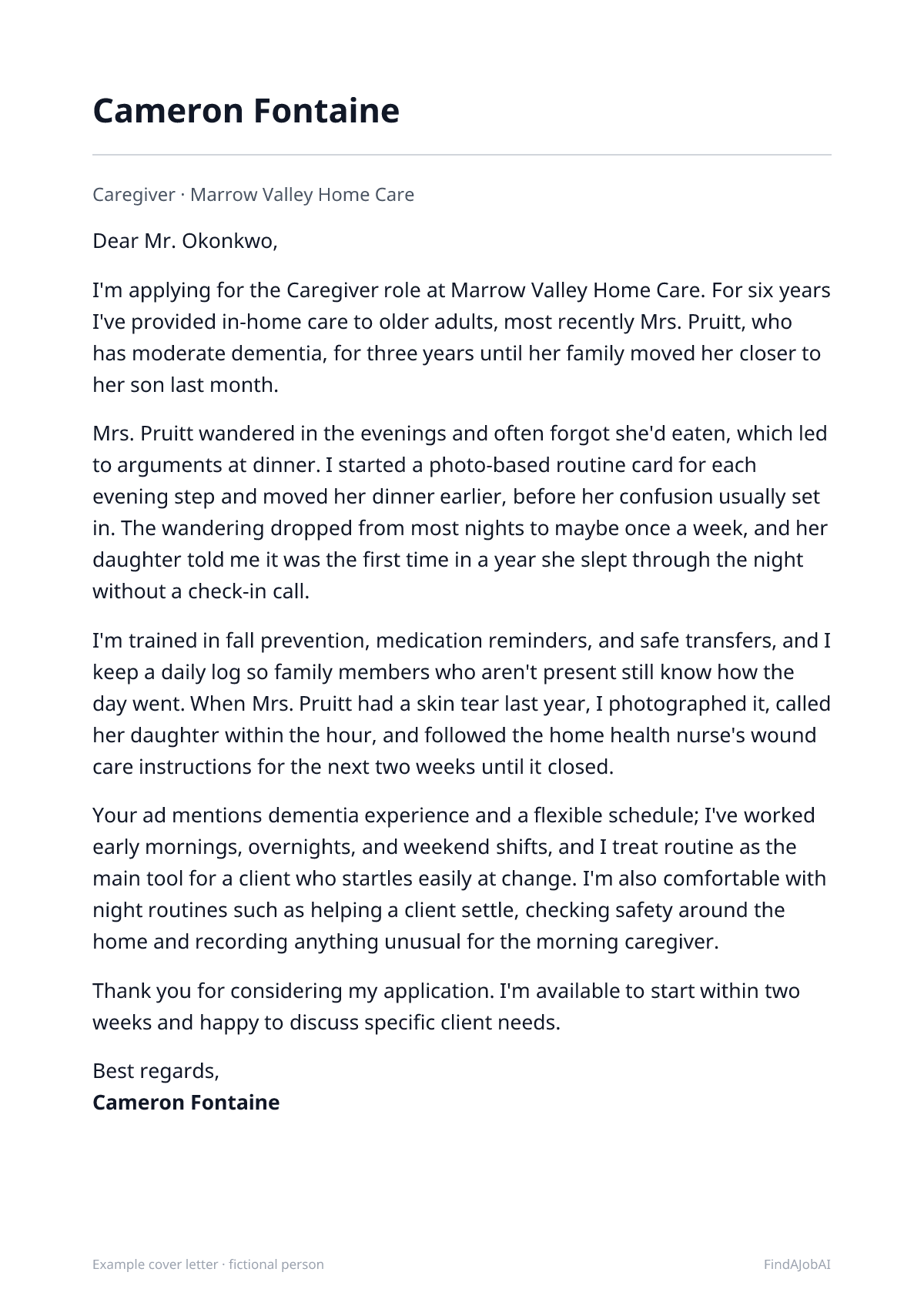
Caregiver cover letter template
This letter as a one-page template: an opening that names the job and your strongest fact, proof that answers the ad, a reason for this employer and a short close.
After you sign up, FindAJobAI drafts your own letter for a real job from your CV in this format, and you edit it before you send it.
Example 1 · Experienced
Home caregiver applying to an in-home care agency
Cameron has cared for private clients for six years. The ad asks for dementia experience and a flexible schedule.
Example letter · fictional
Dear Mr. Okonkwo,
I'm applying for the Caregiver role at Marrow Valley Home Care. For six years I've provided in-home care to older adults, most recently Mrs. Pruitt, who has moderate dementia, for three years until her family moved her closer to her son last month.
Mrs. Pruitt wandered in the evenings and often forgot she'd eaten, which led to arguments at dinner. I started a photo-based routine card for each evening step and moved her dinner earlier, before her confusion usually set in. The wandering dropped from most nights to maybe once a week, and her daughter told me it was the first time in a year she slept through the night without a check-in call.
I'm trained in fall prevention, medication reminders, and safe transfers, and I keep a daily log so family members who aren't present still know how the day went. When Mrs. Pruitt had a skin tear last year, I photographed it, called her daughter within the hour, and followed the home health nurse's wound care instructions for the next two weeks until it closed.
Your ad mentions dementia experience and a flexible schedule; I've worked early mornings, overnights, and weekend shifts, and I treat routine as the main tool for a client who startles easily at change. I'm also comfortable with night routines such as helping a client settle, checking safety around the home and recording anything unusual for the morning caregiver.
Thank you for considering my application. I'm available to start within two weeks and happy to discuss specific client needs.
Best regards,
Cameron Fontaine
Example 2 · Career changer
Restaurant server moving into caregiving after caring for a grandparent
Nnamdi cared for his grandfather unpaid for two years. The ad is for an entry-level caregiver with training provided.
Example letter · fictional
Dear Hiring Manager,
I'm applying for the Caregiver role at Thistlewood Senior Living. For two years I was the main caregiver for my grandfather after his stroke, alongside working as a server, and I'm now looking to do that work full time.
My grandfather lost speech on his left side and grew frustrated when people talked over him or rushed his answers. I learned to wait, offer a notepad, and read his face for yes or no when words didn't come. I managed his seven medications on a schedule taped to the fridge, drove him to physical therapy twice a week, and tracked his blood pressure each morning so his doctor could adjust his medication without guessing.
Serving tables for four years taught me to notice small signs before they become problems: a regular who seems off, a client who's gone quiet. I've completed a CPR and first aid course and I'm enrolled in a home health aide class that finishes next month, and I'm comfortable with transfers, bathing, and toileting care from assisting my grandfather directly.
Your posting says training is provided and values patience over experience. I bring two years of exactly the patience the job needs, learned with someone I loved, and I'd like to bring it to people who aren't my family too. I'd also ask a lot of questions in my first weeks, learn each resident's routines from the senior staff and write them down so I can follow them consistently.
Thank you for your time. I'm available for an interview whenever suits your schedule.
Kind regards,
Nnamdi Eze
Example 3 · Senior or lead
Lead caregiver applying to oversee a memory care unit
Beatrix leads six caregivers at a senior living facility. The ad is for a lead caregiver who trains staff and handles family communication.
Example letter · fictional
Dear Ms. Vantassel,
I'm applying for the Lead Caregiver role at Hollowmere Memory Care. For the last two years I've led a team of six caregivers on the memory care floor at Birchcrest Senior Living, and before that I spent five years as a direct caregiver there.
When I took over, new caregivers were leaving within three months, and residents noticed the constant turnover as new faces and new routines. I built a two-week shadow program pairing every new hire with an experienced caregiver and a one-page care summary for each resident covering their routine, triggers, and what calms them. Turnover slowed enough that our newest caregiver has now stayed over a year, and residents have fewer agitation episodes tied to unfamiliar staff.
I handle the calls families dread making. When a resident, Mr. Abernathy, started refusing meals, I didn't wait for the weekly family update; I called his daughter that evening, we tried smaller plates and finger foods based on his old habits, and his weight stabilized within a month. I now train new caregivers to flag changes the same day rather than at the next shift change.
I haven't managed a facility's staffing budget or handled formal disciplinary action, and at Hollowmere I'd want to learn your scheduling software and documentation standards early. I'd begin by sitting in on a few of your shift handoffs, so I can see what your caregivers already do well before suggesting changes.
I'd welcome a conversation about how your unit currently trains new caregivers and what you'd want improved in the first few months.
Sincerely,
Beatrix Solheim
All three letters, and the short version below, are fictional: the people, employers and numbers are invented. Borrow the structure, never the facts.
- Prefer to write it yourself? Use the free cover letter template.
- Check your CV against the job first: the free CV score shows the missing keywords.
Why the first letter works, paragraph by paragraph
Paragraph 1: Opening
Names a specific client and how long the writer cared for them, with a plain reason the role ended (a family move), which reads as honest rather than evasive.
Paragraph 2: The change that helped
A concrete problem (wandering, missed meals), a specific response (a photo routine card, an earlier dinner), and a result measured in the family's own terms, a full night's sleep.
Paragraph 3: Skills shown through use
Fall prevention and medication reminders are named, then proven with a wound care story that shows the writer notifies family and follows clinical instructions without being asked.
Paragraph 4: Why this fits the ad
Directly answers the two things the ad named, dementia experience and flexible scheduling, instead of repeating them as traits.
Paragraph 5: Close
Gives a start date and invites a conversation about the specific client, which signals the writer expects to be matched to a real person, not a shift.
What the career changer's letter does differently
The career changer's letter uses unpaid family caregiving as the real experience, naming the condition (aphasia after a stroke), the daily tasks (medications, transfers, appointments), and a skill carried over from serving tables, reading people before they ask for help. It closes by matching the ad's own language about training and patience rather than listing certifications it doesn't have.
What the senior letter does differently
A lead caregiver letter reports what changed about the team, not just the resident care: a shadow program, turnover that slowed, a documentation habit that caught problems earlier. The Mr. Abernathy story shows the writer's judgment under a real risk, weight loss, and the letter names the gap, budgeting and discipline, instead of implying full management experience.
Short caregiver cover letter: an email-ready version
Many applications arrive as an email or a small text box, and a full page doesn't fit. This version runs 120 to 150 words and keeps only what a reader needs to decide whether to reply. A caregiver answers a short online application field for a hospice support agency, sent by email after a portal error.
Short version · email · fictional121 words
Subject: Caregiver application – hospice and end-of-life experience – Soren Lindqvist
Hello Ms. Okafor-Reyes,
I'm applying for the Caregiver role at Willowbrae Hospice Support. I have four years of experience caring for older adults, including a year supporting a hospice client, Mr. Lindgren, through his final months.
Mr. Lindgren wanted to stay in his own bedroom rather than move to a facility. I coordinated his daily care around his hospice nurse's visits, kept his family updated by a short evening text, and adjusted his routine as his needs changed week to week, which let him remain home until he passed.
That kind of steady, honest presence is what I'd bring to your clients and their families. My resume is attached, and I'm available to discuss availability at your convenience.
Best,
Soren Lindqvist
A short field forces one story instead of a resume recap, so this version keeps the hardest kind of caregiving, hospice support, and the one outcome the family valued: staying home. It drops the training list entirely since the resume already covers it.
Opening lines that work for caregiver cover letters
The first sentence decides whether the second gets read. Here are six openings, one for each situation you might be in. Pick the one that matches yours and swap in your own facts: every name and number below is invented.
1. You have a standout result
For three years I cared for a client with Parkinson's whose falls dropped once I changed how we moved through her morning routine. I'd like to bring that same attention to your clients.
2. The ad names a problem you've solved
Your ad says families want same-day updates when something changes. I built that habit into every shift I've worked, calling before a family has to ask.
3. Someone referred you
Your current caregiver, Delphine Ashworth, recommended I apply after we worked opposite shifts for the same client last year. She said your agency takes care planning seriously, which matches how I like to work.
4. You admire what they build
I've driven past your building for years on my way to see my own mother, and the way your staff greets residents by name in the lobby is part of why I'm applying here.
5. You're new to the field or switching into it
I spent two years as my father's full-time caregiver after his diagnosis, managing his medications and appointments alongside my own job. I'd like to keep doing that work for other families.
6. You have senior scope or a specialism
As a caregiver for nine years, I've trained new hires informally on every team I've joined. I'm looking for a role where that's part of the job, not an extra.
How to write a caregiver cover letter
Five steps, in the order you'd write them. The shape stays the same for every job (a short opening, proof, a reason for this employer, a close), and what goes into each part is what changes with the role.
Lead with one client, not a list of duties
Pick a client or family member you cared for and describe one real change: a routine that reduced falls, a meal adjustment that solved refusal to eat. Specifics read as true. A list of tasks like bathing and transfers reads the same in every application.
Name the condition and what it actually required
Dementia, Parkinson's, recovery from a stroke or surgery each call for different judgment. Say what the condition was and what you adjusted because of it, such as timing meals around confusion or pacing movement for balance. This shows understanding, not just willingness.
Show how you handle a change, not just a routine
Routines run themselves once set up. What employers want to see is what you did when something went wrong: a fall, a refusal, a new symptom. Describe the moment you noticed it and the action you took, including who you told and when.
Match your schedule and certifications to the ad
State the shifts you can work and any training you hold, CPR, first aid, medication administration, inside a sentence that connects to the ad's own wording. An agency scanning quickly should see its own requirements answered, not guessed at.
End with your schedule, not a thank-you
Give a real start date or window and invite a conversation about a specific client's needs. This signals you're ready to be placed with someone now, which matters more in caregiving hiring than a general thank-you line.
Caregiver cover letter do's and don'ts
Do
- Name one person you cared for and one specific thing that changed because of something you did.
- List care tasks (transfers, toileting, medication reminders) inside a story, not as a bare checklist.
- Say what shifts and schedule you can actually work; agencies read for availability as closely as skill.
Don't
- Don't write "I love helping people" as your only reason; show one hour where that showed up.
- Don't use a client's full name or identifying details without family permission; a first name or initial is safer.
- Don't hide a caregiving gap or an unlicensed background; say what training you have and what you're completing.
Common caregiver cover letter mistakes
Each one is easy to make and quick to fix before you send the letter.
Writing only general traits like "patient and caring"
Those words appear in nearly every caregiver letter. Replace the sentence with one moment where your patience mattered, such as waiting through a client's slow, frustrated attempt to speak instead of finishing their sentence.
Listing every task without a story
Bathing, transfers, meal prep, and medication reminders in a row tell the reader nothing about your judgment. Fold two of them into the client story you're already telling, and let the resume carry the full list.
Sharing identifying details about a client
A full name, address, or medical record detail can raise privacy concerns even in a cover letter. Use a first name or initial, and keep details to what the client's family would be comfortable with being shared.
Leaving out your actual availability
Agencies often hire around specific shift gaps. Say directly which shifts, weekends, or overnight hours you can work, rather than a vague "flexible schedule," so you're matched faster.
Treating unpaid family caregiving as less than real work
Caring for a parent or grandparent without pay still involves medications, appointments, and judgment calls. Describe it with the same detail and confidence you would a paid role.
Email subject lines for caregiver applications
Applying by email? Put the job title, any reference number and your name in the subject line.
- Caregiver application – six years in-home, dementia experience – Cameron Fontaine
- Entry-level Caregiver – former family caregiver, CPR certified – Nnamdi Eze
- Application: Overnight Caregiver (Req. 4410) – Cameron Fontaine
Everything for Caregivers
- Caregiver resume exampleA full resume, plus bullet and summary examples
- Caregiver interview questions30 questions with sample answers
- Caregiver job descriptionDuties, skills and requirements
- Career change cover letter: template + examples
Other cover letter examples
Caregiver cover letter FAQ
What should I write in a caregiver cover letter?
Name one client you cared for, one problem you noticed, and what you did about it, with a result the family or care team could see. Then say what shifts and care tasks you can cover. Certifications belong on your resume.
How do I write a caregiver cover letter with no paid experience?
Use caregiving you've done for family or neighbors, even unpaid, with the same detail you'd give a job: the condition, the daily tasks, and what you learned. Add any completed or in-progress training and your availability.
Should I name a specific client in a caregiver cover letter?
A first name or initial is fine if it reads naturally, but leave out identifying details you wouldn't want shared without permission. The story matters more than the name.
How long should a caregiver cover letter be?
About half a page. One real story carries more weight than a long list of duties, and agencies are often reading many applications quickly.
How we built this page
The FindAJobAI team wrote the three example letters, the short email version, the opening lines and the advice for caregiver roles. The people, employers and numbers in the letters are invented; the structure, the kind of evidence and the order of the paragraphs are the parts to copy.
Once we track enough live caregiver job ads, this page also shows the skills they ask for most, counted the same way as our in-demand skills report.
Last reviewed on November 1, 2026.