Process Engineer Cover Letter Example (2026)
By FindAJobAI Team Updated How we built this page
Plant managers reading a process engineer letter want to know two things fast: which kind of process you've owned, and whether your changes held up on night shift once you went home. A good letter picks one change you made to a real unit, explains how you proved it worked, and shows you kept operators and safety reviews on side while doing it.
Process Engineer cover letter template
This letter as a one-page template: an opening that names the job and your strongest fact, proof that answers the ad, a reason for this employer and a short close.
After you sign up, FindAJobAI drafts your own letter for a real job from your CV in this format, and you edit it before you send it.
Example 1 · Experienced
Batch resin engineer applying to a food ingredients plant
Delphine owns two reactor trains at a resin maker. The ad wants someone to cut cycle time on spray dryers and lead MOC reviews.
Example letter · fictional
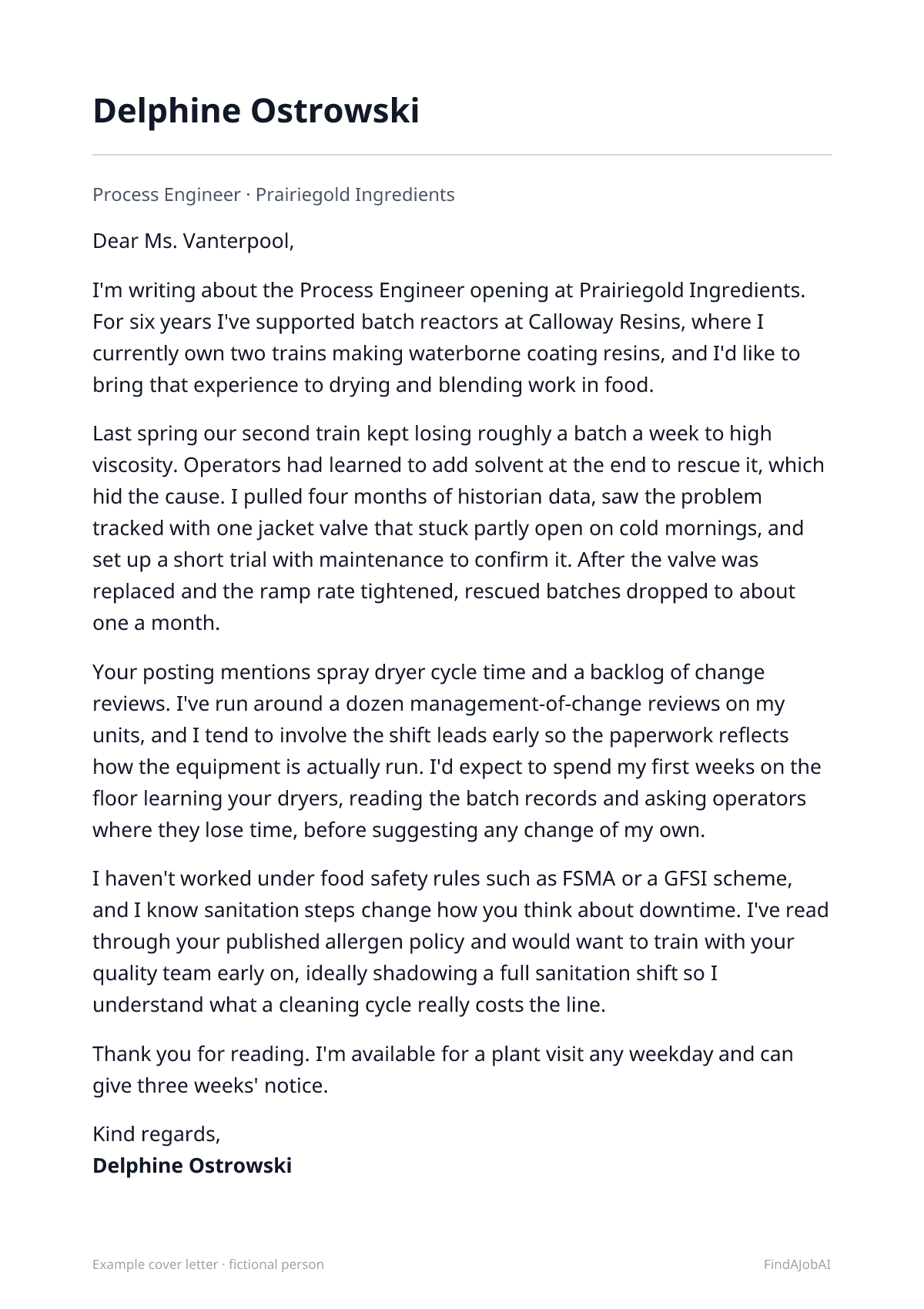
Dear Ms. Vanterpool,
I'm writing about the Process Engineer opening at Prairiegold Ingredients. For six years I've supported batch reactors at Calloway Resins, where I currently own two trains making waterborne coating resins, and I'd like to bring that experience to drying and blending work in food.
Last spring our second train kept losing roughly a batch a week to high viscosity. Operators had learned to add solvent at the end to rescue it, which hid the cause. I pulled four months of historian data, saw the problem tracked with one jacket valve that stuck partly open on cold mornings, and set up a short trial with maintenance to confirm it. After the valve was replaced and the ramp rate tightened, rescued batches dropped to about one a month.
Your posting mentions spray dryer cycle time and a backlog of change reviews. I've run around a dozen management-of-change reviews on my units, and I tend to involve the shift leads early so the paperwork reflects how the equipment is actually run. I'd expect to spend my first weeks on the floor learning your dryers, reading the batch records and asking operators where they lose time, before suggesting any change of my own.
I haven't worked under food safety rules such as FSMA or a GFSI scheme, and I know sanitation steps change how you think about downtime. I've read through your published allergen policy and would want to train with your quality team early on, ideally shadowing a full sanitation shift so I understand what a cleaning cycle really costs the line.
Thank you for reading. I'm available for a plant visit any weekday and can give three weeks' notice.
Kind regards,
Delphine Ostrowski
Example 2 · Career changer
Quality control chemist moving into a process engineering role
Tobias runs lab release testing at a polymer plant and keeps getting pulled into line problems. The ad is for an associate process engineer.
Example letter · fictional
Dear Hiring Team,
I'd like to be considered for the Associate Process Engineer role at Northfork Polymers. I've spent four years as a quality control chemist at Elkhorn Plastics, testing melt flow and color on every lot we ship, and over time more of my week has gone to the production side of those results.
When our extrusion line started producing pellets with yellowing last year, the lab's job was simply to reject lots. I asked to sit with the line for a few shifts, compared barrel zone temperatures against my color readings, and showed the process engineer that the worst lots followed long holds at one zone setting. He changed the hold limit and asked me to keep tracking it with him, which is how I learned what his role actually involves. Over the following months I joined him on two more trials, one on cooling water temperature and one on screen pack changes, and wrote up the lab side of each.
Since then I've finished a statistics certificate covering control charts and designed experiments, and I've started an evening course in unit operations. I can read P&IDs, I know our SOPs well from enforcing them, and I'm used to explaining test data to operators who don't want to hear it.
Your ad asks for someone who can connect lab and line data, and that is the part of my current job I most enjoy. I'd still need guidance on equipment design and on leading safety reviews, and I'd rather ask early than guess. I'm also comfortable on rotating shifts while I learn the line.
Thank you for your time. I'd welcome a conversation whenever it suits your schedule.
Sincerely,
Tobias Wainwright-Achebe
Example 3 · Senior or lead
Senior process engineer applying to lead a new-product scale-up group
Marisol has scaled four products from pilot to plant. The ad is for a lead who'll run a three-engineer scale-up team at a specialty chemical site.
Example letter · fictional
Dear Dr. Hammersley,
I'm applying for the Lead Process Engineer, Scale-Up position at Ridgecrest Specialty Chemicals. Over twelve years at Wexford Chemical I've moved four new products from the pilot bay to full production, and for the last three I've informally coordinated two junior engineers on that work.
The scale-up I learned the most from went badly at first. A dispersant that behaved well in a fifty-gallon reactor foamed over in the first full-size batch because the plant vessel's agitator pulled air at the higher fill level. We lost two batches before I insisted we stop and run a mixing study with the agitator vendor rather than keep adjusting the recipe. The fix was a baffle change and a slower charge, and the next four batches met spec. I wrote up the whole episode for the site, including the two lost batches, because the lesson mattered more than how it made the team look.
That experience shapes how I'd run your group: a written scale-up checklist covering mixing, heat removal and relief sizing before any first plant batch, and a short review with operations so they know what to watch. I've already drafted a version of that list at Wexford, and the plant manager now requires it for new products.
I haven't managed a formal budget or hired engineers. I'd want to understand your current pilot capacity, how product launch dates are set and who signs off on a first plant batch before committing to any timelines.
I'd be glad to talk about the products you plan to scale next year and where past launches have struggled.
Best regards,
Marisol Thorvaldsen
All three letters, and the short version below, are fictional: the people, employers and numbers are invented. Borrow the structure, never the facts.
- Prefer to write it yourself? Use the free cover letter template.
- Check your CV against the job first: the free CV score shows the missing keywords.
Why the first letter works, paragraph by paragraph
Paragraph 1: Opening
Names the process type she owns, batch reactors, and frames the move into food as a deliberate change instead of letting the reader guess why a resin engineer is applying.
Paragraph 2: One problem traced to a cause
The jacket valve story shows the habit plants pay for: refusing a workaround, finding the cause in data and proving it with a trial before changing anything.
Paragraph 3: Matching the ad
Responds to the two items in the posting, dryer cycle time and change reviews, and shows she involves shift leads, which tells the reader her changes survive night shift.
Paragraph 4: The honest gap
Food safety rules are new to her, so she says so and shows she has already read the company's allergen policy, which reads as preparation instead of weakness.
Paragraph 5: Close
Offers a plant visit and a notice period, both practical facts a hiring manager needs before scheduling an interview.
What the career changer's letter does differently
The chemist's letter turns a lab role into process evidence: he followed a quality problem onto the line, matched his data to zone temperatures and helped the engineer fix it. He names his coursework and is clear about what he still needs to learn, such as equipment design and safety reviews.
What the senior letter does differently
A senior letter can lead with a failure if it ends in a better system. Marisol's foaming batch turns into a scale-up checklist the plant adopted, which is the leadership evidence the ad is really asking for. Her missing budget and hiring experience is stated without fuss.
Short process engineer cover letter: an email-ready version
Many applications arrive as an email or a small text box, and a full page doesn't fit. This version runs 120 to 150 words and keeps only what a reader needs to decide whether to reply. A process engineer applies through a recruiter's portal that only accepts a short note, so the letter goes out as a brief email instead.
Short version · email · fictional141 words
Subject: Process Engineer – 5 years continuous processing, Six Sigma Green Belt – Anselm Kowalewski
Hello Ms. Ekstrand-Moye,
I'm applying for the Process Engineer role at Cedar Basin Foods. I have five years supporting continuous evaporators and dryers at a dairy ingredients plant, and I hold a Six Sigma Green Belt.
My main project this year was reducing product loss during evaporator washdowns. By changing the flush sequence and adding a conductivity check to end each rinse sooner, we cut the volume of product sent to drain on every clean, which plant finance now reports monthly. I also rewrote the washdown SOP with the sanitation lead so each crew runs it the same way.
I'm looking to move closer to family in your region. My resume is attached, and I can talk any afternoon this week. I could start within three weeks of an offer and am open to a plant tour first.
Thanks,
Anselm Kowalewski
The short note keeps one project with a clear mechanism, the washdown flush change, instead of a list of skills, and gives a plain reason for the move because recruiters ask about it anyway.
Opening lines that work for process engineer cover letters
The first sentence decides whether the second gets read. Here are six openings, one for each situation you might be in. Pick the one that matches yours and swap in your own facts: every name and number below is invented.
1. You have a standout result
Our second reactor train was losing about a batch a week until I matched the failures to a sticking jacket valve in historian data. Finding causes like that is what I'd bring to your plant.
2. The ad names a problem you've solved
Your posting mentions spray dryer cycle time and a backlog of change reviews, two problems I've worked on directly while owning batch reactor trains at a resin plant.
3. Someone referred you
Your plant manager, Ilse Gutierrez, and I worked through a solvent recovery revamp together at my previous company, and she suggested I apply for your open process engineer role.
4. You admire what they build
I toured your plant during a regional engineering society visit last year and remember how openly the shift leads talked about their bottlenecks. I'd like to help work on them.
5. You're new to the field or switching into it
After four years of rejecting off-spec lots in a quality lab, I want to be the engineer who stops them being made, which is why I'm applying for your associate process engineer role.
6. You have senior scope or a specialism
Twelve years of moving products from pilot reactors to full production taught me that most scale-up trouble starts with mixing and heat removal, and I'd like to build that discipline into your team.
How to write a process engineer cover letter
Five steps, in the order you'd write them. The shape stays the same for every job (a short opening, proof, a reason for this employer, a close), and what goes into each part is what changes with the role.
Say which process you've owned in the first two sentences
Batch reactors, continuous distillation, spray drying and extrusion each need different instincts. Open with the unit and industry you know best so the reader can map you to their plant, and if you're switching industries, name the switch and why you want it.
Tell one improvement story with the data behind it
Pick a change you made to a real unit: the symptom, the data that pointed to the cause, the trial that confirmed it and the result afterward. Plant managers trust a letter that shows the proof step, because untested changes are what cause upsets.
Show how you work with operators and maintenance
A process change only lasts if the shift crews accept it. Mention how you involved operators or maintenance planners, such as reviewing an SOP with shift leads or running a trial together, so the reader sees your changes hold after you leave the floor.
Mention process safety with your real role
Management of change and HAZOP reviews are part of the job in most plants. Say whether you led, scribed or attended them, roughly how many, and one action you closed, rather than describing yourself as safety-minded without evidence.
Be plain about gaps and how you'll close them
New regulations, a different industry or a first team lead role are common gaps. Name the one that matters for this posting, say what you've already done to prepare, and describe how you'd learn the rest in your first months on site.
Process Engineer cover letter do's and don'ts
Do
- Name the process type you've owned (batch reactor, distillation, spray drying, extrusion) in the first paragraph.
- Tell one improvement story with the data you used and how you confirmed the fix before rolling it out.
- Mention process safety work such as MOC or HAZOP with your actual role in it.
Don't
- Don't claim savings figures you can't explain in an interview; describe what changed and roughly how often.
- Don't list every simulation package you've opened; mention the one that supported a real decision.
- Don't skip the industry switch if you're making one; say why and what you'll learn first.
Common process engineer cover letter mistakes
Each one is easy to make and quick to fix before you send the letter.
Opening with a general passion for engineering
Every applicant likes engineering. Replace the line with the process you own and one change you made to it, which tells the reader far more in the same space.
Quoting big savings without a mechanism
A large dollar figure with no explanation invites doubt. Describe what changed, such as fewer rescued batches or less steam, and let the resume carry the detailed number.
Ignoring the plant's own process
If the posting names spray dryers or evaporators and your letter only talks about reactors, connect them. Explain which of your skills transfer and what you'd need to learn first.
Leaving out safety reviews entirely
Plants hire process engineers partly to protect their safety record. One sentence on your MOC or HAZOP work, with your actual role, answers a question the reader is already asking.
Email subject lines for process engineer applications
Applying by email? Put the job title, any reference number and your name in the subject line.
- Process Engineer application – batch reactor and MOC experience – Delphine Ostrowski
- Associate Process Engineer – QC chemist with line data experience – Tobias Wainwright-Achebe
- Application: Process Engineer, Spray Drying (Req. 2271) – Delphine Ostrowski
Everything for Process Engineers
- Process Engineer resume exampleA full resume, plus bullet and summary examples
- Process Engineer interview questions30 questions with sample answers
- Process Engineer job descriptionDuties, skills and requirements
- Career change cover letter: template + examples
Other cover letter examples
Process Engineer cover letter FAQ
What should a process engineer cover letter include?
The process you've owned, one change you made to it with how you proved it worked, and a line on process safety work such as MOC or HAZOP reviews. Close with your availability for a plant visit.
How do I move from a lab or quality role into process engineering?
Pick a time your lab data led to a change on the production line and describe your part in it. Add any statistics or unit operations coursework, and be plain about the equipment and safety skills you still need.
Should a process engineer cover letter mention the PE license?
Mention a PE or EIT once in the opening if you hold it, especially for utilities, consulting or roles that stamp drawings. For most plant roles it supports your case but won't replace a concrete improvement story.
How we built this page
The FindAJobAI team wrote the three example letters, the short email version, the opening lines and the advice for process engineer roles. The people, employers and numbers in the letters are invented; the structure, the kind of evidence and the order of the paragraphs are the parts to copy.
Once we track enough live process engineer job ads, this page also shows the skills they ask for most, counted the same way as our in-demand skills report.
Last reviewed on November 1, 2026.