Python Developer Cover Letter Example (2026)
By FindAJobAI team Updated How we built this page
Python ads cover a wide range of jobs: Django backends, data pipelines, automation scripts, ML support code. The cover letter is where you show which of those you've actually done, with one script or service that solved a real problem, not a tour of the standard library.
Python Developer cover letter template
This letter as a one-page template: an opening that names the job and your strongest fact, proof that answers the ad, a reason for this employer and a short close.
After you sign up, FindAJobAI drafts your own letter for a real job from your CV in this format, and you edit it before you send it.
Example 1 · Experienced
Backend engineer applying to a subscription box company
Milo maintains a Django billing service at a meal-kit startup. The ad asks for experience with Django, Celery and payment integrations.
Example letter · fictional
Dear Ms. Lindqvist,
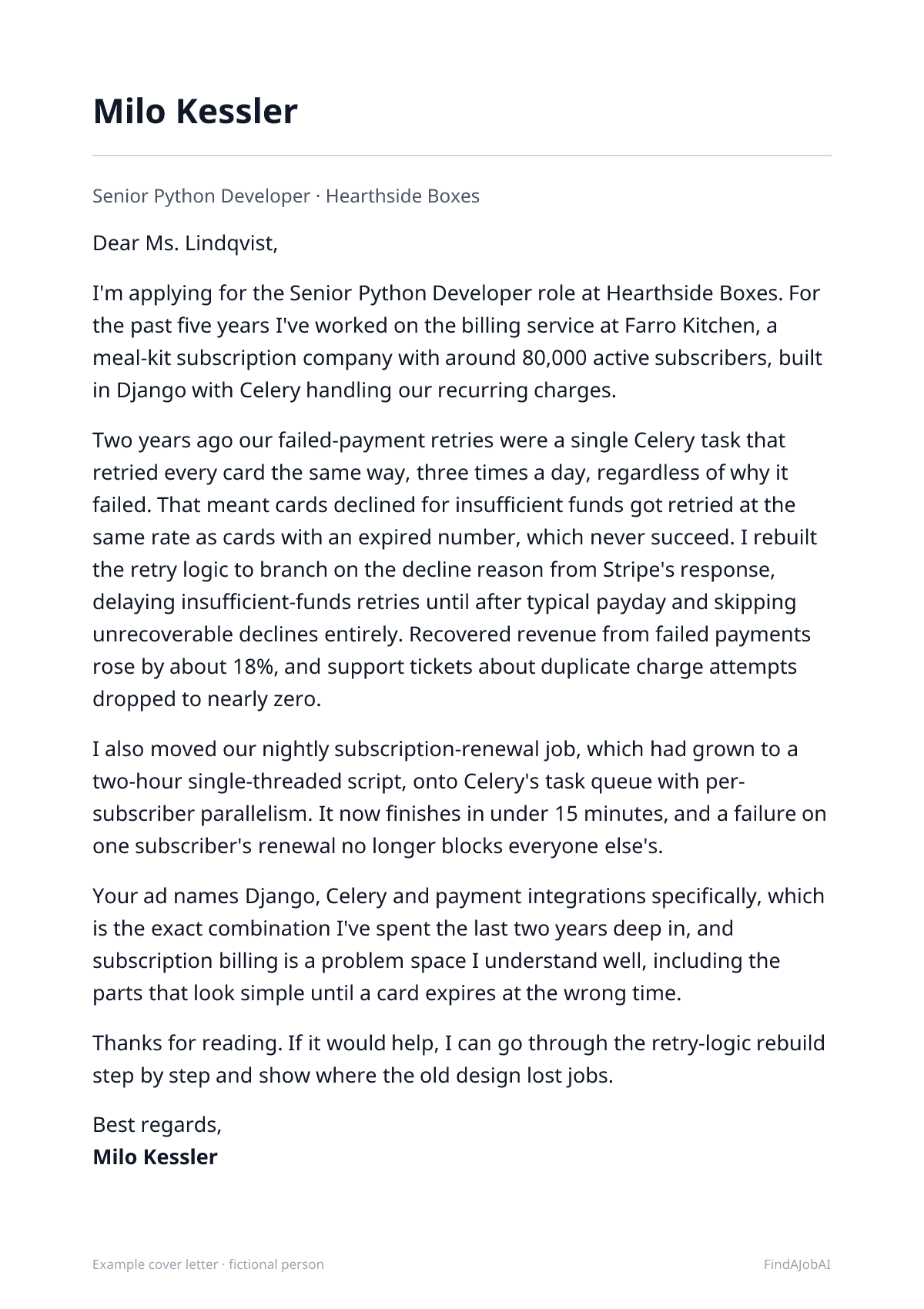
I'm applying for the Senior Python Developer role at Hearthside Boxes. For the past five years I've worked on the billing service at Farro Kitchen, a meal-kit subscription company with around 80,000 active subscribers, built in Django with Celery handling our recurring charges.
Two years ago our failed-payment retries were a single Celery task that retried every card the same way, three times a day, regardless of why it failed. That meant cards declined for insufficient funds got retried at the same rate as cards with an expired number, which never succeed. I rebuilt the retry logic to branch on the decline reason from Stripe's response, delaying insufficient-funds retries until after typical payday and skipping unrecoverable declines entirely. Recovered revenue from failed payments rose by about 18%, and support tickets about duplicate charge attempts dropped to nearly zero.
I also moved our nightly subscription-renewal job, which had grown to a two-hour single-threaded script, onto Celery's task queue with per-subscriber parallelism. It now finishes in under 15 minutes, and a failure on one subscriber's renewal no longer blocks everyone else's.
Your ad names Django, Celery and payment integrations specifically, which is the exact combination I've spent the last two years deep in, and subscription billing is a problem space I understand well, including the parts that look simple until a card expires at the wrong time.
Thanks for reading. If it would help, I can go through the retry-logic rebuild step by step and show where the old design lost jobs.
Best regards,
Milo Kessler
Example 2 · Career changer
Data-entry clerk moving into Python development
Yuki automated her own data-entry job with a Python script before holding a developer title. The ad is for a junior role on a small reporting team.
Example letter · fictional
Dear Hiring Manager,
I'm writing about the Junior Python Developer opening at Marrow Analytics. For two years I was a data-entry clerk at a regional distributor, retyping order details from supplier PDFs into our inventory system, and automating most of that job myself is what pulled me toward programming.
I was spending close to three hours a day transcribing supplier invoices by hand. I taught myself enough Python to use pdfplumber to pull line items out of our suppliers' PDF invoices and load them straight into our inventory database, handling the handful of formatting quirks each supplier used. My daily transcription time dropped to about 20 minutes of spot-checking, and the script is still running, now used by two other clerks on my old team.
Since then I've finished a Python course covering Flask and SQL, built a small Flask app with a Postgres backend to track my own freelance invoices, and started a book on algorithms to cover what a short course skips. My daily tools are Python, SQL and Git, and I'm picking up pytest and Docker.
Your posting mentions a small reporting team, and the PDF-parsing problem I solved is close to what reporting work often looks like underneath, pulling messy real-world data into something structured and trustworthy. I'd expect to learn your reporting stack quickly, because I already know which numbers the business checks first.
My GitHub link is on my resume. If it helps, I can show you the invoice script and explain how it handles the odd formats each supplier sends.
Kind regards,
Yuki Hoffman
Example 3 · Senior or lead
Principal engineer applying to rebuild a reporting platform
Aisha leads five Python developers at a logistics company. The ad is for a principal engineer to lead the move off a slow, script-based reporting system.
Example letter · fictional
Dear Mr. Vasquez,
I'm applying for the Principal Python Developer role at Northgate Freight. For the last four years I've led five developers at Caldera Shipping, where we turned the company's reporting platform from a pile of cron-scheduled scripts into a proper service, after eight years as a senior Python developer.
Your ad says reports that used to take a few minutes now sometimes take hours, and nobody is sure why. We had the same complaint at Caldera: around 60 scheduled scripts, each written by a different person over several years, all reading from the same production database with no coordination. I started by adding query logging across all of them for two weeks, found that a handful of scripts were running full table scans on our largest table during business hours, and moved those to read from a nightly replica instead. Report run times fell from a worst case of four hours to under eight minutes, and our production database stopped slowing down every morning at 9 AM.
The harder problem was ownership. Nobody wanted to touch scripts they hadn't written, so reports quietly broke and stayed broken for weeks. I introduced a shared library for common operations like date-range filtering and currency conversion, with tests, and migrated the 15 most-used reports onto it over two quarters. New reports now take a day instead of a week to build, and three other developers have added reports to the library without me reviewing every line.
I haven't led a rebuild this size with real-time data requirements attached, since our reports were always run on a delay, and at Northgate I'd expect that constraint to change how much of the replica-based approach would still apply.
I'd like to hear which of your reports people double-check by hand today, and what it would take for them to stop.
Sincerely,
Aisha Okonkwo
All three letters, and the short version below, are fictional: the people, employers and numbers are invented. Borrow the structure, never the facts.
- Prefer to write it yourself? Use the free cover letter template.
- Check your CV against the job first: the free CV score shows the missing keywords.
Why the first letter works, paragraph by paragraph
Paragraph 1: Opening
Names the specific service (billing) and its scale (80,000 subscribers), which tells the reader the writer has run Python code against real financial data, not a side project.
Paragraph 2: The fix that changed revenue
A clear before-and-after: a blunt retry task, a smarter one branching on decline reason, and a measured result (18% more recovered revenue). This is the paragraph proving the writer understands the business behind the code.
Paragraph 3: Scaling a slow job
Turning a two-hour single-threaded script into a 15-minute parallel one, using the exact tool the ad names (Celery), shows a second distinct skill: performance, not just correctness.
Paragraph 4: Why this company
Mirrors the ad's own stack (Django, Celery, payments) and names a specific, humble detail about the domain (cards expiring at odd times) that shows real familiarity.
Paragraph 5: Close
A concrete offer to go through the retry logic closes the letter, which beats a generic thank-you.
What the career changer's letter does differently
The career changer's letter opens with a specific, measurable automation (three hours of transcription down to twenty minutes) built to solve the writer's own job before any title changed. A course, a personal Flask project and a direct line from PDF-parsing to reporting work show both new formal skills and an instinct for the role.
What the senior letter does differently
A principal engineer letter reports organizational habits, not just code: an investigation method (two weeks of query logging across 60 scripts), a structural fix (a shared, tested library) that outlives any one rebuild, and a measured operational result (four hours to eight minutes). The gap, no real-time reporting experience, is named plainly.
Short Python developer cover letter: an email-ready version
Many applications arrive as an email or a small text box, and a full page doesn't fit. This version runs 120 to 150 words and keeps only what a reader needs to decide whether to reply. A Python developer answers a nonprofit's short 'why you' application field, sent as an email because the job post listed a direct contact instead of a portal.
Short version · email · fictional138 words
Subject: Python Developer (Django, pandas) – grant reporting – Anil Vance
Hello Ms. Farouk,
I'm applying for the Python Developer role at Lumenfield Trust. I have three years of Django experience on a donor-management platform at a mid-size nonprofit, where I'm the developer who built our grant-reporting tools.
My most useful project was automating our annual grant report, which used to take a staff member about two weeks of manual spreadsheet work each year. I wrote a Django management command using pandas to pull and aggregate the data directly from our donor database, and the report now takes about 20 minutes to generate and review.
Grant reports are tedious but they decide what a nonprofit can fund next, and I'd like to bring the same habit of automating repeat work to your team. I've attached my resume and can demo the reporting tool on a call.
Best,
Anil Vance
A short email keeps one automation and its concrete time saved (two weeks to twenty minutes), in a task the nonprofit cares about, and names why that specific task matters rather than praising automation in general.
Opening lines that work for Python developer cover letters
The first sentence decides whether the second gets read. Here are six openings, one for each situation you might be in. Pick the one that matches yours and swap in your own facts: every name and number below is invented.
1. You have a standout result
One reporting script I rebuilt last year cut a two-week manual process down to about 20 minutes. I'd like to bring that same instinct for automation to your reporting team.
2. The ad names a problem you've solved
Your ad says report run times sometimes stretch to hours with no clear cause. At my last company I traced a similar problem to unindexed queries hitting production during business hours, and fixed it by moving those reports to a nightly replica.
3. Someone referred you
Your data lead, Priya Chandrasekaran, and I spent two years on a Celery-based billing system before she joined your team. She told me you want someone who can untangle old cron scripts, and that is why I'm writing.
4. You admire what they build
I've donated to your organization for three years and noticed your annual report always arrives late, which made me curious whether the reporting pipeline behind it could use some automation.
5. You're new to the field or switching into it
I spent two years doing manual data entry, then taught myself Python to automate the most repetitive part of that job. I want to keep solving problems like that in backend development.
6. You have senior scope or a specialism
I spent eight years as the senior Python developer on a reporting platform and led its move from loose scripts to a maintained service. I now want to lead a rebuild like that from the very start.
How to write a Python developer cover letter
Five steps, in the order you'd write them. The shape stays the same for every job (a short opening, proof, a reason for this employer, a close), and what goes into each part is what changes with the role.
Identify which kind of Python work the ad actually describes
Python roles range from Django web backends to data pipelines to automation scripts, and they reward different stories. Read the ad for its stack and its data (web requests, scheduled jobs, large datasets), then pick a project of yours in a similar shape.
Open with the problem your code replaced, not the library list
Describe what was slow, manual or broken before your fix, such as hours of hand work, a script that kept timing out or a database that crawled. Mention the library once you explain the fix, not in the opening sentence.
Quantify the time or money a script actually saved
Tie one project to a measurable before-and-after: hours of manual work eliminated, run time cut, revenue recovered. Avoid counting scripts written or lines of code. If you can't measure the outcome precisely, describe what stopped being a manual chore.
Name libraries inside the story of what you built
Work Django, Flask, Celery, pandas or pytest into the explanation of a specific script or service, with enough detail on data size or request volume that the reader can judge the scale. A library named mid-story is more convincing than one named in a list.
Show how you handle messy, real-world data
One sentence on a specific mess you cleaned up: inconsistent PDFs, missing fields, duplicate records. Close by naming a type of data problem in their domain you'd want to dig into first, so the reader sees what you'd actually work on early on.
Python Developer cover letter do's and don'ts
Do
- Name a script or service you built, the problem it replaced, and the metric that moved once it ran.
- Mention the specific framework or library the ad names (Django, Flask, Celery, pandas) inside a real example.
- Show scale: records processed, users served, or time saved, so the reader knows the size of what you've touched.
Don't
- Don't list every Python library you've ever imported; name the ones central to the story you're telling.
- Don't describe scripts written as a count; describe the one that solved a real problem and why it mattered.
- Don't claim a project is production code if it's a personal script; say plainly what it is and who, if anyone, else uses it.
Common Python developer cover letter mistakes
Each one is easy to make and quick to fix before you send the letter.
Listing every Python library like a resume restated in prose
A row of names like Django, Flask, pandas, Celery and pytest shows no depth at all. Keep the single framework behind your strongest example and leave the others on your resume.
Describing scripts written instead of problems solved
'Wrote 30 automation scripts' says nothing about difficulty or value. Pick the one that replaced real manual work or fixed a real failure, and say what changed because of it.
Giving a time-saved number with no baseline
'Saved the team hours every week' is vague and unverifiable. State what the task used to take, what it takes now, and what specifically caused the change.
Treating all Python work as interchangeable
A letter that could apply equally to a Django shop, a data team or an automation role signals you haven't read the ad closely. Match your example to the kind of system the job actually involves.
Calling a personal script 'production code'
Overstating a side project is easy to catch in a technical interview. Say plainly what the project is, who if anyone else uses it, and what you'd still need to do to make it production-ready.
Email subject lines for Python developer applications
Applying by email? Put the job title, any reference number and your name in the subject line.
- Senior Python Developer application – Django and Celery billing systems – Milo Kessler
- Junior Python Developer – data-entry background, Flask portfolio project – Yuki Hoffman
- Application: Python Developer, Data Platform Team (Req. 3015) – Milo Kessler
Everything for Python Developers
- Python Developer resume exampleA full resume, plus bullet and summary examples
- Python Developer interview questions30 questions with sample answers
- Python Developer job descriptionDuties, skills and requirements
- Career change cover letter: template + examples
Other cover letter examples
Python Developer cover letter FAQ
What should I write in a Python developer cover letter?
Show one script or service you built: the problem it replaced, the tools behind it and the outcome, with numbers where you have them. Add one sentence on how you deal with messy input data. Keep the long library list on your resume instead.
How do I write a Python developer cover letter with no experience?
Use a script you wrote to fix a real problem in another job, then add a course and one small project with a clear write-up of what it does and why you built it that way. Name the libraries you used and the result.
Should I mention specific Python frameworks like Django or Flask?
Yes, but inside an example of what you built with them, not as a standalone list. Naming Django while describing a real billing or content system is more convincing than listing Django, Flask and FastAPI separately with no project attached.
How we built this page
The FindAJobAI team wrote the three example letters, the short email version, the opening lines and the advice for Python developer roles. The people, employers and numbers in the letters are invented; the structure, the kind of evidence and the order of the paragraphs are the parts to copy.
Once we track enough live Python developer job ads, this page also shows the skills they ask for most, counted the same way as our in-demand skills report.
Last reviewed on November 1, 2026.