Python Developer Resume Example (2026)
By FindAJobAI team Updated How we built this page
Python developer postings span web backends, data pipelines and automation, so ads vary more than most roles. What ties strong candidates together is evidence that their code ran in production at some real volume, not just that they know the language. A Python developer resume should name the framework or pipeline, the scale involved, and what changed when it shipped.
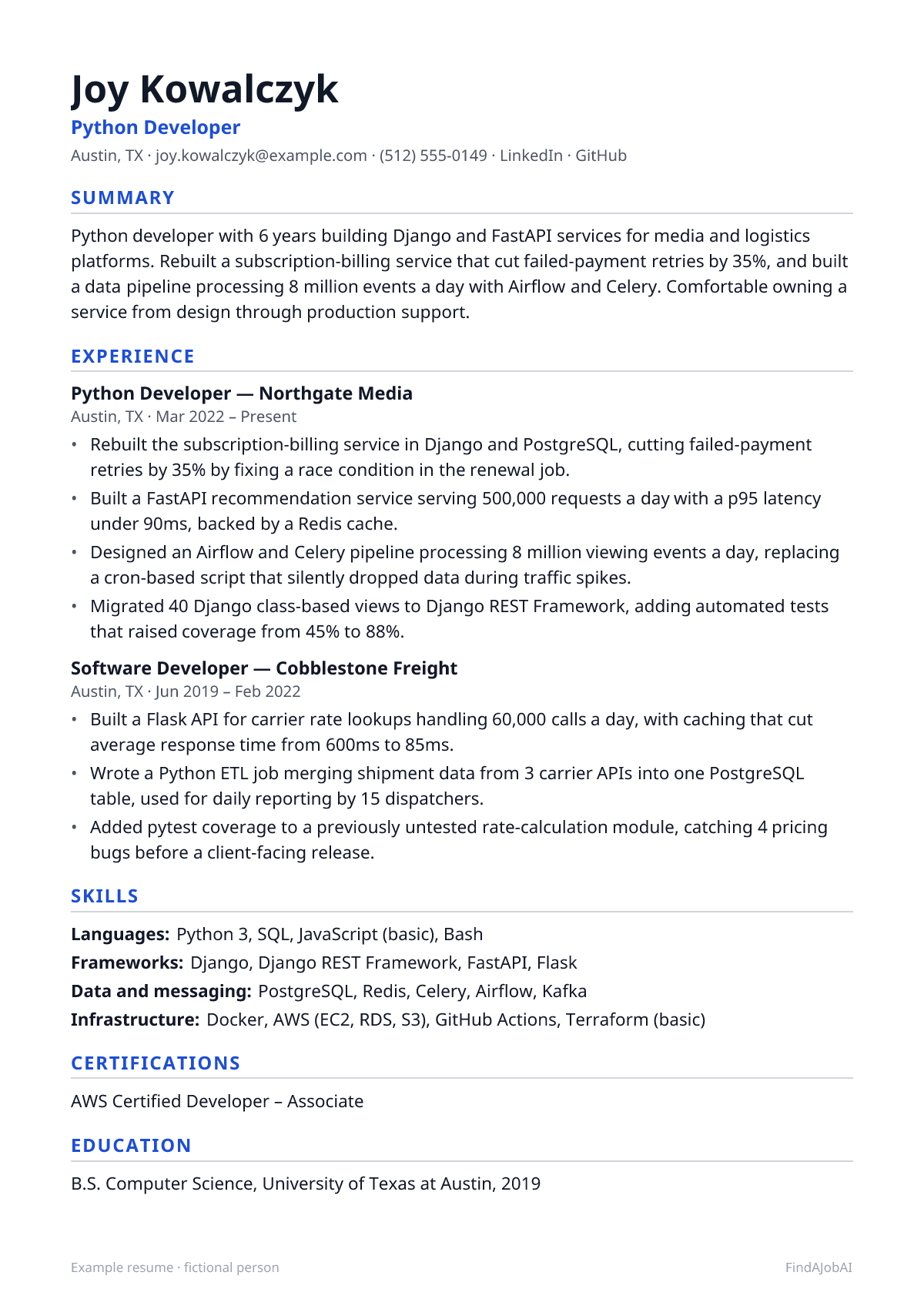
The example below is a Python developer with six years split between a subscription media company and a logistics startup. Notice how each bullet names the framework or tool, the data or traffic involved, and a measured result, instead of listing libraries with no context.
Python Developer resume template
This example as a one-page template: one column, standard headings and plain text, the format applicant tracking systems read most reliably.
After you sign up, Create my CV builds your own resume in this same one-column layout, from your real experience.
Mid-level Python developer resume example
A complete one-page example for a fictional Python developer: every bullet pairs an action with what changed because of it.
Example resume · fictional person
Summary
Python developer with 6 years building Django and FastAPI services for media and logistics platforms. Rebuilt a subscription-billing service that cut failed-payment retries by 35%, and built a data pipeline processing 8 million events a day with Airflow and Celery. Comfortable owning a service from design through production support.
Experience
Python Developer, Northgate Media
Austin, TX · Mar 2022 – Present
- Rebuilt the subscription-billing service in Django and PostgreSQL, cutting failed-payment retries by 35% by fixing a race condition in the renewal job.
- Built a FastAPI recommendation service serving 500,000 requests a day with a p95 latency under 90ms, backed by a Redis cache.
- Designed an Airflow and Celery pipeline processing 8 million viewing events a day, replacing a cron-based script that silently dropped data during traffic spikes.
- Migrated 40 Django class-based views to Django REST Framework, adding automated tests that raised coverage from 45% to 88%.
Software Developer, Cobblestone Freight
Austin, TX · Jun 2019 – Feb 2022
- Built a Flask API for carrier rate lookups handling 60,000 calls a day, with caching that cut average response time from 600ms to 85ms.
- Wrote a Python ETL job merging shipment data from 3 carrier APIs into one PostgreSQL table, used for daily reporting by 15 dispatchers.
- Added pytest coverage to a previously untested rate-calculation module, catching 4 pricing bugs before a client-facing release.
Skills
- Languages: Python 3, SQL, JavaScript (basic), Bash
- Frameworks: Django, Django REST Framework, FastAPI, Flask
- Data and messaging: PostgreSQL, Redis, Celery, Airflow, Kafka
- Infrastructure: Docker, AWS (EC2, RDS, S3), GitHub Actions, Terraform (basic)
Certifications
- AWS Certified Developer – Associate
Education
- B.S. Computer Science, University of Texas at Austin, 2019
Fictional example by the FindAJobAI team: the person, employers and numbers are invented. Keep the structure; use your own work and numbers you can explain in an interview.
Entry-level Python developer resume example
A new graduate with one summer internship and a teaching assistant job, so a transit-data side project carries real weight. Education comes right after the summary, and the project line ends on what the chart reveals instead of naming every package used.
Entry-level example resume · fictional person
Summary
Python developer starting out, with a B.S. in Computer Science and a summer at a regional nonprofit writing Flask endpoints. Works in Python and SQL every day, and built a side project that scrapes bus arrival data and charts delays with pandas and Plotly. Seeking a first full-time backend or data position.
Education
- B.S. Computer Science, Portland State University, 2026
Experience
Software Development Intern, Willamette Community Fund
Portland, OR · Jun 2026 – Aug 2026
- Built a Flask API endpoint letting 8 staff look up donor history instead of searching a shared spreadsheet, cutting lookup time from several minutes to seconds.
- Wrote pytest tests for an existing donation-processing script with no test coverage, bringing it to 65% and catching a rounding bug in refund amounts.
- Cleaned and merged 2 donor spreadsheets totaling 14,000 records into one PostgreSQL table, removing 900 duplicates.
Teaching Assistant, Intro to Programming, Portland State University
Portland, OR · Jan 2025 – May 2026
- Graded and gave feedback on Python assignments for 70 students covering loops, functions and basic data structures.
- Held weekly office hours helping students debug recursive functions and understand list comprehensions.
Skills
- Languages: Python 3, SQL, JavaScript (basic), Bash
- Frameworks: Flask, FastAPI, pytest, SQLAlchemy
- Data and tools: PostgreSQL, SQLite, pandas, Git, Postman
Certifications
- PCEP – Certified Entry-Level Python Programmer
Projects
- Transit delay tracker (Python, pandas, Plotly): scraped 6 months of public transit arrival data and built an interactive chart showing which 3 bus routes had the worst rush-hour delays.
- Recipe API (Python, FastAPI, SQLite): a REST API with search and filtering over 2,000 recipes, with automatic Swagger docs and basic rate limiting.
Senior Python developer resume example
A staff-level engineer with a decade behind them, who now decides how backend and data systems fit together. Bullets shift from shipping endpoints to platforms that other teams depend on, and the summary states payment volume and the people coached.
Senior example resume · fictional person
Ingrid Solheim
Senior Python Developer
Minneapolis, MN · [email protected] · (612) 555-0193 · LinkedIn · GitHub
Summary
Senior Python engineer, 10 years across fintech and healthcare backends and data platforms. Sets the architecture for a payments system that handles $250M a year, drove the switch from nightly batch jobs to event streams, and coaches 3 developers toward senior roles.
Experience
Senior Python Developer, Castleborne Financial
Minneapolis, MN · Jan 2020 – Present
- Lead architecture for a Django and FastAPI payments platform processing $250M a year across 10 services, setting standards for retries, idempotency and audit logging.
- Designed the migration from nightly batch settlement jobs to a Kafka-based event pipeline, cutting settlement latency from hours to under 2 minutes.
- Introduced async FastAPI services for 4 high-traffic endpoints, cutting p95 latency from 400ms to 70ms under peak load.
- Guide 3 mid-level developers through design reviews and pairing sessions, with 2 reaching senior roles within 18 months.
Python Developer, Birchfield Health Analytics
Minneapolis, MN · Aug 2016 – Dec 2019
- Built a Django service for patient-eligibility checks handling 20,000 lookups a day across 25 clinics.
- Replaced a nightly batch eligibility sync with a Celery and Redis task queue, cutting stale-data errors by 90%.
- Led a HIPAA-focused review that added field-level encryption to 3 services holding patient data.
Python Developer, Hollowbrook Analytics
Minneapolis, MN · Jul 2014 – Jul 2016
- Built Flask APIs for an internal reporting tool used by 50 analysts across 3 regional offices.
- Optimized a batch ETL job in Python, cutting nightly runtime from 5 hours to 1 hour with multiprocessing and bulk database inserts.
Skills
- Languages: Python 3, SQL, Go (basic), Bash
- Frameworks: Django, FastAPI, Flask, SQLAlchemy
- Data and messaging: Kafka, Celery, Airflow, Redis, PostgreSQL
- Leadership: Architecture reviews, mentoring, incident response, hiring
Education
- B.S. Computer Science, University of Minnesota, 2014
How to write a Python developer resume
Five steps, in the order a recruiter reads the page. The format around them stays plain for every job: one column, standard headings, newest role first.
Header: name, target title and links
Lead with “Python Developer” (or “Backend Engineer, Python” if that was your title) so keyword filters and recruiters both find you. Add a GitHub link only when it holds code you wrote that someone can run in a few minutes.
Summary: what you do and your best proof
Open with the framework you know best (Django, FastAPI or Flask) and say if you lean toward web services or data work. Follow with one outcome, such as an API you launched or a pipeline that retired a spreadsheet job. Cut slogans like “passionate about clean code”.
Experience: newest first, a result in every bullet
Start every bullet with the problem you faced, name the Python tool you used, then give the outcome: what was slow, flaky or manual before and what changed. “Built APIs with Python” tells a reader almost nothing; a response time or a daily event count tells them plenty.
Skills: grouped, in the ad's words
Split the list into languages, web and data frameworks, storage and deployment tools. Name the databases and job queues you have run in production, and leave out any library you only read about, unless the posting asks for it by name.
Education and certifications
Put the degree and graduation year first, then any credential you earned, like PCEP or an AWS developer certificate. If you have no paid experience yet, a short Projects block works: two builds, each with the libraries used and the problem it solves.
Skills to put on a Python developer resume
Hard skills are the tools and methods of the job; soft skills are how you work with people. Each comes with one way to prove it, because a skill named only in a list counts for little. Add the ones you really have.
Hard skills
- Python
- Give your working version (Python 3.11 or 3.9) and one language feature, like async/await or dataclasses, that you used on a real task.
- Django
- Say which product the Django app serves, how much traffic it takes, and the model or query work you owned.
- FastAPI
- Point to an endpoint you built and its latency or throughput, especially if async made a measurable difference.
- Flask
- Describe a lightweight service you built with it and what made Flask the right fit over a heavier framework.
- SQL and ORMs
- Pick one engine and one fix, such as an N+1 query or a locked migration, instead of claiming you "know SQL".
- Celery
- Give the kind of background job you moved to Celery and the user-facing timeout or delay it fixed.
- Airflow
- Name the pipeline, its schedule and data volume, and what manual or cron-based process it replaced.
- pytest
- Report your coverage figure and one regression that a test stopped from reaching users.
- Docker
- Note what you packaged into containers and one result, like a consistent local setup or quicker CI builds.
- AWS or another cloud provider
- List the services you used (EC2, RDS, S3, Lambda) and your part in them, like provisioning, deploys or spend.
- pandas
- Point to a cleaning, merging or analysis task you did with it, with a row count or time saved.
- Kafka or RabbitMQ
- State how many messages the queue carries and which polling job or batch sync it displaced.
Soft skills
- Debugging under pressure
- Walk through an outage you traced, which tool found the cause (logs, profiler, tracing), and how long the fix took.
- Code review
- Mention the number of pull requests you review weekly and a standard you enforce, such as type hints or test coverage.
- Cross-team communication
- Cite a decision you worked out with another team, like an API contract or a shared schema.
- Mentoring
- Note how many developers you guided and name a result, like a promotion or a new skill gained.
- Ownership
- Explain a service you managed start to finish, including on-call duty, and an incident you caught or fixed.
- Pragmatism
- Give an example of choosing a simpler tool (Flask over Django, a script over a pipeline) and why it was the right call.
- Documentation
- Mention a README, design doc or API doc you wrote and who used it later.
Python Developer resume bullet examples: weak vs strong
The same work, written two ways. The strong version names the tool, the scope and a result; the numbers are examples, yours must be real.
Weak: Developed features in Python.
Strong: Built a Django endpoint for bulk subscription updates that replaced a 3-step manual process, now used by 12 support staff daily.
States the framework, the audience and the process it replaced.
Weak: Worked with Django and REST APIs.
Strong: Migrated 40 Django views to Django REST Framework with versioned serializers, letting the mobile team ship 3 features without backend changes.
Shows scope and a concrete benefit to another team.
Weak: Improved performance of API endpoints.
Strong: Added Redis caching to a product-search endpoint, cutting average response time from 450ms to 60ms under peak traffic.
Names the fix and gives before-and-after numbers.
Weak: Wrote automated tests.
Strong: Raised pytest coverage on the billing module from 40% to 90%, catching 3 edge cases that had caused duplicate charges in production.
Replaces a vague testing claim with a coverage number and a real bug.
Weak: Built a data pipeline.
Strong: Built an Airflow pipeline that processes 5 million log events a day, replacing a cron script that silently failed roughly once a week.
Gives volume and names the reliability problem solved.
Weak: Used Celery for background tasks.
Strong: Moved report generation to Celery with a Redis broker, cutting a request that used to time out at 30 seconds down to an instant response with email delivery.
Shows the specific user-facing problem the change fixed.
15 more Python developer resume bullet examples
Grouped by area of the job, so you can find the ones closest to your work. Keep the shape (action, scope, result) and replace the invented numbers with your own.
Web APIs and services
- Built a FastAPI service with async database calls serving 300,000 requests a day at a p95 latency of 65ms.
- Added pagination and field filtering to a Django REST Framework endpoint, cutting average payload size by 55% for the mobile app.
- Introduced idempotency keys on the payments endpoint, ending duplicate charges that hit 80 customers every month.
- Shipped v2 of a public API alongside v1 for 60 days, moving 25 internal and 8 external consumers over with zero downtime.
Data pipelines and automation
- Built an Airflow DAG that ingests data from 5 partner APIs nightly, replacing a manual spreadsheet process that took 3 hours a day.
- Wrote a pandas script that reconciles 2 financial ledgers of 100,000 rows each, cutting a manual reconciliation task from 2 days to 20 minutes.
- Built a Celery pipeline generating PDF reports for 10,000 customers monthly, cutting generation time from 6 hours to 40 minutes with parallel workers.
- Set up a Kafka Streams-equivalent job in Python using Faust, joining order and shipment events in near real time instead of a 20-minute-delayed batch job.
Performance and reliability
- Added Redis caching to a product-search endpoint, cutting database load by 65% during peak traffic.
- Profiled a slow Django view with cProfile and fixed an N+1 query, cutting response time from 1.2s to 150ms.
- Set up retry logic with exponential backoff on 6 external API calls, cutting failed webhook deliveries from 50 a day to under 5.
- Rewrote a sequential data-validation script using multiprocessing, cutting runtime on a 2 million-row file from 3 hours to 25 minutes.
Testing and CI/CD
- Wired pytest and mypy into GitHub Actions for every pull request, halving the bugs that reached staging.
- Introduced factory_boy and pytest fixtures to replace hand-written test data, cutting new test-writing time by about a third.
- Built a canary deployment process on AWS, cutting deployment-related incidents from 3 a month to 1.
Python Developer resume summary examples
Two or three lines on what you do and your strongest proof. Start from the one closest to your level and use your own facts.
Computer science graduate who spent a summer at a regional nonprofit writing Flask endpoints. Knows Python, SQL and REST well enough to ship, and charted public transit delays in a side project built on pandas.
Python developer with 6 years building Django and FastAPI services for media and logistics platforms. Rebuilt a billing service that cut failed-payment retries by 35%, and built a data pipeline processing 8 million events a day.
Senior Python developer, 10 years designing backend and data systems for a fintech platform that moves $250M a year. Guides architecture for 6 engineers, led the shift to event-driven pipelines, and is coaching 3 mid-level developers toward senior.
Common Python developer resume mistakes
Each one is easy to make and quick to fix before you apply.
Listing libraries with no system attached
A skills line shows what you can use; only a bullet shows what you built. Pair each tool, such as Django, Celery or pandas, with the system it ran and the outcome.
Vague data pipeline claims
"Built a data pipeline" tells a recruiter nothing. Name the tool, the data volume and what manual or broken process it replaced.
Performance work lacks figures
"Improved performance" raises questions. Share the before-and-after latency, throughput or error rate, even a rough figure.
Mixing web and data work without context
Python covers both backend APIs and data engineering. State which kind of work each role involved so the resume reads coherently instead of like a list of unrelated tools.
Hiding QA work
Testing is easy to leave out. Write it down with a tool (pytest, unittest) and a coverage figure so a reviewer sees you ship code that others can change safely.
ATS tips for a Python developer resume
Applicant tracking systems turn your file into text that recruiters search, mostly for the skills and titles in the ad. They rarely reject a resume on their own; one that parses badly or misses the ad's words just doesn't come up.
- Name the framework you used (Django, FastAPI, Flask); Python ads vary widely and recruiters scan for the specific one they need.
- Tie database work to an engine (PostgreSQL, MySQL) and a concrete fix, like a slow query or a risky migration, rather than a bare "SQL" entry.
- If you built a data pipeline, state the data volume, the tool (Airflow, Celery, Kafka) and the manual process or failure it replaced.
- Put pytest or unittest next to a coverage figure or a regression the suite caught before release; it shows quality is part of how you work.
- Claim Docker or AWS only when you set up deploys, images or cloud resources yourself; running code on someone else's platform is not the same.
For the format itself, run the free ATS resume checklist.
Everything for Python Developers
- Python Developer cover letter examplesThree example letters and a short email version
- Python Developer interview questions30 questions with sample answers
- Python Developer job descriptionDuties, skills and requirements
- How to tailor your resume without lying
Other resume examples
Python Developer resume FAQ
What should a Python developer resume include besides Python?
A framework such as Django, FastAPI or Flask, a database (PostgreSQL or MySQL), and some exposure to testing, task queues or data tools depending on the role. Web-focused and data-focused Python jobs look for different combinations, so match the ad.
How do I show data pipeline experience on a resume?
Name the tool (Airflow, Celery, Kafka), the volume of data or events it handles, and what it replaced, such as a manual script or a process that silently failed. A bullet that just says "built a pipeline" tells a recruiter nothing about scale or reliability.
Should I list Django and FastAPI separately if I've used both?
Yes, since they signal different things: Django suggests full-stack web experience with an ORM and admin tooling, while FastAPI suggests lighter, often async services. List both if true, but only ones you've used enough to discuss in an interview.
How we built this page
The FindAJobAI team wrote the three example resumes, the bullets, the skills and the advice for Python developer roles. The people, employers and numbers in the examples are invented; the structure, the tools and the way each bullet is built are the parts to copy.
Once we track enough live Python developer job ads, this page also shows the skills they ask for most, counted the same way as our in-demand skills report.
Last reviewed on November 1, 2026.