Respiratory Therapist Cover Letter Example (2026)
By FindAJobAI team Updated How we built this page
Respiratory therapist ads list credentials almost everyone applying already has, so the cover letter should show judgment under pressure: a vent setting changed, a patient weaned, a code where you were the one managing the airway.
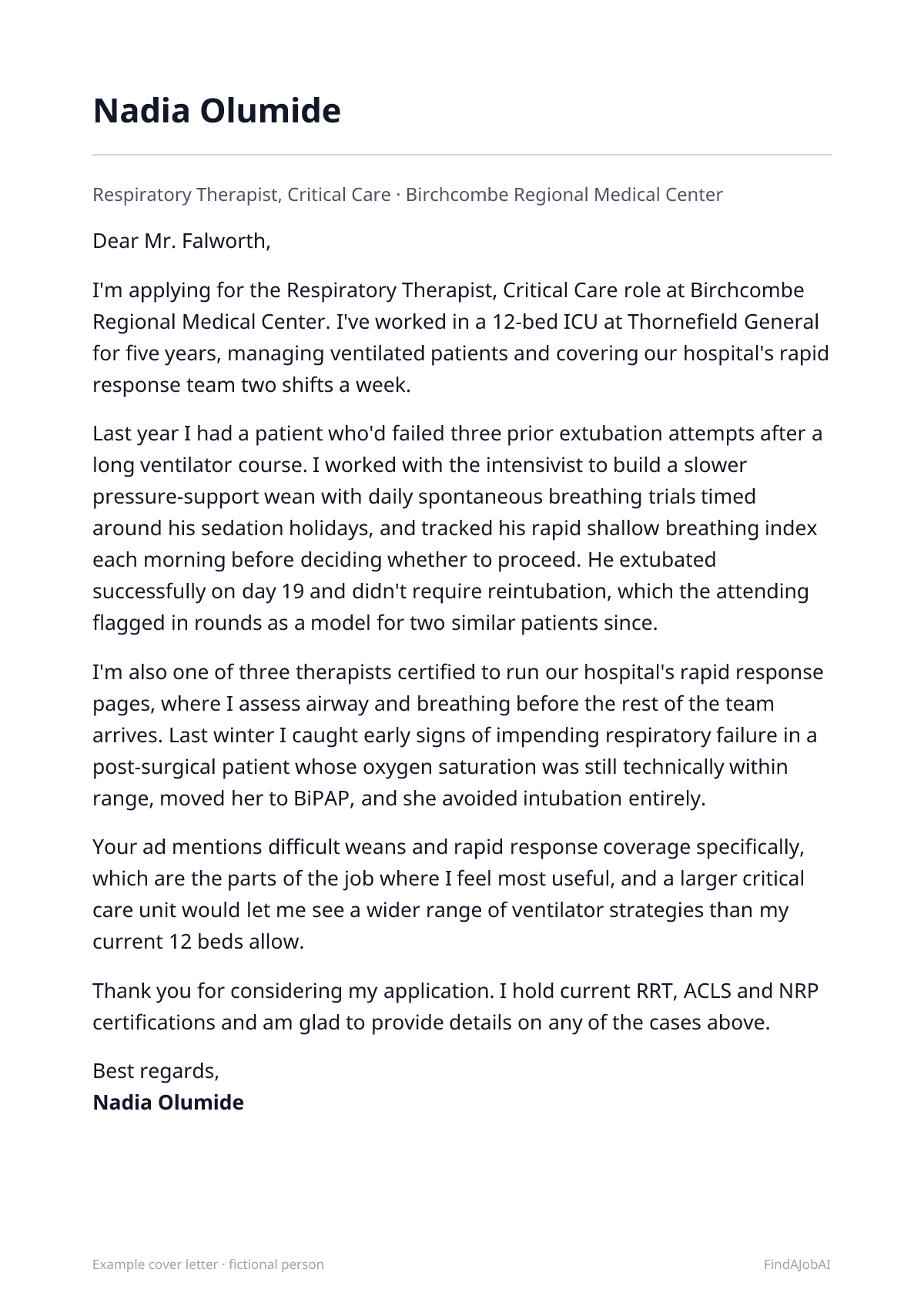
Respiratory Therapist cover letter template
This letter as a one-page template: an opening that names the job and your strongest fact, proof that answers the ad, a reason for this employer and a short close.
After you sign up, FindAJobAI drafts your own letter for a real job from your CV in this format, and you edit it before you send it.
Example 1 · Experienced
ICU respiratory therapist applying to a larger hospital's critical care unit
Nadia manages ventilator patients in a 12-bed ICU. The ad asks for experience with difficult weans and rapid response coverage.
Example letter · fictional
Dear Mr. Falworth,
I'm applying for the Respiratory Therapist, Critical Care role at Birchcombe Regional Medical Center. I've worked in a 12-bed ICU at Thornefield General for five years, managing ventilated patients and covering our hospital's rapid response team two shifts a week.
Last year I had a patient who'd failed three prior extubation attempts after a long ventilator course. I worked with the intensivist to build a slower pressure-support wean with daily spontaneous breathing trials timed around his sedation holidays, and tracked his rapid shallow breathing index each morning before deciding whether to proceed. He extubated successfully on day 19 and didn't require reintubation, which the attending flagged in rounds as a model for two similar patients since.
I'm also one of three therapists certified to run our hospital's rapid response pages, where I assess airway and breathing before the rest of the team arrives. Last winter I caught early signs of impending respiratory failure in a post-surgical patient whose oxygen saturation was still technically within range, moved her to BiPAP, and she avoided intubation entirely.
Your ad mentions difficult weans and rapid response coverage specifically, which are the parts of the job where I feel most useful, and a larger critical care unit would let me see a wider range of ventilator strategies than my current 12 beds allow.
Thank you for considering my application. I hold current RRT, ACLS and NRP certifications and am glad to provide details on any of the cases above.
Best regards,
Nadia Olumide
Example 2 · Entry level
New graduate respiratory therapist applying to a community hospital
Cyrus finished his respiratory therapy program, including a strong NICU rotation. The ad is an entry-level opening on a med-surg and ICU float pool.
Example letter · fictional
Dear Ms. Abeku,
I'm applying for the Respiratory Therapist role at Pinehollow Community Hospital. I completed my respiratory therapy degree at Rourke State College this spring, passed my RRT exam in June, and finished clinical rotations in the NICU, ICU and emergency department at Thornefield General.
My NICU rotation was the most demanding part of my training. I helped manage a 28-week preemie on high-frequency oscillatory ventilation, charting blood gas trends every few hours and adjusting settings alongside my preceptor as the infant's lungs matured. By the time I rotated off, she was down to low-flow nasal cannula, and my preceptor had me present the case to the unit's weekly teaching rounds.
In my ICU rotation I ran daily ventilator checks on four to six patients under supervision, performed arterial blood gas draws, and sat in on two family conferences about goals of care for ventilated patients, which taught me how much this job involves talking with families, not just machines.
Your posting mentions a float pool covering both med-surg and ICU, which matches the range of my rotations, and I'd like to keep building that range early in my career rather than specializing right away. I'm used to being the newest person on a unit: I introduce myself to the charge nurse at the start of each shift, ask which patients worry the team most and write down the equipment settings I'm asked to follow so I can repeat them exactly.
Thank you for your time. I hold RRT, BLS and NRP certifications and am available to start as soon as your orientation schedule allows.
Sincerely,
Cyrus Obrien
Example 3 · Senior or lead
Lead respiratory therapist applying to run a department
Edwin supervises eight therapists across three shifts. The ad is for a lead role overseeing staffing, protocols and a new ventilator rollout.
Example letter · fictional
Dear Dr. Nkemelu,
I'm applying for the Lead Respiratory Therapist role at Caldwater General Hospital. For three years I've supervised a department of eight therapists across three shifts at Thornefield General, after six years as a staff therapist in the ICU and emergency department.
Your ad mentions a ventilator fleet upgrade coming next year. I led a similar rollout at Thornefield, training all eight therapists on new vent software over six weeks, writing a one-page quick-reference card for common alarm scenarios, and running a shadow period where I covered extra shifts myself while staff got comfortable. We had no missed alarms attributed to the new equipment in the first quarter after go-live.
I also rewrote our weaning protocol after noticing therapists were making inconsistent calls on spontaneous breathing trials depending on who was on shift. I built a standardized checklist with the ICU's medical director, and our average ventilator days per patient dropped, which the unit's quality committee now tracks as one of its core metrics.
I've managed staffing and protocols but haven't yet owned a full department budget, and at Caldwater I'd want to learn how capital requests for equipment like the new fleet move through your finance process. I'd begin by listing the current ventilator models in service, who is trained on each and where the gaps are, before drafting a training calendar around your busiest shifts and asking the ICU's medical director which protocol changes need to be in place before go-live.
I'd welcome a conversation about where you're starting the ventilator rollout and what your current weaning protocol looks like.
Sincerely,
Edwin Achterberg
All three letters, and the short version below, are fictional: the people, employers and numbers are invented. Borrow the structure, never the facts.
- Prefer to write it yourself? Use the free cover letter template.
- Check your CV against the job first: the free CV score shows the missing keywords.
Why the first letter works, paragraph by paragraph
Paragraph 1: Opening
States the unit size and the writer's rapid response coverage, giving the reader a quick sense of scope and acuity before any story begins.
Paragraph 2: The difficult wean
A specific clinical detail (three prior failed attempts, a rapid shallow breathing index tracked daily) ending in a result other clinicians noticed, which shows judgment over time rather than a single lucky outcome.
Paragraph 3: Rapid response judgment
A second, different example, catching deterioration before the numbers clearly showed it, demonstrates clinical judgment under time pressure, which the ad specifically asks about.
Paragraph 4: Why this unit
Connects the ad's own emphasis (difficult weans, rapid response) to the writer's strengths and names a honest reason for wanting a larger unit.
Paragraph 5: Close
Lists certifications plainly and offers more detail, which is standard and expected in clinical cover letters.
What the entry-level letter does differently
The new graduate's letter leans on rotation detail instead of job history: a specific NICU case followed through recovery, a concrete ICU task count, and a family conference that shows awareness beyond the technical side of the job. Certifications are stated clearly since there's no work history to lean on.
What the senior letter does differently
A lead therapist letter reports on department-level change: a six-week training rollout with no missed alarms afterward, and a standardized weaning protocol that lowered ventilator days. The budget gap is named honestly rather than glossed over.
Short respiratory therapist cover letter: an email-ready version
Many applications arrive as an email or a small text box, and a full page doesn't fit. This version runs 120 to 150 words and keeps only what a reader needs to decide whether to reply. A respiratory therapist answers a hospital's brief online application question after the main portal timed out twice during upload.
Short version · email · fictional127 words
Subject: Respiratory Therapist application – ICU experience, RRT certified – Saoirse Delacroix
Hello Mr. Osagie,
I'm applying for the Respiratory Therapist role at Wrenfield Medical Center. For three years I've worked in a 10-bed ICU, managing ventilated patients and covering code response two shifts a week.
Last quarter I weaned a patient off the ventilator after two previous failed attempts by slowing the pressure-support reduction and timing spontaneous breathing trials around his sedation schedule. He extubated successfully and stayed off the vent.
I hold current RRT and ACLS certifications and would welcome the chance to bring that same approach to your unit. I also respond to rapid response calls on the med-surg floors and I've trained two new graduates on our ventilator checklist. I can share the weaning approach in more detail. My resume is attached.
Best,
Saoirse Delacroix
The short version keeps a single difficult wean, since it's the clearest proof of clinical judgment in limited space, and drops the rapid response detail and credential list down to the two most relevant certifications.
Opening lines that work for respiratory therapist cover letters
The first sentence decides whether the second gets read. Here are six openings, one for each situation you might be in. Pick the one that matches yours and swap in your own facts: every name and number below is invented.
1. You have a standout result
Last quarter I weaned a patient off the ventilator after two previous failed attempts, timing spontaneous breathing trials around his sedation schedule. I'd like to bring that same patience to your ICU.
2. The ad names a problem you've solved
Your ad asks for rapid response experience. I'm one of three therapists certified to run our hospital's code pages, and I caught impending respiratory failure in a patient whose oxygen levels hadn't yet dropped out of range.
3. Someone referred you
Your ICU's charge nurse, Delphine Osakwe, mentioned you're short-staffed on nights and need someone comfortable running ventilator checks without close supervision, which is most of my current shift.
4. You admire what they build
I toured your hospital's new NICU wing last year during a conference and was struck by how your team set up the high-frequency oscillation bays; I'd like to work in that unit.
5. You're new to the field or switching into it
I finished my respiratory therapy clinical rotations this spring, including a NICU rotation where I helped wean a 28-week preemie off oscillatory ventilation, and I'm looking for my first full-time role.
6. You have senior scope or a specialism
As the therapist who leads ventilator training for new hires on my unit, I've learned where most early mistakes happen. I'm looking for a lead role where I can fix that at a department level.
How to write a respiratory therapist cover letter
Five steps, in the order you'd write them. The shape stays the same for every job (a short opening, proof, a reason for this employer, a close), and what goes into each part is what changes with the role.
Identify the unit and acuity level in the ad
Respiratory therapist ads vary widely: NICU, ICU, med-surg float, emergency department or a specific equipment rollout. Read for the unit type and any named challenge, such as difficult weans or rapid response coverage, and choose a case that matches.
Open with a specific case, not a credential list
Certifications belong on your resume and can be stated plainly later. Open with a patient situation that shows judgment, described in a sentence or two, so the reader sees clinical reasoning before anything else. Keep the case short enough to finish in one paragraph.
Describe the decision, not just the outcome
Say what you tracked, adjusted or noticed, such as a rapid shallow breathing index or an early sign of deterioration, before stating the result. The decision-making is what distinguishes an experienced therapist from someone reciting a protocol.
Keep patient details general but credible
Describe condition, unit and rough context (a 28-week preemie, a post-surgical patient) without names, exact dates or anything identifying. Enough clinical specificity that another therapist would recognize the situation is what makes the case credible.
Close with certifications and availability
State your RRT and any relevant certifications like ACLS or NRP plainly in the closing paragraph. Add your availability or notice period, since staffing timelines matter in clinical hiring more than in many other fields.
Respiratory Therapist cover letter do's and don'ts
Do
- Describe one patient case with enough clinical detail that another therapist would recognize the judgment involved.
- Name your certifications (RRT, ACLS, NRP) plainly; don't bury them at the end of a paragraph.
- Mention specific equipment or modes (BiPAP, high-frequency oscillatory ventilation, specific vent brands) only where they fit a real case.
Don't
- Don't include identifying patient details; describe cases by condition and unit, not by name or exact dates.
- Don't write "compassionate caregiver" without a specific moment that shows it.
- Don't list every rotation or shift you've worked; one or two well-told cases carry more weight.
Common respiratory therapist cover letter mistakes
Each one is easy to make and quick to fix before you send the letter.
Opening with a certification list
RRT, ACLS and NRP belong on the resume and can be restated briefly at the end. Open with a case that shows judgment instead, since the credentials alone don't distinguish you from other applicants.
Identifying a specific patient
Names, exact admission dates or unusual personal details can raise confidentiality concerns. Describe the patient by condition and unit only, which is both safer and standard practice in clinical writing.
Writing "compassionate and dedicated" without a case
Every clinical applicant writes this. Replace it with a specific moment, such as a family conference you sat in on or a patient you followed through a long wean, that shows the quality in action.
Describing tasks instead of decisions
"Performed ventilator checks and blood gas draws" describes a routine, not judgment. Say what a check revealed and what you did about it, so the reader sees reasoning, not just a task list.
Ignoring the specific unit type in the ad
A generic letter that could apply to any respiratory therapist job misses the chance to match a NICU, ICU or float pool ad to relevant experience. Pick the case and rotation detail that fits the unit named in the posting.
Email subject lines for respiratory therapist applications
Applying by email? Put the job title, any reference number and your name in the subject line.
- Respiratory Therapist, Critical Care application – ICU and rapid response experience – Nadia Olumide
- Respiratory Therapist application – new graduate, RRT certified – Cyrus Obrien
- Application: Respiratory Therapist, Float Pool (Req. 3391) – Nadia Olumide
Everything for Respiratory Therapists
- Respiratory Therapist resume exampleA full resume, plus bullet and summary examples
- Respiratory Therapist interview questions30 questions with sample answers
- Respiratory Therapist job descriptionDuties, skills and requirements
- Cover letter with no experience: templates
Other cover letter examples
Respiratory Therapist cover letter FAQ
What should I write in a respiratory therapist cover letter?
One clinical case that shows judgment, such as a difficult wean or a deterioration you caught early, described with enough detail to be credible but without identifying the patient. Then your certifications, stated plainly rather than buried.
How do I write a respiratory therapist cover letter as a new graduate?
Use a specific case from your clinical rotations, described in detail, plus your RRT exam result and any specialty rotation like NICU or ICU. Mention a concrete task you performed under supervision rather than general rotation descriptions.
Is it okay to describe a specific patient case in a cover letter?
Yes, as long as you remove anything that could identify the patient, such as names, exact dates or unusual details, and describe the condition and setting in general terms. Hospitals expect this and look for the clinical reasoning in how you tell it.
How we built this page
The FindAJobAI team wrote the three example letters, the short email version, the opening lines and the advice for respiratory therapist roles. The people, employers and numbers in the letters are invented; the structure, the kind of evidence and the order of the paragraphs are the parts to copy.
Once we track enough live respiratory therapist job ads, this page also shows the skills they ask for most, counted the same way as our in-demand skills report.
Last reviewed on November 1, 2026.