Robotics Engineer Cover Letter Example (2026)
By FindAJobAI Team Updated How we built this page
Robotics hiring managers read cover letters looking for one thing: evidence that you have made a real robot work outside a lab demo. Name the robot, the part of the stack you owned, a failure you chased down and the number that improved once it was fixed. Keep framework lists for the resume and use the letter for the story behind them.
Robotics Engineer cover letter template
This letter as a one-page template: an opening that names the job and your strongest fact, proof that answers the ad, a reason for this employer and a short close.
After you sign up, FindAJobAI drafts your own letter for a real job from your CV in this format, and you edit it before you send it.
Example 1 · Experienced
Picking robot engineer applying to an agricultural robotics startup
Leopold has five years on mobile picking robots in warehouses. The startup builds robots that harvest strawberries and wants grasp planning experience.
Example letter · fictional
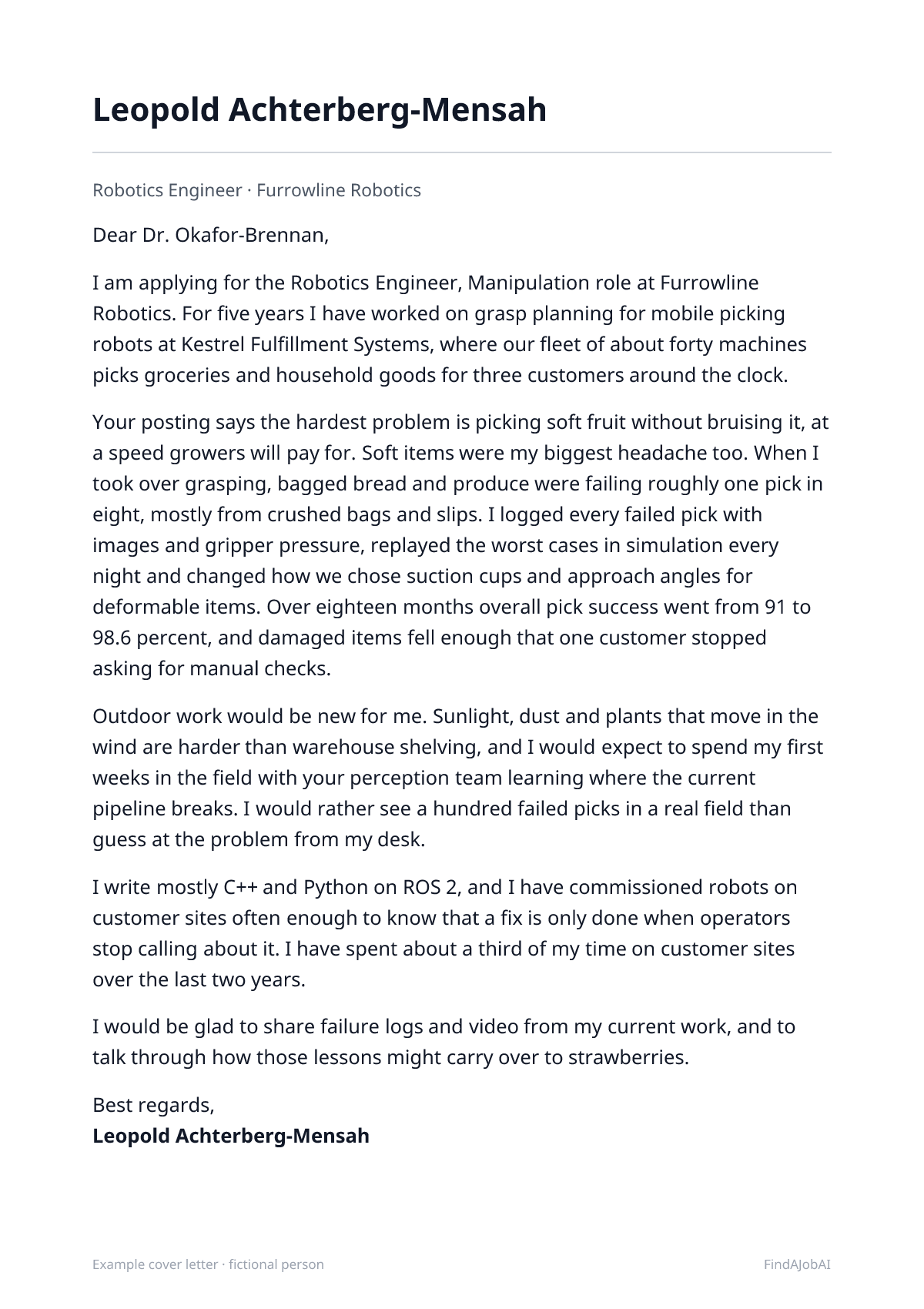
Dear Dr. Okafor-Brennan,
I am applying for the Robotics Engineer, Manipulation role at Furrowline Robotics. For five years I have worked on grasp planning for mobile picking robots at Kestrel Fulfillment Systems, where our fleet of about forty machines picks groceries and household goods for three customers around the clock.
Your posting says the hardest problem is picking soft fruit without bruising it, at a speed growers will pay for. Soft items were my biggest headache too. When I took over grasping, bagged bread and produce were failing roughly one pick in eight, mostly from crushed bags and slips. I logged every failed pick with images and gripper pressure, replayed the worst cases in simulation every night and changed how we chose suction cups and approach angles for deformable items. Over eighteen months overall pick success went from 91 to 98.6 percent, and damaged items fell enough that one customer stopped asking for manual checks.
Outdoor work would be new for me. Sunlight, dust and plants that move in the wind are harder than warehouse shelving, and I would expect to spend my first weeks in the field with your perception team learning where the current pipeline breaks. I would rather see a hundred failed picks in a real field than guess at the problem from my desk.
I write mostly C++ and Python on ROS 2, and I have commissioned robots on customer sites often enough to know that a fix is only done when operators stop calling about it. I have spent about a third of my time on customer sites over the last two years.
I would be glad to share failure logs and video from my current work, and to talk through how those lessons might carry over to strawberries.
Best regards,
Leopold Achterberg-Mensah
Example 2 · Entry level
Robotics graduate applying for a first robotics software role
Nadia has just finished a robotics degree with one internship. She is applying to a warehouse automation company hiring junior robotics engineers.
Example letter · fictional
Dear Ms. Thibodeaux-Kahn,
I am applying for the Robotics Engineer I position at Copperline Warehouse Automation. I finished my robotics degree at Georgia Tech this spring, and last summer I interned on the navigation team at a company that builds autonomous carts for distribution centers.
During the internship my task was to reduce how often carts stopped dead in narrow aisles. I began by reading a few weeks of logs to find where the stops happened, and most came from the local planner reacting to shelf edges as if they were people. I adjusted costmap inflation and controller settings, tested each change on a small fleet of six carts in our test aisle and reviewed results with my mentor every morning. By the end of the summer stop events had dropped by about a third, and the team shipped my settings in their next release.
My capstone was a vision-guided arm that sorted four kinds of parts from a bin. Getting the camera calibration right took far longer than writing the grasp code, which taught me to test the boring parts first. The cell reached 94 percent success over three hundred trials, and the code and video are on my GitHub.
I know a production fleet will be far less forgiving than a test aisle, and I want to learn from engineers who run robots for real customers every day. Your team's work on mixed-case picking is exactly where I hope to start.
I am free to start in July and would be happy to walk your team through my capstone code whenever suits you.
Kind regards,
Nadia Feldmann-Osei
Example 3 · Referral or internal move
Integration engineer referred to a robot control team at the same company
Bartholomew commissions robot cells for his employer's customers. A controls lead suggested he apply to the internal motion control team.
Example letter · fictional
Dear Mr. Szymanski-Ade,
Priyanka Venkataraman on your motion control team suggested I apply for the Robotics Engineer opening, after we spent a week together on a palletizing cell that kept faulting at a customer plant. I have been an integration engineer at Harborfield Automation for four years, commissioning our cells in food, beverage and packaging plants.
That week showed me why I want to move closer to the control code. The cell stopped several times a shift with a following error alarm, and the plant was ready to send it back. Priyanka and I logged joint currents during the failures and found that heavy mixed pallets pushed one axis past the limits the tuning assumed. She changed the payload handling, and I tested each build on the line during night shifts. The alarms stopped, and the customer later ordered two more cells. It was the first time I saw how much a small control change could matter on a real line.
Since then I have been studying the control stack on my own time and reading our trajectory module. I have taken an online course in robot dynamics and written small test tools in C++ to replay field logs against new builds. Priyanka has reviewed two of them and suggested changes I have since made.
My main gap is depth in control theory, and I would expect a steady learning period with the team. What I can bring from the field is a list of the faults customers actually see and a habit of testing changes on real lines before they ship.
I would welcome a conversation about the role, and I am happy to bring my field fault list to it.
Sincerely,
Bartholomew Nwachukwu-Lindgren
All three letters, and the short version below, are fictional: the people, employers and numbers are invented. Borrow the structure, never the facts.
- Prefer to write it yourself? Use the free cover letter template.
- Check your CV against the job first: the free CV score shows the missing keywords.
Why the first letter works, paragraph by paragraph
Paragraph 1: Opening
Names the fleet size and customers, so a hiring lead knows the experience comes from production robots.
Paragraph 2: Soft item story
Matches the ad's fruit problem with a similar warehouse one, including the method and a measured gain.
Paragraph 3: Outdoor gap
Admits field conditions are new and says how the writer would learn them from the perception team.
Paragraph 4: Stack and site work
States languages and frameworks once, then shows the commissioning habit that matters in startups.
Paragraph 5: Close
Offers logs and video, which gives the reader something concrete to ask for.
What the entry-level letter does differently
The entry-level letter makes one internship task do the work: a clear problem, log reading, careful tests and a shipped result. The capstone adds a lesson about calibration, and the closing is honest about the step from test aisle to production.
What the referral letter does differently
This referral letter names the colleague and the shared problem in the first sentence, then tells that story with evidence and an outcome. It is open about the theory gap and offers field knowledge the control team lacks.
Short robotics engineer cover letter: an email-ready version
Many applications arrive as an email or a small text box, and a full page doesn't fit. This version runs 120 to 150 words and keeps only what a reader needs to decide whether to reply. An engineer emails a hiring lead who posted a robotics opening on a professional network and asked for brief replies.
Short version · email · fictional123 words
Subject: Robotics Engineer – 4 years in ROS 2 perception for mobile robots – Margarethe Oyelaran-Castillo
Hi Dr. Lindqvist-Amari,
I saw your post about the robotics engineer opening at Tidewater Inspection Robotics. For four years I have built perception for mobile robots that inspect solar farms, working in C++ and ROS 2 on lidar and camera fusion.
My main project cut false defect alerts by about half by merging thermal and visible images before classification, which saved our field team many wasted site visits each month. I also run our nightly simulation tests and review every perception change before it ships to the fleet.
Your post mentions inspection in tight industrial spaces. I would be glad to share a short video of our robot and talk about how the approach might carry over to your sites.
Thanks,
Margarethe Oyelaran-Castillo
A hiring lead skimming replies wants the robot type, the stack and one result. This email gives all three and links them to the inspection setting named in the post.
Opening lines that work for robotics engineer cover letters
The first sentence decides whether the second gets read. Here are six openings, one for each situation you might be in. Pick the one that matches yours and swap in your own facts: every name and number below is invented.
1. You have a standout result
Over eighteen months I raised pick success on a fleet of forty warehouse robots from 91 to 98.6 percent, and I would like to bring that work to your team.
2. The ad names a problem you've solved
Your posting describes grasping soft, fragile items at speed, a problem I have worked on every week for five years.
3. Someone referred you
Priyanka Venkataraman suggested I apply after we tracked down a following error fault together at a customer plant.
4. You admire what they build
My capstone arm sorted four part types at 94 percent success, and it taught me to test calibration before anything else.
5. You're new to the field or switching into it
I have commissioned robot cells in plants across three states and want to move closer to the control code.
6. You have senior scope or a specialism
Your team builds robots for inspection, and my last four years were spent on perception for exactly that.
How to write a robotics engineer cover letter
Five steps, in the order you'd write them. The shape stays the same for every job (a short opening, proof, a reason for this employer, a close), and what goes into each part is what changes with the role.
Lead with a robot you made work
In the first sentences, name the robot or cell, how many are in use and the part you owned. A reader should know at once whether your experience is in production fleets, industrial cells, research platforms or student projects, because each prepares you differently for their team.
Tell one hardware debugging story
Pick a failure from a real robot and walk through how you found its cause, with logs, sensor data or tests. Finish with the measured change and what customers or operators noticed. This story shows more about your skill than any list of frameworks or courses.
Connect to their robot
Read the ad and the company's videos, then name one challenge they face, such as outdoor perception, soft items or surgical precision. Explain how your past problem is similar and where it differs, so the reader sees you have thought about their product.
Admit what is new
Robotics domains differ a lot. If you have not worked outdoors, in medical devices or with a given arm brand, say so in a sentence and describe how you would learn it. Hiring leads trust honest candidates more than ones who claim to know everything.
Offer proof and close
End by offering code, logs or video you are allowed to share, and ask for a conversation. Keep the final paragraph to two sentences, and check that links in your signature or application form work before you send the letter.
Robotics Engineer cover letter do's and don'ts
Do
- Name the robot, your part of it and a measured result.
- Tell one debugging story from real hardware.
- Link to code or video you are allowed to share.
Don't
- Don't fill the letter with a list of frameworks.
- Don't present simulation numbers as field results.
- Don't hide what is new to you in the employer's domain.
Common robotics engineer cover letter mistakes
Each one is easy to make and quick to fix before you send the letter.
Pasting the skills section into the letter
Mention only the tools behind your story. The resume already holds the full list.
Quoting simulation as real results
Say clearly where numbers came from, and lead with hardware results when you have them.
Writing about robotics in general
Name the employer's robot and one of its real challenges so the letter could not go anywhere else.
Skipping the team side
Robots are built by mixed teams. Show you worked with mechanical, electrical or field colleagues.
Sending a letter with no link
Add a repository, paper or video so the reader can see your robot move.
Email subject lines for robotics engineer applications
Applying by email? Put the job title, any reference number and your name in the subject line.
- Robotics Engineer, Manipulation – 5 years on picking fleets – Leopold Achterberg-Mensah
- Robotics Engineer I – Georgia Tech 2026, navigation intern – Nadia Feldmann-Osei
- Internal application: Senior Robotics Engineer, Controls (Req. 5208) – Leopold Achterberg-Mensah
Everything for Robotics Engineers
- Robotics Engineer resume exampleA full resume, plus bullet and summary examples
- Robotics Engineer interview questions30 questions with sample answers
- Robotics Engineer job descriptionDuties, skills and requirements
- Cover letter with no experience: templates
Other cover letter examples
Robotics Engineer cover letter FAQ
What should a robotics engineer cover letter include?
The robots you worked on, the part of the stack you owned, one problem you solved on real hardware and the measured result. Close by linking your experience to a challenge named in the job ad.
How do I write a robotics cover letter as a new graduate?
Use internships, capstones, research and competitions. Pick one project, describe the problem, your tests and the result, and link to code or video. Say what you want to learn from a production team.
How long should a robotics engineer cover letter be?
About 250 to 350 words. One opening, one detailed story with numbers, a short note on tools and fit and a brief close are enough. Technical detail can go in a portfolio link.
How we built this page
The FindAJobAI team wrote the three example letters, the short email version, the opening lines and the advice for robotics engineer roles. The people, employers and numbers in the letters are invented; the structure, the kind of evidence and the order of the paragraphs are the parts to copy.
Once we track enough live robotics engineer job ads, this page also shows the skills they ask for most, counted the same way as our in-demand skills report.
Last reviewed on November 1, 2026.