Salesforce Administrator Cover Letter Example (2026)
By FindAJobAI team Updated How we built this page
Salesforce admin ads usually list the same clouds and certifications, so the letter is where you show what you actually fixed: a broken approval process, a report nobody trusted, a rollout that stuck. Name the org's size, the teams you supported, and one change you made to the system, not just your badge count.
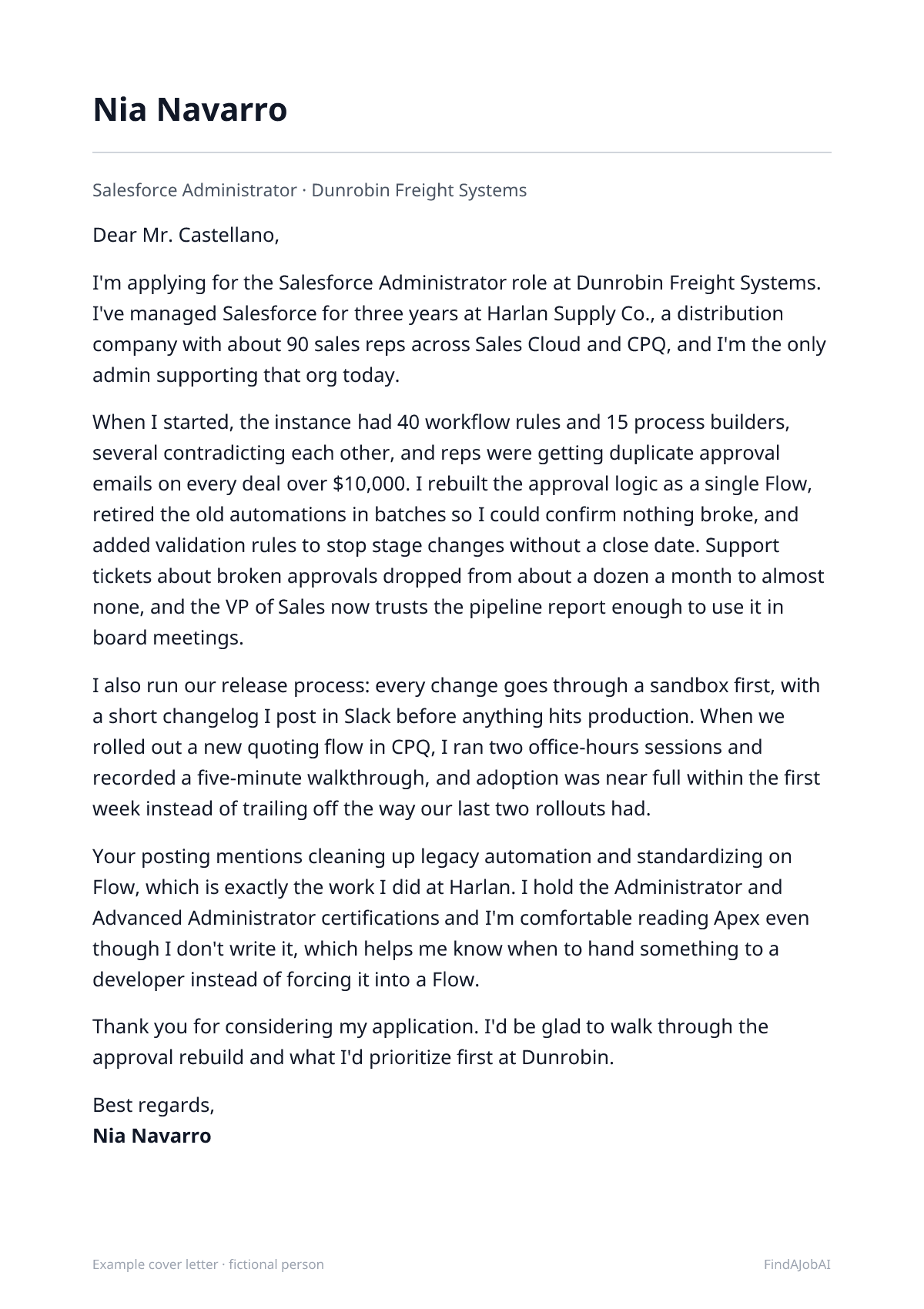
Salesforce Administrator cover letter template
This letter as a one-page template: an opening that names the job and your strongest fact, proof that answers the ad, a reason for this employer and a short close.
After you sign up, FindAJobAI drafts your own letter for a real job from your CV in this format, and you edit it before you send it.
Example 1 · Experienced
Sales ops admin applying to a logistics software company
Nia runs Salesforce for a 90-rep sales team. The ad asks for someone who can own flows and clean up legacy automation.
Example letter · fictional
Dear Mr. Castellano,
I'm applying for the Salesforce Administrator role at Dunrobin Freight Systems. I've managed Salesforce for three years at Harlan Supply Co., a distribution company with about 90 sales reps across Sales Cloud and CPQ, and I'm the only admin supporting that org today.
When I started, the instance had 40 workflow rules and 15 process builders, several contradicting each other, and reps were getting duplicate approval emails on every deal over $10,000. I rebuilt the approval logic as a single Flow, retired the old automations in batches so I could confirm nothing broke, and added validation rules to stop stage changes without a close date. Support tickets about broken approvals dropped from about a dozen a month to almost none, and the VP of Sales now trusts the pipeline report enough to use it in board meetings.
I also run our release process: every change goes through a sandbox first, with a short changelog I post in Slack before anything hits production. When we rolled out a new quoting flow in CPQ, I ran two office-hours sessions and recorded a five-minute walkthrough, and adoption was near full within the first week instead of trailing off the way our last two rollouts had.
Your posting mentions cleaning up legacy automation and standardizing on Flow, which is exactly the work I did at Harlan. I hold the Administrator and Advanced Administrator certifications and I'm comfortable reading Apex even though I don't write it, which helps me know when to hand something to a developer instead of forcing it into a Flow.
Thank you for considering my application. I'd be glad to walk through the approval rebuild and what I'd prioritize first at Dunrobin.
Best regards,
Nia Navarro
Example 2 · Career changer
Support agent moving into Salesforce administration
Desmond fixed his team's case routing in Service Cloud before he had the title. The ad mentions queues and case assignment rules.
Example letter · fictional
Dear Hiring Manager,
I'm applying for the Associate Salesforce Administrator role at Birchwater Insurance Group. For four years I've worked as a support agent on a 20-person team using Service Cloud, and the part of that job I liked best was fixing the system itself, not just the tickets in front of me.
Our case queue used to dump every ticket into one list, so agents cherry-picked easy ones and billing cases sat for days. I didn't have admin access yet, so I documented the pattern, proposed a set of assignment rules split by case type and account tier, and worked with our admin to build and test them. Average time to first response on billing cases dropped from about two days to under four hours, and I was given admin access soon after to maintain the rules myself.
Since then I earned my Salesforce Administrator certification, built a Trailhead playground with custom objects and a Flow that reassigns stale cases automatically, and I shadow our admin on report builds and page layout changes whenever I can. I understand the case lifecycle from the agent's side, which I think is missing from a lot of admin work I've seen.
Your ad asks for someone to own queues and assignment rules, which is the exact problem I solved before I had the title. I'd bring both the Salesforce skills I've built and a clear sense of what agents actually need from the system day to day.
Thank you for your time. My certification and playground link are on my resume, and I'd welcome the chance to talk.
Kind regards,
Desmond Okafor-Reyes
Example 3 · Senior or lead
Lead admin applying to a larger, multi-cloud org
Fenwick leads a two-person admin team at a mid-size company. The ad is for a lead admin who will own governance across Sales and Service Cloud.
Example letter · fictional
Dear Ms. Odunlami,
I'm applying for the Lead Salesforce Administrator role at Castellane Health Partners. For the past two years I've led a two-person admin team at Thornbury Analytics, supporting Sales Cloud and Service Cloud for about 300 users, and before that I was a solo admin for four years.
Your ad mentions that three business units each built their own fields and processes with no shared standard. We had the same problem at Thornbury: 340 custom fields, a third of them unused, and five different ways of recording the same deal stage across regions. I led a field audit, retired or merged about 40% of those fields, and set up a change advisory process where any new automation gets a short write-up and a 15-minute review before it ships. New field requests dropped sharply, and two org-wide duplicate-record issues that used to surface every quarter haven't recurred since.
I also rebuilt our sandbox strategy, moving from one shared sandbox where people stepped on each other's changes to separate developer sandboxes plus one staging sandbox for final testing. Release day incidents, which used to average two or three per quarter, are now rare enough that we track them by the year instead.
I haven't managed a team larger than two, and I haven't worked with Health Cloud specifically, though I've supported HIPAA-adjacent data handling in Service Cloud. At Castellane I'd want to learn your compliance requirements early and lean on your team's experience there.
I'd welcome a conversation about which business unit's data is causing the most friction right now, and how your team currently reviews changes before they ship.
Sincerely,
Fenwick Adeyemi
All three letters, and the short version below, are fictional: the people, employers and numbers are invented. Borrow the structure, never the facts.
- Prefer to write it yourself? Use the free cover letter template.
- Check your CV against the job first: the free CV score shows the missing keywords.
Why the first letter works, paragraph by paragraph
Paragraph 1: Opening
Names the org size, the clouds in use, and that the writer is the sole admin. Scope and ownership matter more to a hiring admin than years of experience alone.
Paragraph 2: The automation rebuild
States the mess (40 workflow rules, 15 process builders), the fix (one Flow, staged retirement, validation rules), and the result in support ticket volume and a stakeholder's trust in the data.
Paragraph 3: Release process and rollout
Shows the writer has a repeatable way of shipping changes safely and getting people to actually use them, which separates admins who maintain a system from admins who improve one.
Paragraph 4: Why this company
Mirrors the ad's specific ask (legacy cleanup, standardizing on Flow) and adds certifications and a note about knowing when to escalate to a developer.
Paragraph 5: Close
Offers a concrete next step, a walkthrough of the rebuild, rather than a general offer to discuss qualifications.
What the career changer's letter does differently
The career changer's letter starts from a workflow problem solved from the support side before the title existed, with a measurable result (response time from two days to under four hours). A certification and a Trailhead playground show the skills are now formal, and the letter turns the agent background into an advantage rather than apologizing for it.
What the senior letter does differently
A lead admin letter reports organizational habits, not just fixes: a change advisory process, a field audit that cut unused fields, a sandbox strategy that reduced release incidents. It also names a real gap, team size and a specific cloud, instead of claiming full readiness.
Short Salesforce administrator cover letter: an email-ready version
Many applications arrive as an email or a small text box, and a full page doesn't fit. This version runs 120 to 150 words and keeps only what a reader needs to decide whether to reply. A Salesforce administrator answers a nonprofit's short online application field, sent as an email because the portal upload kept failing.
Short version · email · fictional130 words
Subject: Salesforce Administrator (Nonprofit Cloud) – Soraya Lindqvist
Hello Mr. Tunde,
I'm applying for the Salesforce Administrator role at Marrowfield Community Fund. I have three years of experience administering Nonprofit Success Pack for a mid-size nonprofit, where I'm the sole admin for about 60 staff and volunteers.
My main project was cleaning up our donor data: duplicate records were causing double mailings and overstated donor counts in board reports. I ran a dedupe using matching rules and a merge tool, cutting active donor records by roughly 2,000 and fixing the double-mailing complaints entirely.
I'm comfortable with Flow, reports and dashboards, and NPSP's household model specifically. My resume is attached, and I'm glad to describe the dedupe process in more detail. I can also share a sanitized before-and-after of the matching rules if that would help.
Best,
Soraya Lindqvist
A short application field forces one project, so the short version keeps the dedupe story and its concrete effect (fewer double mailings, fewer inflated donor counts) and drops the release-process detail that the longer letters include.
Opening lines that work for Salesforce administrator cover letters
The first sentence decides whether the second gets read. Here are six openings, one for each situation you might be in. Pick the one that matches yours and swap in your own facts: every name and number below is invented.
1. You have a standout result
A duplicate-record cleanup I led last year cut our active donor records by roughly 2,000 and ended a recurring double-mailing complaint. I'd like to bring that kind of cleanup work to your Salesforce org.
2. The ad names a problem you've solved
Your ad says reps wait on manual approval routing for every discount over a set threshold. At my current company I replaced that exact bottleneck with a single Flow, and approval complaints nearly disappeared.
3. Someone referred you
Your sales ops lead, Imogen Castellanos, and I worked together for a year on quoting automation, from the admin and sales sides respectively. She mentioned you need someone who can both build and explain changes to reps, which is why I'm writing.
4. You admire what they build
I've used your member portal as a volunteer coordinator for two years, and the way it handles shift sign-ups made me curious about the Salesforce org behind it; I'd like to help maintain and improve it directly.
5. You're new to the field or switching into it
I spent four years as a support agent before fixing my team's case routing without admin access. Salesforce administration is where I want to keep solving problems like that, now with the tools to do it properly.
6. You have senior scope or a specialism
As the only admin for a 300-user org for the past two years, I built the change process and sandbox strategy the company still relies on. I'm looking for a role where I can do that at a larger scale with a team.
How to write a Salesforce administrator cover letter
Five steps, in the order you'd write them. The shape stays the same for every job (a short opening, proof, a reason for this employer, a close), and what goes into each part is what changes with the role.
Identify the org's size and who it's breaking for
Admin ads differ by scale and cloud: a 20-person Service Cloud team has different problems than a 300-user multi-cloud org. Read the ad for user count, clouds, and any pain point it names, then pick a story of yours that matches that scale.
Open with the problem the system had, not your tools
Say what was broken, duplicate approvals, messy case routing, inflated donor counts, in one or two sentences before naming Flow or any feature. A reader who sees a real problem in your first paragraph keeps reading past the certification list.
Quantify the fix in tickets, time, or adoption
Tie one rebuild to a measurable change: fewer support tickets, faster response time, higher adoption, fewer duplicate records. If you can't measure the end result, describe what stopped happening, like complaints or recurring errors, once the fix shipped.
Name clouds, features, and certifications inside the story
Work Sales Cloud, Service Cloud, CPQ, Flow, or NPSP into the account of what you built, not as a standalone list. State your certifications once, briefly, and only mention Apex or developer tools if you actually use them.
Show how you manage change safely
One sentence on your release process, sandboxes, a changelog, a review step, signals you won't break production. Close by naming a question about their org you'd want to ask first, so the reader sees what you'd investigate early.
Salesforce Administrator cover letter do's and don'ts
Do
- Name the clouds and object model you've worked in (Sales Cloud, Service Cloud, CPQ) inside a specific story, not as a bare list.
- Describe one process you rebuilt or cleaned up, including what was broken before, and the result in tickets, time, or adoption.
- Mention your release process: sandboxes, change logs, or how you test before deploying to production.
- List certifications by name (Administrator, Advanced Administrator, Platform App Builder) rather than just saying 'certified.'
Don't
- Don't say you're 'passionate about Salesforce'; show it with one automation you built or fixed.
- Don't claim Apex or Lightning Web Components skills you don't have; say clearly that you hand development work to a developer.
- Don't list every object and field you've touched; pick the one process that mattered to the business.
Common Salesforce administrator cover letter mistakes
Each one is easy to make and quick to fix before you send the letter.
Leading with certifications instead of a fix
A list of badges up front reads like a resume restated. Open with the problem you solved, then mention certifications once, later, as support for the story.
Describing features built, not problems solved
'Built 12 Flows and 5 dashboards' says nothing about impact. Name the one process that was broken, what you changed, and what got better for the people using it.
Claiming Apex or integration skills you don't have
Overstating technical depth gets exposed in the first technical interview question. It's fine, and often stronger, to say clearly that you escalate development work and explain how you decide when to do that.
Ignoring how changes get released
A letter silent on testing and deployment leaves out a core part of the job. Mention briefly how you use sandboxes or a review step before anything reaches production.
Writing generic lines like 'detail-oriented problem solver'
Every applicant writes this. Replace it with the actual detail you caught, like a validation rule that stopped bad data entry, or a duplicate rule that caught records others missed.
Email subject lines for Salesforce administrator applications
Applying by email? Put the job title, any reference number and your name in the subject line.
- Salesforce Administrator application – Sales Cloud and CPQ – Nia Navarro
- Associate Salesforce Administrator – support background, certified – Desmond Okafor-Reyes
- Application: Salesforce Administrator, Service Cloud (Req. 2240) – Nia Navarro
Everything for Salesforce Administrators
- Salesforce Administrator resume exampleA full resume, plus bullet and summary examples
- Salesforce Administrator job descriptionDuties, skills and requirements
- Career change cover letter: template + examples
Other cover letter examples
Salesforce Administrator cover letter FAQ
What should I write in a Salesforce administrator cover letter?
One process you rebuilt or automated, what was broken about it before, and the measurable result, such as fewer tickets or faster response time. Add how you release changes safely, then name your certifications once, briefly.
How do I write a Salesforce administrator cover letter with no admin title yet?
Use a system problem you solved from an adjacent role, such as support or sales ops, plus a certification and a Trailhead playground project. Name the objects or clouds involved and the result, even without the admin title.
Should I list all my Salesforce certifications in the cover letter?
Name one or two relevant ones in a single sentence; your resume already lists the rest. The letter should spend most of its space on what you built or fixed, not on badges.
Do I need to mention Apex or developer skills as an administrator?
Only if you actually have them. It's fine, and often more credible, to say you know when to hand a request to a developer instead of forcing a workaround into a Flow.
How we built this page
The FindAJobAI team wrote the three example letters, the short email version, the opening lines and the advice for Salesforce administrator roles. The people, employers and numbers in the letters are invented; the structure, the kind of evidence and the order of the paragraphs are the parts to copy.
Once we track enough live Salesforce administrator job ads, this page also shows the skills they ask for most, counted the same way as our in-demand skills report.
Last reviewed on November 1, 2026.