Systems Administrator Cover Letter Example (2026)
By FindAJobAI team Updated How we built this page
Systems administrator ads usually list the same operating systems and a backup tool, so the resume looks like everyone else's. The cover letter is where you name the outage you prevented, the migration you ran after hours, and the server room nobody else wanted to touch.
Systems Administrator cover letter template
This letter as a one-page template: an opening that names the job and your strongest fact, proof that answers the ad, a reason for this employer and a short close.
After you sign up, FindAJobAI drafts your own letter for a real job from your CV in this format, and you edit it before you send it.
Example 1 · Experienced
Healthcare IT systems administrator applying to a hospital network
Walter manages Windows Server and VMware infrastructure for a clinic group. The ad stresses uptime for clinical systems and HIPAA compliance.
Example letter · fictional
Dear Ms. Obuya,
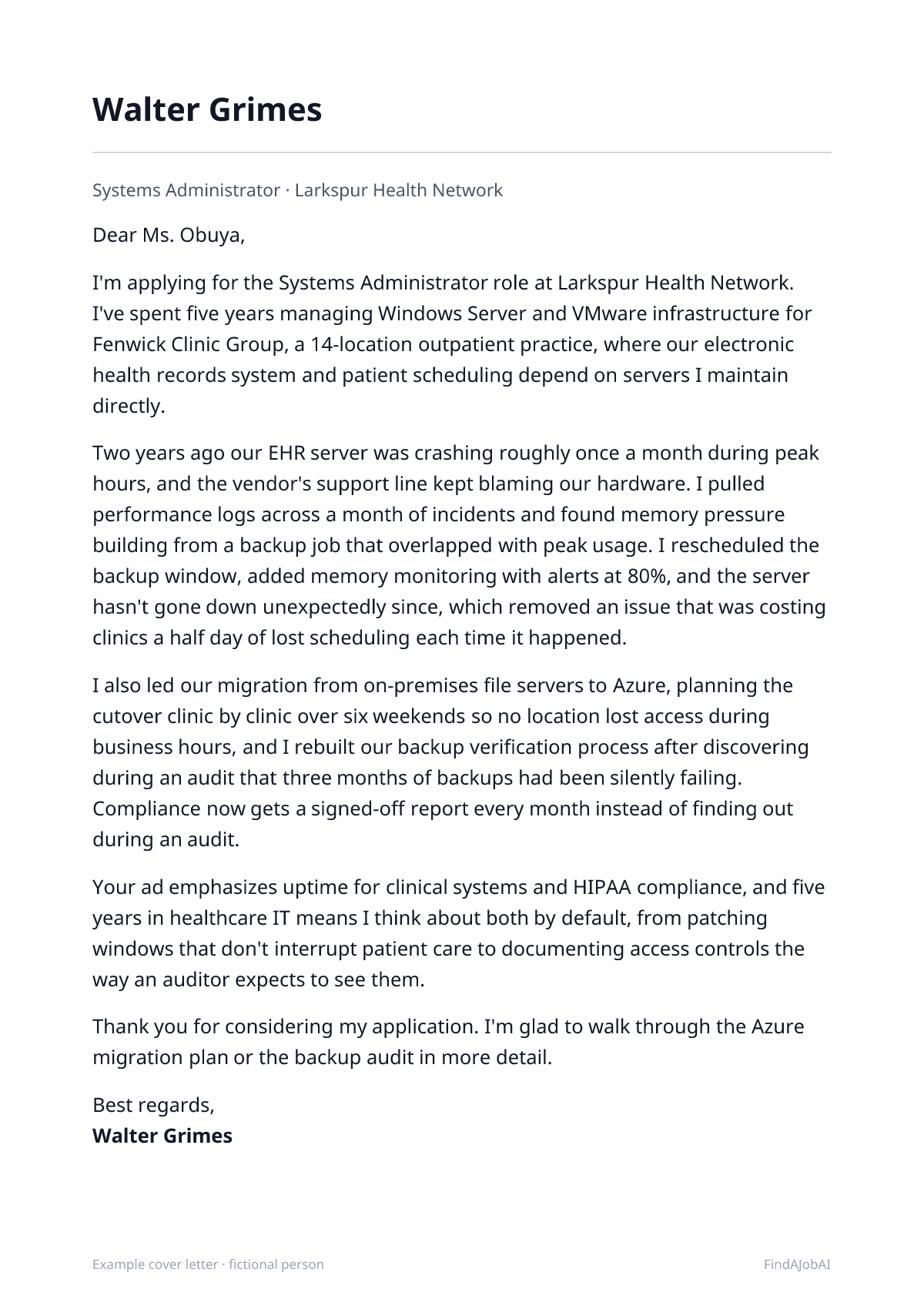
I'm applying for the Systems Administrator role at Larkspur Health Network. I've spent five years managing Windows Server and VMware infrastructure for Fenwick Clinic Group, a 14-location outpatient practice, where our electronic health records system and patient scheduling depend on servers I maintain directly.
Two years ago our EHR server was crashing roughly once a month during peak hours, and the vendor's support line kept blaming our hardware. I pulled performance logs across a month of incidents and found memory pressure building from a backup job that overlapped with peak usage. I rescheduled the backup window, added memory monitoring with alerts at 80%, and the server hasn't gone down unexpectedly since, which removed an issue that was costing clinics a half day of lost scheduling each time it happened.
I also led our migration from on-premises file servers to Azure, planning the cutover clinic by clinic over six weekends so no location lost access during business hours, and I rebuilt our backup verification process after discovering during an audit that three months of backups had been silently failing. Compliance now gets a signed-off report every month instead of finding out during an audit.
Your ad emphasizes uptime for clinical systems and HIPAA compliance, and five years in healthcare IT means I think about both by default, from patching windows that don't interrupt patient care to documenting access controls the way an auditor expects to see them.
Thank you for considering my application. I'm glad to walk through the Azure migration plan or the backup audit in more detail.
Best regards,
Walter Grimes
Example 2 · Career changer
Help desk technician moving into systems administration
Layla rebuilt her company's patching process and earned her Server+ cert on her own time. The ad mentions Active Directory and patch management.
Example letter · fictional
Dear Hiring Manager,
I'm applying for the Junior Systems Administrator role at Birchwood Manufacturing. I've worked on the IT help desk at Calder Industrial for three years, and the part of that job I've grown into is the server and Active Directory work our sysadmin used to handle alone before he left.
When he left, patching had been done manually and inconsistently, and two servers were months behind on security updates nobody had noticed. I set up WSUS to manage Windows updates across our 30 servers, built a monthly patching schedule with a test group before full rollout, and we haven't missed a patching cycle since. I also took over day-to-day Active Directory work, including resetting permissions after a departing employee's account was found to still have access three weeks after they left, which led me to build a weekly access review as a habit rather than a one-time fix.
I've since earned my CompTIA Server+ certification studying on my own time, and I run a small home lab with Hyper-V to practice Active Directory, group policy and backup restores before I try anything new at work. I document each change in a shared wiki so the next person doesn't have to guess.
Your posting mentions Active Directory and patch management, and both are things I'm already doing day to day, just without the title. I'd bring that experience along with the habit of checking my own work before something breaks.
Thank you for your time. I'd welcome the chance to talk about how I'd fit on your team.
Kind regards,
Layla Gill
Example 3 · Senior or lead
Infrastructure manager applying to lead a growing IT operations team
Tanya manages six systems administrators at a logistics company. The ad is for a manager who will set standards for patching, backup and server lifecycle.
Example letter · fictional
Dear Mr. Antolini,
I'm applying for the Infrastructure Manager role at Haverford Logistics. For the past three years I've managed a team of six systems administrators at Trellis Warehousing, where we support servers and networking across 18 warehouses, and before that I spent seven years as a senior systems administrator.
Your ad says the company has grown faster than its IT standards, with some sites patched monthly and others untouched for over a year. Trellis had the same gap after two warehouse acquisitions. I wrote a standard server build and patching policy, moved every site onto centralized patch management within four months, and retired 22 end-of-life servers that had been quietly running unsupported operating systems.
The clearest case for that work came during a ransomware attempt that started on an unpatched server at one site. Because that site had just been migrated to the new standard, the affected server was already isolated on its own network segment with current backups, so we restored it within three hours instead of losing the week of data an older, unpatched backup routine would have cost us.
I haven't built an infrastructure team from its earliest stage, only grown one that already existed, and I haven't managed a budget for data center colocation, since Trellis runs mostly on its own sites. At Haverford I'd expect to lean on your finance and facilities leads while I get up to speed on both.
A conversation about which of your sites is furthest behind on patching standards today would be a good place to start.
Sincerely,
Tanya Chaudhry
All three letters, and the short version below, are fictional: the people, employers and numbers are invented. Borrow the structure, never the facts.
- Prefer to write it yourself? Use the free cover letter template.
- Check your CV against the job first: the free CV score shows the missing keywords.
Why the first letter works, paragraph by paragraph
Paragraph 1: Opening
Names the scale (14 locations) and what depends on the writer's work (the EHR system), so the reader understands the stakes before any technical detail arrives.
Paragraph 2: The recurring crash nobody else could explain
A specific, hard-to-find cause, the fix, and the business cost that stopped (a half day of lost scheduling per incident). This is the moment that shows real troubleshooting, not just server maintenance.
Paragraph 3: A migration and a compliance fix
Shows planning on a live system (the weekend-by-weekend cutover) and catching a serious gap (silently failing backups) before it became a bigger problem, which matters more in healthcare than almost any other detail.
Paragraph 4: Why this fits the ad
Mirrors the ad's two specific concerns (uptime, HIPAA) instead of repeating the full job description back.
Paragraph 5: Close
Offers two concrete things to discuss further, inviting a technical conversation rather than ending on a generic thank-you.
What the career changer's letter does differently
The career changer's letter starts from a real gap she noticed and fixed (inconsistent patching, a stale access permission) rather than a job title, and backs it with a Server+ certification and home lab practice so the ad's specific asks (Active Directory, patch management) land on work she's already doing.
What the senior letter does differently
An infrastructure manager letter reports organizational habits, not single fixes: a patching policy rolled out across 18 sites, 22 unsupported servers retired, a ransomware attempt contained to three hours of downtime instead of a week of lost data because the standard was already in place. The gap, building a team from scratch and managing a colocation budget, is named directly.
Short systems administrator cover letter: an email-ready version
Many applications arrive as an email or a small text box, and a full page doesn't fit. This version runs 120 to 150 words and keeps only what a reader needs to decide whether to reply. A systems administrator answers a nonprofit's short online application after the portal's attachment upload failed, sent as an email instead.
Short version · email · fictional146 words
Subject: Systems Administrator (Windows Server, Azure AD) – Omar Brennan
Hello Ms. Farrugia,
I'm applying for the Systems Administrator role at Maple Grove Housing Trust. I have four years of experience managing Windows Server and Azure AD for a 60-employee nonprofit, where I'm the only IT staff member supporting both headquarters and three satellite offices.
My most useful project was migrating our file storage and email from an aging on-site server to Microsoft 365, which I planned and ran over two weekends with zero data loss and no disruption to staff on Monday morning. I also cut our average help desk ticket resolution time from about two days to same-day by documenting fixes for our ten most common issues.
I'd like to bring that same steadiness to a team supporting work that matters as much as housing services does. My resume is attached, and I'm glad to share the migration plan I used.
Best,
Omar Brennan
The short version keeps one project, the Microsoft 365 migration, and its two measurable results (zero data loss, faster ticket resolution), since a brief email only has room for one proof point instead of the full story of running IT alone across four locations.
Opening lines that work for systems administrator cover letters
The first sentence decides whether the second gets read. Here are six openings, one for each situation you might be in. Pick the one that matches yours and swap in your own facts: every name and number below is invented.
1. You have a standout result
I migrated our file storage and email to Microsoft 365 last year with zero data loss and no disruption to staff, and I'd like to bring that same planning to your infrastructure.
2. The ad names a problem you've solved
Your ad mentions inconsistent patching across locations. At my current company I moved 18 sites onto centralized patch management in four months, and I'd like to do the same for yours.
3. Someone referred you
Your IT director, Marcus Oyelaran, and I met at a regional sysadmin meetup last fall. He mentioned your team needs someone comfortable with Azure AD and hybrid environments, which is most of what I do now.
4. You admire what they build
I've supported your company's donated laptops as a volunteer for a community program for two years, and the behind-the-scenes server work that keeps that program running is what made me want to do this full time.
5. You're new to the field or switching into it
I spent three years on a help desk fixing the server and Active Directory problems our sysadmin left behind before I earned my Server+ certification and started handling that work directly.
6. You have senior scope or a specialism
As the senior systems administrator for a 14-location clinic group, I wrote the backup verification process the company still relies on after an audit found months of silent failures. A role that applies that same standard across the whole company is what I'm after.
How to write a systems administrator cover letter
Five steps, in the order you'd write them. The shape stays the same for every job (a short opening, proof, a reason for this employer, a close), and what goes into each part is what changes with the role.
Read the ad for what the infrastructure actually runs
A hospital's EHR servers, a warehouse's inventory systems and a nonprofit's file shares are different jobs even with the same tool list. Identify what the ad's systems support and choose your strongest example from a similar environment.
Open with what was at risk, not the server you fixed
State what depended on the system, like patient scheduling or payroll, before naming the platform. A reader who understands the stakes in your first paragraph keeps reading past the technical detail. Keep the platform name for the second sentence.
Walk through one diagnosis, not just the fix
Say what symptom you noticed, what you checked, and how you found the actual cause, like a backup job overlapping with peak hours. This is the detail that separates administrators who troubleshoot from those who just restart services.
Attach a number to downtime, time, or risk avoided
Unexpected crashes eliminated, migration completed with zero data loss, resolution time cut, or a compliance gap caught before an audit. If you can't measure the final result, describe what stopped happening, like repeat tickets or missed backups.
Name the platforms the ad lists, inside your example
Work Windows Server, Active Directory, VMware, Azure, or Linux into the story of what you built or fixed, rather than listing them separately. A platform named next to a result is credible; a platform named alone is a keyword match.
Systems Administrator cover letter do's and don'ts
Do
- Describe one outage, migration or security gap you handled: what you found, what you did, and the result.
- Name the platforms the ad lists (Windows Server, Active Directory, VMware, Azure, Linux) inside an example, not as a list.
- Mention compliance or uptime requirements if the ad asks for them; many sysadmin roles care about this as much as the tools.
Don't
- Don't just name certifications; explain how you applied them, even from a home lab.
- Don't describe routine patching or backups as if they were a crisis; save the detail for something that was actually hard to diagnose.
- Don't name a former employer's exact server counts or security incidents in sensitive detail; describe scale and outcome instead.
Common systems administrator cover letter mistakes
Each one is easy to make and quick to fix before you send the letter.
Naming certifications without context for their use
'Server+, MCSA, and ITIL Foundation' on its own tells the reader you passed exams. Say what you configured, diagnosed, or automated using that knowledge, even if it was a home lab or a small deployment.
Describing a fix without the cause
'I rebuilt the server and it worked' skips the part employers want to see. Explain what led you to that cause and what else you ruled out first; that's the troubleshooting skill they're hiring for.
Lumping every outage into one category
A planned maintenance window and an unplanned crash during business hours are different stories. Be specific about duration, scope, and what business function was affected.
Naming every tool and platform you've touched
A paragraph listing Windows Server, Linux, VMware, Hyper-V, Azure, AWS, and three backup tools reads as scattered. Focus on the stack the ad mentions and dig deep on one or two examples rather than touching on all of them.
Skipping who depends on the systems
A letter that only discusses server specs could apply to any company. Name what the systems support, like patient records or payroll, and show you understand what's actually at stake when something breaks.
Email subject lines for systems administrator applications
Applying by email? Put the job title, any reference number and your name in the subject line.
- Systems Administrator application – healthcare IT, VMware and Azure – Walter Grimes
- Junior Systems Administrator – Server+, Active Directory and patch management – Layla Gill
- Application: Systems Administrator II (Req. 3087) – Walter Grimes
Everything for Systems Administrators
- Systems Administrator resume exampleA full resume, plus bullet and summary examples
- Systems Administrator interview questions30 questions with sample answers
- Systems Administrator job descriptionDuties, skills and requirements
- Career change cover letter: template + examples
Other cover letter examples
Systems Administrator cover letter FAQ
What should I write in a systems administrator cover letter?
One outage, migration or security gap you handled: what you found, what you did about it, and the result. Then a sentence on uptime or compliance if the ad mentions it. Your platform list and certifications belong on your resume, not retold in prose.
How do I write a systems administrator cover letter with no formal experience?
Use server or account administration work from an adjacent role, such as help desk or IT support, plus a certification like CompTIA Server+ and home lab practice. Name what you set up or fixed and what would have gone wrong otherwise.
Should I mention specific certifications like Server+ or MCSA in the letter?
Mention them briefly if the ad asks for them, but spend most of the space on what you did with that knowledge. A certification without an example of its use looks the same as everyone else's resume line.
How we built this page
The FindAJobAI team wrote the three example letters, the short email version, the opening lines and the advice for systems administrator roles. The people, employers and numbers in the letters are invented; the structure, the kind of evidence and the order of the paragraphs are the parts to copy.
Once we track enough live systems administrator job ads, this page also shows the skills they ask for most, counted the same way as our in-demand skills report.
Last reviewed on November 1, 2026.