SAP Consultant Cover Letter Example (2026)
By FindAJobAI team Updated How we built this page
SAP ads list modules and certifications first, so the cover letter has to show what you did inside a client's system: which process you configured, what broke during testing, and how the business ran afterward. Naming the module without naming the business change reads like every other applicant's letter.
SAP Consultant cover letter template
This letter as a one-page template: an opening that names the job and your strongest fact, proof that answers the ad, a reason for this employer and a short close.
After you sign up, FindAJobAI drafts your own letter for a real job from your CV in this format, and you edit it before you send it.
Example 1 · Experienced
Senior FI/CO consultant applying to a manufacturing client project
Dariusz leads FI/CO configuration for a consultancy. The ad wants someone to run a S/4HANA finance rollout for a mid-size manufacturer.
Example letter · fictional
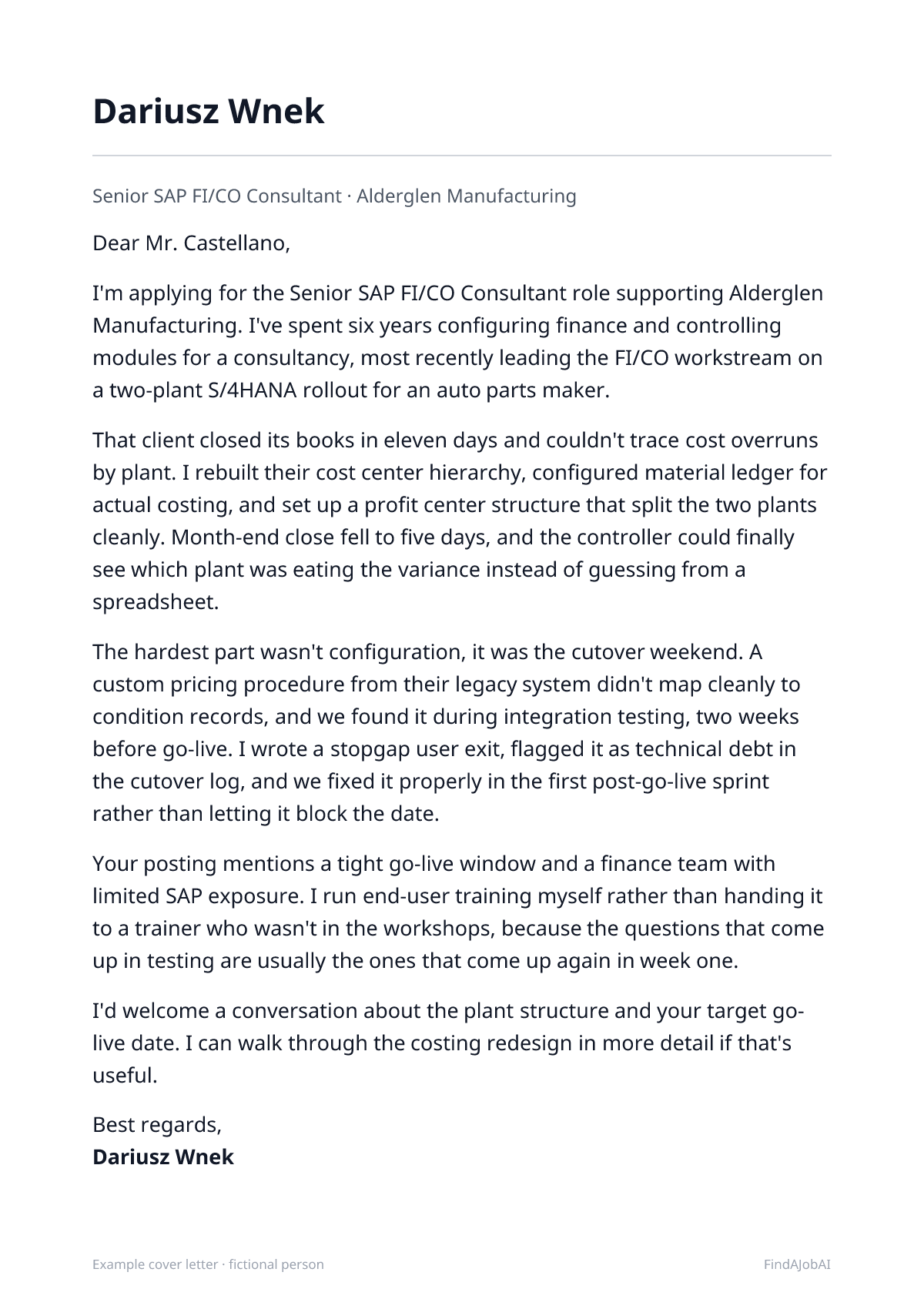
Dear Mr. Castellano,
I'm applying for the Senior SAP FI/CO Consultant role supporting Alderglen Manufacturing. I've spent six years configuring finance and controlling modules for a consultancy, most recently leading the FI/CO workstream on a two-plant S/4HANA rollout for an auto parts maker.
That client closed its books in eleven days and couldn't trace cost overruns by plant. I rebuilt their cost center hierarchy, configured material ledger for actual costing, and set up a profit center structure that split the two plants cleanly. Month-end close fell to five days, and the controller could finally see which plant was eating the variance instead of guessing from a spreadsheet.
The hardest part wasn't configuration, it was the cutover weekend. A custom pricing procedure from their legacy system didn't map cleanly to condition records, and we found it during integration testing, two weeks before go-live. I wrote a stopgap user exit, flagged it as technical debt in the cutover log, and we fixed it properly in the first post-go-live sprint rather than letting it block the date.
Your posting mentions a tight go-live window and a finance team with limited SAP exposure. I run end-user training myself rather than handing it to a trainer who wasn't in the workshops, because the questions that come up in testing are usually the ones that come up again in week one.
I'd welcome a conversation about the plant structure and your target go-live date. I can walk through the costing redesign in more detail if that's useful.
Best regards,
Dariusz Wnek
Example 2 · Career changer
Warehouse operations planner moving into SAP consulting
Deepa ran WM processes daily and then helped configure them during an upgrade. The ad is an entry-level SAP EWM analyst role.
Example letter · fictional
Dear Hiring Manager,
I'm applying for the SAP EWM Associate Consultant role at Northfell Logistics Partners. For four years I've planned inbound and outbound operations at a distribution center running SAP WM, and I spent the last of those years working alongside consultants during our move to EWM.
Our putaway strategy was mismatched to our layout, slow movers sat near the dock and fast movers sat in the back, and pickers walked extra distance on every shift. I mapped our top two hundred SKUs by pick frequency, worked with the consultants to rebuild the storage type assignments and putaway rules around that data, and pick times for the busiest shift dropped by about a fifth within two months of go-live.
That project is why I want to do configuration full time rather than operate around it. I've since completed an SAP EWM foundations course and a warehouse structures workshop, and I spent UAT asking the consultants to explain each customization so I understood why a rule was built that way, not just that it worked.
I know a warehouse floor the way a consultant usually only knows it from a process document: where congestion happens, which exceptions pickers work around instead of reporting, and what a rule looks like when it's wrong in practice. I think that's useful on a team configuring EWM for other operations teams.
Thank you for considering my application. I'd welcome the chance to talk about how you support clients through their first weeks live.
Sincerely,
Deepa Torres
Example 3 · Senior or lead
SAP practice lead applying to build a new client delivery team
Oyelaran leads a 12-person SAP practice at a consultancy. The ad is for a practice lead to build a logistics-focused delivery team from six consultants.
Example letter · fictional
Dear Ms. Byrne,
I'm applying for the SAP Practice Lead role at Westmarch Advisory Group. I've led a twelve-person SAP practice at Trellis Consulting for the past three years, after eight years as a hands-on consultant across FI/CO and SD, and I'd like to build a logistics-focused team the way you're describing.
Your ad says the practice has six consultants and no shared delivery method, so every engagement starts from scratch. I inherited a similar gap at Trellis: estimates varied by consultant, cutover checklists lived in people's heads, and two projects had slipped their go-live dates in the year before I started. I built a standard cutover runbook, a staffing model based on module complexity rather than headcount guesses, and a post-go-live review that feeds back into the estimate. Our on-time go-live rate across eleven projects since then has held steady, and new consultants ramp onto a live project in about half the time it used to take.
The work that convinced me this mattered was a retail client's SD rollout that was quoted at four months and was going to run eight. I re-scoped it around their actual order volume and custom pricing complexity, cut the customization list by a third after showing the client which pieces offered no real business value, and we delivered in five months instead of the original eight or the recalculated worse case.
I haven't run a practice this specialized in logistics specifically, and I haven't owned a P&L for a team this size; at Trellis the practice sits under a larger delivery P&L I report into. I'd want to understand how Westmarch prices logistics engagements before I commit to a staffing model.
I'd welcome a conversation about the six consultants you have today and which gaps in their skills you most want the next few hires to close.
Sincerely,
Oyelaran Adeyemi
All three letters, and the short version below, are fictional: the people, employers and numbers are invented. Borrow the structure, never the facts.
- Prefer to write it yourself? Use the free cover letter template.
- Check your CV against the job first: the free CV score shows the missing keywords.
Why the first letter works, paragraph by paragraph
Paragraph 1: Opening
States the module scope (FI/CO), the project type (a two-plant S/4HANA rollout) and the client industry, so the reader immediately knows the writer's level and relevance.
Paragraph 2: The configuration that changed the business
Names the business problem (an eleven-day close, no plant-level cost visibility), the configuration work, and the result in the client's own terms, days to close.
Paragraph 3: Handling a problem under deadline pressure
A cutover issue found in testing, a documented stopgap, and a planned proper fix shows judgment under a fixed go-live date, which distinguishes senior consultants from people who've only configured in a sandbox.
Paragraph 4: Why this engagement
Responds directly to the ad's stated constraints, a tight window and a less experienced finance team, with a specific practice (running training personally).
Paragraph 5: Close
Offers a concrete next step, a conversation about the plant structure, rather than a generic request for an interview.
What the career changer's letter does differently
The career changer's letter is built from the operations side of a WM-to-EWM project the writer lived through daily, with a measured result (pick times down about a fifth) she can describe honestly because she was the one walking the floor. Training and workshop completion make the module knowledge formal, and the letter turns operations experience into a stated advantage for configuration work rather than apologizing for it.
What the senior letter does differently
A practice lead letter reports what the writer built across a team, not inside one client's system: a standard cutover runbook, a staffing model, a measured on-time go-live rate held steady across eleven projects. The scoping example shows judgment applied to a client relationship, and the gap, a dedicated logistics P&L, is named rather than glossed over.
Short SAP consultant cover letter: an email-ready version
Many applications arrive as an email or a small text box, and a full page doesn't fit. This version runs 120 to 150 words and keeps only what a reader needs to decide whether to reply. An SAP MM consultant answers a packaging company's short online application form after a recruiter forwarded the req by email.
Short version · email · fictional132 words
Subject: SAP MM Consultant application – procurement and inventory – Henrike Solberg
Hello Mr. Oduya,
I'm applying for the SAP MM Consultant role at Varnholt Packaging. I have five years configuring procurement and inventory management on ECC and S/4HANA projects, most recently leading the MM workstream for a packaging distributor's warehouse consolidation.
That project merged two warehouses' stock into one SAP instance with mismatched material master data. I built a cleanup and mapping plan before cutover, and we went live with zero inventory discrepancies in the first physical count, which the client's controller called their cleanest go-live in three attempts.
I'd like to bring that same attention to data quality to your procurement rollout. My resume is attached, and I'm glad to discuss specifics by phone. I can also send a one-page summary of the mapping approach if that would help.
Best,
Henrike Solberg
A short application form rewards one credible claim over several vague ones, so this version keeps the warehouse consolidation and its concrete outcome, zero discrepancies at first count, instead of listing every module touched across five years.
Opening lines that work for SAP consultant cover letters
The first sentence decides whether the second gets read. Here are six openings, one for each situation you might be in. Pick the one that matches yours and swap in your own facts: every name and number below is invented.
1. You have a standout result
A warehouse consolidation I led last year went live with zero inventory discrepancies at first physical count, after two prior attempts by other teams had failed. I'd like to bring that same discipline to your procurement rollout.
2. The ad names a problem you've solved
Your ad says consultants here inherit projects mid-engagement more often than they start them. That's most of what I've done for the past three years, and I've learned to get useful fast without rewriting what's already working.
3. Someone referred you
Your delivery lead, Soren Kallberg, and I worked together on a client engagement two years ago. He mentioned you need someone who can run FI/CO configuration independently on a tight timeline, which is why I'm writing.
4. You admire what they build
I've used your company's supply chain planning product as a client-side analyst for two years, and I'm curious what the configuration looks like from your side of the relationship.
5. You're new to the field or switching into it
I spent four years planning warehouse operations before I started configuring the system I used to work around every day. I'd like to keep doing that work from the consultant's side of the table.
6. You have senior scope or a specialism
As the FI/CO lead on eleven S/4HANA rollouts over eight years, I've built the cutover runbook my practice still uses. I'm looking for a role where I set the delivery standard rather than follow someone else's.
How to write a SAP consultant cover letter
Five steps, in the order you'd write them. The shape stays the same for every job (a short opening, proof, a reason for this employer, a close), and what goes into each part is what changes with the role.
Match the module and project type to the ad
SAP ads specify a module (FI/CO, MM, SD, EWM, ABAP) and a project type, greenfield, upgrade, or support. Pick a project of yours in the same module and a similar project type, so the reader sees relevant depth rather than general SAP familiarity.
Open with the business problem, not the module name
Say what wasn't working for the client before your configuration, in plain terms a non-technical reader would understand. The module and transaction codes come after the problem. A reader who sees a real business pain in your first paragraph keeps reading.
Describe one go-live or testing problem honestly
Every real project hits something during integration testing or cutover. Name one, say how you resolved it or managed around it under the deadline, and what happened afterward. This separates consultants who've shipped from those who've only configured in a sandbox.
Quantify the result in the client's own metric
Close days, order cycle time, inventory accuracy, pick times, or cost visibility are the numbers that matter to the business, not the number of configuration objects built. If exact figures are confidential, use approximate ranges rather than omitting the result entirely.
Name your certification or course only inside a project
A certification on its own proves you passed an exam. Mention it alongside the project where you applied what it taught you, so the reader sees the credential backed by actual configuration work rather than standing alone on a list.
SAP Consultant cover letter do's and don'ts
Do
- Name the module (FI/CO, MM, SD, EWM, ABAP) and the SAP version or release the ad specifies, tied to one project.
- Describe one cutover or go-live problem and how it was resolved, not just that the project went live on time.
- State the business metric the configuration changed: close days, order cycle time, inventory accuracy, cost visibility.
Don't
- Don't list every module you've touched; depth in two or three reads stronger than a surface pass over eight.
- Don't describe a client engagement in enough detail to identify the client without permission; keep figures approximate.
- Don't call yourself a "certified SAP expert" without naming the certification and the module it covers.
Common SAP consultant cover letter mistakes
Each one is easy to make and quick to fix before you send the letter.
Listing modules with no project attached
'Experienced in FI, CO, MM and SD' reads like a checkbox exercise. Pick the one or two modules the ad actually asks for and describe one project in each, so the reader can judge depth instead of guessing at it.
Describing a go-live with no problems mentioned
A letter that says every project went smoothly sounds unlikely to anyone who's run a cutover. Naming one real issue and how it was handled is more convincing than claiming a flawless record.
Naming the client without permission
Specific client names can breach confidentiality agreements most consultants sign. Describe the industry and approximate size instead, and say details are available on request if the client allows it.
Treating certification as the main qualification
A certification shows you studied the material. Pair it with a project where you used what it covers, since clients hire for applied configuration experience, not exam results.
Skipping the business outcome entirely
A letter full of configuration steps with no stated result leaves the reader to guess whether any of it worked. Close the story with what changed for the client once the configuration went live.
Email subject lines for SAP consultant applications
Applying by email? Put the job title, any reference number and your name in the subject line.
- Senior SAP FI/CO Consultant – S/4HANA finance rollout – Dariusz Wnek
- SAP EWM Associate Consultant application – warehouse operations background – Deepa Torres
- Application: SAP MM Consultant, Procurement Workstream – Dariusz Wnek
Everything for SAP Consultants
- SAP Consultant resume exampleA full resume, plus bullet and summary examples
- SAP Consultant interview questions30 questions with sample answers
- SAP Consultant job descriptionDuties, skills and requirements
- Career change cover letter: template + examples
Other cover letter examples
SAP Consultant cover letter FAQ
What should I include in an SAP consultant cover letter?
One project where your configuration changed a business result: the module, the problem, what you built, and a metric like close time, cycle time or accuracy. Then a sentence on how you handled a go-live or testing problem, since that's where consultants are actually tested.
How do I write an SAP cover letter with no consulting experience?
Use a project where you worked with or around an SAP module in an operating role, add any certification or structured course you've completed, and say plainly what the operating experience gives you that a consultant without it wouldn't have.
Should I mention which SAP version or modules I know?
Yes, but inside a project, not as a bare list. Say which module, which version if the ad specifies one, and what you configured in it, so the claim is tied to something checkable.
How specific can I be about a client's systems?
Specific enough to be credible, vague enough to respect confidentiality. Describe the problem and the result in approximate terms and avoid naming the client unless you have permission or the engagement is public knowledge.
How we built this page
The FindAJobAI team wrote the three example letters, the short email version, the opening lines and the advice for SAP consultant roles. The people, employers and numbers in the letters are invented; the structure, the kind of evidence and the order of the paragraphs are the parts to copy.
Once we track enough live SAP consultant job ads, this page also shows the skills they ask for most, counted the same way as our in-demand skills report.
Last reviewed on November 1, 2026.