Sterile Processing Technician Cover Letter Example (2026)
By FindAJobAI Team Updated How we built this page
Sterile processing ads list certification, decontamination, sterilization and a strong eye for detail, and most cover letters echo those words back. A better letter shows a department manager the things they lose sleep over: incomplete trays reaching the OR, skipped load documentation and loaners that arrive too late to process properly. One clear story about a catch or a fix says more than any list.
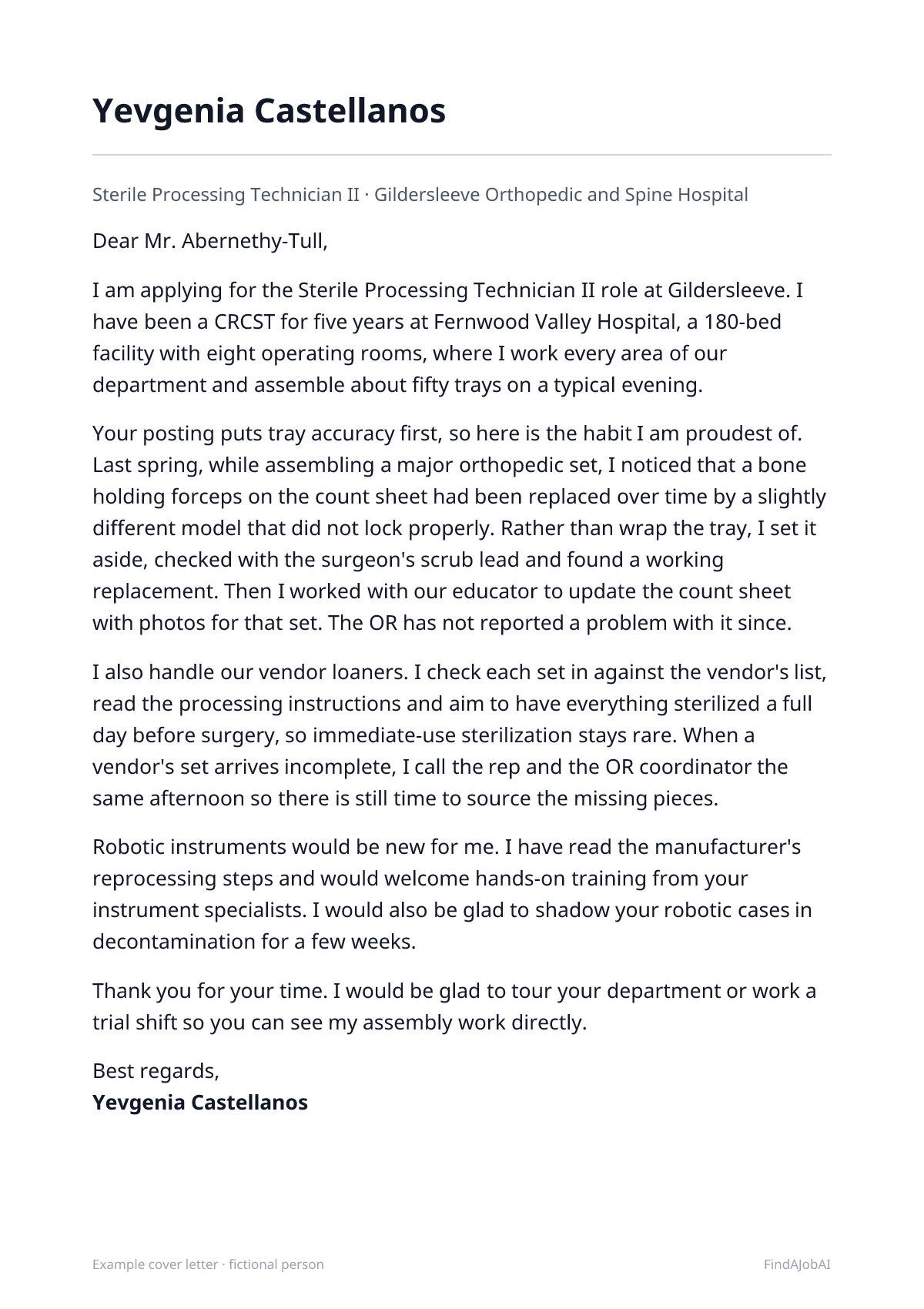
Sterile Processing Technician cover letter template
This letter as a one-page template: an opening that names the job and your strongest fact, proof that answers the ad, a reason for this employer and a short close.
After you sign up, FindAJobAI drafts your own letter for a real job from your CV in this format, and you edit it before you send it.
Example 1 · Experienced
Sterile processing technician applying to a larger hospital department
Yevgenia works at a small hospital and wants orthopedic and robotic work. The ad stresses tray accuracy and instrument knowledge.
Example letter · fictional
Dear Mr. Abernethy-Tull,
I am applying for the Sterile Processing Technician II role at Gildersleeve. I have been a CRCST for five years at Fernwood Valley Hospital, a 180-bed facility with eight operating rooms, where I work every area of our department and assemble about fifty trays on a typical evening.
Your posting puts tray accuracy first, so here is the habit I am proudest of. Last spring, while assembling a major orthopedic set, I noticed that a bone holding forceps on the count sheet had been replaced over time by a slightly different model that did not lock properly. Rather than wrap the tray, I set it aside, checked with the surgeon's scrub lead and found a working replacement. Then I worked with our educator to update the count sheet with photos for that set. The OR has not reported a problem with it since.
I also handle our vendor loaners. I check each set in against the vendor's list, read the processing instructions and aim to have everything sterilized a full day before surgery, so immediate-use sterilization stays rare. When a vendor's set arrives incomplete, I call the rep and the OR coordinator the same afternoon so there is still time to source the missing pieces.
Robotic instruments would be new for me. I have read the manufacturer's reprocessing steps and would welcome hands-on training from your instrument specialists. I would also be glad to shadow your robotic cases in decontamination for a few weeks.
Thank you for your time. I would be glad to tour your department or work a trial shift so you can see my assembly work directly.
Best regards,
Yevgenia Castellanos
Example 2 · Career changer
Warehouse order picker moving into sterile processing
Dashiell picked orders in a warehouse for four years, then finished a sterile processing course. The ad is for an entry-level SPD tech.
Example letter · fictional
Dear Ms. Hargreaves-Pinto,
I'm applying for the Sterile Processing Technician I opening at Rookwood Lutheran. I spent four years as an order picker in a large distribution center, and this winter I completed a sterile processing certificate with 400 hands-on hours at a teaching hospital. I hold provisional CRCST status.
Picking orders taught me something that turned out to matter a lot in sterile processing: a near miss on a count still counts as a miss. My scan accuracy stayed above 99.8% because I checked every item twice, even on peak nights. In the department, that same habit made assembling trays from count sheets feel natural, and my preceptor rarely had to send a tray back to me.
During my hours, I worked in decontamination, prep and pack and sterilization. I learned to brush lumens following the instructions for use, load the washer so water reaches every surface, and read chemical indicators before releasing packs. One night I noticed a peel pouch with a small tear along its seal after cooling. I pulled it, reported it and reprocessed the item, which my preceptor noted in my evaluation. I also learned to log every load carefully, because I saw how a clear record made a small recall drill take minutes rather than an hour.
I know I still have a lot to learn about specialty instruments, and I would appreciate a structured orientation. I'm available for evening and weekend shifts. Your posting mentions a growing endoscopy service, and I'd be glad to train toward CER.
Thank you for considering my application. I'd welcome the chance to meet your team and show what I've learned.
Kind regards,
Dashiell Omondi
Example 3 · Senior or lead
Lead sterile processing technician applying for a department supervisor role
Perpetua leads an evening SPD shift and wants a supervisor role. The ad stresses OR relations, staffing and survey readiness.
Example letter · fictional
Dear Dr. Whitcombe-Adair,
I'm applying for the Sterile Processing Supervisor position at Calloway Ridge. I have twelve years in sterile processing and hold CRCST and CHL certification. For the past four years I've led the evening shift at Ashgrove University Hospital, a team of fourteen technicians supporting twenty-six operating rooms.
Your posting mentions strained relations with the OR, which I recognize. When I took over evenings, surgeons were calling our department daily about missing instruments, and my team felt blamed for problems they couldn't see. I started a short daily huddle with the OR charge nurse, began tracking every reported tray error by set and cause, and shared the results with both teams each month. Most errors came from five outdated count sheets. We rewrote them with photos, and reported tray errors dropped by about half within six months.
Survey readiness is the other part of the role I enjoy. I review load records, cleaning verification logs and competency files each month, so nothing is scrambled together the week a surveyor arrives. Our last two inspections closed with no findings in sterile processing. I also walk the department with a new technician each quarter as a mock surveyor, asking what an inspector would ask and fixing what we find.
I have not supervised day and night shifts together, and I would spend my first weeks working alongside each shift before changing anything. I'd also meet the OR leaders early to hear their concerns first-hand.
I would welcome a conversation about where your department stands today and what the OR most needs from sterile processing.
Sincerely,
Perpetua Lindahl
All three letters, and the short version below, are fictional: the people, employers and numbers are invented. Borrow the structure, never the facts.
- Prefer to write it yourself? Use the free cover letter template.
- Check your CV against the job first: the free CV score shows the missing keywords.
Why the first letter works, paragraph by paragraph
Paragraph 1: Opening
Gives certification, facility size, rooms supported and daily tray volume in two sentences, so the manager sees the scale of current work.
Paragraph 2: Accuracy story
A faulty forceps caught before wrapping, followed by an updated count sheet, proves attention to detail and a habit of fixing root causes.
Paragraph 3: Loaner process
Shows the writer plans ahead so immediate-use sterilization stays rare, a common concern for SPD managers.
Paragraph 4: Honest gap
Names robotic instruments as new and asks for training, which builds trust with a reader who will test that skill anyway.
Paragraph 5: Close
Offers a tour or trial shift, a practical next step that lets the work speak for itself.
What the career changer's letter does differently
The career changer's letter turns warehouse picking into sterile processing strengths: double-checking counts and accuracy under pressure. It then proves readiness with hands-on hours, specific steps learned and one real catch, and asks plainly for a structured orientation.
What the senior letter does differently
A lead technician's letter talks about systems: a daily huddle with the OR, error tracking by cause and rewritten count sheets. It shows survey readiness as a monthly habit and names whole-department supervision as an honest gap with a plan to learn each shift first.
Short sterile processing technician cover letter: an email-ready version
Many applications arrive as an email or a small text box, and a full page doesn't fit. This version runs 120 to 150 words and keeps only what a reader needs to decide whether to reply. A sterile processing technician replies to a staffing recruiter's message about a night-shift opening, attaching a resume.
Short version · email · fictional132 words
Subject: SPD Technician, nights – CRCST and CER, 4 years hospital SPD – Anselm Okorafor
Hello Mr. Delacroix-Benn,
Thank you for your message about the night-shift Sterile Processing Technician role at Brackenridge General. I am CRCST and CER certified and have worked four years in a hospital department supporting fourteen operating rooms and an endoscopy unit.
On nights I usually cover decontamination and sterilization alone for part of the shift, so I am comfortable running steam and low-temperature loads, completing load records and reprocessing flexible endoscopes for the morning list. I also build case carts for the first cases of the day. I double-check every endoscope's leak test and drying record before release, and I leave clear notes for the day lead about anything unusual.
My resume is attached. I'm free to talk any weekday before noon and could start with two weeks' notice.
Best,
Anselm Okorafor
The short email covers what a recruiter needs for a night role: certifications, hospital volume, independent work, endoscopes and start date. It saves stories for the interview.
Opening lines that work for sterile processing technician cover letters
The first sentence decides whether the second gets read. Here are six openings, one for each situation you might be in. Pick the one that matches yours and swap in your own facts: every name and number below is invented.
1. You have a standout result
While assembling an orthopedic set last spring, I caught a forceps that no longer locked properly and fixed the count sheet behind it. That is the kind of care I'd bring to your trays.
2. The ad names a problem you've solved
Your posting asks for a technician who can keep up with a busy surgical schedule. I assemble about fifty trays an evening for eight operating rooms with very few errors reported back.
3. Someone referred you
Your instrument specialist, Rosamund Achebe, precepted me during my hands-on hours and suggested I apply for your evening opening.
4. You admire what they build
After four years picking orders in a distribution center, I completed a sterile processing course. I'd like to bring that habit of checking every count twice to your department.
5. You're new to the field or switching into it
Endoscope reprocessing is the part of sterile processing I know best, and your posting puts it near the top of the list.
6. You have senior scope or a specialism
As an evening lead, I cut OR-reported tray errors by about half by tracking each one to its cause. I'd like to do that across your department.
How to write a sterile processing technician cover letter
Five steps, in the order you'd write them. The shape stays the same for every job (a short opening, proof, a reason for this employer, a close), and what goes into each part is what changes with the role.
Lead with a catch or a fix
Open with one real moment: a damaged instrument pulled, a torn pouch caught after cooling or a count sheet you corrected. Sterile processing managers hire for accuracy, and a specific example in the first lines proves it better than calling yourself detail-oriented.
Give certification and scale early
State CRCST or CSPDT status, the facility type, operating rooms supported and roughly how many trays you assemble per shift. Those facts help the manager place you quickly, so the rest of the letter can focus on what sets you apart.
Match the methods and specialties in the ad
If the posting names endoscopes, low-temperature sterilization, loaners or robotic sets, say which you already handle and how often. Pick the two or three most relevant and tie each to real work instead of listing every machine you have used.
Be honest about instruments you haven't processed
Robotic, power and specialty sets need specific training. If you haven't handled them, say so briefly and mention related experience. Asking for structured training shows maturity, and it matches what the manager will learn on a tour or trial shift.
Close with shifts and a practical next step
Many sterile processing openings are evenings, nights or weekends. Say which you can work, then offer a department tour or trial shift. Clear availability and an easy next step make your letter simple for a busy manager to act on.
Sterile Processing Technician cover letter do's and don'ts
Do
- Describe one defect, missing item or packaging problem you caught and what you did next.
- State your certification status, including provisional status and the expected date.
- Give daily tray volume and the number of operating rooms you support.
- Name the sterilization methods and specialty work from the posting that you already do.
Don't
- Don't write only that you are detail-oriented; show one detail you caught.
- Don't claim experience with robotic sets or endoscopes you haven't processed.
- Don't skip documentation; managers want to know you complete load records every time.
Common sterile processing technician cover letter mistakes
Each one is easy to make and quick to fix before you send the letter.
Claiming precision with no example
Every applicant uses that phrase. Replace it with one defect or count error you caught and what you did to stop it happening again.
Leaving out documentation
Load records and cleaning verification logs support recalls and surveys. Mention that you complete them every time, especially if you've helped with an audit or recall.
Overstating specialty experience
Claiming robotic or endoscope skills you don't have is easy to spot on a trial shift. Describe what you've processed and ask for training on the rest.
Burying certification status
CRCST or CSPDT is often a requirement. Put it in your opening, or give provisional status and the date you expect to finish your hours.
Writing only about the department
Sterile processing exists to support surgery. Show how your work kept cases on time or helped the OR, and the manager sees you understand the bigger picture.
Email subject lines for sterile processing technician applications
Applying by email? Put the job title, any reference number and your name in the subject line.
- Sterile Processing Technician II – CRCST, orthopedic sets and loaner intake – Yevgenia Castellanos
- Sterile Processing Technician I – provisional CRCST, 400 hands-on hours – Dashiell Omondi
- Application: SPD Technician II, Gildersleeve (Req. 8841) – Yevgenia Castellanos
Everything for Sterile Processing Technicians
- Sterile Processing Technician resume exampleA full resume, plus bullet and summary examples
- Sterile Processing Technician interview questions30 questions with sample answers
- Sterile Processing Technician job descriptionDuties, skills and requirements
- Career change cover letter: template + examples
Other cover letter examples
Sterile Processing Technician cover letter FAQ
What should a sterile processing technician cover letter include?
Your certification, facility type and tray volume, then one story about a defect or error you caught. Add the sterilization methods or specialty work the posting stresses and close with availability or an offer to tour the department.
How do I write a sterile processing cover letter with no experience?
Lead with your sterile processing course, hands-on hours and provisional certification. Connect earlier work, such as warehouse, lab or kitchen jobs, to the accuracy and routine that sterile processing needs, and give one example from your hours.
Should I mention certification in a sterile processing cover letter?
Yes. Many hospitals and some states require CRCST or CSPDT. State your status in the first paragraph, including provisional status or an exam date if you are close.
How we built this page
The FindAJobAI team wrote the three example letters, the short email version, the opening lines and the advice for sterile processing technician roles. The people, employers and numbers in the letters are invented; the structure, the kind of evidence and the order of the paragraphs are the parts to copy.
Once we track enough live sterile processing technician job ads, this page also shows the skills they ask for most, counted the same way as our in-demand skills report.
Last reviewed on November 1, 2026.