Unity Developer Cover Letter Example (2026)
By FindAJobAI Team Updated How we built this page
Unity jobs range from mobile games to hospital training simulators, so the ad usually tells you the device and the pressure: frame rate on a headset, build size on cheap phones, or content that non-programmers must edit. A good letter answers that pressure with one project where you met it.
Unity Developer cover letter template
This letter as a one-page template: an opening that names the job and your strongest fact, proof that answers the ad, a reason for this employer and a short close.
After you sign up, FindAJobAI drafts your own letter for a real job from your CV in this format, and you edit it before you send it.
Example 1 · Experienced
VR training developer applying to an industrial simulation company
Saoirse builds Quest training lessons in Unity. The ad asks for XR Interaction Toolkit work, URP performance and tools for instructional designers.
Example letter · fictional
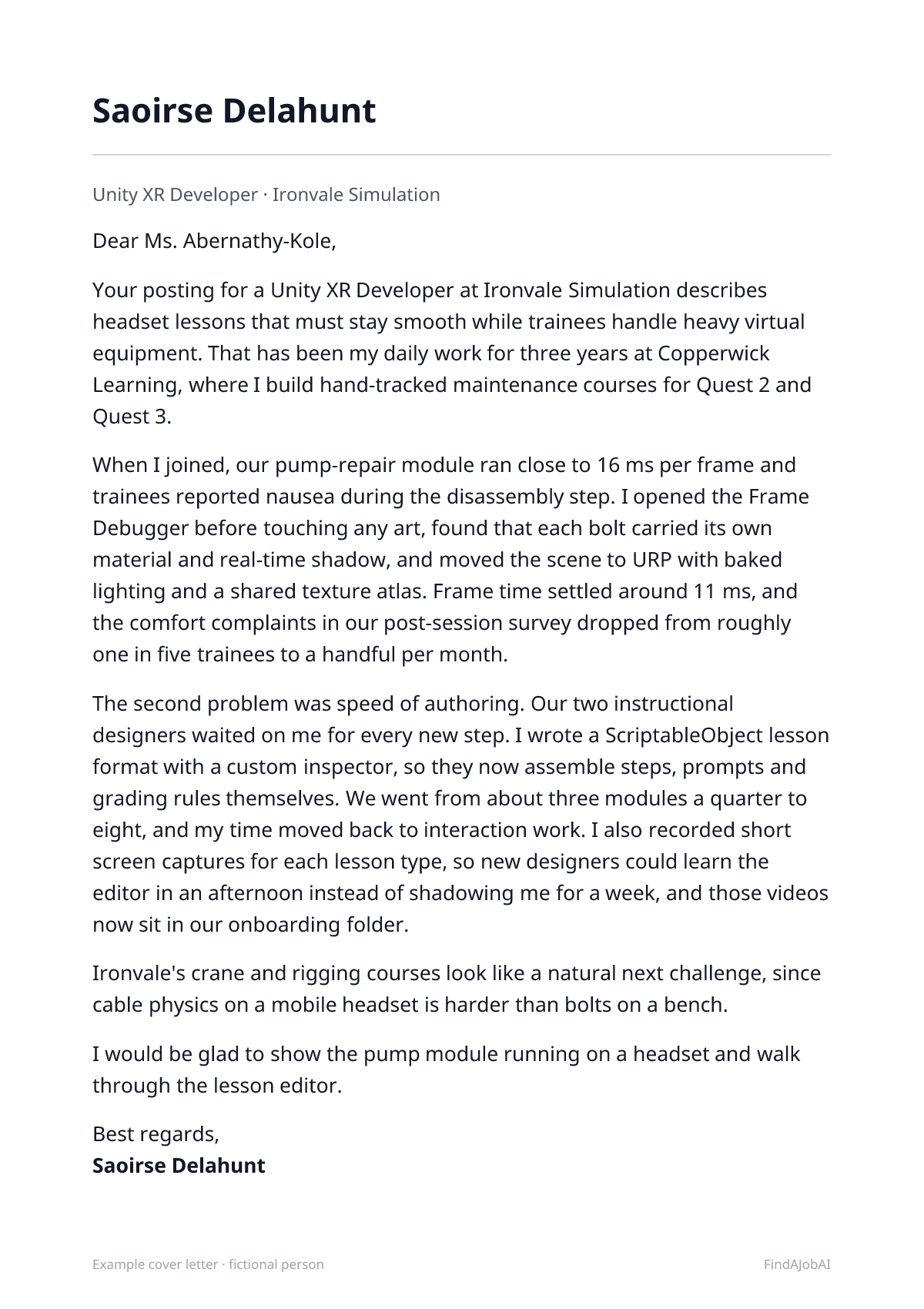
Dear Ms. Abernathy-Kole,
Your posting for a Unity XR Developer at Ironvale Simulation describes headset lessons that must stay smooth while trainees handle heavy virtual equipment. That has been my daily work for three years at Copperwick Learning, where I build hand-tracked maintenance courses for Quest 2 and Quest 3.
When I joined, our pump-repair module ran close to 16 ms per frame and trainees reported nausea during the disassembly step. I opened the Frame Debugger before touching any art, found that each bolt carried its own material and real-time shadow, and moved the scene to URP with baked lighting and a shared texture atlas. Frame time settled around 11 ms, and the comfort complaints in our post-session survey dropped from roughly one in five trainees to a handful per month.
The second problem was speed of authoring. Our two instructional designers waited on me for every new step. I wrote a ScriptableObject lesson format with a custom inspector, so they now assemble steps, prompts and grading rules themselves. We went from about three modules a quarter to eight, and my time moved back to interaction work. I also recorded short screen captures for each lesson type, so new designers could learn the editor in an afternoon instead of shadowing me for a week, and those videos now sit in our onboarding folder.
Ironvale's crane and rigging courses look like a natural next challenge, since cable physics on a mobile headset is harder than bolts on a bench.
I would be glad to show the pump module running on a headset and walk through the lesson editor.
Best regards,
Saoirse Delahunt
Example 2 · Career changer
Web developer moving into Unity for an AR retail product
Dariusz spent five years as a TypeScript developer and built two AR prototypes in Unity. The ad wants C#, ARFoundation and UI polish.
Example letter · fictional
Dear Mr. Ferreira-Holt,
I am applying for the Junior Unity Developer role at Lumenhart Commerce. For five years I have built checkout and product pages in TypeScript, and in the last eighteen months I have moved my evenings into Unity because I want to build the try-before-you-buy features I kept linking to from those pages.
My first serious project was a lamp-placement app in Unity with ARFoundation. Early builds placed lamps floating above tables, because I trusted the first detected plane. I learned to wait for plane stability, added a raycast against the latest mesh, and showed a soft shadow so users could judge contact. Friends testing on six different phones went from asking why the lamp hovered to asking where to buy it. A second prototype, a rug configurator, taught me Addressables, since loading twenty textures at startup made the app freeze on older devices.
Moving from TypeScript to C# was easier than I expected. Async patterns, component thinking and careful UI states carry over directly, and years of web work have made me picky about loading states and small screens, which your posting mentions twice. I have also started writing edit-mode tests with the Unity Test Framework for the rug configurator's pricing logic, because testing before shipping was the most valuable habit my web team taught me.
What I lack is a shipped Unity title with real store traffic. I am ready to learn your pipeline and code review standards quickly, and both prototypes are on GitHub with short videos.
Thank you for considering an unusual route into this role.
Kind regards,
Dariusz Wolanski
Example 3 · Senior or lead
Lead Unity engineer applying to unify a studio's product codebases
Oyelaran leads a five-person Unity team. The ad seeks a lead to merge three apps onto one core and set performance budgets.
Example letter · fictional
Dear Dr. Sandoval-Ikeda,
The Lead Unity Engineer opening at Quillbrook Health XR asks for someone to bring three separate apps onto one foundation without stalling releases. I did nearly that at Tamarind Reality, where I lead five Unity engineers and own the architecture behind our surgical rehearsal and patient education products.
Two years ago each of our apps had its own input layer, analytics calls and content loader, and a bug fixed in one product often survived in the others for months. Rather than pause feature work for a rewrite, I extracted one module per quarter into a shared package, starting with content loading because it caused the most crashes. Each extraction shipped behind a flag in one app first. After four quarters all three products used the shared core, and starting a new app went from roughly ten weeks of setup to about three.
I also introduced per-device frame and memory budgets checked by automated performance scenes in CI. Releases now fail before QA if a headset scene runs over budget, which ended the late-cycle optimisation scrambles we used to have. Producers now see a simple chart of frame time per headset for every build, which made budget conversations far shorter and moved debates about expensive effects from the week before release to the week a feature is proposed.
Your products also run on Pico and Windows PCs, which I have supported only lightly, so I would want to understand those pipelines before proposing changes.
I would welcome a conversation about which of your three codebases hurts the most today.
Sincerely,
Oyelaran Adeyemi-Strand
All three letters, and the short version below, are fictional: the people, employers and numbers are invented. Borrow the structure, never the facts.
- Prefer to write it yourself? Use the free cover letter template.
- Check your CV against the job first: the free CV score shows the missing keywords.
Why the first letter works, paragraph by paragraph
Paragraph 1: Opening
Repeats the ad's real pressure (smooth headset lessons under heavy interaction) and shows the writer already works under it on named devices.
Paragraph 2: The frame-time fix
Symptom, tool, root cause, change and measured result in one paragraph, with a comfort outcome that matters for a training buyer.
Paragraph 3: Tools for non-programmers
Proves the developer thinks about the content team's throughput, a frequent hidden requirement in enterprise Unity work.
Paragraph 4: Why this company
Names a specific course type and explains why it is technically harder, which signals genuine interest rather than flattery.
Paragraph 5: Close
Offers a live demo on hardware, the most convincing next step for XR work.
What the career changer's letter does differently
This letter turns a career change into a strength by describing an AR bug the writer found and fixed alone, then mapping web habits (loading states, small screens) to the ad's wording. It names the missing piece, a shipped store title, honestly instead of hiding it.
What the senior letter does differently
A lead letter reports decisions and their consequences: a gradual extraction plan chosen over a risky rewrite, the order of modules justified by crash data, budgets enforced by CI, and an honest gap on two platforms.
Short unity developer cover letter: an email-ready version
Many applications arrive as an email or a small text box, and a full page doesn't fit. This version runs 120 to 150 words and keeps only what a reader needs to decide whether to reply. A Unity developer replies by email to a recruiter who found their portfolio and asked for a resume plus a few lines about recent work.
Short version · email · fictional127 words
Subject: Unity Developer (mobile, Addressables) – Ainhoa Zubizarreta
Hi Mr. Nakagawa-Reyes,
Thanks for reaching out about the Unity Developer role at Brackenfold Games. I have four years of C# work on casual mobile titles, mostly on content delivery and performance for older Android phones.
My most useful recent project was shrinking our puzzle game's install size. Large downloads were costing us players in markets with slow connections, so I moved music, seasonal art and later levels to Addressables served from a CDN and kept only the first twenty levels in the base build. The download dropped by roughly half, and store reviews about size nearly disappeared.
Your games target similar markets, so this felt relevant. My resume is attached, and I am happy to share a short write-up of the Addressables setup.
Best,
Ainhoa Zubizarreta
The email stays under 150 words: one sentence of background, one measurable project tied to the recruiter's market, and a light offer of more detail.
Opening lines that work for unity developer cover letters
The first sentence decides whether the second gets read. Here are six openings, one for each situation you might be in. Pick the one that matches yours and swap in your own facts: every name and number below is invented.
1. You have a standout result
Your ad mentions frame drops on standalone headsets during busy scenes. I spent last spring bringing a Quest training module from 16 ms to 11 ms per frame, and I would like to do the same work for your simulators.
2. The ad names a problem you've solved
Our casual puzzle game lost players at the download screen until I moved most of its content to Addressables; I'd like to bring that habit of measuring build size to your mobile team.
3. Someone referred you
Kestrel Ambrose, who mentored me at a regional game jam, told me your team needs a Unity developer comfortable writing tools for designers. Editor scripting is the part of Unity I enjoy most.
4. You admire what they build
I have shipped Unity apps for warehouse training, retail AR and a mobile word game, and each taught me a different way a build can fail on real devices.
5. You're new to the field or switching into it
After five years of building web storefronts, I taught myself Unity to make the AR previews I kept linking to. Two finished prototypes later, I'm applying to do it full time.
6. You have senior scope or a specialism
Three products on one shared C# core, with budgets enforced in CI, is the result I'm proudest of as a lead, and it's close to what your posting asks for.
How to write a unity developer cover letter
Five steps, in the order you'd write them. The shape stays the same for every job (a short opening, proof, a reason for this employer, a close), and what goes into each part is what changes with the role.
Find the device and pressure in the ad
Unity ads usually reveal a target device and a pain point: headset comfort, phone install size, console certification or content throughput. Underline it, then choose the one project in your history that dealt with the same pressure, even if the industry differs.
Open with the problem, then name the tool
Describe what users or testers saw first, such as stutter, a crash or an oversized download. Then say how you investigated it with the Profiler, Frame Debugger, Memory Profiler or device logs, which shows a method the reader can trust you to repeat.
Give the result on named hardware
State the outcome in frame time, fps, megabytes, crash-free sessions or survey comments, and always say which phone or headset it was measured on. If exact figures are confidential, describe the change in relative terms.
Add one line about other disciplines
Unity developers often build editors, importers or lesson formats for designers and artists. One sentence on a tool you made for them, and how it changed their output, shows you improve the whole team's speed.
Close with something they can see running
Offer a short video, a WebGL build or a headset demo instead of a generic request for a call. Visual work is judged fastest by watching it, and a concrete offer gives the reader an easy reply.
Unity Developer cover letter do's and don'ts
Do
- Name the device and Unity feature in your main story, such as URP on Quest 3 or Addressables on older Android phones.
- Describe how you found a problem (profiler, frame debugger, device testing) before you describe the fix.
- Mention one tool or workflow you built for designers, artists or instructors, since many Unity teams depend on it.
Don't
- Don't fill the letter with a package list; your resume already carries it.
- Don't claim performance gains without the hardware they were measured on.
- Don't share client builds, proprietary assets or internal tools from a current employer without permission.
Common unity developer cover letter mistakes
Each one is easy to make and quick to fix before you send the letter.
Listing every Unity package you have touched
A long list hides depth. Pick the two or three packages central to the ad and show them inside a real project story instead.
Claiming optimisation without measurements
Words like faster or smoother give no scale. Add the frame time, fps or memory figure before and after, plus the device you tested on.
Treating simulation or AR roles like game jobs
Enterprise buyers care about reliability, content updates and comfort. Talk about uptime, authoring tools and user feedback rather than fun or genre taste.
Hiding a career change
Name your previous field and show which habits carry over, such as UI states from web work or physics intuition from engineering, so the switch reads as deliberate.
Sending no visual evidence
Unity work is visual. Include a link to a short clip or playable build and say which thirty seconds to watch first.
Email subject lines for unity developer applications
Applying by email? Put the job title, any reference number and your name in the subject line.
- Unity XR Developer application: Quest performance and lesson tooling – Saoirse Delahunt
- Junior Unity Developer – ARFoundation prototypes, 5 years TypeScript – Dariusz Wolanski
- Application: Unity Developer, Simulation Team (Ref. 4472) – Saoirse Delahunt
Everything for Unity Developers
- Unity Developer resume exampleA full resume, plus bullet and summary examples
- Unity Developer interview questions30 questions with sample answers
- Unity Developer job descriptionDuties, skills and requirements
- Career change cover letter: template + examples
Other cover letter examples
Unity Developer cover letter FAQ
What should a Unity developer cover letter focus on?
One project on the platform the ad targets: what was slow or broken, which Unity tool showed you why, what you changed, and the result in frame time, build size, crash rate or user feedback.
How do I apply for a Unity job without professional Unity experience?
Lead with a finished prototype that solves a real problem, explain one bug you fixed in it, and connect skills from your current job to the ad. Link a video so the reader can see it run.
Should a Unity cover letter mention games if the job is in simulation or AR?
Only if the skill transfers directly, such as physics, performance or input handling. Industrial and retail employers care more about reliability and content workflows than genre experience.
How long should a Unity developer cover letter be?
Around 250 to 350 words: an opening tied to the ad, one technical story, one collaboration point and a short close offering a demo or walkthrough.
How we built this page
The FindAJobAI team wrote the three example letters, the short email version, the opening lines and the advice for unity developer roles. The people, employers and numbers in the letters are invented; the structure, the kind of evidence and the order of the paragraphs are the parts to copy.
Once we track enough live unity developer job ads, this page also shows the skills they ask for most, counted the same way as our in-demand skills report.
Last reviewed on November 1, 2026.