Cardiovascular Technologist Resume Example (2026)
By FindAJobAI Team Updated How we built this page
Cardiovascular technologist postings usually name the lab and the credential first: invasive cath lab work with an RCIS, electrophysiology with an RCES, or noninvasive testing with an RCS or CCT. Hiring managers then look for case volume, the procedures you scrub, circulate or monitor, and whether you can take call for STEMI activations.
The example below is an invasive cardiovascular technologist with six years in a high-volume hospital cath lab. Each bullet gives the procedure type, the role in the room and a number, such as cases per week, door-to-balloon times or inventory savings.
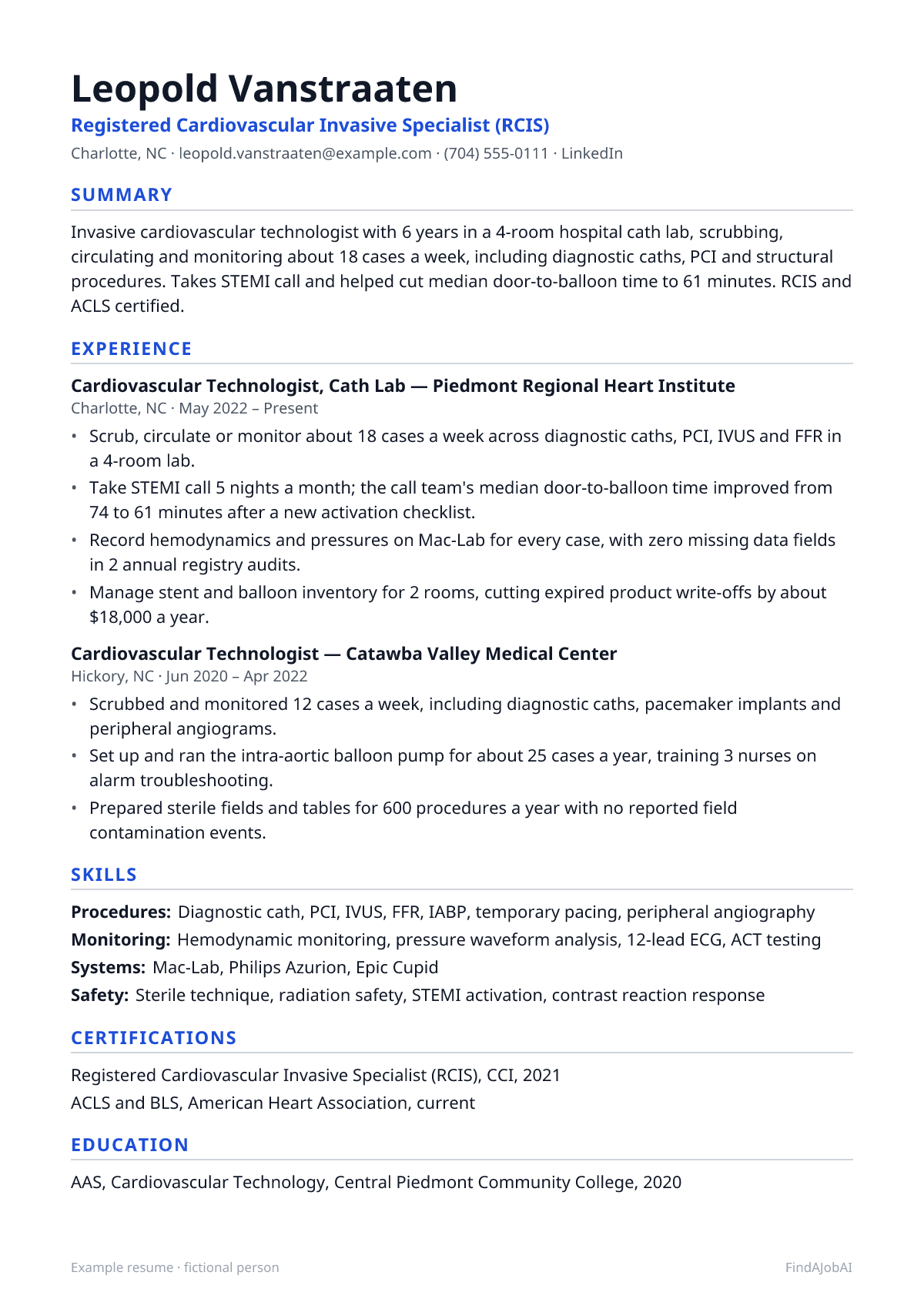
Cardiovascular Technologist resume template
This example as a one-page template: one column, standard headings and plain text, the format applicant tracking systems read most reliably.
After you sign up, Create my CV builds your own resume in this same one-column layout, from your real experience.
Mid-level cardiovascular technologist resume example
A complete one-page example for a fictional cardiovascular technologist: every bullet pairs an action with what changed because of it.
Example resume · fictional person
Leopold Vanstraaten
Registered Cardiovascular Invasive Specialist (RCIS)
Charlotte, NC · [email protected] · (704) 555-0111 · LinkedIn
Summary
Invasive cardiovascular technologist with 6 years in a 4-room hospital cath lab, scrubbing, circulating and monitoring about 18 cases a week, including diagnostic caths, PCI and structural procedures. Takes STEMI call and helped cut median door-to-balloon time to 61 minutes. RCIS and ACLS certified.
Experience
Cardiovascular Technologist, Cath Lab, Piedmont Regional Heart Institute
Charlotte, NC · May 2022 – Present
- Scrub, circulate or monitor about 18 cases a week across diagnostic caths, PCI, IVUS and FFR in a 4-room lab.
- Take STEMI call 5 nights a month; the call team's median door-to-balloon time improved from 74 to 61 minutes after a new activation checklist.
- Record hemodynamics and pressures on Mac-Lab for every case, with zero missing data fields in 2 annual registry audits.
- Manage stent and balloon inventory for 2 rooms, cutting expired product write-offs by about $18,000 a year.
Cardiovascular Technologist, Catawba Valley Medical Center
Hickory, NC · Jun 2020 – Apr 2022
- Scrubbed and monitored 12 cases a week, including diagnostic caths, pacemaker implants and peripheral angiograms.
- Set up and ran the intra-aortic balloon pump for about 25 cases a year, training 3 nurses on alarm troubleshooting.
- Prepared sterile fields and tables for 600 procedures a year with no reported field contamination events.
Skills
- Procedures: Diagnostic cath, PCI, IVUS, FFR, IABP, temporary pacing, peripheral angiography
- Monitoring: Hemodynamic monitoring, pressure waveform analysis, 12-lead ECG, ACT testing
- Systems: Mac-Lab, Philips Azurion, Epic Cupid
- Safety: Sterile technique, radiation safety, STEMI activation, contrast reaction response
Certifications
- Registered Cardiovascular Invasive Specialist (RCIS), CCI, 2021
- ACLS and BLS, American Heart Association, current
Education
- AAS, Cardiovascular Technology, Central Piedmont Community College, 2020
Fictional example by the FindAJobAI team: the person, employers and numbers are invented. Keep the structure; use your own work and numbers you can explain in an interview.
Entry-level cardiovascular technologist resume example
A new graduate with clinical rotations but no paid cath lab job yet. Education sits first, and the rotation entries count supervised cases and name procedures so a lab manager can see exactly what the graduate has already handled.
Entry-level example resume · fictional person
Octavia Ravensworth
Cardiovascular Technologist (RCIS eligible)
Richmond, VA · [email protected] · (804) 555-0153 · LinkedIn
Summary
Cardiovascular technology graduate with 900 clinical hours across a hospital cath lab and a noninvasive lab. Trained in scrubbing diagnostic caths, hemodynamic monitoring, 12-lead ECG and stress testing. BLS and ACLS certified and scheduled to sit the RCIS exam this year.
Education
- AAS, Cardiovascular Technology, Reynolds Community College, 2026
Experience
Cardiovascular Technology Clinical Student, James River Medical Center
Richmond, VA · Aug 2025 – Apr 2026
- Scrubbed 85 diagnostic caths and 30 PCI cases under supervision in a 3-room lab.
- Monitored hemodynamics on 60 cases, documenting pressures and rhythm changes for the attending physician.
- Prepared sterile tables for about 150 procedures and passed every sterile technique competency check.
- Performed 40 treadmill stress tests in the noninvasive lab with a technologist present.
Patient Care Technician, Westover Heart Hospital
Richmond, VA · Jun 2023 – Jul 2025
- Recorded vitals and 12-lead ECGs for up to 14 telemetry patients a shift.
- Assisted with 20 patient transfers a week to and from the cath lab recovery area.
Skills
- Procedures: Diagnostic cath scrub, PCI assist, stress testing, 12-lead ECG
- Monitoring: Hemodynamic monitoring, rhythm recognition, ACT testing
- Systems: Mac-Lab (clinical), GE stress testing system
- Safety: Sterile technique, radiation protection, patient transfer
Certifications
- ACLS and BLS, American Heart Association, current
- RCIS exam scheduled, 2026
Senior cardiovascular technologist resume example
A lead technologist thirteen years in, now running a combined cath and EP lab. The bullets shift from cases to staffing, throughput, inventory spend and program launches, while a line on still scrubbing complex cases keeps clinical credibility.
Senior example resume · fictional person
Ambrose Kettleborough
Lead Cardiovascular Technologist, Cath and EP Lab
Nashville, TN · [email protected] · (615) 555-0168 · LinkedIn
Summary
Lead cardiovascular technologist with 13 years in invasive cardiology, running daily operations for a 5-room cath and EP lab with 22 staff. Owns scheduling, inventory and registry reporting, and helped launch a structural heart program that grew to 140 TAVR cases a year.
Experience
Lead Cardiovascular Technologist, Cumberland Heart and Vascular Center
Nashville, TN · Feb 2019 – Present
- Lead 22 technologists and nurses across 5 cath and EP rooms handling about 5,200 procedures a year.
- Rebuilt room scheduling and turnover, raising first-case on-time starts from 58% to 86%.
- Negotiated consignment for high-cost devices, reducing on-hand inventory value by $310,000.
- Helped launch a structural heart program, training 9 staff on TAVR roles; volume grew to 140 cases a year.
Senior Cardiovascular Technologist, Belle Meade Medical Center
Nashville, TN · Jul 2015 – Jan 2019
- Scrubbed and monitored 20 cases a week including complex PCI, atherectomy and Impella support.
- Served as registry data lead, keeping NCDR CathPCI submissions complete for 12 straight quarters.
- Precepted 11 new technologists through a 12-week orientation.
Cardiovascular Technologist, Harpeth Valley Hospital
Franklin, TN · Jun 2013 – Jun 2015
- Scrubbed and monitored 14 diagnostic and interventional cases a week.
- Covered STEMI call 6 nights a month on a 4-person team.
Skills
- Leadership: Staff scheduling, orientation programs, throughput, vendor negotiation
- Procedures: Complex PCI, atherectomy, Impella, TAVR support, EP studies
- Quality: NCDR CathPCI registry, radiation dose tracking, peer review
- Systems: Mac-Lab, Siemens Artis, Epic Cupid, inventory software
Certifications
- RCIS, CCI, 2014
- RCES, CCI, 2018
- ACLS and BLS, current
Education
- BS, Health Sciences, Middle Tennessee State University, 2013
How to write a cardiovascular technologist resume
Five steps, in the order a recruiter reads the page. The format around them stays plain for every job: one column, standard headings, newest role first.
Header: name, target title and links
Use the title “Cardiovascular Technologist” plus your lab focus, and put your credential (RCIS, RCES, RCS or CCT) right after your name.
Summary: what you do and your best proof
State your credential, years, lab type, weekly case volume and the main procedures you support, plus call coverage. One result, such as a door-to-balloon improvement or registry accuracy, makes the summary specific.
Experience: newest first, a result in every bullet
Start each bullet with the procedure and your role (scrub, circulate, monitor), then the volume and a result. Name devices and systems the way postings do, such as IVUS, FFR, IABP or Mac-Lab.
Skills: grouped, in the ad's words
Group skills into procedures, monitoring, systems and safety. Keep invasive, EP and noninvasive skills distinct so a manager can match you to the right lab quickly.
Education and certifications
List your cardiovascular technology program and year, and add clinical hours and case counts if you're a recent graduate. Credentials and ACLS/BLS go in their own section with dates.
Skills to put on a cardiovascular technologist resume
Hard skills are the tools and methods of the job; soft skills are how you work with people. Each comes with one way to prove it, because a skill named only in a list counts for little. Add the ones you really have.
Hard skills
- Scrubbing diagnostic caths and PCI
- Give weekly case volume and the device types you handle.
- Hemodynamic monitoring
- Name the recording system and an accuracy result such as complete registry data.
- Circulating
- Describe room setup, supply runs and documentation you own during a case.
- IVUS and FFR
- Say how many cases a month use them and your role in setup.
- Intra-aortic balloon pump
- Give annual cases and any training you provide.
- Temporary pacing
- Mention how often you set up and monitor temporary wires.
- 12-lead ECG and rhythm recognition
- Show where you use it, such as pre-case baselines.
- STEMI activation response
- Give call frequency and your team's door-to-balloon results.
- Sterile technique
- Point to competency checks or a contamination-free record.
- Radiation safety
- Mention dose tracking or shielding practices you follow.
- Inventory management
- Give a savings figure or a reduction in expired product.
- Registry documentation (NCDR)
- State audit results or submission completeness.
Soft skills
- Calm in emergencies
- Describe your role during a code or a crashing patient in general terms.
- Anticipation
- Show how you prepare devices before the physician asks.
- Team communication
- Mention time-outs, closed-loop callouts or huddles you lead.
- Attention to detail
- Point to error-free documentation or count records.
- Patient reassurance
- Describe how you explain the procedure to an anxious patient on the table.
- Flexibility
- Mention covering extra call or switching rooms during busy days.
- Precepting
- Count new staff or students you trained.
Cardiovascular Technologist resume bullet examples: weak vs strong
The same work, written two ways. The strong version names the tool, the scope and a result; the numbers are examples, yours must be real.
Weak: Worked in the cath lab.
Strong: Scrubbed, circulated or monitored about 18 cath lab cases a week, including PCI, IVUS and FFR, in a 4-room lab.
Gives volume, roles and procedure types.
Weak: Took call.
Strong: Covered STEMI call 5 nights a month on a team that cut median door-to-balloon time from 74 to 61 minutes.
Ties call coverage to a patient outcome metric.
Weak: Monitored patients.
Strong: Recorded hemodynamics and pressure waveforms on Mac-Lab for every case, with no missing registry fields in 2 audits.
Shows accuracy that matters for registry reporting.
Weak: Responsible for supplies.
Strong: Managed stent and balloon inventory for 2 rooms, cutting expired product write-offs by about $18,000 a year.
Puts a dollar value on inventory work.
Weak: Ran balloon pumps.
Strong: Set up and ran the intra-aortic balloon pump for about 25 cases a year and trained 3 nurses on alarm troubleshooting.
Shows a specialized skill and teaching.
Weak: Kept a sterile field.
Strong: Prepared sterile tables for about 600 procedures a year with no reported field contamination events.
Turns a routine duty into a safety record.
15 more cardiovascular technologist resume bullet examples
Grouped by area of the job, so you can find the ones closest to your work. Keep the shape (action, scope, result) and replace the invented numbers with your own.
Procedures and monitoring
- Monitored hemodynamics for 900 cases a year, flagging pressure changes to the physician within seconds.
- Set up Impella support for 30 high-risk PCI cases a year with no device setup delays.
- Scrubbed 250 peripheral angiograms and interventions a year, including atherectomy.
- Ran ACT testing at set intervals on every heparinized case, keeping results logged in real time.
Emergency response
- Answered 60 STEMI activations a year, arriving within the lab's 30-minute call window every time.
- Wrote a STEMI room setup checklist that trimmed table preparation from 12 minutes to 7.
- Assisted in 15 in-lab codes a year, managing defibrillator pads and the code documentation.
Quality and safety
- Cut average fluoroscopy time by 14% through a team dose-awareness project with 2 physicians.
- Kept NCDR registry fields complete for 8 consecutive quarters as data reviewer.
- Led 4 annual sterile technique refreshers for 18 staff with zero field breaches reported.
- Reduced contrast use per diagnostic case by 10% by tracking volumes and sharing monthly reports.
Inventory and training
- Tracked 1,200 stocked devices with barcode scanning, cutting expired write-offs by 40%.
- Precepted 7 new technologists through a 10-week orientation, all signed off on time.
- Built a quick-reference binder for 25 common devices used by float staff.
- Ran monthly par-level reviews with the buyer, keeping stockouts under 2 a quarter.
Cardiovascular Technologist resume summary examples
Two or three lines on what you do and your strongest proof. Start from the one closest to your level and use your own facts.
Cardiovascular technology graduate with 900 clinical hours in a hospital cath lab and noninvasive lab, trained in scrubbing diagnostic caths, hemodynamic monitoring and 12-lead ECG. BLS and ACLS certified and preparing for the RCIS exam.
Invasive cardiovascular technologist with 6 years in a 4-room cath lab, scrubbing, circulating and monitoring about 18 cases a week. Takes STEMI call and holds the RCIS.
Lead cardiovascular technologist with 13 years in invasive cardiology, running daily operations for a 5-room cath and EP lab with 22 staff. Owns scheduling, inventory and quality reporting and helped launch a structural heart program.
Common cardiovascular technologist resume mistakes
Each one is easy to make and quick to fix before you apply.
No case volume
"Assisted in the cath lab" tells a manager nothing. Give cases per week and the procedure mix.
Credential buried at the end
RCIS, RCES or RCS is often a hard requirement. Put it next to your name or in the headline.
Mixing invasive and noninvasive work
Group procedures by lab type so a reader can quickly see whether you fit their role.
Leaving out call coverage
Many labs require STEMI call. State how often you cover it and your team's response results.
Generic device lists
Name specific devices and systems you've used, such as IABP, Impella or Mac-Lab, instead of "various equipment".
ATS tips for a cardiovascular technologist resume
Applicant tracking systems turn your file into text that recruiters search, mostly for the skills and titles in the ad. They rarely reject a resume on their own; one that parses badly or misses the ad's words just doesn't come up.
- Put your credential (RCIS, RCES, RCS or CCT) in the headline; it is often the first screening filter.
- Give weekly case volume and name the procedure types you scrub, circulate or monitor.
- Mention STEMI call coverage and any door-to-balloon or registry results your team achieved.
- Name the hemodynamic recording system and imaging equipment you have used.
- List ACLS and BLS with current status; most cath labs require both.
For the format itself, run the free ATS resume checklist.
Everything for Cardiovascular Technologists
- Cardiovascular Technologist cover letter examplesThree example letters and a short email version
- Cardiovascular Technologist interview questions30 questions with sample answers
- Cardiovascular Technologist job descriptionDuties, skills and requirements
- How to tailor your resume without lying
Other resume examples
Cardiovascular Technologist resume FAQ
What should a cardiovascular technologist resume include?
Your credential, the lab type (invasive, EP or noninvasive), weekly case volume, the procedures you support and in which role, call coverage, and the recording or imaging systems you use. ACLS and BLS should be listed as current.
How do I show cath lab experience as a new graduate?
Treat clinical rotations like jobs: give total hours, the number of cases you scrubbed or monitored under supervision, and the procedure types. Mention your planned credential exam date.
Should I separate invasive and noninvasive experience?
Yes. Group procedures by lab type so a hiring manager can quickly see whether you match an invasive, EP or echo and stress testing role.
How we built this page
The FindAJobAI team wrote the three example resumes, the bullets, the skills and the advice for cardiovascular technologist roles. The people, employers and numbers in the examples are invented; the structure, the tools and the way each bullet is built are the parts to copy.
Once we track enough live cardiovascular technologist job ads, this page also shows the skills they ask for most, counted the same way as our in-demand skills report.
Last reviewed on November 1, 2026.