Respiratory Therapist Resume Example (2026)
By FindAJobAI team Updated How we built this page
Respiratory therapist job postings almost always list the same credentials up front: RRT or CRT, state license, and specific equipment like ventilators and ABG analyzers. Beyond that, hiring managers are reading for judgment calls under pressure. A respiratory therapist resume should show a patient situation, what you decided, and what happened next.
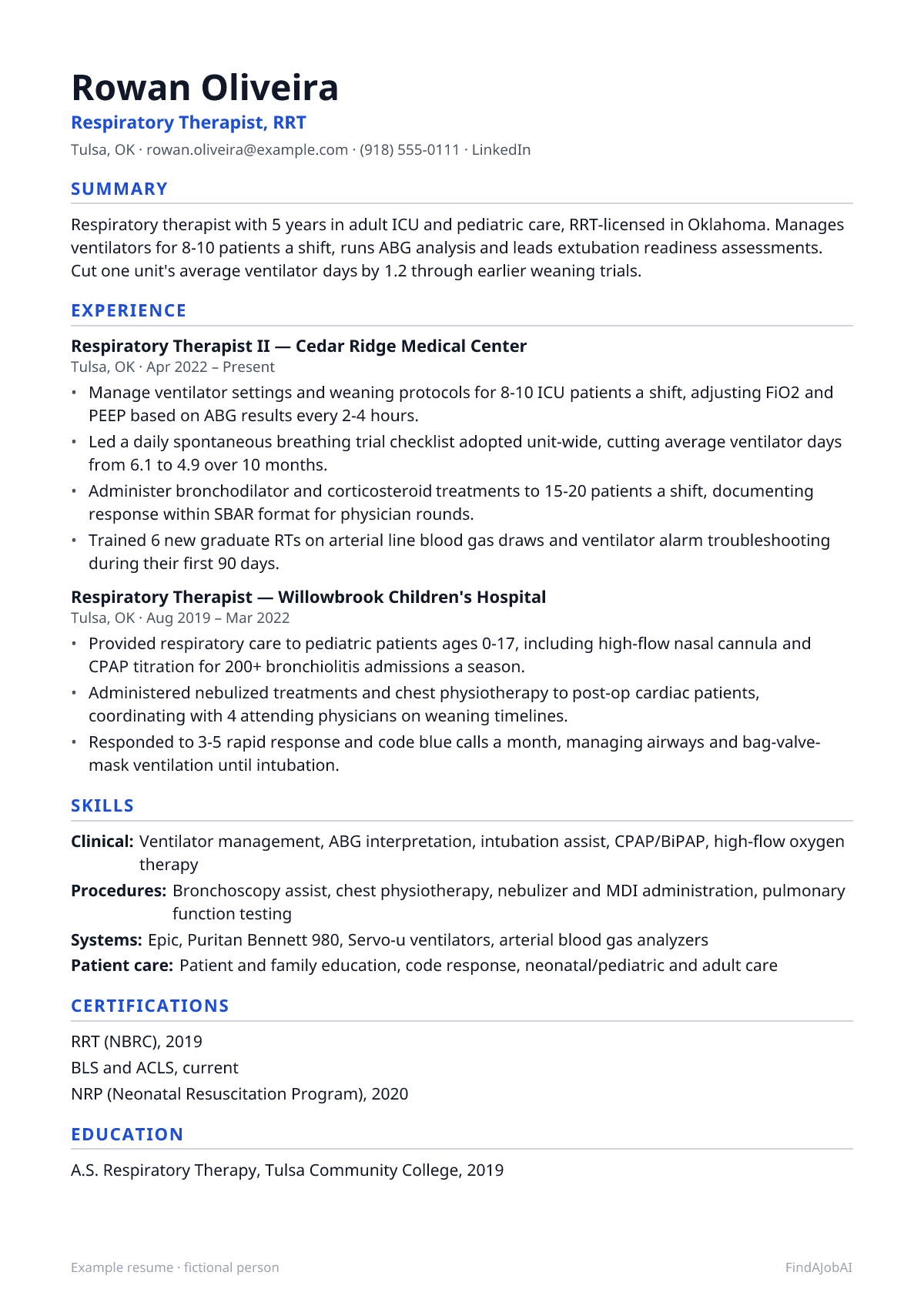
The example below is a respiratory therapist with five years split between a community hospital ICU and a children's hospital. Notice how each bullet names the setting, the intervention and the outcome, instead of just listing procedures performed.
Respiratory Therapist resume template
This example as a one-page template: one column, standard headings and plain text, the format applicant tracking systems read most reliably.
After you sign up, Create my CV builds your own resume in this same one-column layout, from your real experience.
Mid-level respiratory therapist resume example
A complete one-page example for a fictional respiratory therapist: every bullet pairs an action with what changed because of it.
Example resume · fictional person
Summary
Respiratory therapist with 5 years in adult ICU and pediatric care, RRT-licensed in Oklahoma. Manages ventilators for 8-10 patients a shift, runs ABG analysis and leads extubation readiness assessments. Cut one unit's average ventilator days by 1.2 through earlier weaning trials.
Experience
Respiratory Therapist II, Cedar Ridge Medical Center
Tulsa, OK · Apr 2022 – Present
- Manage ventilator settings and weaning protocols for 8-10 ICU patients a shift, adjusting FiO2 and PEEP based on ABG results every 2-4 hours.
- Led a daily spontaneous breathing trial checklist adopted unit-wide, cutting average ventilator days from 6.1 to 4.9 over 10 months.
- Administer bronchodilator and corticosteroid treatments to 15-20 patients a shift, documenting response within SBAR format for physician rounds.
- Trained 6 new graduate RTs on arterial line blood gas draws and ventilator alarm troubleshooting during their first 90 days.
Respiratory Therapist, Willowbrook Children's Hospital
Tulsa, OK · Aug 2019 – Mar 2022
- Provided respiratory care to pediatric patients ages 0-17, including high-flow nasal cannula and CPAP titration for 200+ bronchiolitis admissions a season.
- Administered nebulized treatments and chest physiotherapy to post-op cardiac patients, coordinating with 4 attending physicians on weaning timelines.
- Responded to 3-5 rapid response and code blue calls a month, managing airways and bag-valve-mask ventilation until intubation.
Skills
- Clinical: Ventilator management, ABG interpretation, intubation assist, CPAP/BiPAP, high-flow oxygen therapy
- Procedures: Bronchoscopy assist, chest physiotherapy, nebulizer and MDI administration, pulmonary function testing
- Systems: Epic, Puritan Bennett 980, Servo-u ventilators, arterial blood gas analyzers
- Patient care: Patient and family education, code response, neonatal/pediatric and adult care
Certifications
- RRT (NBRC), 2019
- BLS and ACLS, current
- NRP (Neonatal Resuscitation Program), 2020
Education
- A.S. Respiratory Therapy, Tulsa Community College, 2019
Fictional example by the FindAJobAI team: the person, employers and numbers are invented. Keep the structure; use your own work and numbers you can explain in an interview.
Entry-level respiratory therapist resume example
A new RRT graduate with clinical rotations instead of job history. Education sits right under the summary, and each rotation bullet names the unit and a specific skill practiced under supervision rather than claiming independent judgment she hasn't had the chance to prove yet.
Entry-level example resume · fictional person
Blair Marchetti
Respiratory Therapist, RRT
Little Rock, AR · [email protected] · (501) 555-0119 · LinkedIn
Summary
Newly licensed RRT with clinical rotations in medical ICU, emergency department and pediatric respiratory care completed during an associate degree program. Comfortable with ventilator checks, ABG draws and nebulizer treatments under supervision. Seeking a first full-time RT role in acute care.
Education
- A.S. Respiratory Therapy, University of Arkansas Community College at Pulaski, 2026
Experience
Respiratory Therapy Clinical Rotation, Medical ICU, Pinnacle Valley Hospital
Little Rock, AR · Jan 2026 – Apr 2026
- Assisted RTs with ventilator checks and ABG draws for 4-6 ICU patients a shift under direct supervision, documenting readings in Epic.
- Observed and assisted 3 intubations, prepping equipment and confirming tube placement sounds during auscultation.
- Practiced spontaneous breathing trial assessments on 10+ patients, learning to read RSBI and minute ventilation trends.
Respiratory Therapy Clinical Rotation, Pediatrics, Magnolia Children's Medical Center
Little Rock, AR · Sep 2025 – Dec 2025
- Administered nebulized treatments to 8-10 pediatric patients a shift under supervision, learning age-appropriate dosing and delivery.
- Assisted with high-flow nasal cannula setup for 12 bronchiolitis admissions, monitoring flow and saturation trends.
Skills
- Clinical: Ventilator checks, ABG draws (supervised), CPAP/BiPAP setup, nebulizer and MDI administration
- Procedures: Chest physiotherapy, pulmonary function testing (coursework), intubation assist
- Systems: Epic, Puritan Bennett 840, basic arterial blood gas analyzers
Certifications
- RRT (NBRC), 2026
- BLS, current
Senior respiratory therapist resume example
A charge therapist twelve years in, now leading a unit rather than just treating patients. The bullets shift toward protocol changes, staff oversight and outcomes across a whole floor, and the summary names team size and the scope of the programs she runs.
Senior example resume · fictional person
Quinn Sharma
Senior Respiratory Therapist / Charge RT
Richmond, VA · [email protected] · (804) 555-0179 · LinkedIn
Summary
Senior respiratory therapist with 12 years across ICU, ED and home care, now charge therapist for a 20-bed ICU. Oversees ventilator rounds and staffing for a team of 9 RTs, leads the hospital's lung-protective ventilation protocol, and mentors new graduates through their first year.
Experience
Charge Respiratory Therapist, Blue Ridge Regional Medical Center
Richmond, VA · May 2020 – Present
- Lead a team of 9 RTs across 3 shifts in a 20-bed ICU, assigning patient loads and covering gaps during call-outs.
- Led adoption of a lung-protective ventilation protocol (low tidal volume, driving pressure targets) that cut ventilator-associated pneumonia cases from 14 to 5 a year.
- Audit 100+ ventilator charts a month for protocol compliance, flagging drift in weaning timing to physicians within 24 hours.
- Redesigned the new-grad RT onboarding program, pairing each hire with a preceptor for 12 weeks; first-year turnover dropped from 30% to 12%.
Respiratory Therapist, ICU, Tidewater General Hospital
Norfolk, VA · Jun 2016 – Apr 2020
- Managed ventilators and ABG-driven adjustments for 6-8 ICU patients a shift, including ECMO-supported cases.
- Served on the hospital's rapid response team, responding to 4-6 calls a month across medical-surgical floors.
- Trained 15 nursing staff on tracheostomy care and suctioning technique as part of a unit safety initiative.
Respiratory Therapist, Appalachian Home Health Services
Roanoke, VA · Jul 2013 – May 2016
- Managed home oxygen and ventilator setups for 30+ patients across a rural coverage area, including equipment troubleshooting visits.
- Taught caregivers tracheostomy suctioning and emergency airway steps, reducing avoidable ED visits reported by 2 referring clinics.
Skills
- Clinical: Lung-protective ventilation, ECMO support, ABG interpretation, difficult airway management
- Leadership: Staff scheduling, preceptor program design, protocol development, chart auditing
- Systems: Epic, Hamilton-C6, Servo-u, Cerner (prior role)
Certifications
- RRT (NBRC), 2013
- ACLS and PALS, current
- ECMO Specialist Training, 2021
Education
- A.S. Respiratory Therapy, J. Sargeant Reynolds Community College, 2013
How to write a respiratory therapist resume
Five steps, in the order a recruiter reads the page. The format around them stays plain for every job: one column, standard headings, newest role first.
Header: name, target title and links
Lead with your credential (RRT or CRT) and state license in your headline, since many hospital ATS systems filter on it directly before a human ever opens the resume.
Summary: what you do and your best proof
State your years of experience, your care setting (ICU, ED, pediatric, home care), and one concrete outcome, like a protocol you led or a readmission number you improved. Skip lines like 'compassionate caregiver'; every applicant says that.
Experience: newest first, a result in every bullet
Open each bullet with the clinical situation or patient population, then your action and its result. 'Managed ventilators' says little; a weaning trial that worked, a gas reading that changed a plan, or a code you helped run says a lot more.
Skills: grouped, in the ad's words
Group into clinical skills, procedures and systems/equipment. Name specific ventilator models and monitoring systems you've used, since units often standardize on particular brands and search for them.
Education and certifications
List your degree and year, plus your RRT/CRT credential and current BLS/ACLS/PALS dates. New grads without job history should list clinical rotations like experience, each with the unit type and a specific skill practiced.
Skills to put on a respiratory therapist resume
Hard skills are the tools and methods of the job; soft skills are how you work with people. Each comes with one way to prove it, because a skill named only in a list counts for little. Add the ones you really have.
Hard skills
- Ventilator management
- Name the ventilator model you've run and describe a setting adjustment you made based on patient response.
- ABG interpretation
- Give an example where a gas reading changed a treatment decision, not just that you drew and read them.
- Intubation assist
- Mention how many intubations you've supported and your specific role, such as prepping equipment or confirming placement.
- CPAP/BiPAP titration
- Note the patient population and how you adjusted settings over a shift based on saturation or comfort.
- High-flow oxygen therapy
- Tie it to a specific case type, like bronchiolitis or COPD exacerbation, and the flow range you used.
- Weaning protocols
- Describe a weaning trial you led or followed and whether the patient extubated successfully.
- Bronchoscopy assist
- State your role in the procedure and how many you've supported in a given period.
- Chest physiotherapy
- Name the patient group it helped most and any measurable change, like reduced secretions or fewer infections.
- Pulmonary function testing
- Mention the test types you administer and how many patients you test in a typical week.
- Code response
- Give the frequency of calls you respond to and your specific airway management actions.
- Patient and family education
- Count the patients taught and the outcome, like fewer readmission questions or successful home setup.
- Tracheostomy care
- Note whether you've trained others on it, which signals depth beyond routine care.
Soft skills
- Clinical judgment under pressure
- Describe one moment where reading a situation correctly changed the outcome, with the specific sign you caught.
- Communication with physicians
- Mention using a structured format like SBAR and how often you report findings during rounds.
- Teaching and mentoring
- Count the staff or patients you've trained and what skill you taught them.
- Calm in emergencies
- Give a code or rapid response example with your specific action, not just that you 'stayed calm.'
- Attention to detail
- Mention a subtle finding you caught, like a mucus plug or alarm pattern, before it became a bigger problem.
- Collaboration across shifts
- Describe how you hand off patient status to the next shift or team.
- Adaptability
- Note a time you adjusted a plan quickly when a patient's condition changed mid-treatment.
Respiratory Therapist resume bullet examples: weak vs strong
The same work, written two ways. The strong version names the tool, the scope and a result; the numbers are examples, yours must be real.
Weak: Managed ventilators for patients.
Strong: Adjusted ventilator settings for a post-op patient failing a weaning trial, catching a mucus plug on exam that an X-ray had missed and avoiding a reintubation.
Shows the clinical reasoning behind a routine-sounding task.
Weak: Gave breathing treatments.
Strong: Switched a recurring asthma patient from MDI to nebulizer after noting poor inhaler technique on 3 visits, which ended her monthly ED returns.
Connects an intervention to a lasting outcome.
Weak: Responded to codes.
Strong: Managed the airway during a cardiac arrest, maintaining oxygen saturation above 92% with bag-valve-mask for 6 minutes until the intubation team arrived.
Specific, measurable detail under pressure.
Weak: Trained new staff.
Strong: Built a one-page ABG troubleshooting guide now used to onboard every new graduate RT on the unit, cutting their time to independent gas draws by about a week.
Turns informal mentoring into a measurable contribution.
Weak: Worked in the NICU.
Strong: Titrated CPAP for premature infants under 1,500 grams, adjusting flow in 0.5 L/min steps based on retraction and saturation trends every 15 minutes.
Precise clinical detail that signals real NICU experience.
Weak: Educated patients on equipment.
Strong: Taught 40+ COPD patients home oxygen setup and pursed-lip breathing before discharge, reducing 30-day readmission questions logged by the floor nurses.
Ties education to a patient outcome a hiring manager cares about.
15 more respiratory therapist resume bullet examples
Grouped by area of the job, so you can find the ones closest to your work. Keep the shape (action, scope, result) and replace the invented numbers with your own.
Ventilator and airway management
- Adjusted PEEP and FiO2 for a patient with worsening ARDS, titrating settings every hour overnight until oxygenation stabilized above 90%.
- Supported 25+ intubations a year in the ED, prepping equipment and confirming tube placement via capnography.
- Ran daily weaning trials for 5-7 ventilated patients, successfully extubating roughly 70% within protocol time.
- Managed tracheostomy care and suctioning for 10 long-term ventilator patients a week on a step-down unit.
Patient assessment and treatment
- Interpreted ABG results for 15 patients a shift, flagging 2 cases of unexpected respiratory acidosis to the attending before it appeared on routine labs.
- Titrated high-flow nasal cannula for a premature infant from 8 to 4 liters over 48 hours as respiratory status improved.
- Administered nebulized albuterol and ipratropium to 20 ED patients a shift during a respiratory illness surge.
- Assessed and adjusted CPAP pressure for 6 sleep lab patients, reducing apnea-hypopnea index readings by half on average.
Emergency response
- Managed bag-valve-mask ventilation during a code lasting 8 minutes before the airway team arrived, maintaining saturation above 90%.
- Responded to 40+ rapid response calls over a year, assessing airway status and recommending escalation in 15 cases.
- Set up emergency airway carts for 3 trauma bay resuscitations, ensuring equipment was ready before patient arrival.
Education, training and quality
- Taught 50+ COPD and asthma patients inhaler technique before discharge, cutting repeat ED visits reported by the floor over 6 months.
- Precepted 4 new graduate RTs through their first 90 days, covering ABG draws, ventilator alarms and documentation.
- Audited 40 ventilator charts for protocol compliance, identifying a gap in sedation vacation timing that was corrected unit-wide.
- Led a lunch-and-learn on new BiPAP equipment for 12 nursing staff, reducing equipment setup calls to RT by a third.
Respiratory Therapist resume summary examples
Two or three lines on what you do and your strongest proof. Start from the one closest to your level and use your own facts.
Recently licensed RRT with clinical rotations in ICU, ED and pediatric respiratory care during an associate degree program. Comfortable with ventilator checks, ABG draws and nebulizer treatments under supervision. Looking for a first full-time RT role in acute care.
Respiratory therapist with 5 years in adult ICU and pediatric care, RRT-licensed in Oklahoma. Manages ventilators for 8-10 patients a shift and led a weaning protocol that cut average ventilator days by over a day.
Senior respiratory therapist with 12 years across ICU, ED and home care, now charge therapist for a 20-bed ICU. Oversees ventilator rounds for a team of 9 RTs and led the hospital's transition to lung-protective ventilation protocols.
Common respiratory therapist resume mistakes
Each one is easy to make and quick to fix before you apply.
Burying the credential
RRT or CRT status is often the first ATS filter. Put it in the headline or right under your name, not only in a certifications list at the bottom.
No patient outcome listed with duties
'Administered nebulizer treatments' describes a task anyone in the role does. Add what it was for and what changed, like fewer repeat ED visits.
Treating every ventilator bullet the same
Vary bullets by scenario, such as a weaning trial, a gas reading, or a code response, instead of repeating 'managed ventilator settings' three times.
Omitting patient population and setting
ICU, NICU, ED and home care RTs need different skills. Name your setting so a hiring manager sees it matches their unit.
No mention of training or mentoring
If you've precepted new grads or taught patients, say so with a count. It signals readiness for charge or senior roles.
ATS tips for a respiratory therapist resume
Applicant tracking systems turn your file into text that recruiters search, mostly for the skills and titles in the ad. They rarely reject a resume on their own; one that parses badly or misses the ad's words just doesn't come up.
- List your credential (RRT or CRT) and state license right under your name; many ATS filters search for it directly.
- Name the ventilator models you've run (Puritan Bennett, Servo-u, Hamilton); units often standardize on one brand.
- Show ABG interpretation in a bullet with an action it led to, not just as a skill on a list.
- Mention patient population (adult ICU, NICU, pediatric, home care) since RT roles vary a lot by setting.
- Quantify shift volume (patients, treatments, codes responded to) to show pace and scope, not just duties.
For the format itself, run the free ATS resume checklist.
Everything for Respiratory Therapists
- Respiratory Therapist cover letter examplesThree example letters and a short email version
- Respiratory Therapist interview questions30 questions with sample answers
- Respiratory Therapist job descriptionDuties, skills and requirements
- How to tailor your resume without lying
Other resume examples
Respiratory Therapist resume FAQ
What credentials go on a respiratory therapist resume?
Your RRT or CRT credential from the NBRC, your state license number if required, and current BLS/ACLS. List these near the top since they're often the first filter in an ATS.
How do I show ventilator experience without sounding repetitive?
Vary bullets by scenario: a weaning trial, a tricky ABG reading, a code response. Each should include the situation, your action and the result, not just 'managed ventilators.'
Should a new grad RT include clinical rotations as experience?
Yes. List rotations like work experience with the unit type, hours or duration, and a specific skill you practiced, such as ABG draws or CPAP titration.
How we built this page
The FindAJobAI team wrote the three example resumes, the bullets, the skills and the advice for respiratory therapist roles. The people, employers and numbers in the examples are invented; the structure, the tools and the way each bullet is built are the parts to copy.
Once we track enough live respiratory therapist job ads, this page also shows the skills they ask for most, counted the same way as our in-demand skills report.
Last reviewed on November 1, 2026.