Clinical Research Coordinator Resume Example (2026)
By FindAJobAI team Updated How we built this page
Clinical research coordinator postings ask for GCP knowledge, experience with a specific therapeutic area, and proof you can keep a trial on schedule without protocol deviations. What separates resumes is evidence that you managed real enrollment numbers, audits and deadlines, not just that you worked on studies. A CRC resume should name the trial phase, the task and a number tied to it.
The example below is a clinical research coordinator with four years split between an academic cardiology trial site and a private oncology research group. Notice how each bullet names the study type, the regulatory or enrollment action, and a measurable result.
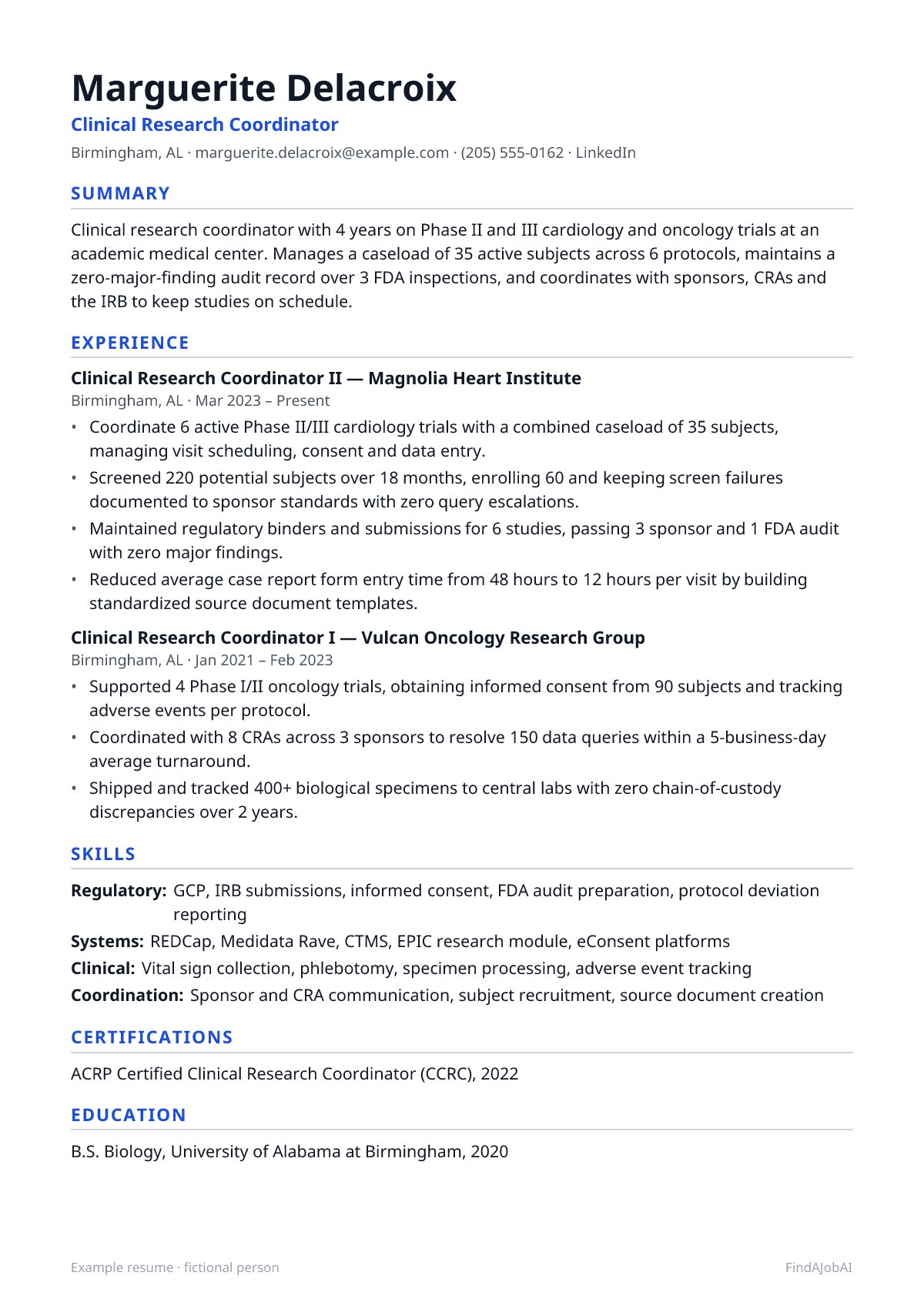
Clinical Research Coordinator resume template
This example as a one-page template: one column, standard headings and plain text, the format applicant tracking systems read most reliably.
After you sign up, Create my CV builds your own resume in this same one-column layout, from your real experience.
Mid-level clinical research coordinator resume example
A complete one-page example for a fictional clinical research coordinator: every bullet pairs an action with what changed because of it.
Example resume · fictional person
Marguerite Delacroix
Clinical Research Coordinator
Birmingham, AL · [email protected] · (205) 555-0162 · LinkedIn
Summary
Clinical research coordinator with 4 years on Phase II and III cardiology and oncology trials at an academic medical center. Manages a caseload of 35 active subjects across 6 protocols, maintains a zero-major-finding audit record over 3 FDA inspections, and coordinates with sponsors, CRAs and the IRB to keep studies on schedule.
Experience
Clinical Research Coordinator II, Magnolia Heart Institute
Birmingham, AL · Mar 2023 – Present
- Coordinate 6 active Phase II/III cardiology trials with a combined caseload of 35 subjects, managing visit scheduling, consent and data entry.
- Screened 220 potential subjects over 18 months, enrolling 60 and keeping screen failures documented to sponsor standards with zero query escalations.
- Maintained regulatory binders and submissions for 6 studies, passing 3 sponsor and 1 FDA audit with zero major findings.
- Reduced average case report form entry time from 48 hours to 12 hours per visit by building standardized source document templates.
Clinical Research Coordinator I, Vulcan Oncology Research Group
Birmingham, AL · Jan 2021 – Feb 2023
- Supported 4 Phase I/II oncology trials, obtaining informed consent from 90 subjects and tracking adverse events per protocol.
- Coordinated with 8 CRAs across 3 sponsors to resolve 150 data queries within a 5-business-day average turnaround.
- Shipped and tracked 400+ biological specimens to central labs with zero chain-of-custody discrepancies over 2 years.
Skills
- Regulatory: GCP, IRB submissions, informed consent, FDA audit preparation, protocol deviation reporting
- Systems: REDCap, Medidata Rave, CTMS, EPIC research module, eConsent platforms
- Clinical: Vital sign collection, phlebotomy, specimen processing, adverse event tracking
- Coordination: Sponsor and CRA communication, subject recruitment, source document creation
Certifications
- ACRP Certified Clinical Research Coordinator (CCRC), 2022
Education
- B.S. Biology, University of Alabama at Birmingham, 2020
Fictional example by the FindAJobAI team: the person, employers and numbers are invented. Keep the structure; use your own work and numbers you can explain in an interview.
Entry-level clinical research coordinator resume example
A recent biology graduate with a research assistant job and a short internship, no coordinator title yet. Education sits right under the summary, and the research assistant role is written with the regulatory and data tasks that transfer directly to coordinating.
Entry-level example resume · fictional person
Ozkar Benediktsson
Clinical Research Coordinator
Madison, WI · [email protected] · (608) 555-0106 · LinkedIn
Summary
Entry-level clinical research coordinator with a biology degree, GCP certification and a year of research assistant experience supporting IRB submissions, subject recruitment and REDCap data entry on a university diabetes study. Looking for a first coordinator role on a Phase II or III trial team.
Education
- B.S. Biology, University of Wisconsin–Madison, 2025
Experience
Clinical Research Assistant, University of Wisconsin Diabetes Research Center
Madison, WI · Jun 2025 – Present
- Screened 80 potential subjects for a Phase II diabetes trial, scheduling 45 for consent visits and tracking eligibility documentation.
- Entered case report form data for 30 subjects in REDCap, maintaining a query rate under 3% through double-checking source documents.
- Assisted the lead coordinator with 2 IRB continuing review submissions, compiling enrollment and adverse event summaries.
Research Intern, Badger State Clinical Trials Network
Madison, WI · Jan 2025 – May 2025
- Shadowed informed consent visits for 20 subjects across 2 studies, learning GCP-compliant documentation standards.
- Organized regulatory binders for 3 studies ahead of a sponsor monitoring visit, with zero missing documents found.
Skills
- Regulatory: GCP (CITI certified), informed consent procedures, IRB submission support
- Systems: REDCap, basic Medidata Rave (training environment), Excel
- Clinical: Vital sign collection, specimen handling basics, adverse event documentation
Certifications
- CITI GCP Certification, 2025
Training
- CITI Program: Good Clinical Practice and Human Subjects Research certifications, completed 2025.
- Capstone project: analyzed enrollment timelines for 5 past university trials to identify common screening delays, presented to the department.
Senior clinical research coordinator resume example
A site manager nine years in, overseeing a multi-study portfolio and training other coordinators. The bullets move from direct subject work to managing sponsor relationships, audit readiness and a team, and the summary names the portfolio size and revenue.
Senior example resume · fictional person
Perpetua Nakashima
Senior Clinical Research Coordinator & Site Manager
Denver, CO · [email protected] · (303) 555-0145 · LinkedIn
Summary
Senior clinical research coordinator and site manager with 9 years running a 12-study portfolio across cardiology, oncology and endocrinology for an academic trial site. Manages 4 coordinators and sponsor relationships worth $3M in annual trial revenue, and built the site's audit readiness program that has produced zero major findings across 6 inspections.
Experience
Senior Clinical Research Coordinator & Site Manager, Rocky Mountain Clinical Research Center
Denver, CO · Apr 2021 – Present
- Oversee a 12-study portfolio across 3 therapeutic areas, managing 4 coordinators and setting enrollment and audit targets each quarter.
- Built the site's audit readiness program, including mock inspections and binder checklists, resulting in zero major findings across 6 sponsor and FDA inspections.
- Manage sponsor relationships representing $3M in annual trial revenue, negotiating 5 new study budgets a year.
- Standardized source document templates across all studies, cutting average case report form entry time by 60% site-wide.
Clinical Research Coordinator II, Front Range Oncology Partners
Denver, CO · Aug 2017 – Mar 2021
- Coordinated 8 Phase II/III oncology trials with a combined caseload of 50 subjects, managing consent, scheduling and adverse event tracking.
- Trained 6 new coordinators on GCP documentation and REDCap entry, reducing their average onboarding time from 6 weeks to 3.
- Resolved sponsor data queries across 3 studies with a 3-day average turnaround, the fastest among the network's 7 sites.
Clinical Research Coordinator I, Centennial Medical Research Institute
Aurora, CO · Jul 2015 – Jul 2017
- Managed informed consent and visit scheduling for 40 subjects across 3 cardiology trials.
- Maintained regulatory binders for 3 studies, passing 2 sponsor audits with zero findings.
Skills
- Regulatory: GCP, FDA audit readiness, IRB submissions, budget negotiation
- Leadership: Coordinator training, portfolio management, sponsor relationship management
- Systems: Medidata Rave, Veeva CTMS, REDCap, EPIC research module
Certifications
- ACRP Certified Clinical Research Coordinator (CCRC), 2017
- ACRP Certified Principal Investigator (CPI), 2023
Education
- B.S. Biology, Colorado State University, 2015
How to write a clinical research coordinator resume
Five steps, in the order a recruiter reads the page. The format around them stays plain for every job: one column, standard headings, newest role first.
Header: name, target title and links
Use the title “Clinical Research Coordinator” even if your title was Research Assistant or Study Coordinator, and list your GCP certification date near the top. Sponsors and site managers often filter by certification currency before reading further.
Summary: what you do and your best proof
Name your trial phase experience, therapeutic area and caseload size, then one compliance or efficiency result, like an audit outcome or a turnaround time. Skip lines like “detail-oriented team player”; show the detail orientation in a number instead.
Experience: newest first, a result in every bullet
Open each bullet with the study type or task, then the action and the measurable outcome: how many subjects screened, how many queries resolved, what audit result followed. Listing “assisted with trials” says less than naming the phase, the task and a number.
Skills: grouped, in the ad's words
Group into regulatory knowledge, EDC and CTMS systems, clinical tasks and coordination. Name the exact systems the job ad lists (Medidata Rave, Veeva, REDCap) since many postings filter for specific platform experience.
Education and certifications
List your degree and year, plus GCP or CCRC certification dates since many lapse after 2-3 years. Without coordinator experience, add a Training section naming CITI or ACRP coursework and any research assistant or capstone project with a stated result.
Skills to put on a clinical research coordinator resume
Hard skills are the tools and methods of the job; soft skills are how you work with people. Each comes with one way to prove it, because a skill named only in a list counts for little. Add the ones you really have.
Hard skills
- GCP (Good Clinical Practice)
- State your certification date and name a bullet where it shaped a consent or documentation decision.
- Informed consent
- Give the subject count and a compliance result, like zero consent-related monitoring findings.
- IRB submissions
- Count the submissions or amendments you handled and the turnaround time compared to peers or deadlines.
- EDC systems (Medidata Rave, REDCap)
- Name the system and a data quality metric, like query rate or entry turnaround time.
- CTMS (Veeva, OnCore)
- Describe what you tracked in it, such as visit windows or enrollment status across studies.
- Subject recruitment
- Give a screening-to-enrollment funnel with numbers at each stage.
- Audit and inspection prep
- Name the audit type (sponsor, FDA) and the finding count it closed with.
- Adverse event reporting
- State the volume tracked and the reporting timeline you met.
- Specimen handling
- Give the specimen count or type and a chain-of-custody or shipping accuracy result.
- Protocol deviation management
- Mention how many deviations you documented and resolved, and any process you built to reduce them.
- Budget negotiation
- Name the number of study budgets you negotiated or the revenue they represented.
- Source document creation
- Point to a template you built and the time it saved per visit.
Soft skills
- Attention to detail
- Mention a documentation error or discrepancy you caught before it reached a monitor or auditor.
- Sponsor communication
- Give your query turnaround time or the number of sponsors you coordinate with regularly.
- Time management
- State your concurrent study or subject count and how you prioritized visit windows.
- Problem-solving
- Describe an enrollment or documentation obstacle you resolved and its measurable fix.
- Training and mentorship
- Count the coordinators or assistants you trained and their onboarding time improvement.
- Ethical judgment
- Describe a consent or eligibility situation you handled carefully, without naming identifiable details.
- Cross-functional coordination
- Name the roles you worked with regularly, like CRAs, PIs and pharmacy, and what you kept aligned.
Clinical Research Coordinator resume bullet examples: weak vs strong
The same work, written two ways. The strong version names the tool, the scope and a result; the numbers are examples, yours must be real.
Weak: Enrolled study subjects.
Strong: Screened 120 candidates against a cardiology trial's inclusion criteria and enrolled 32, exceeding the site's 6-month target by 4 subjects.
Shows the funnel and a target beaten, not just activity.
Weak: Maintained regulatory documents.
Strong: Rebuilt the regulatory binder system for 5 open studies ahead of an FDA inspection, which closed with zero major findings.
Connects documentation work to an audit outcome.
Weak: Collected patient data.
Strong: Entered case report form data for 60 subjects across 2 EDC systems, keeping query rates under 2% per visit.
Gives a volume and a quality metric instead of a vague task.
Weak: Worked with the IRB.
Strong: Prepared and submitted 8 IRB amendments in a year, with the fastest site turnaround among 5 sister sites in the network.
Turns IRB contact into a measurable comparison.
Weak: Responsible for informed consent.
Strong: Obtained informed consent from 90 oncology subjects, documenting the process to withstand sponsor monitoring visits with zero consent-related findings.
Shows volume and a compliance result.
Weak: Communicated with sponsors.
Strong: Resolved an average of 15 sponsor data queries a week within a 5-day turnaround, keeping the site off 2 consecutive corrective action lists.
Quantifies responsiveness and its downstream effect.
15 more clinical research coordinator resume bullet examples
Grouped by area of the job, so you can find the ones closest to your work. Keep the shape (action, scope, result) and replace the invented numbers with your own.
Enrollment and recruitment
- Screened 150 candidates for a Phase III hypertension trial using a pre-screening phone script, enrolling 38 and beating the site's quarterly target by 20%.
- Built a recruitment flyer and clinic referral process that raised monthly screening volume from 12 to 25 candidates.
- Tracked screen failure reasons across 200 candidates in a shared log, which helped the PI tighten inclusion criteria for the next amendment.
- Coordinated recruitment across 2 satellite clinics, adding 15 enrolled subjects to a lagging oncology trial within one quarter.
Regulatory and compliance
- Prepared the regulatory binder and source documents for an FDA pre-approval inspection on a Phase III trial, which closed with zero findings.
- Submitted 10 IRB continuing reviews and 6 amendments in a year, with zero late submissions across all studies on the caseload.
- Documented and resolved 12 protocol deviations within required timelines, briefing the PI on root causes to prevent repeats.
- Maintained delegation of authority logs and training records for 8 study staff, passing a sponsor audit with zero documentation gaps.
Data and systems
- Migrated case report form entry for 4 studies from paper to Medidata Rave, cutting average entry time per visit by 65%.
- Reduced open data queries from 40 to under 10 at any time by setting a weekly query review with the study team.
- Built a REDCap tracking dashboard for visit windows across 50 subjects, cutting missed-window visits by half.
- Reconciled drug accountability logs for 3 studies monthly, catching and correcting 5 dosing record errors before audit.
Team and sponsor coordination
- Trained 3 new coordinators on consent procedures and REDCap entry, cutting their independent caseload ramp-up from 8 weeks to 4.
- Managed weekly status calls with CRAs across 5 active studies, resolving an average of 20 open items per call.
- Negotiated a budget amendment with a sponsor that added $80,000 in site funding for additional monitoring visits.
Clinical Research Coordinator resume summary examples
Two or three lines on what you do and your strongest proof. Start from the one closest to your level and use your own facts.
Clinical research coordinator with a biology degree and a 6-month internship supporting IRB submissions and subject recruitment at a university research office. Trained in GCP and informed consent procedures, with hands-on REDCap data entry experience from coursework and the internship.
Clinical research coordinator with 4 years on Phase II/III cardiology and oncology trials, managing a 35-subject caseload across 6 protocols. Passed 3 sponsor audits and 1 FDA inspection with zero major findings, and cut case report form entry time by 75%.
Senior clinical research coordinator and site manager with 9 years running a 12-study portfolio for an academic trial site. Trains and oversees 4 coordinators, manages sponsor relationships worth $3M in annual trial revenue, and leads the site's audit readiness program.
Common clinical research coordinator resume mistakes
Each one is easy to make and quick to fix before you apply.
No mention of trial phase or therapeutic area
Sponsors often need Phase II oncology experience specifically. Name the phase and therapeutic area for each study role.
Vague enrollment claims
“Helped with recruitment” hides your actual contribution. Give the screened, consented and enrolled numbers as a funnel.
Omitting audit or inspection outcomes
A clean audit record is one of the strongest signals on this resume. State the audit type and the finding count, even if it's zero.
Letting GCP certification dates go unstated
GCP training expires every 2-3 years. Include the completion date so reviewers know it's current.
Listing every EDC system you've seen once
Naming 6 systems you briefly touched dilutes real proficiency. List the 2-3 you've used regularly and tie one to a specific data metric.
ATS tips for a clinical research coordinator resume
Applicant tracking systems turn your file into text that recruiters search, mostly for the skills and titles in the ad. They rarely reject a resume on their own; one that parses badly or misses the ad's words just doesn't come up.
- Name the trial phase (I, II, III) and therapeutic area in each role; sponsors often filter for specific phase experience.
- List the EDC and CTMS systems you've used by name (Medidata Rave, REDCap, Veeva); most postings specify one.
- Show audit and inspection outcomes directly: zero findings, corrective actions closed, or inspection readiness work.
- Quantify enrollment with a funnel, not just a final count: screened, consented and enrolled numbers tell a fuller story.
- Mention your CCRC or ACRP certification status prominently if you have it; many sponsor-funded roles require it or prefer it.
For the format itself, run the free ATS resume checklist.
Everything for Clinical Research Coordinators
- Clinical Research Coordinator cover letter examplesThree example letters and a short email version
- Clinical Research Coordinator interview questions30 questions with sample answers
- Clinical Research Coordinator job descriptionDuties, skills and requirements
- How to tailor your resume without lying
Other resume examples
Clinical Research Coordinator resume FAQ
What certifications matter most for a clinical research coordinator resume?
ACRP's CCRC and SOCRA's CCRP are the most recognized. List the certification and year directly under your name or in a certifications section if you hold one.
How do I show trial experience with no coordinator job yet?
Count IRB, recruitment or data entry work from internships, research assistant roles or thesis projects, naming the systems and procedures you used, such as GCP training or REDCap data entry.
Should I list every study I've worked on?
No. Group similar studies by therapeutic area and phase in your bullets, and name specific studies only when they involved a standout result, like fast enrollment or a clean audit.
How important is GCP certification on this resume?
Very; most sponsors require current GCP training. State it with the completion date, since many lapse after 2-3 years and recruiters check the date.
How we built this page
The FindAJobAI team wrote the three example resumes, the bullets, the skills and the advice for clinical research coordinator roles. The people, employers and numbers in the examples are invented; the structure, the tools and the way each bullet is built are the parts to copy.
Once we track enough live clinical research coordinator job ads, this page also shows the skills they ask for most, counted the same way as our in-demand skills report.
Last reviewed on November 1, 2026.