Research Analyst Resume Example (2026)
By FindAJobAI team Updated How we built this page
Research analyst ads cover a wide range: market research, competitive intelligence, survey design, secondary research in trade and academic sources, and enough Excel or SQL to back up a claim with numbers. What hiring managers look for is evidence that a report changed a decision, not a count of reports written. A research analyst resume should name the question, the method and who acted on the answer.
The example below is a research analyst with five years split between a market research firm and an industrial equipment maker. Each bullet names the method, the data source and the decision the findings supported, instead of listing topics researched.
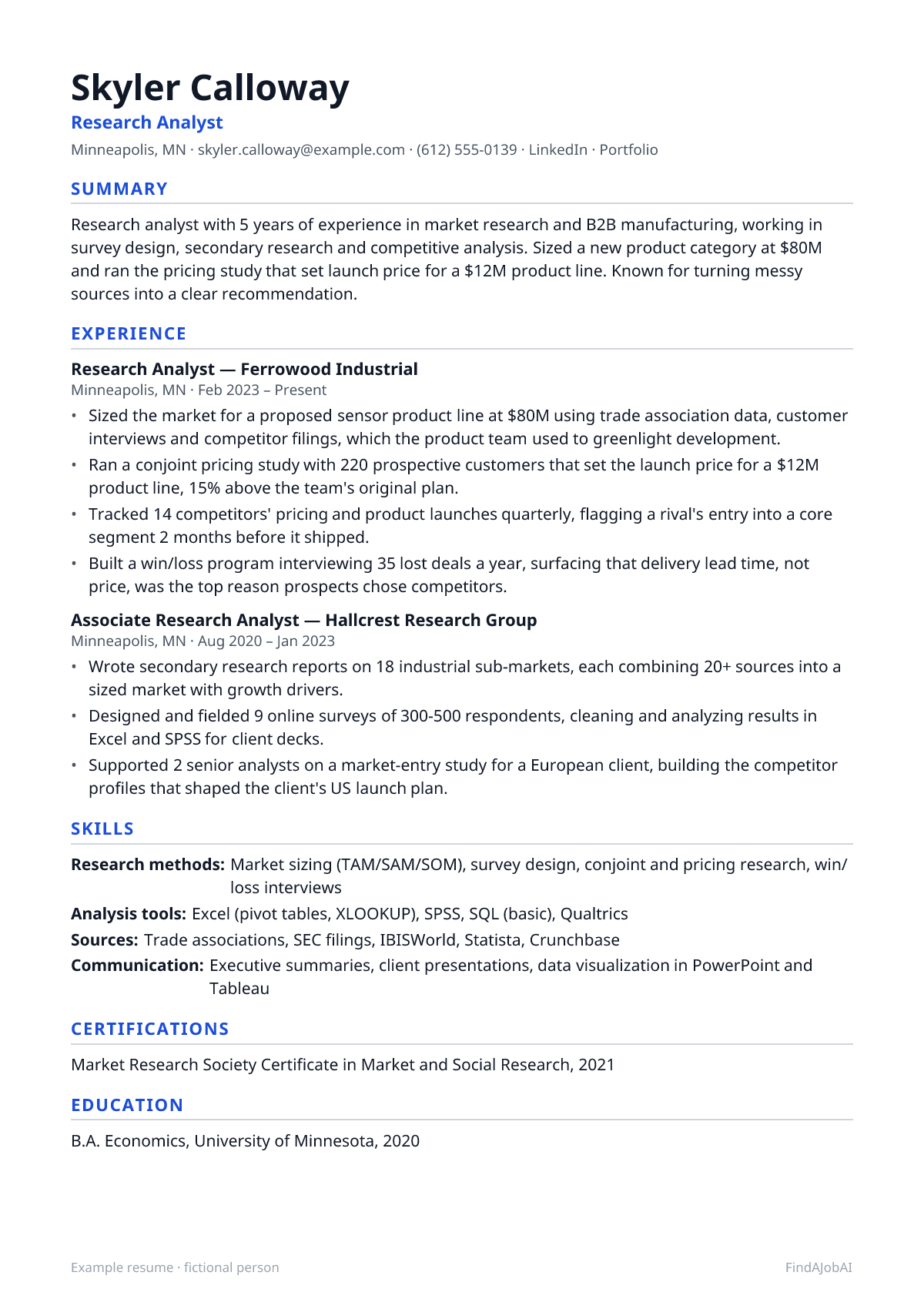
Research Analyst resume template
This example as a one-page template: one column, standard headings and plain text, the format applicant tracking systems read most reliably.
After you sign up, Create my CV builds your own resume in this same one-column layout, from your real experience.
Mid-level research analyst resume example
A complete one-page example for a fictional research analyst: every bullet pairs an action with what changed because of it.
Example resume · fictional person
Skyler Calloway
Research Analyst
Minneapolis, MN · [email protected] · (612) 555-0139 · LinkedIn · Portfolio
Summary
Research analyst with 5 years of experience in market research and B2B manufacturing, working in survey design, secondary research and competitive analysis. Sized a new product category at $80M and ran the pricing study that set launch price for a $12M product line. Known for turning messy sources into a clear recommendation.
Experience
Research Analyst, Ferrowood Industrial
Minneapolis, MN · Feb 2023 – Present
- Sized the market for a proposed sensor product line at $80M using trade association data, customer interviews and competitor filings, which the product team used to greenlight development.
- Ran a conjoint pricing study with 220 prospective customers that set the launch price for a $12M product line, 15% above the team's original plan.
- Tracked 14 competitors' pricing and product launches quarterly, flagging a rival's entry into a core segment 2 months before it shipped.
- Built a win/loss program interviewing 35 lost deals a year, surfacing that delivery lead time, not price, was the top reason prospects chose competitors.
Associate Research Analyst, Hallcrest Research Group
Minneapolis, MN · Aug 2020 – Jan 2023
- Wrote secondary research reports on 18 industrial sub-markets, each combining 20+ sources into a sized market with growth drivers.
- Designed and fielded 9 online surveys of 300-500 respondents, cleaning and analyzing results in Excel and SPSS for client decks.
- Supported 2 senior analysts on a market-entry study for a European client, building the competitor profiles that shaped the client's US launch plan.
Skills
- Research methods: Market sizing (TAM/SAM/SOM), survey design, conjoint and pricing research, win/loss interviews
- Analysis tools: Excel (pivot tables, XLOOKUP), SPSS, SQL (basic), Qualtrics
- Sources: Trade associations, SEC filings, IBISWorld, Statista, Crunchbase
- Communication: Executive summaries, client presentations, data visualization in PowerPoint and Tableau
Certifications
- Market Research Society Certificate in Market and Social Research, 2021
Education
- B.A. Economics, University of Minnesota, 2020
Fictional example by the FindAJobAI team: the person, employers and numbers are invented. Keep the structure; use your own work and numbers you can explain in an interview.
Entry-level research analyst resume example
A recent economics graduate with a research assistant role and one capstone project standing in for work experience. Education moves up under the summary, and the capstone is written like a real study with a method and a finding.
Entry-level example resume · fictional person
Summary
Entry-level research analyst with a B.A. in Economics and a research assistant role analyzing survey data for a university policy lab. Comfortable with Excel, SPSS and secondary research, and built a market-sizing capstone on the regional craft brewery industry. Looking for a first research role in consumer goods or market research.
Education
- B.A. Economics, University of Wisconsin–Madison, 2026
Experience
Research Assistant, University of Wisconsin Policy Lab
Madison, WI · Sep 2025 – May 2026
- Cleaned and coded 850 survey responses on local transit use in SPSS, catching 60 duplicate entries before the final dataset was used in a published brief.
- Built cross-tabs comparing commute time by neighborhood, which the lab cited as the basis for recommending 2 new bus routes.
- Summarized 25 academic papers on transit ridership into a 4-page literature review for the lab director.
Campus Survey Coordinator, University of Wisconsin Student Government
Madison, WI · Jan 2024 – May 2025
- Designed and fielded an annual student satisfaction survey of 1,100 respondents, writing the questions and the Qualtrics logic.
- Analyzed 3 years of survey trends in Excel and presented findings to the student senate, leading to extended dining hall hours.
Skills
- Research methods: Survey design, secondary research, literature review, basic market sizing
- Analysis tools: Excel (pivot tables, cross-tabs), SPSS, Qualtrics, Google Forms
- Communication: Written briefs, presentations to non-technical audiences
Projects
- Regional craft brewery market sizing (capstone): estimated a $45M local market using state licensing data and 20 owner interviews, with a bottom-up method.
- Consumer survey on streaming habits: fielded a 300-respondent survey and found a 2-to-1 preference for ad-supported tiers among respondents under 25.
Senior research analyst resume example
A senior analyst ten years in, now leading a small research team. The bullets shift from running individual studies to setting the research agenda and sizing categories that led to real launches, and the summary names the team and the dollar value of the categories she has shaped.
Senior example resume · fictional person
Perpetua Androvich
Senior Research Analyst
Charlotte, NC · [email protected] · (704) 555-0171 · LinkedIn
Summary
Senior research analyst with 10 years in retail and consumer packaged goods, leading competitive intelligence and market sizing for a national chain. Built the sizing model behind 3 new category launches worth $150M combined and manages a 2-person research team supporting merchandising and strategy.
Experience
Senior Research Analyst, Birchfield Retail Group
Charlotte, NC · Apr 2021 – Present
- Lead a 2-person research team setting the quarterly research agenda for merchandising, strategy and 2 regional VPs.
- Built the market-sizing model behind 3 new category launches worth $150M combined, each validated against 18 months of post-launch sales.
- Ran a standing competitive intelligence program covering 25 competitors, cutting the time to flag a major pricing move from weeks to days.
- Redesigned the annual customer segmentation study, reducing fielding cost by 30% while expanding the sample from 2,000 to 3,500 respondents.
Research Analyst, Castellane Consumer Insights
Charlotte, NC · Jun 2017 – Mar 2021
- Managed research for 6 CPG clients a year, scoping studies from a one-page brief to a fielded survey and final report.
- Ran win/loss interviews across 45 lost retail accounts for one client, identifying delivery reliability as the top reason for losses.
- Trained 4 junior analysts on survey design and SPSS analysis as the team's informal methods lead.
Associate Research Analyst, Castellane Consumer Insights
Charlotte, NC · Jul 2015 – May 2017
- Fielded and analyzed 20+ consumer surveys a year, from 200 to 2,000 respondents, for clients in food and beverage.
- Wrote secondary research sections combining trade data and public filings for 15 market-entry reports.
Skills
- Research methods: Market sizing, conjoint and pricing research, segmentation, win/loss programs
- Analysis tools: SPSS, Excel, SQL (basic), Qualtrics, Tableau
- Leadership: Research roadmap setting, client and stakeholder management, mentoring analysts
Education
- B.A. Sociology, University of North Carolina at Charlotte, 2015
How to write a research analyst resume
Five steps, in the order a recruiter reads the page. The format around them stays plain for every job: one column, standard headings, newest role first.
Header: name, target title and links
Use the title “Research Analyst” and list any specialty (market research, competitive intelligence) in your headline if the ad names it, since teams search for both the general and the specific title.
Summary: what you do and your best proof
Name your main research methods, your industry and one study whose result a team acted on. Skip phrases like “strong analytical skills”; let a specific finding prove it instead.
Experience: newest first, a result in every bullet
Open each bullet with the question or market, then the method and the decision it informed: who used the finding and what they did with it. A list of reports written says little; one sizing number that changed a budget says a lot.
Skills: grouped, in the ad's words
Group into research methods, analysis tools and sources. Name the specific tools (SPSS, Qualtrics, SQL) rather than writing “research tools,” and drop ones you only saw in a course unless the ad asks for them.
Education and certifications
List your degree and the year, plus a certificate such as a market research society credential if you hold one. Without research experience, add a Projects section with a sizing or survey study on public data stating its method and its number.
Skills to put on a research analyst resume
Hard skills are the tools and methods of the job; soft skills are how you work with people. Each comes with one way to prove it, because a skill named only in a list counts for little. Add the ones you really have.
Hard skills
- Market sizing
- Name your method (top-down or bottom-up) and the dollar figure you reached, plus who used it.
- Survey design
- Give the sample size and the tool (Qualtrics, SurveyMonkey) and one finding that shaped a decision.
- Secondary research
- Name the source types you combine (trade data, filings, census) and the report they fed.
- Competitive analysis
- State how many competitors you track and one move you flagged before it shipped.
- Win/loss interviews
- Give the number of interviews a year and the pattern they revealed.
- SPSS or R
- Point to the analysis you ran, such as cross-tabs or regression, and the dataset size.
- Excel
- Mention pivot tables or cross-tabs specifically, tied to the survey or report they supported.
- Conjoint or pricing research
- Name the product and the price or feature decision the study set.
- Qualtrics or SurveyMonkey
- Mention the logic or branching you built, not just that you used the tool.
- Data visualization
- Name the audience for your charts and one chart that changed a mind.
- Executive summary writing
- Describe the length and audience of a report and the decision it supported.
- Segmentation
- Give the number of segments you built and how a team used them.
Soft skills
- Translating data into decisions
- Write one bullet where a finding changed a plan, naming who changed it.
- Client or stakeholder communication
- Name the audience you presented to and one objection you addressed.
- Curiosity
- Describe a question you pursued beyond the original brief and what it turned up.
- Attention to detail
- Mention a data error you caught before it reached a client or executive.
- Project management
- Give the number of studies you ran at once and how you kept them on schedule.
- Clear writing
- Mention the length of a report you wrote and the non-technical audience it reached.
- Objectivity
- Describe a time your findings contradicted a stakeholder's assumption and how you presented it.
Research Analyst resume bullet examples: weak vs strong
The same work, written two ways. The strong version names the tool, the scope and a result; the numbers are examples, yours must be real.
Weak: Conducted market research.
Strong: Sized the addressable market for a subscription meal kit expansion at $220M using census data, trade reports and 40 customer interviews, which supported the board's go-ahead.
States the method, the number and who used it.
Weak: Analyzed competitors.
Strong: Profiled 9 competitors' pricing and feature sets, finding a gap in the mid-tier segment that the product team filled with a new plan 6 months later.
A finding tied to a specific product decision.
Weak: Ran surveys.
Strong: Fielded a 400-respondent satisfaction survey across 3 regions and traced a 12-point score drop in the Southeast to a shipping delay, prompting a carrier change.
Shows the survey leading to a root cause and an action.
Weak: Wrote reports.
Strong: Wrote a 15-page market-entry report on the Canadian market that led the executive team to delay entry by a year pending a tariff ruling.
A report measured by the decision it influenced.
Weak: Good with data.
Strong: Cleaned and merged 3 survey waves of 1,500 responses each in Excel, catching a coding error that had overstated brand awareness by 9 points.
A data skill shown through a specific catch and its size.
Weak: Presented findings to stakeholders.
Strong: Presented pricing research to 8 regional sales directors, reframing 2 objections that led the team to adjust the proposed discount structure.
Shows influence on a real business outcome, not just presenting.
15 more research analyst resume bullet examples
Grouped by area of the job, so you can find the ones closest to your work. Keep the shape (action, scope, result) and replace the invented numbers with your own.
Market sizing and sizing studies
- Sized a new direct-to-consumer category at $35M using a bottom-up model built from census and industry association data.
- Built a TAM/SAM/SOM model for a software add-on that supported a $4M budget request to the executive team.
- Combined 3 third-party market reports with primary interviews to size an emerging segment at $60M for a client pitch.
Surveys and primary research
- Fielded a 500-respondent brand tracking survey twice a year, flagging a 10-point awareness drop that led to a new ad campaign.
- Designed a conjoint study with 300 respondents that identified the 3 features customers valued most, reshaping the product roadmap.
- Ran 40 customer interviews over 2 months to validate a pricing hypothesis, which the team used to set a $29 monthly price.
Competitive and secondary research
- Tracked pricing and promotions for 20 competitors monthly, giving the pricing team a 2-week head start on seasonal matches.
- Wrote a 12-page competitive landscape report ahead of a product launch, identifying a gap that became the launch's main message.
- Monitored 8 industry trade publications and 3 analyst firms for signals, surfacing a regulatory change 4 months before it took effect.
Reporting and stakeholder communication
- Presented quarterly research findings to 10 department leads, with one recommended action per finding to keep decks actionable.
- Built a self-serve dashboard of tracked metrics for 30 stakeholders, cutting repeat data requests to the research team by 40%.
- Wrote executive summaries for 25 studies a year, each under 2 pages, for an audience with no time to read the full report.
Process and quality
- Standardized the team's survey intake form, cutting average project scoping time from 2 weeks to 4 days.
- Caught a sampling error in a vendor-run study that would have overstated a key segment by 15%, before the report went to the client.
- Validated a prior market-sizing estimate against 18 months of actual sales, finding it had overstated demand by 20%, and corrected the model.
Research Analyst resume summary examples
Two or three lines on what you do and your strongest proof. Start from the one closest to your level and use your own facts.
Research analyst with an economics degree and a research assistant role analyzing survey data for a university lab. Comfortable with Excel, SPSS and secondary research; built a market-sizing project on the regional coffee shop industry as a capstone.
Research analyst with 5 years in consumer goods, running pricing and competitive studies. Led the segmentation study that identified a $30M underserved customer group and the win/loss program that cut lost-deal rate by tracking root causes monthly.
Senior research analyst with 10 years leading competitive intelligence for a national retail chain. Built the market-sizing model behind 3 new category launches worth $150M combined and manages a 2-person research team.
Common research analyst resume mistakes
Each one is easy to make and quick to fix before you apply.
Listing topics researched instead of findings
“Researched the beverage industry” says nothing. State the question you answered and the number or recommendation it produced.
No sample size or source count
A survey of 50 people and one of 5,000 carry different weight. Always give the sample size or number of sources behind a finding.
Methods with no decision attached
Conjoint analysis or win/loss interviews in Skills only say what you can run. Tie each to the decision it informed in a bullet.
Vague audience for reports
“Wrote research reports” doesn't say who read them. Name the audience, such as executives or an external client, to show the stakes.
Treating secondary research as a weaker skill
Synthesizing scattered public sources into one sized market is a real skill. Describe the sources combined and the number you reached.
ATS tips for a research analyst resume
Applicant tracking systems turn your file into text that recruiters search, mostly for the skills and titles in the ad. They rarely reject a resume on their own; one that parses badly or misses the ad's words just doesn't come up.
- Name your research methods specifically (conjoint analysis, win/loss interviews, secondary research) rather than writing "market research".
- State the market size, survey sample or competitor count behind a finding, not just that you "researched" a topic.
- Tie each major study to the decision it informed: a launch, a price, a market entry or exit.
- List the tools you used to analyze data (Excel, SPSS, SQL, Qualtrics), since ads vary widely on which they require.
- If you wrote client-facing reports, mention the audience (executives, sales leadership, external client) to show you can communicate up.
For the format itself, run the free ATS resume checklist.
Everything for Research Analysts
- Research Analyst cover letter examplesThree example letters and a short email version
- Research Analyst interview questions30 questions with sample answers
- Research Analyst job descriptionDuties, skills and requirements
- How to tailor your resume without lying
Other resume examples
Research Analyst resume FAQ
What is the difference between a research analyst and a data analyst?
A research analyst more often designs the study itself, such as a survey or competitive scan, and works with messier outside sources. A data analyst usually works from a company's own transaction or product data. Many postings blend the two, so read the ad closely.
Do I need SPSS or can I use Excel for a research analyst resume?
Excel is fine for most roles if you can show real analysis, such as cross-tabs or pivot tables on survey data. List SPSS, R or SQL only if you have used them, since some employers test for them in interviews.
How do I show market sizing skills without real company data?
Build one market-sizing project using public data, such as census figures or industry reports, and state your method (top-down or bottom-up) along with the number you reached.
How we built this page
The FindAJobAI team wrote the three example resumes, the bullets, the skills and the advice for research analyst roles. The people, employers and numbers in the examples are invented; the structure, the tools and the way each bullet is built are the parts to copy.
Once we track enough live research analyst job ads, this page also shows the skills they ask for most, counted the same way as our in-demand skills report.
Last reviewed on November 1, 2026.