Detective Resume Example (2026)
By FindAJobAI Team Updated How we built this page
Promotion boards, unit commanders and outside agencies read detective resumes for results they can verify: how many cases you carried, how many you cleared, how your warrants and case files held up and how often you testified. “Investigated crimes” tells them nothing they did not already assume.
The example below belongs to a detective with nine years of service, four of them in a property and financial crimes unit. Every bullet gives a caseload, a clearance figure, a warrant count or a court outcome, so a reader can judge both the volume and the quality of the work.
Detective resume template
This example as a one-page template: one column, standard headings and plain text, the format applicant tracking systems read most reliably.
After you sign up, Create my CV builds your own resume in this same one-column layout, from your real experience.
Mid-level detective resume example
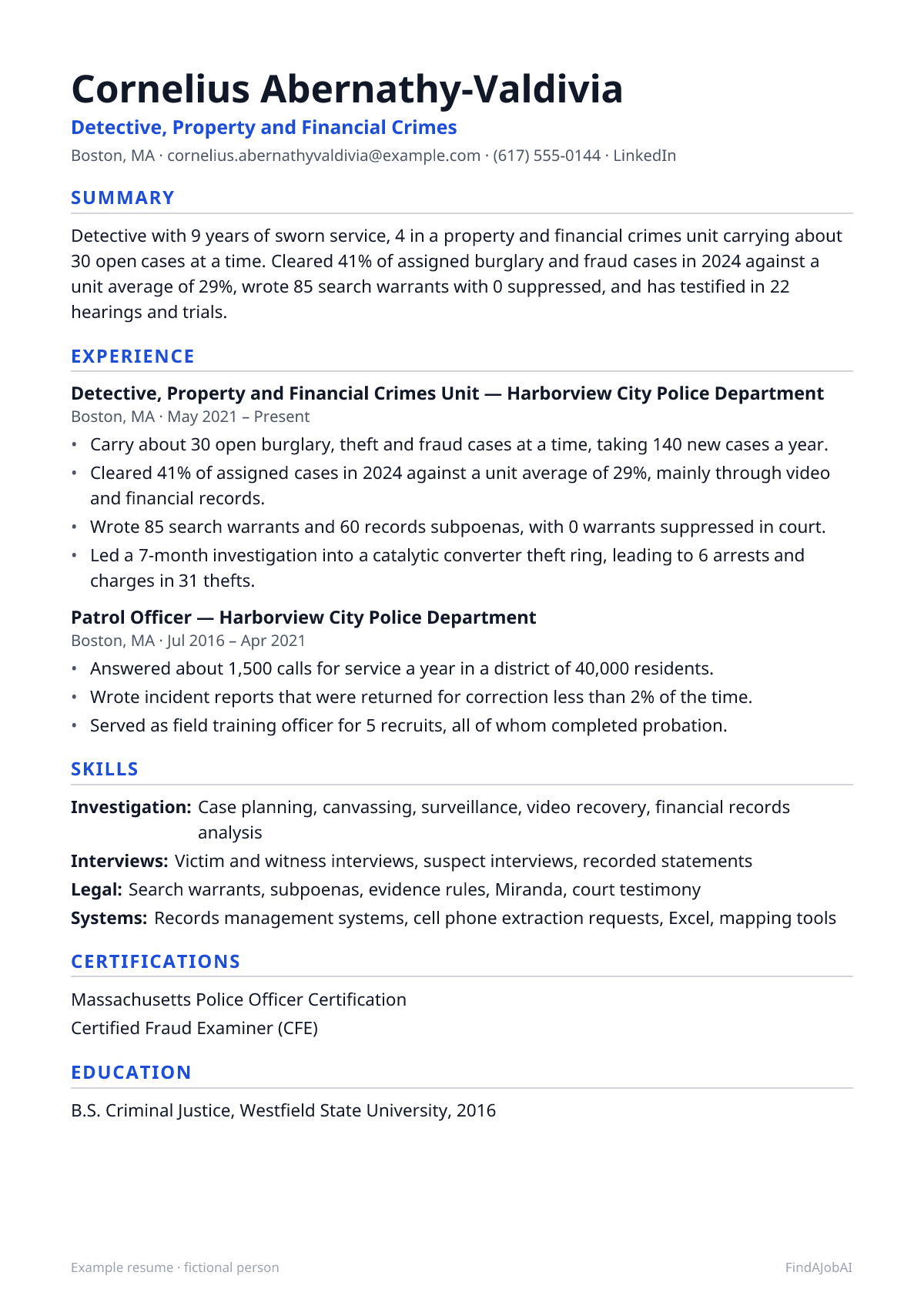
A complete one-page example for a fictional detective: every bullet pairs an action with what changed because of it.
Example resume · fictional person
Cornelius Abernathy-Valdivia
Detective, Property and Financial Crimes
Boston, MA · [email protected] · (617) 555-0144 · LinkedIn
Summary
Detective with 9 years of sworn service, 4 in a property and financial crimes unit carrying about 30 open cases at a time. Cleared 41% of assigned burglary and fraud cases in 2024 against a unit average of 29%, wrote 85 search warrants with 0 suppressed, and has testified in 22 hearings and trials.
Experience
Detective, Property and Financial Crimes Unit, Harborview City Police Department
Boston, MA · May 2021 – Present
- Carry about 30 open burglary, theft and fraud cases at a time, taking 140 new cases a year.
- Cleared 41% of assigned cases in 2024 against a unit average of 29%, mainly through video and financial records.
- Wrote 85 search warrants and 60 records subpoenas, with 0 warrants suppressed in court.
- Led a 7-month investigation into a catalytic converter theft ring, leading to 6 arrests and charges in 31 thefts.
Patrol Officer, Harborview City Police Department
Boston, MA · Jul 2016 – Apr 2021
- Answered about 1,500 calls for service a year in a district of 40,000 residents.
- Wrote incident reports that were returned for correction less than 2% of the time.
- Served as field training officer for 5 recruits, all of whom completed probation.
Skills
- Investigation: Case planning, canvassing, surveillance, video recovery, financial records analysis
- Interviews: Victim and witness interviews, suspect interviews, recorded statements
- Legal: Search warrants, subpoenas, evidence rules, Miranda, court testimony
- Systems: Records management systems, cell phone extraction requests, Excel, mapping tools
Certifications
- Massachusetts Police Officer Certification
- Certified Fraud Examiner (CFE)
Education
- B.S. Criminal Justice, Westfield State University, 2016
Fictional example by the FindAJobAI team: the person, employers and numbers are invented. Keep the structure; use your own work and numbers you can explain in an interview.
Entry-level detective resume example
A patrol officer newly promoted to detective. Patrol work carries the page, and each bullet points to investigation skills: follow-up, reports, interviews and training.
Entry-level example resume · fictional person
Summary
Newly assigned detective with 5 years of patrol experience, 2 as a field training officer, and 60 hours of investigations training. Made about 300 arrests with 0 cases dismissed for report errors, and ready to carry a property crimes caseload.
Experience
Patrol Officer and Field Training Officer, Merrimack Mills Police Department
Lowell, MA · Jun 2020 – Aug 2025
- Answered about 1,400 calls a year and made around 300 arrests over 5 years.
- Followed up on 25 burglary cases with detectives, recovering video that identified suspects in 9.
- Trained 6 new officers as field training officer, all of whom passed probation.
- Wrote reports with 0 cases dismissed for paperwork errors.
Skills
- Investigation: Follow-up interviews, canvassing, video recovery, evidence logging
- Writing: Incident reports, arrest reports, warrant drafts under supervision
- Systems: Records management system, body-worn camera review, Excel
Investigations training
- Completed 60 hours of courses in interviews, crime scene basics and search warrants.
- Assisted the detective bureau on 2 major cases, running canvasses and logging evidence.
Education
- B.A. Criminology, University of Massachusetts Lowell, 2020
Senior detective resume example
A detective sergeant who runs a major crimes squad. The bullets move from solving cases to raising the unit's results: supervision, task forces, training and case review.
Senior example resume · fictional person
Thelonius Brightwater-Okeke
Detective Sergeant, Major Crimes
Springfield, MA · [email protected] · (617) 555-0153 · LinkedIn
Summary
Detective sergeant with 18 years of service, supervising 8 detectives in a major crimes unit. Raised homicide clearance from 52% to 68% over 4 years, led 3 multi-agency task forces and trains new detectives in interviews and case preparation.
Experience
Detective Sergeant, Major Crimes Unit, Pioneer Valley Metro Police
Springfield, MA · Feb 2020 – Present
- Supervise 8 detectives investigating homicides, shootings and serious assaults.
- Raised homicide clearance from 52% to 68% over 4 years with weekly case reviews and faster digital evidence requests.
- Led 3 task forces with state and federal partners, resulting in 27 indictments.
- Built a 2-week training course for new detectives, completed by 14 officers.
Detective, Major Crimes Unit, Pioneer Valley Metro Police
Springfield, MA · Mar 2013 – Jan 2020
- Served as lead detective on 35 homicide and attempted homicide cases.
- Testified in 40 trials and hearings, including 12 murder trials.
- Wrote 150 warrants for phones, vehicles and homes, none suppressed.
Patrol Officer, Pioneer Valley Metro Police
Springfield, MA · Jun 2007 – Feb 2013
- Answered about 1,600 calls a year in a high-volume district.
- Received 3 department commendations for follow-up investigations.
Skills
- Leadership: Squad supervision, case review, task force coordination, training
- Investigation: Homicide investigation, digital evidence, cell site records, informant management
- Legal: Grand jury preparation, warrants, discovery, trial testimony
- Partners: State police, federal agencies, prosecutors, victim advocates
Certifications
- Homicide Investigation Course, state police academy
- Supervisor Leadership Institute
Education
- M.S. Criminal Justice, American International College, 2015
- B.S. Sociology, Springfield College, 2006
How to write a detective resume
Five steps, in the order a recruiter reads the page. The format around them stays plain for every job: one column, standard headings, newest role first.
Header: name, target title and links
Use “Detective” with your unit, such as “Detective, Financial Crimes”, and add your department. Include city and LinkedIn, but never a badge number or home address.
Summary: what you do and your best proof
Open with years of service and your unit, then caseload and clearance rate. Add warrant or testimony counts and one notable certification or task force role.
Experience: newest first, a result in every bullet
Write each bullet as caseload, action and outcome: cases cleared, warrants upheld, arrests charged or property recovered. Keep every detail general enough to protect victims and open cases.
Skills: grouped, in the ad's words
Group skills into investigation, interviews, legal and systems. Name specialties such as financial or digital evidence and list only methods you have used on real cases.
Education and certifications
List your degree with the year, then police certification and key courses such as interviewing, homicide or fraud examination. Include advanced degrees if you have them.
Skills to put on a detective resume
Hard skills are the tools and methods of the job; soft skills are how you work with people. Each comes with one way to prove it, because a skill named only in a list counts for little. Add the ones you really have.
Hard skills
- Case management
- Give your typical open caseload and yearly case intake.
- Interviewing
- Count recorded interviews and note any statements excluded.
- Warrant writing
- Give the number of warrants and how many were suppressed.
- Evidence handling
- Mention chain of custody and any audit results.
- Digital evidence
- Name phone, video or social media records you obtained and used.
- Financial analysis
- Describe bank or payment records traced and amounts recovered.
- Surveillance
- Give the number of operations and what they produced.
- Court testimony
- Count hearings and trials and note outcomes.
- Report writing
- Show how rarely prosecutors returned your files.
- Crime scene work
- Mention scenes processed and training completed.
- Legal knowledge
- Name the search and seizure or evidence rules you apply.
Soft skills
- Objectivity
- Describe a case where evidence cleared a suspect.
- Empathy with victims
- Mention how you kept victims informed through a case.
- Persistence
- Give a long case you saw through to charges.
- Clear writing
- Show prosecutors accepting your files without rework.
- Team coordination
- Name task forces or units you worked with.
- Calm in tense situations
- Describe a difficult interview or arrest handled safely.
- Discretion
- Show how you protected sensitive information.
Detective resume bullet examples: weak vs strong
The same work, written two ways. The strong version names the tool, the scope and a result; the numbers are examples, yours must be real.
Weak: Investigated burglaries.
Strong: Investigated about 90 residential burglaries a year, clearing 38% through prints, video and pawn records.
Gives caseload, outcome and methods.
Weak: Wrote warrants.
Strong: Drafted 70 search warrants for phones, homes and accounts, all approved by judges and none suppressed.
Shows legal quality, not only activity.
Weak: Interviewed suspects.
Strong: Conducted 120 recorded suspect interviews, with 0 statements excluded for procedure.
Proves interviews hold up in court.
Weak: Testified in court.
Strong: Testified in 18 hearings and trials, with prosecutors securing convictions in 15 cases.
Adds outcomes to the testimony count.
Weak: Worked with other agencies.
Strong: Joined a 4-agency task force on retail theft, sharing intelligence that linked 45 incidents to 1 group.
Shows the scale and value of cooperation.
Weak: Helped victims.
Strong: Returned about $210,000 in stolen property and funds to victims over 3 years.
Turns victim service into a measurable result.
15 more detective resume bullet examples
Grouped by area of the job, so you can find the ones closest to your work. Keep the shape (action, scope, result) and replace the invented numbers with your own.
Investigations
- Investigated 60 identity theft cases a year, tracing accounts across 12 banks.
- Recovered video in 70% of commercial burglaries by canvassing within 24 hours.
- Cleared 14 cold cases using new DNA and records requests.
- Ran 20 surveillance operations that produced 11 arrests.
Legal and court
- Wrote 50 warrants for digital records with 0 rejected by judges.
- Prepared 30 case files accepted by prosecutors without major rework.
- Testified in 16 trials, with convictions in 13.
- Completed grand jury preparation for 8 felony cases.
Victims and community
- Returned $95,000 in stolen funds to 40 fraud victims.
- Updated victims at least every 30 days on open cases.
- Gave 12 fraud prevention talks to senior centers and banks.
- Worked with 3 victim advocate agencies on special victims cases.
Team and training
- Mentored 4 new detectives through their first 6 months.
- Wrote a warrant template adopted by a 20-person detective bureau.
- Coordinated with 5 neighboring departments on a regional theft pattern.
Detective resume summary examples
Two or three lines on what you do and your strongest proof. Start from the one closest to your level and use your own facts.
Newly assigned detective with 5 years of patrol experience, 2 years as a field training officer and 60 hours of investigations training. Strong report writer with a record of 300 arrests and 0 cases dismissed for paperwork errors, ready to carry a property crimes caseload.
Detective with 9 years of service, 4 in property and financial crimes, carrying about 30 cases at a time. Clears cases well above the unit average, writes warrants that hold up and testifies regularly.
Detective sergeant with 18 years of service, supervising 8 detectives in a major crimes unit. Raised the unit's homicide clearance rate from 52% to 68% over 4 years, led 3 multi-agency task forces and trains new detectives in interviews and case files.
Common detective resume mistakes
Each one is easy to make and quick to fix before you apply.
Listing case duties without clearance results
Every detective investigates. Give clearance rates, warrants upheld and convictions so readers can judge your results.
Describing open investigations in detail
Never include names, case numbers or details of open investigations. Describe the type and scale of cases only.
Using heavy police jargon
Panels outside your department may not know your codes. Use plain terms like burglary, fraud and search warrant.
Forgetting court results
Cases are judged in court. Show how often you testified and how your work held up there.
ATS tips for a detective resume
Applicant tracking systems turn your file into text that recruiters search, mostly for the skills and titles in the ad. They rarely reject a resume on their own; one that parses badly or misses the ad's words just doesn't come up.
- Give caseloads and clearance rates, and compare them with the unit average if you can.
- Count warrants, subpoenas and interviews, and show how they held up in court.
- Name your units and specialties, such as fraud, special victims or homicide.
- Include court testimony and outcomes, since cases are judged there.
- Never include real victim or suspect names or case numbers.
For the format itself, run the free ATS resume checklist.
Everything for Detectives
- Detective cover letter examplesThree example letters and a short email version
- Detective interview questions30 questions with sample answers
- Detective job descriptionDuties, skills and requirements
- How to tailor your resume without lying
Other resume examples
Detective resume FAQ
What should a detective resume include?
Your years of service, units, caseloads, clearance rates, warrant and interview counts, court testimony, training and certifications. Leave out any confidential case details.
How do I write a resume for a detective promotion?
Lead with patrol achievements that show investigation skill: arrests that led to charges, quality reports, follow-up work and training. Add any investigations courses and time spent on task forces or assisting detectives.
Can a detective resume help with private sector jobs?
Yes. Fraud, insurance and corporate investigations value interviewing, evidence handling and report writing. Translate police terms into plain language and stress financial or digital investigation work.
How we built this page
The FindAJobAI team wrote the three example resumes, the bullets, the skills and the advice for detective roles. The people, employers and numbers in the examples are invented; the structure, the tools and the way each bullet is built are the parts to copy.
Once we track enough live detective job ads, this page also shows the skills they ask for most, counted the same way as our in-demand skills report.
Last reviewed on November 1, 2026.