Game Designer Resume Example (2026)
By FindAJobAI Team Updated How we built this page
Game designer postings ask for shipped titles, clear design documents, prototyping in an engine and comfort with player data. Most resumes stop at "designed levels" or "balanced gameplay." A strong game designer resume names the game, your area of ownership and what players actually did differently because of your work.
The example below is a mid-level designer with six years across a mobile studio and a mid-size console team. Each bullet links a design decision to a result, such as retention, completion rate or review feedback, and the portfolio link sits in the header where recruiters expect it.
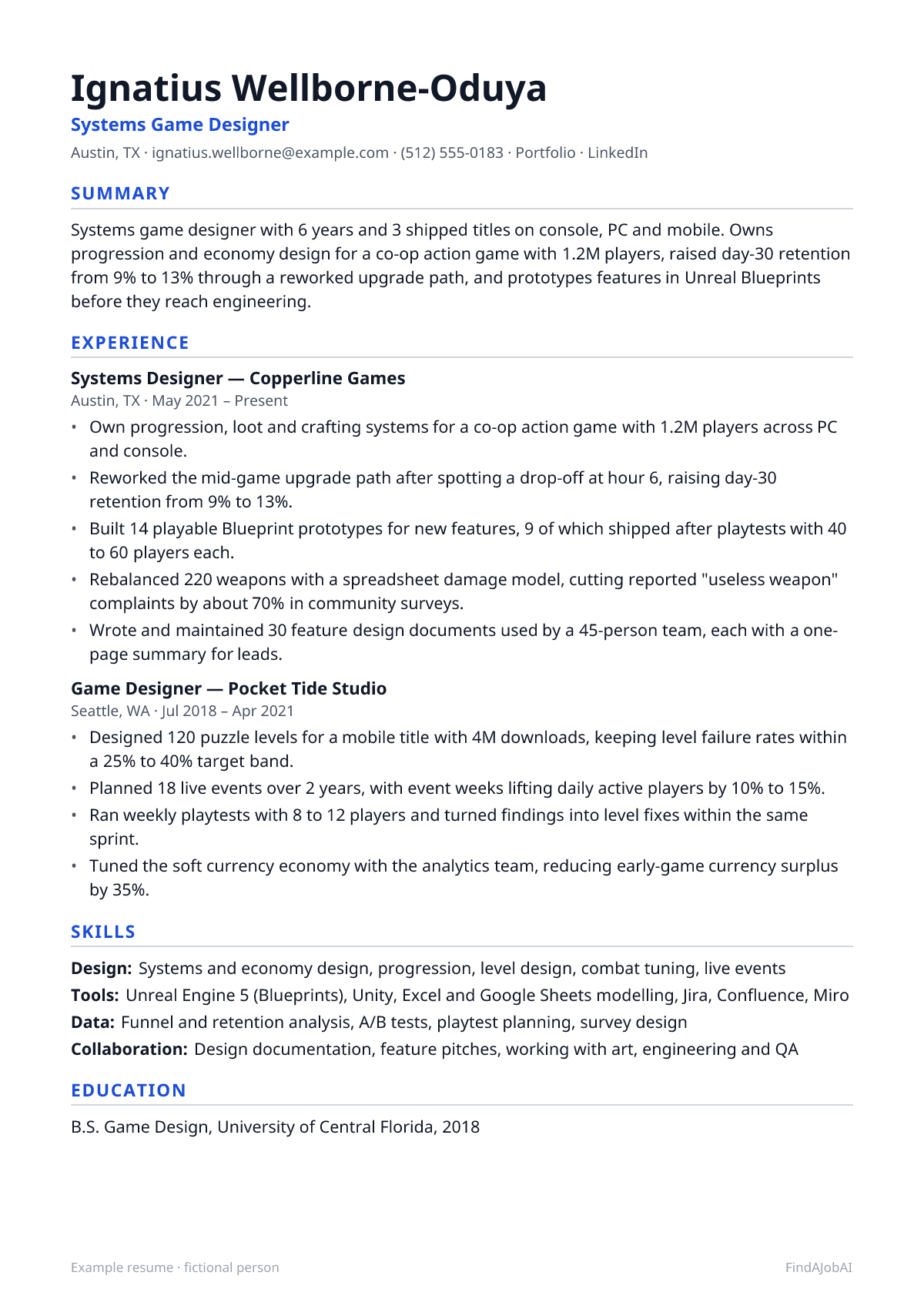
Game Designer resume template
This example as a one-page template: one column, standard headings and plain text, the format applicant tracking systems read most reliably.
After you sign up, Create my CV builds your own resume in this same one-column layout, from your real experience.
Mid-level game designer resume example
A complete one-page example for a fictional game designer: every bullet pairs an action with what changed because of it.
Example resume · fictional person
Ignatius Wellborne-Oduya
Systems Game Designer
Austin, TX · [email protected] · (512) 555-0183 · Portfolio · LinkedIn
Summary
Systems game designer with 6 years and 3 shipped titles on console, PC and mobile. Owns progression and economy design for a co-op action game with 1.2M players, raised day-30 retention from 9% to 13% through a reworked upgrade path, and prototypes features in Unreal Blueprints before they reach engineering.
Experience
Systems Designer, Copperline Games
Austin, TX · May 2021 – Present
- Own progression, loot and crafting systems for a co-op action game with 1.2M players across PC and console.
- Reworked the mid-game upgrade path after spotting a drop-off at hour 6, raising day-30 retention from 9% to 13%.
- Built 14 playable Blueprint prototypes for new features, 9 of which shipped after playtests with 40 to 60 players each.
- Rebalanced 220 weapons with a spreadsheet damage model, cutting reported "useless weapon" complaints by about 70% in community surveys.
- Wrote and maintained 30 feature design documents used by a 45-person team, each with a one-page summary for leads.
Game Designer, Pocket Tide Studio
Seattle, WA · Jul 2018 – Apr 2021
- Designed 120 puzzle levels for a mobile title with 4M downloads, keeping level failure rates within a 25% to 40% target band.
- Planned 18 live events over 2 years, with event weeks lifting daily active players by 10% to 15%.
- Ran weekly playtests with 8 to 12 players and turned findings into level fixes within the same sprint.
- Tuned the soft currency economy with the analytics team, reducing early-game currency surplus by 35%.
Skills
- Design: Systems and economy design, progression, level design, combat tuning, live events
- Tools: Unreal Engine 5 (Blueprints), Unity, Excel and Google Sheets modelling, Jira, Confluence, Miro
- Data: Funnel and retention analysis, A/B tests, playtest planning, survey design
- Collaboration: Design documentation, feature pitches, working with art, engineering and QA
Education
- B.S. Game Design, University of Central Florida, 2018
Fictional example by the FindAJobAI team: the person, employers and numbers are invented. Keep the structure; use your own work and numbers you can explain in an interview.
Entry-level game designer resume example
A junior designer with one shipped mobile game and several jam projects. Bullets focus on concrete levels and playtests, and the portfolio carries much of the weight.
Entry-level example resume · fictional person
Saoirse Lindqvist-Amadi
Junior Game Designer
Montreal, QC · [email protected] · (514) 555-0187 · Portfolio · Game jam page
Summary
Junior game designer with 1 shipped mobile title and 3 game jam projects. Designed 40 levels and the tutorial for a casual puzzle game, raising tutorial completion from 71% to 86%, and prototypes quickly in Unity with C#. Looking for a level or systems design role on a small team.
Experience
Junior Game Designer, Maplewick Interactive
Montreal, QC · Jun 2024 – Present
- Designed 40 levels for a casual mobile puzzle game with 600,000 downloads in its first 6 months.
- Rebuilt the tutorial into 4 short interactive steps, raising tutorial completion from 71% to 86%.
- Ran 12 playtests with 6 to 10 players each and logged findings in a shared tracker for the team.
- Tuned star thresholds for 40 levels using completion data, so 3 stars stayed a stretch goal for most players.
Game Jam Designer and Programmer, Independent projects
Montreal, QC · Sep 2021 – May 2024
- Built 3 jam games in Unity in 48 to 72 hours each, one placing in the top 10 of 400 entries for design.
- Designed a co-op puzzle mechanic that 2,300 players tried on itch.io, with a 4.3 average rating.
- Wrote short design one-pagers for each project, used as the core of my portfolio.
Skills
- Design: Level design, tutorial design, puzzle design, playtesting
- Tools: Unity, C# scripting, Figma, Google Sheets, Trello
- Communication: Design one-pagers, playtest reports, team critiques
Education
- B.A. Game Design, Concordia University, 2024
Senior game designer resume example
A lead designer who sets direction for a team. Bullets move from individual features to pillars, team leadership and decisions across the whole game.
Senior example resume · fictional person
Evander Mbeki-Torres
Lead Game Designer
Los Angeles, CA · [email protected] · (213) 555-0191 · Portfolio · LinkedIn
Summary
Lead game designer with 13 years and 6 shipped titles on console and PC. Leads 8 designers on an open-world RPG, wrote its core combat and quest pillars, and works with art, audio and engineering leads to keep scope realistic. Known for fast paper and engine prototypes and clear decision records.
Experience
Lead Game Designer, Highmoor Studios
Los Angeles, CA · Mar 2020 – Present
- Lead 8 designers across combat, quests and systems on an open-world RPG built by a team of 140.
- Wrote the game's 5 design pillars and a decision log of 300 entries that kept features aligned through 4 years of production.
- Cut 2 planned systems after vertical slice playtests with 80 players, saving about 6 months of team time.
- Introduced fortnightly cross-discipline reviews that reduced late design changes by roughly 40% compared with the previous project.
- Mentored 3 designers into senior roles, each now owning a major feature area.
Senior Game Designer, Highmoor Studios
Los Angeles, CA · Jan 2016 – Feb 2020
- Owned combat design for an action game that sold over 2M copies, including 45 enemy types and 6 bosses.
- Built an enemy tuning spreadsheet used by 4 designers to balance encounters across 3 difficulty levels.
- Ran 25 external playtests and turned findings into 120 tracked design changes before launch.
Game Designer, Bluefen Games
San Diego, CA · Jun 2012 – Dec 2015
- Designed 22 missions for 2 shipped console titles in a proprietary level editor.
- Built 60 scripted events and checkpoints using the studio's Lua tools.
Skills
- Leadership: Design direction, pillars, hiring, mentoring, cross-discipline reviews
- Design: Combat, quests, systems, encounter design, difficulty tuning
- Tools: Unreal Engine, proprietary editors, Lua, Excel modelling, Jira, Confluence
Education
- B.F.A. Interactive Media, University of Southern California, 2012
How to write a game designer resume
Five steps, in the order a recruiter reads the page. The format around them stays plain for every job: one column, standard headings, newest role first.
Header: name, target title and links
Use the design title that matches the posting, such as "Systems Designer" or "Level Designer", and put your portfolio link first. Recruiters at studios often open it before reading further.
Summary: what you do and your best proof
State your years in design, shipped titles and platforms, your main area of ownership and one result backed by player data. Mention the engine you prototype in.
Experience: newest first, a result in every bullet
Start each bullet with the feature or system, then what you did and what changed for players. "Balanced gameplay" says little; "rebalanced 220 weapons with a damage model" shows the size and method.
Skills: grouped, in the ad's words
Group skills into design, tools, data and collaboration. Name the engine, scripting language and documentation tools exactly, since studio postings list them.
Education and certifications
List your degree, or relevant courses and jams if you do not have one. Game design degrees help, but shipped work and a strong portfolio usually matter more.
Skills to put on a game designer resume
Hard skills are the tools and methods of the job; soft skills are how you work with people. Each comes with one way to prove it, because a skill named only in a list counts for little. Add the ones you really have.
Hard skills
- Systems design
- Name the systems you owned and a player metric that changed.
- Level design
- Give the number of levels or missions and a completion or difficulty goal.
- Economy design
- Describe the currency or reward loop and how you tuned it with data.
- Combat design
- Mention enemies, bosses or weapons designed and how you balanced them.
- Prototyping
- Count prototypes built and how many shipped after testing.
- Unreal Blueprints or Unity
- Name the engine and what you built in it yourself.
- Spreadsheet modelling
- Describe the model and how many items or encounters it balanced.
- Playtesting
- Give the number of sessions and an example of a change you made from them.
- Design documentation
- Mention how many documents you wrote and who used them.
- Analytics and A/B testing
- Describe a test you designed and the result.
Soft skills
- Communication
- Show how you explained a design to art, engineering or leadership.
- Taking feedback
- Describe a design you changed after playtest or review feedback.
- Scope judgment
- Mention a feature you cut or simplified to protect the schedule.
- Collaboration
- Name the disciplines you worked with on a feature.
- Player empathy
- Give an example of spotting a frustration and fixing it.
- Mentoring
- Count designers you mentored and what they went on to own.
Game Designer resume bullet examples: weak vs strong
The same work, written two ways. The strong version names the tool, the scope and a result; the numbers are examples, yours must be real.
Weak: Designed game systems.
Strong: Owned progression, loot and crafting systems for a co-op action game with 1.2M players across PC and console.
Names the systems, the game type and the player base.
Weak: Improved player retention.
Strong: Raised day-30 retention from 9% to 13% by redesigning the mid-game upgrade path where players were quitting around hour 6.
Shows the data signal, the design change and the result.
Weak: Built some test versions of features.
Strong: Built 14 playable Blueprint prototypes, 9 of which shipped after playtests with 40 to 60 players each.
Counts output and shows ideas were tested before shipping.
Weak: Balanced weapons.
Strong: Rebalanced 220 weapons with a spreadsheet damage model, cutting "useless weapon" complaints by about 70% in surveys.
Scale, method and a player-facing result.
Weak: Created levels.
Strong: Built 120 levels for a 4M-download mobile puzzle game, holding each level's failure rate inside a 25% to 40% band.
Volume, reach and a measurable difficulty goal.
Weak: Worked on live events.
Strong: Ran an 18-event live calendar across 2 years; each event week raised daily active players by 10% to 15%.
Turns a task into a recurring, measured result.
15 more game designer resume bullet examples
Grouped by area of the job, so you can find the ones closest to your work. Keep the shape (action, scope, result) and replace the invented numbers with your own.
Systems and economy
- Designed a crafting system with 85 recipes that 62% of active players used weekly after launch.
- Reduced premium currency inflation by 30% after reworking daily reward values with the analytics team.
- Built a progression curve model covering 50 player levels, used to tune 3 content updates.
Levels and missions
- Designed 16 multiplayer maps, 5 of which became the most played in the game's first season.
- Cut average mission failure on a difficulty spike from 55% to 30% by adding a checkpoint and clearer enemy tells.
- Blocked out 30 levels in greybox within 8 weeks for art handoff.
Combat and balance
- Balanced 40 character abilities using win-rate data from 200,000 matches a week.
- Designed 4 boss fights with distinct phases, each tested with at least 20 players before final tuning.
- Reduced the gap between the strongest and weakest class win rates from 12 points to 4.
Live operations
- Planned a seasonal event calendar of 24 events a year with product and marketing.
- Designed a weekly challenge system that raised average sessions per player by 8%.
- Ran 6 A/B tests on reward pacing, rolling out the 2 that improved day-7 retention.
Process and collaboration
- Introduced one-page feature briefs that cut design review meetings from 90 to 45 minutes.
- Set up a playtest pipeline with QA that gathered feedback from 50 players every 2 weeks.
- Worked with 3 engineers to build designer-friendly tuning tools, removing 200 hours of manual data entry a year.
Game Designer resume summary examples
Two or three lines on what you do and your strongest proof. Start from the one closest to your level and use your own facts.
Junior game designer with 1 shipped mobile title and 3 jam games. Designed 40 levels and the tutorial for a casual puzzle game, and prototypes quickly in Unity. Hoping to join a small team as a level or systems designer.
Systems game designer with 6 years and 3 shipped titles on console, PC and mobile. Owns progression and economy for a co-op game with 1.2M players and raised day-30 retention from 9% to 13%.
Lead game designer with 13 years and 6 shipped titles. Leads a team of 8 designers on an open-world RPG, set the core combat and quest pillars, and guided the game to a strong critical reception at launch.
Common game designer resume mistakes
Each one is easy to make and quick to fix before you apply.
Portfolio missing from the header
Studios want to see and play your work. Add a portfolio with videos, playable builds or design docs to the header.
Unclear ownership on shipped games
Saying you worked on a game is not enough. State exactly which levels, systems or features you designed.
Only describing ideas
Design is about testing and iterating. Mention prototypes, playtests and changes made from feedback.
No player data
Where you have retention, completion or survey results, use them to show your design worked for players.
Listing engines you barely used
Name only the tools you built content in, and say what you built, so interview questions don't catch you out.
ATS tips for a game designer resume
Applicant tracking systems turn your file into text that recruiters search, mostly for the skills and titles in the ad. They rarely reject a resume on their own; one that parses badly or misses the ad's words just doesn't come up.
- Put a portfolio link in the header with playable builds, videos or design docs; most studios check it before the resume.
- Name each shipped title and the platform, and say exactly which parts you owned.
- List the engines and tools you actually built content in, such as Unreal Blueprints, Unity or a proprietary editor.
- Use player data where you have it: retention, completion rates, session length or survey results.
- Mention playtesting and documentation, since design is a team job and studios look for clear communicators.
For the format itself, run the free ATS resume checklist.
Everything for Game Designers
- Game Designer cover letter examplesThree example letters and a short email version
- Game Designer interview questions30 questions with sample answers
- Game Designer job descriptionDuties, skills and requirements
- How to tailor your resume without lying
Other resume examples
Game Designer resume FAQ
What should a game designer include on a resume?
Shipped titles with platforms, your specific area of ownership, the tools and engines you used, and results such as retention or completion rates. Add a portfolio link near the top.
How do I write a game designer resume with no shipped games?
Lead with game jam projects, mods or student games with a playable link. Describe the design problem you solved in each, the tools you used and what playtesters told you.
Should a game designer resume list programming skills?
List scripting and visual scripting you actually use, such as Blueprints, Lua or C#. Designers who can prototype on their own are easier to place on small teams.
How we built this page
The FindAJobAI team wrote the three example resumes, the bullets, the skills and the advice for game designer roles. The people, employers and numbers in the examples are invented; the structure, the tools and the way each bullet is built are the parts to copy.
Once we track enough live game designer job ads, this page also shows the skills they ask for most, counted the same way as our in-demand skills report.
Last reviewed on November 1, 2026.