Paramedic Resume Example (2026)
By FindAJobAI team Updated How we built this page
Paramedic job ads tend to list the same core: ALS certification, a set number of years running 911 calls, and comfort leading a crew under pressure. What separates candidates is evidence of judgment on real calls, not just a list of skills. A paramedic resume should say what the patient presented with, what you did, and what happened next.
The example below is a paramedic with five years split between a busy urban 911 service and a rural county EMS agency. Notice how each bullet names the call type, the intervention and the outcome, instead of counting transports run.
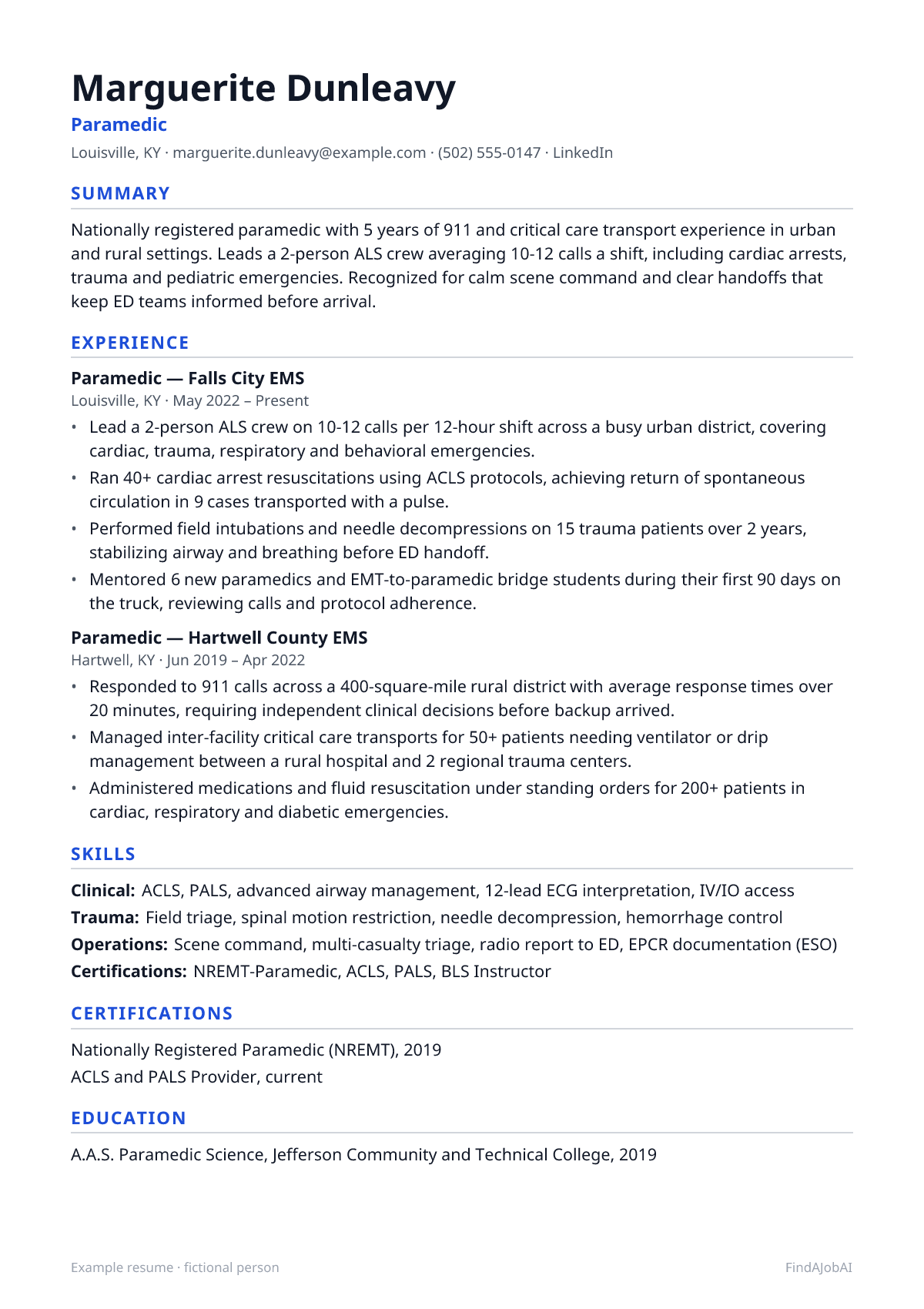
Paramedic resume template
This example as a one-page template: one column, standard headings and plain text, the format applicant tracking systems read most reliably.
After you sign up, Create my CV builds your own resume in this same one-column layout, from your real experience.
Mid-level paramedic resume example
A complete one-page example for a fictional paramedic: every bullet pairs an action with what changed because of it.
Example resume · fictional person
Summary
Nationally registered paramedic with 5 years of 911 and critical care transport experience in urban and rural settings. Leads a 2-person ALS crew averaging 10-12 calls a shift, including cardiac arrests, trauma and pediatric emergencies. Recognized for calm scene command and clear handoffs that keep ED teams informed before arrival.
Experience
Paramedic, Falls City EMS
Louisville, KY · May 2022 – Present
- Lead a 2-person ALS crew on 10-12 calls per 12-hour shift across a busy urban district, covering cardiac, trauma, respiratory and behavioral emergencies.
- Ran 40+ cardiac arrest resuscitations using ACLS protocols, achieving return of spontaneous circulation in 9 cases transported with a pulse.
- Performed field intubations and needle decompressions on 15 trauma patients over 2 years, stabilizing airway and breathing before ED handoff.
- Mentored 6 new paramedics and EMT-to-paramedic bridge students during their first 90 days on the truck, reviewing calls and protocol adherence.
Paramedic, Hartwell County EMS
Hartwell, KY · Jun 2019 – Apr 2022
- Responded to 911 calls across a 400-square-mile rural district with average response times over 20 minutes, requiring independent clinical decisions before backup arrived.
- Managed inter-facility critical care transports for 50+ patients needing ventilator or drip management between a rural hospital and 2 regional trauma centers.
- Administered medications and fluid resuscitation under standing orders for 200+ patients in cardiac, respiratory and diabetic emergencies.
Skills
- Clinical: ACLS, PALS, advanced airway management, 12-lead ECG interpretation, IV/IO access
- Trauma: Field triage, spinal motion restriction, needle decompression, hemorrhage control
- Operations: Scene command, multi-casualty triage, radio report to ED, EPCR documentation (ESO)
- Certifications: NREMT-Paramedic, ACLS, PALS, BLS Instructor
Certifications
- Nationally Registered Paramedic (NREMT), 2019
- ACLS and PALS Provider, current
Education
- A.A.S. Paramedic Science, Jefferson Community and Technical College, 2019
Fictional example by the FindAJobAI team: the person, employers and numbers are invented. Keep the structure; use your own work and numbers you can explain in an interview.
Entry-level paramedic resume example
A newly certified paramedic with a field internship and prior EMT experience. Education sits right under the summary, and the internship bullets lean on what she was cleared to do under a preceptor rather than years on the truck.
Entry-level example resume · fictional person
Summary
Newly certified paramedic with an A.A.S. in Paramedic Science and 500 hours of field internship on a busy urban ALS unit. Prior 3 years as an EMT-Basic running BLS transports. Comfortable with ACLS protocols, advanced airway management and IV therapy under a preceptor, looking for a first paramedic role in a 911 system.
Education
- A.A.S. Paramedic Science, Bluegrass Community and Technical College, 2026
Experience
Paramedic Field Intern, Bluegrass Regional EMS
Lexington, KY · Jan 2026 – May 2026
- Completed 500 hours of field internship on an ALS unit, running 8-10 calls a shift under direct preceptor supervision.
- Led patient assessment and treatment on 12 cardiac and respiratory calls, with a preceptor signing off on independent 12-lead interpretation.
- Performed IV starts on 35 patients with a 90% first-attempt success rate, and assisted on 3 advanced airway placements.
- Documented patient care reports for all internship calls, with zero corrections required on narrative accuracy by week 10.
EMT-Basic, Commonwealth Ambulance Service
Lexington, KY · Aug 2022 – Dec 2025
- Staffed BLS transport and 911 response units, running an average of 6 calls per 12-hour shift across medical and minor trauma patients.
- Assisted paramedic partners on 50+ ALS calls, preparing equipment and managing scene logistics during cardiac and respiratory emergencies.
Skills
- Clinical: ACLS (student), basic 12-lead interpretation, IV therapy, airway management (BVM, OPA/NPA)
- Operations: Patient assessment, EPCR documentation, scene safety, BLS transport
- Certifications: NREMT-Paramedic (pending state license), EMT-Basic, BLS, ACLS (in progress)
Certifications
- EMT-Basic, 2022
Senior paramedic resume example
A field training officer eleven years in, now shaping clinical standards for an agency. The bullets move from running calls to redesigning protocols and reviewing crew performance, and the summary names the agency's size and the protocol change she led.
Senior example resume · fictional person
Thessaly Vandermeer
Paramedic / Field Training Officer
Columbus, OH · [email protected] · (614) 555-0175 · LinkedIn
Summary
Field training officer and paramedic with 11 years of 911 and critical care transport experience, now overseeing clinical competency for a 40-person EMS agency. Redesigned the agency's cardiac arrest protocol after reviewing 2 years of call data, raising witnessed ROSC rates and standardizing crew performance reviews across 12 ambulances.
Experience
Field Training Officer / Paramedic, Scioto Valley EMS
Columbus, OH · Jul 2019 – Present
- Oversee clinical competency and field training for 40 paramedics and EMTs across 12 ambulances, reviewing call documentation and running quarterly skills evaluations.
- Redesigned the agency's cardiac arrest protocol after auditing 2 years of call outcomes, raising witnessed ROSC rates from 24% to 33% within a year.
- Precepted 22 new paramedics through field training, with 20 passing independent clinical evaluation on their first attempt.
- Led the response to a 12-patient bus collision, establishing triage and coordinating 5 mutual-aid units until all patients were transported within 50 minutes.
Paramedic, Capitol City Ambulance
Columbus, OH · Mar 2015 – Jun 2019
- Ran ALS 911 calls in a high-volume downtown district, averaging 12 calls per 12-hour shift including frequent cardiac and overdose emergencies.
- Administered naloxone and managed airways on 80+ opioid overdose calls, with no reported adverse reactions to field dosing.
- Served on the agency's protocol review committee, contributing to updates on pediatric dosing and stroke recognition criteria.
Paramedic, Muskingum County EMS
Zanesville, OH · Feb 2015 – Feb 2015
- Responded to rural 911 calls with response times averaging 18 minutes, requiring independent decision-making before backup arrival.
- Managed 30+ inter-facility critical care transports for ventilated and drip-dependent patients over a 2-month assignment.
Skills
- Clinical: ACLS, PALS, advanced airway, 12-lead interpretation, critical care transport medications
- Leadership: Field training, protocol design, call review and QA, mass casualty incident command
- Certifications: NREMT-Paramedic, ACLS/PALS Instructor, CCEMT-P
Certifications
- Critical Care Emergency Medical Transport Paramedic (CCEMT-P), 2018
- ACLS/PALS Instructor, current
Education
- A.A.S. Paramedic Science, Columbus State Community College, 2015
How to write a paramedic resume
Five steps, in the order a recruiter reads the page. The format around them stays plain for every job: one column, standard headings, newest role first.
Header: name, target title and links
Use the title "Paramedic" and lead with your NREMT or state license status right under your name, since agencies often screen applications by certification before reading further.
Summary: what you do and your best proof
Name your years of 911 or critical care experience, your setting (urban, rural, inter-facility), and one result: a resuscitation outcome, a protocol you influenced, or trainees you mentored. Skip lines like "dedicated to patient care"; every applicant says that.
Experience: newest first, a result in every bullet
Open each bullet with the call type, then the intervention and the outcome: what the patient presented with, what you did, and what happened next. Counting calls run says little; one resuscitation, trauma save or protocol decision says a lot.
Skills: grouped, in the ad's words
Group them into clinical skills, trauma, operations and certifications. Name specific protocols (ACLS, PALS) and documentation systems (ESO, ImageTrend) the ad lists, and keep certifications current and dated.
Education and certifications
List your paramedic program and degree with the year, plus your NREMT status and specialty certifications like CCEMT-P or NRP. Without full paramedic experience, detail your field internship hours and what you were cleared to do under a preceptor.
Skills to put on a paramedic resume
Hard skills are the tools and methods of the job; soft skills are how you work with people. Each comes with one way to prove it, because a skill named only in a list counts for little. Add the ones you really have.
Hard skills
- ACLS protocols
- Name a cardiac arrest or arrhythmia call and the drugs or interventions you ran under protocol.
- Advanced airway management
- Give the method (intubation, King airway) and the outcome or complication you avoided.
- 12-lead ECG interpretation
- Describe a STEMI or arrhythmia you caught and the action it triggered, like a cath lab activation.
- IV/IO access
- Mention your success rate or patient count, especially on difficult access patients.
- Trauma assessment
- Point to a specific injury pattern you identified and the field intervention it led to.
- Pediatric emergency care (PALS)
- Name a pediatric call and the weight-based dosing or intervention you performed correctly under pressure.
- Critical care transport
- Describe a ventilated or drip-managed patient you transported and the duration or distance.
- Scene command
- Give the patient count and unit count you coordinated on a multi-casualty call.
- EPCR documentation (ESO, ImageTrend)
- Mention the system by name and a habit, like same-shift completion, that reduced errors.
- Medication administration
- Name specific drugs you've pushed under protocol and the call volume or outcome.
- Hemorrhage control
- Describe a tourniquet or packing application and how quickly you controlled the bleed.
- Field triage
- Give the patient count on a mass casualty call and how you prioritized transport order.
Soft skills
- Composure under pressure
- Describe a high-acuity call where you stayed effective, with the outcome that followed.
- Clear radio communication
- Mention a handoff that let the ED prepare in advance, such as activating a trauma or stroke team.
- Team leadership
- Give the crew size or unit count you directed on a specific call.
- Mentoring
- Count the trainees you precepted and what they were cleared to do independently afterward.
- Empathy with patients and families
- Describe a difficult call, like a pediatric or death notification, where your approach mattered.
- Adaptability
- Point to a call where protocol didn't fit the situation and how you adjusted safely.
- Documentation accuracy
- Mention a QA or chart review result that reflected consistently clean reports.
Paramedic resume bullet examples: weak vs strong
The same work, written two ways. The strong version names the tool, the scope and a result; the numbers are examples, yours must be real.
Weak: Responded to 911 calls.
Strong: Ran first on 40+ cardiac arrests a year, achieving ROSC before ED arrival in roughly a quarter of cases through early, uninterrupted compressions and timely defibrillation.
Names the call type, the action, and a measurable outcome.
Weak: Administered medications.
Strong: Pushed epinephrine and amiodarone per ACLS protocol on 15 cardiac arrest calls, documenting timing accurately enough that 2 received positive feedback during hospital case review.
Specific drugs, protocol, and a concrete outcome.
Weak: Managed trauma patients.
Strong: Controlled a femoral arterial bleed with a tourniquet in under 2 minutes on scene, preventing the patient from reaching hypovolemic shock before trauma center arrival.
Shows the intervention, speed and the result it prevented.
Weak: Worked well under pressure.
Strong: Took incident command at a 3-car collision with 5 patients, triaging by severity and coordinating 2 additional units until all patients were transported within 35 minutes.
Leadership shown through a specific multi-patient scene.
Weak: Provided patient care during transport.
Strong: Managed a ventilated ICU patient during a 45-minute inter-facility transport, adjusting sedation per orders and arriving with stable vitals throughout.
Turns a generic duty into a specific critical care skill.
Weak: Trained new EMTs.
Strong: Precepted 6 new paramedics through their first 90 days, reviewing 30+ calls each and signing off on independent cardiac arrest management.
Quantifies mentoring and what trainees were cleared to do.
15 more paramedic resume bullet examples
Grouped by area of the job, so you can find the ones closest to your work. Keep the shape (action, scope, result) and replace the invented numbers with your own.
Cardiac and resuscitation
- Ran 25 witnessed cardiac arrests over 2 years, achieving ROSC in 7 cases through early CPR coaching and rapid defibrillation.
- Identified a STEMI on a 12-lead during a chest pain call, activating the cath lab 20 minutes before ED arrival.
- Managed post-ROSC care including targeted temperature considerations and vasopressor titration on 4 transports to a cardiac center.
Trauma response
- Applied a pelvic binder and 2 tourniquets on a motorcycle collision patient, stabilizing for a 15-minute transport to a level 1 trauma center.
- Performed a needle decompression on a suspected tension pneumothorax, restoring breath sounds before helicopter transport.
- Triaged 8 patients at a warehouse collapse, directing immediate transport for 2 critical patients ahead of 6 stable ones.
Medical emergencies
- Managed 60+ diabetic emergency calls with dextrose and glucagon administration, with zero repeat calls within 24 hours for the same patient.
- Administered albuterol and CPAP on 20 respiratory distress calls, avoiding intubation in 17 of them through early intervention.
- Reversed 3 opioid overdoses with titrated naloxone dosing, avoiding withdrawal-related agitation reported in rougher dosing approaches.
Operations and documentation
- Completed EPCR documentation within 30 minutes of call completion on 95% of shifts, supporting faster billing and QA review.
- Restocked and checked ALS equipment before each shift, catching an expired epinephrine supply before it reached a call.
- Coordinated with 2 fire departments and 1 police unit on a structure fire with patients, managing triage at the rehab sector.
Training and quality
- Precepted 4 EMT-to-paramedic bridge students, reviewing 15 calls each and signing off on independent trauma assessment.
- Coached bystander CPR by phone-guided instruction before arrival on 3 calls, improving compression quality on crew arrival.
- Participated in monthly case review presenting 3 complex calls to the medical director, leading to a protocol clarification on pediatric seizure dosing.
Paramedic resume summary examples
Two or three lines on what you do and your strongest proof. Start from the one closest to your level and use your own facts.
Newly certified paramedic with an A.A.S. in Paramedic Science and 500 hours of field internship on a busy urban ALS unit. Comfortable running cardiac, respiratory and trauma calls under a preceptor, with strong ACLS and airway management skills.
Paramedic with 5 years of 911 experience in urban and rural settings, leading ALS crews through cardiac arrests, trauma and critical care transports. Achieved ROSC in 9 witnessed arrests over the past year and mentors new paramedics on protocol adherence.
Field training officer and paramedic with 11 years of 911 and critical care transport experience, now overseeing clinical competency for a 40-person EMS agency. Redesigned the agency's cardiac arrest protocol, raising ROSC rates and standardizing crew performance reviews.
Common paramedic resume mistakes
Each one is easy to make and quick to fix before you apply.
Listing certifications with no call attached
ACLS and PALS in Skills show what you're trained to do; the bullets must show a call where you used those protocols. Pair each certification with an example.
Counting transports instead of outcomes
"Completed 2,000 transports" says little about clinical judgment. Name one high-acuity call and what you did that changed the outcome.
Vague language around resuscitation
"Performed CPR" undersells the skill. Give the call volume, the protocol followed, and the ROSC rate or outcome where you know it.
Omitting the setting
Urban 911, rural response and critical care transport involve different pacing and independence. Say which setting your experience is in so agencies see the overlap with their own calls.
Burying certification status
If your NREMT or state license is pending or about to expire, say so clearly near the top rather than letting a recruiter find out later in the process.
ATS tips for a paramedic resume
Applicant tracking systems turn your file into text that recruiters search, mostly for the skills and titles in the ad. They rarely reject a resume on their own; one that parses badly or misses the ad's words just doesn't come up.
- Lead with your certification (NREMT-Paramedic) and license state; ATS systems and recruiters scan for it first.
- Describe calls by type and outcome (cardiac arrest, ROSC achieved) rather than listing "patient care" generically.
- Name your protocols and skills precisely (ACLS, PALS, advanced airway, 12-lead interpretation) instead of "clinical skills."
- Quantify call volume per shift or year if you can estimate it; agencies use this to gauge your pace and experience.
- Mention your EPCR or documentation system (ESO, ImageTrend) if the ad names one; it signals you can start documentation with minimal training.
For the format itself, run the free ATS resume checklist.
Everything for Paramedics
- Paramedic cover letter examplesThree example letters and a short email version
- Paramedic job descriptionDuties, skills and requirements
- How to tailor your resume without lying
Other resume examples
Paramedic resume FAQ
What certifications should a paramedic resume list?
NREMT-Paramedic (or state license), ACLS, PALS, and BLS at minimum. Add any specialty certifications like NRP, TNCC, or CCEMT-P if you hold them, since agencies often screen for these first.
How do I write a paramedic resume with only internship experience?
List your clinical and field internship hours separately, naming the call types you managed under a preceptor and any skills you performed independently, such as IV starts or medication administration.
Should I include every call type I've responded to?
No. Focus on the call types that show clinical range and judgment, like cardiac arrests, major trauma, and pediatric emergencies, rather than listing every category of call you've run.
How do I show leadership on an EMS resume without a formal title?
Describe scene command on a specific multi-patient or high-acuity call, or mentoring new hires and students, even without the formal title of field training officer.
How we built this page
The FindAJobAI team wrote the three example resumes, the bullets, the skills and the advice for paramedic roles. The people, employers and numbers in the examples are invented; the structure, the tools and the way each bullet is built are the parts to copy.
Once we track enough live paramedic job ads, this page also shows the skills they ask for most, counted the same way as our in-demand skills report.
Last reviewed on November 1, 2026.