Phlebotomist Resume Example (2026)
By FindAJobAI team Updated How we built this page
Phlebotomist job ads usually ask for the same core: a current certification, comfort with difficult draws, and accuracy under a busy schedule. What separates candidates on paper is evidence that you handled real patients and real specimens without errors, not just a list of tasks you were trained on. A phlebotomist resume should say how many draws you performed, what made some of them hard, and how your accuracy held up.
The example below is a phlebotomist with four years split between a hospital lab and an outpatient draw station. Notice how each bullet names the setting, the patient volume or specimen type, and the result, instead of simply listing venipuncture as a skill.
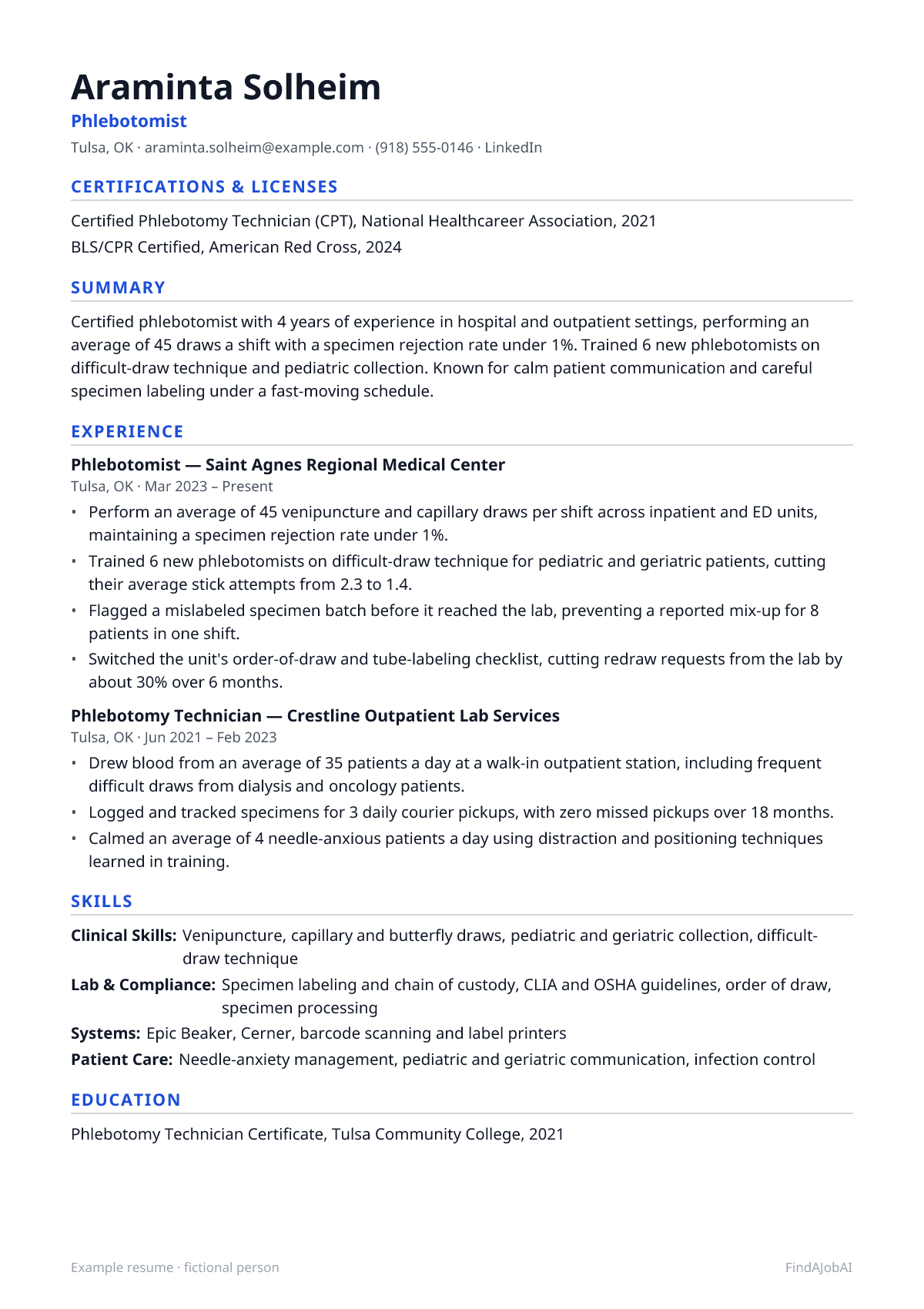
Phlebotomist resume template
This example as a one-page template: one column, standard headings and plain text, the format applicant tracking systems read most reliably.
After you sign up, Create my CV builds your own resume in this same one-column layout, from your real experience.
Mid-level phlebotomist resume example
A complete one-page example for a fictional phlebotomist: every bullet pairs an action with what changed because of it.
Example resume · fictional person
Certifications & Licenses
- Certified Phlebotomy Technician (CPT), National Healthcareer Association, 2021
- BLS/CPR Certified, American Red Cross, 2024
Summary
Certified phlebotomist with 4 years of experience in hospital and outpatient settings, performing an average of 45 draws a shift with a specimen rejection rate under 1%. Trained 6 new phlebotomists on difficult-draw technique and pediatric collection. Known for calm patient communication and careful specimen labeling under a fast-moving schedule.
Experience
Phlebotomist, Saint Agnes Regional Medical Center
Tulsa, OK · Mar 2023 – Present
- Perform an average of 45 venipuncture and capillary draws per shift across inpatient and ED units, maintaining a specimen rejection rate under 1%.
- Trained 6 new phlebotomists on difficult-draw technique for pediatric and geriatric patients, cutting their average stick attempts from 2.3 to 1.4.
- Flagged a mislabeled specimen batch before it reached the lab, preventing a reported mix-up for 8 patients in one shift.
- Switched the unit's order-of-draw and tube-labeling checklist, cutting redraw requests from the lab by about 30% over 6 months.
Phlebotomy Technician, Crestline Outpatient Lab Services
Tulsa, OK · Jun 2021 – Feb 2023
- Drew blood from an average of 35 patients a day at a walk-in outpatient station, including frequent difficult draws from dialysis and oncology patients.
- Logged and tracked specimens for 3 daily courier pickups, with zero missed pickups over 18 months.
- Calmed an average of 4 needle-anxious patients a day using distraction and positioning techniques learned in training.
Skills
- Clinical Skills: Venipuncture, capillary and butterfly draws, pediatric and geriatric collection, difficult-draw technique
- Lab & Compliance: Specimen labeling and chain of custody, CLIA and OSHA guidelines, order of draw, specimen processing
- Systems: Epic Beaker, Cerner, barcode scanning and label printers
- Patient Care: Needle-anxiety management, pediatric and geriatric communication, infection control
Education
- Phlebotomy Technician Certificate, Tulsa Community College, 2021
Fictional example by the FindAJobAI team: the person, employers and numbers are invented. Keep the structure; use your own work and numbers you can explain in an interview.
Entry-level phlebotomist resume example
A recently certified phlebotomist with no paid job yet, just an externship. Education and certification sit right under the summary since the certificate is his strongest credential, and the externship's supervised draw count stands in for job experience.
Entry-level example resume · fictional person
Summary
Entry-level phlebotomist with a Phlebotomy Technician Certificate and 150 supervised clinical draws completed during a 6-week externship at a community health clinic. Comfortable with venipuncture, capillary draws and specimen processing, and trained in pediatric positioning. Looking for a first full-time phlebotomist role in a hospital or outpatient setting.
Education
- Phlebotomy Technician Certificate, Wichita Area Technical College, 2026
Experience
Phlebotomy Externship, Prairie Winds Community Health Clinic
Wichita, KS · Jan 2026 – Feb 2026
- Completed 150 supervised venipuncture and capillary draws on patients ranging from toddlers to adults over 70, with zero reported mislabels.
- Practiced order of draw and specimen processing under a clinical mentor, passing a 40-draw competency check with no failed attempts.
- Assisted with same-day walk-in draws during 2 high-volume flu clinic events, each seeing over 80 patients.
Patient Care Volunteer, Wichita Memorial Hospital
Wichita, KS · Sep 2024 – Dec 2025
- Escorted and comfortably positioned an average of 20 patients a shift for lab and imaging appointments across 2 hospital floors.
- Shadowed phlebotomy staff for 30 hours, logging notes on vein selection and patient communication that fed directly into certificate coursework.
Skills
- Clinical Skills: Venipuncture, capillary draws, order of draw, specimen processing
- Patient Care: Pediatric and geriatric positioning, needle-anxiety support, infection control basics
- Systems: Barcode label printers, Epic Beaker (externship training), order-entry basics
Certifications
- Certified Phlebotomy Technician (CPT), National Healthcareer Association, 2026
Senior phlebotomist resume example
A lead phlebotomist ten years in, now training staff and standardizing protocols across two campuses instead of only drawing blood herself. The bullets shift from draw volume to the systems she built: training programs, protocol changes and the rejection rate she drove down.
Senior example resume · fictional person
Summary
Lead phlebotomist with 10 years of experience across hospital and reference lab settings, now overseeing a 7-person phlebotomy team across 2 hospital campuses. Standardized draw protocols that cut the specimen rejection rate from 3% to under 1%, and built the pediatric and NICU collection training all new hires complete in their first month.
Experience
Lead Phlebotomist, Meridian Valley Health System
Omaha, NE · Jul 2020 – Present
- Oversee a 7-person phlebotomy team across 2 hospital campuses, scheduling coverage for over 300 draws a day combined.
- Standardized draw protocols and order-of-draw checklists across both campuses, cutting the specimen rejection rate from 3% to under 1% in 9 months.
- Built the pediatric and NICU collection training all new hires complete in their first month, cutting failed first-attempt draws on infants from 35% to 12%.
- Investigated 14 specimen-related incidents over 2 years, root-causing 10 of them to labeling steps and rewriting the labeling checklist accordingly.
Senior Phlebotomist, Platte River Reference Laboratory
Omaha, NE · Apr 2016 – Jun 2020
- Performed an average of 50 draws a day at a high-volume reference lab, including frequent difficult draws referred from 3 partner clinics.
- Mentored 8 newly certified phlebotomists through their first 90 days, tracking their stick-success rate until it matched the team average.
- Served on the lab's safety committee, helping cut reported needlestick incidents from 6 to 1 over 2 years.
Phlebotomist, Cedar Bluff Medical Center
Lincoln, NE · Feb 2013 – Mar 2016
- Drew blood from an average of 40 inpatients and outpatients a day across medical-surgical and oncology units.
- Trained in and performed pediatric draws for the hospital's 24-bed pediatric unit, handling an average of 6 pediatric sticks a week.
Skills
- Leadership: Staff scheduling, competency training, incident investigation
- Clinical Skills: Difficult draws, pediatric and NICU collection, dialysis and oncology patients
- Compliance: CLIA and OSHA standards, protocol design, specimen integrity audits
Certifications
- Certified Phlebotomy Technician (CPT), NHA, 2012
- NCPT, American Society for Clinical Pathology, 2017
Education
- Phlebotomy Technician Certificate, Metropolitan Community College, 2012
How to write a phlebotomist resume
Five steps, in the order a recruiter reads the page. The format around them stays plain for every job: one column, standard headings, newest role first.
Header: name, target title and links
Use the title "Phlebotomist" even if your title was "Phlebotomy Technician" or "Clinical Lab Assistant," and list your certification by name right in the header area or summary. Facilities search for the exact credential.
Summary: what you do and your best proof
Name your certification, your typical draw volume, and one accuracy number like a rejection or redraw rate. Skip lines like "great with patients"; show it with a technique or a specific patient situation instead.
Experience: newest first, a result in every bullet
Open each bullet with the setting or patient type, then the technique and the result: how many draws, how difficult, what the outcome was. Counting shifts worked says little; a specimen you caught or a hard draw you completed says a lot.
Skills: grouped, in the ad's words
Group into clinical technique, lab and compliance, systems and patient care. Name the lab system you charted in (Epic Beaker, Cerner, Sunquest) since facilities standardize on one and look for it directly.
Education and certifications
List your certificate program and certification with the year, and the issuing body (NHA, ASCP, AMT). Without paid experience, add your externship or clinical hours as a job entry with the draw count and setting.
Skills to put on a phlebotomist resume
Hard skills are the tools and methods of the job; soft skills are how you work with people. Each comes with one way to prove it, because a skill named only in a list counts for little. Add the ones you really have.
Hard skills
- Venipuncture
- Give your typical draws per shift and one accuracy number, like a rejection or redraw rate.
- Capillary and heel-stick draws
- Mention the patient population, such as infants or geriatric patients, where this technique matters most.
- Difficult-draw technique
- Describe a specific hard-to-stick situation you handled and how many attempts it took.
- Order of draw
- State it as a habit tied to a result, like an error you prevented, not just a memorized rule.
- Specimen labeling and chain of custody
- Point to a catch you made, like a mislabel caught before it reached the lab.
- Pediatric and geriatric collection
- Name the age range you're trained for and a technique you use to ease the draw.
- CLIA and OSHA compliance
- Mention an audit you passed or a safety practice you maintained, with a number if you have one.
- Lab information systems
- Name the system you charted in, such as Epic Beaker, Cerner or Sunquest; facilities standardize on one and look for it directly.
- Specimen processing (centrifuge, aliquoting)
- Mention it if your role went beyond the draw into prepping specimens for the lab.
- Infection control
- Tie it to a practice, like glove changes between patients, rather than stating it alone.
- Needle-anxiety management
- Describe a technique you use and roughly how many anxious patients you handle in a shift.
- Vein assessment for hard-to-stick patients
- Mention dialysis, oncology or chemo patients by name if you draw from them regularly.
- Training and competency checks
- Count the staff you trained and a before-and-after number, like stick-success rate.
Soft skills
- Calm under pressure
- Describe a high-volume shift or a difficult patient and how you kept pace without rushing the draw.
- Patient communication
- Give an example of explaining a procedure to a nervous or confused patient.
- Attention to detail
- Name a labeling or paperwork error you caught before it caused a problem.
- Reliability
- Mention your attendance or your record of covering shifts, with a number if you track it.
- Teamwork
- Describe coordinating with nurses or lab staff during a busy shift or an incident.
- Adaptability
- Give an example of switching between settings, like ED and outpatient, in the same day.
- Patience
- Point to a repeated difficult draw or a pediatric patient you worked with until the draw succeeded.
Phlebotomist resume bullet examples: weak vs strong
The same work, written two ways. The strong version names the tool, the scope and a result; the numbers are examples, yours must be real.
Weak: Performed blood draws on patients.
Strong: Performed 38 to 42 venipuncture and capillary draws per shift in a 24-bed medical-surgical unit, with zero specimen recollections requested in the last quarter.
Gives volume and a concrete accuracy result.
Weak: Good with difficult patients.
Strong: Completed a successful draw on a 4-year-old after 2 prior attempts failed, using a butterfly needle and a distraction technique that became the unit's default for pediatric sticks.
Shows the skill through one specific, verifiable moment.
Weak: Followed lab procedures.
Strong: Caught a wrong-patient label on a specimen before it left the floor, preventing a mix-up that would have affected 2 patients' results.
A compliance habit shown through a real catch, not a policy restated.
Weak: Trained new staff.
Strong: Trained 4 new hires on vein selection for hard-to-stick patients, bringing their first-attempt success rate from 61% to 89% within their first month.
Training turned into a measurable before-and-after.
Weak: Worked in a fast-paced environment.
Strong: Kept average wait time under 8 minutes at a walk-in lab window seeing 40 to 55 patients a day, even during flu season volume spikes.
Names the pace with numbers instead of the phrase 'fast-paced.'
Weak: Maintained patient safety.
Strong: Caught an expired tube lot during a routine supply check, pulling 40 tubes from circulation before any were used on patients.
Safety shown through a specific catch with a count.
15 more phlebotomist resume bullet examples
Grouped by area of the job, so you can find the ones closest to your work. Keep the shape (action, scope, result) and replace the invented numbers with your own.
Draw volume and accuracy
- Performed an average of 55 draws a shift at a Level 1 trauma center, maintaining a first-attempt success rate above 95%.
- Completed 1,200 draws over 6 months at a mobile blood drive unit without a single reported specimen rejection.
- Processed and labeled specimens for an average of 60 patients a day, keeping turnaround time to the lab under 15 minutes.
- Drew blood from 30 to 40 outpatients a day at a cancer center, including repeat draws for patients on weekly chemo schedules.
Difficult draws and patient care
- Successfully drew blood from a dialysis patient after 2 other staff had tried, using an ultrasound-guided technique learned in a hospital training.
- Managed an average of 5 needle-anxious patients a day with distraction and positioning techniques, reducing the need for restraint holds.
- Completed pediatric draws for an average of 8 children a week in a 24-bed pediatric unit, including 3 NICU draws under close supervision.
- Calmed a combative patient during a late-night ED draw by switching to a seated position and a smaller-gauge needle, completing the draw on the second attempt.
Lab accuracy and compliance
- Noticed a printer outputting faint, hard-to-scan barcodes and swapped the label stock, preventing likely rescans for an estimated 40 specimens a week.
- Maintained a specimen rejection rate under 1% across 2,000 draws in a 12-month period.
- Passed 4 consecutive CLIA compliance audits with zero findings related to specimen handling.
- Noticed unusual clotting in 5 consecutive tubes from the same analyzer run and alerted the lab, which traced it to a reagent problem before more samples were affected.
Training and process
- Trained 5 new phlebotomists on vein selection and order of draw, bringing their stick-success rate to the team average within 6 weeks.
- Rewrote the unit's difficult-draw escalation steps, cutting the average time to get a second phlebotomist on a failed draw from 20 minutes to 8.
- Built a one-page pediatric positioning guide now used by 10 staff members across 2 units.
Phlebotomist resume summary examples
Two or three lines on what you do and your strongest proof. Start from the one closest to your level and use your own facts.
Entry-level phlebotomist with a Phlebotomy Technician Certificate and 120 supervised clinical draws completed during an externship at a community clinic. Comfortable with standard venipuncture and capillary draws, and trained in pediatric positioning. Looking for a first full-time phlebotomist role in a hospital or outpatient lab.
Phlebotomist with 4 years in a blood donor center and a pediatric clinic, performing an average of 30 draws a day on patients ranging from infants to donors over 70. Trained 4 new hires on vein assessment for hard-to-stick donors and helped the center keep its donor deferral rate below 3%.
Lead phlebotomist with 9 years of experience, now overseeing a 4-person phlebotomy team at a large outpatient imaging and lab network. Cut average specimen turnaround time from 25 minutes to 12 and built the training program new hires complete before their first solo shift.
Common phlebotomist resume mistakes
Each one is easy to make and quick to fix before you apply.
Listing "phlebotomy" with no draw volume
Naming the skill without a number leaves your pace unclear. State draws per shift or per day, even as an honest average.
No certification name or date
"Certified" alone doesn't say which credential or whether it's current. Name the certification, the issuing body and the year.
Skipping accuracy or safety numbers
A rejection rate, a redraw rate or a caught error shows quality, not just speed. Include one if you track it or can estimate it honestly.
Treating every draw as routine
Hiring managers want to know you can handle hard cases. Name a difficult draw, a patient population or a technique that shows judgment under pressure.
Vague patient care language
"Great with patients" fits every applicant. Replace it with a specific technique, like positioning or distraction, and the kind of patient it worked on.
ATS tips for a phlebotomist resume
Applicant tracking systems turn your file into text that recruiters search, mostly for the skills and titles in the ad. They rarely reject a resume on their own; one that parses badly or misses the ad's words just doesn't come up.
- State your certification by name (CPT, NCPT, CPCT/A) and the issuing body; many ATS systems and hiring managers scan for the exact credential.
- Give your typical draw volume per shift or day; it's the clearest way to show pace and experience.
- Mention specimen accuracy, such as rejection or redraw rate, if you track it or can estimate it honestly.
- Name the patient populations you're comfortable with, especially pediatric, geriatric or difficult-draw patients, since many postings ask for this directly.
- List the lab systems you've used (Epic Beaker, Cerner, Sunquest); facilities often standardize on one and look for it by name.
For the format itself, run the free ATS resume checklist.
Everything for Phlebotomists
- Phlebotomist cover letter examplesThree example letters and a short email version
- Phlebotomist interview questions30 questions with sample answers
- Phlebotomist job descriptionDuties, skills and requirements
- How to tailor your resume without lying
Other resume examples
Phlebotomist resume FAQ
What certification do I need to list on a phlebotomist resume?
List your specific credential, such as Certified Phlebotomy Technician (CPT) from NHA or NCPT from the ASCP, along with the year you earned it. If you're newly certified, say so plainly rather than leaving the date off.
How do I write a phlebotomist resume with no paid work experience?
Count supervised clinical hours or externship draws as experience, with the number of draws or patients if you tracked them, and list the clinic or site where you completed them.
Should I mention difficult draws or needle-anxious patients on my resume?
Yes, if you have a specific example. Naming a population you're comfortable with, like pediatric or dialysis patients, answers a concern many hiring managers have before they even ask.
How we built this page
The FindAJobAI team wrote the three example resumes, the bullets, the skills and the advice for phlebotomist roles. The people, employers and numbers in the examples are invented; the structure, the tools and the way each bullet is built are the parts to copy.
Once we track enough live phlebotomist job ads, this page also shows the skills they ask for most, counted the same way as our in-demand skills report.
Last reviewed on November 1, 2026.