Firmware Engineer Cover Letter Example (2026)
By FindAJobAI Team Updated How we built this page
Firmware postings list parts, an RTOS and a radio stack, and a hundred applicants copy those words back. A cover letter earns its place when it tells one bench story: a reset nobody could reproduce, a battery that died months early, an update that had to be safe on a device nobody can reach. That story shows how you debug, which a skills list never can.
Firmware Engineer cover letter template
This letter as a one-page template: an opening that names the job and your strongest fact, proof that answers the ad, a reason for this employer and a short close.
After you sign up, FindAJobAI drafts your own letter for a real job from your CV in this format, and you edit it before you send it.
Example 1 · Experienced
Low-power IoT firmware engineer applying to a wearables company
Ingmar ships BLE firmware for smart locks. The ad wants someone to own power and OTA updates on a new fitness band running Zephyr.
Example letter · fictional
Dear Dr. Rautio,
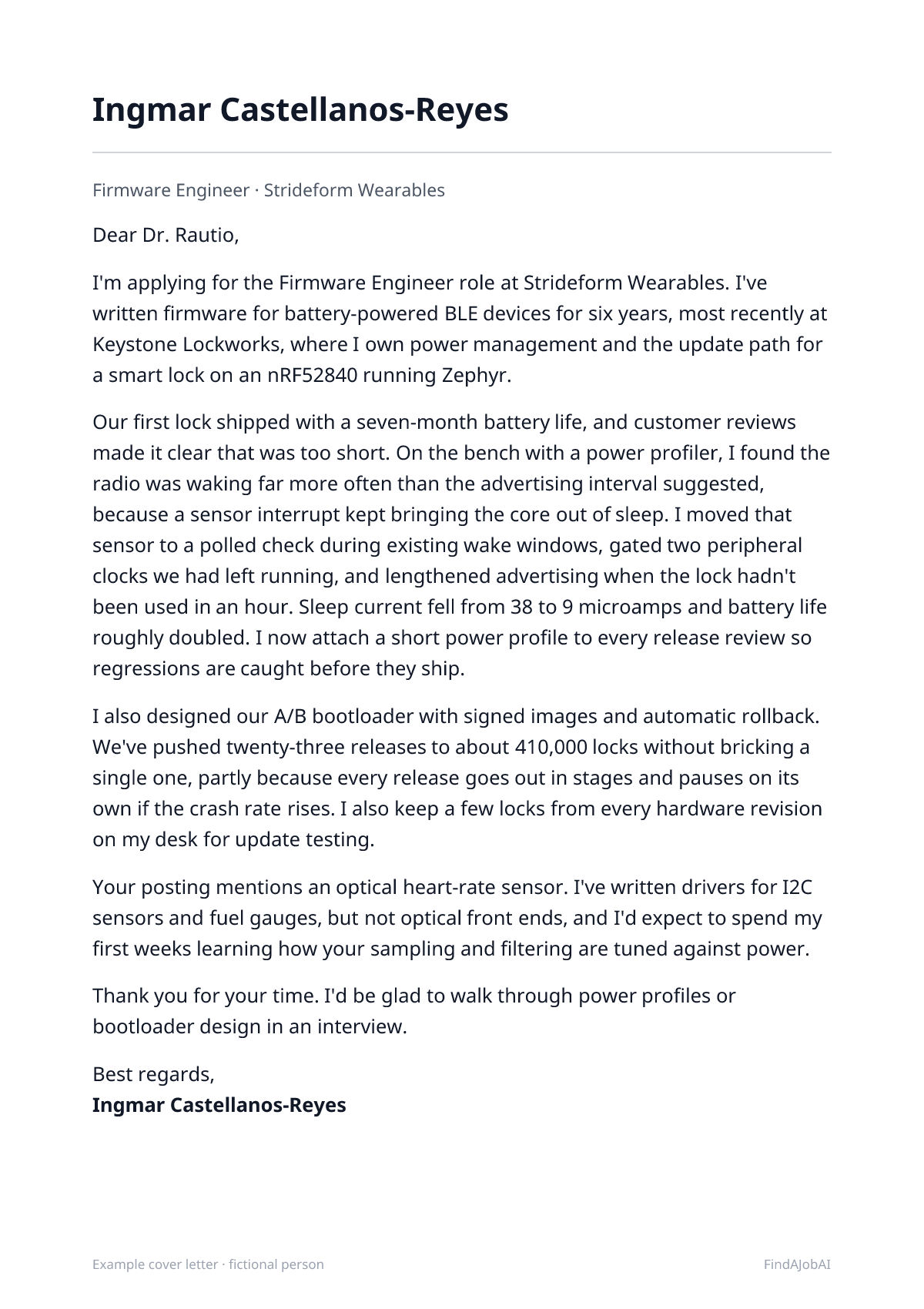
I'm applying for the Firmware Engineer role at Strideform Wearables. I've written firmware for battery-powered BLE devices for six years, most recently at Keystone Lockworks, where I own power management and the update path for a smart lock on an nRF52840 running Zephyr.
Our first lock shipped with a seven-month battery life, and customer reviews made it clear that was too short. On the bench with a power profiler, I found the radio was waking far more often than the advertising interval suggested, because a sensor interrupt kept bringing the core out of sleep. I moved that sensor to a polled check during existing wake windows, gated two peripheral clocks we had left running, and lengthened advertising when the lock hadn't been used in an hour. Sleep current fell from 38 to 9 microamps and battery life roughly doubled. I now attach a short power profile to every release review so regressions are caught before they ship.
I also designed our A/B bootloader with signed images and automatic rollback. We've pushed twenty-three releases to about 410,000 locks without bricking a single one, partly because every release goes out in stages and pauses on its own if the crash rate rises. I also keep a few locks from every hardware revision on my desk for update testing.
Your posting mentions an optical heart-rate sensor. I've written drivers for I2C sensors and fuel gauges, but not optical front ends, and I'd expect to spend my first weeks learning how your sampling and filtering are tuned against power.
Thank you for your time. I'd be glad to walk through power profiles or bootloader design in an interview.
Best regards,
Ingmar Castellanos-Reyes
Example 2 · Entry level
New computer engineering graduate applying for an entry-level firmware role
Priyanka finished a firmware co-op and a hardware senior project. The ad is for a junior firmware engineer on industrial sensors.
Example letter · fictional
Dear Mr. Tsvetanov,
I'm applying for the Associate Firmware Engineer position at Granitepeak Instruments. I graduated in May with a computer engineering degree, after a six-month firmware co-op and a senior project where I designed a board and wrote all of its firmware.
During my co-op on a fitness wearable, I wrote an interrupt-driven I2C driver in Zephyr for a heart-rate sensor that shipped in a beta build to about 1,200 testers. In my second week the sensor kept returning stale samples. Instead of changing the driver blindly, I hooked up a logic analyzer and saw the interrupt line never went fully high. The board was missing a pull-up resistor, which the hardware team added in the next spin, and I documented the symptom so test engineers would recognise it. Later in the co-op I also added forty unit tests for the step-counting filter, which now run in CI on every merge.
For my senior project I designed a four-layer board around an STM32L4 for a bike-light controller and wrote bare-metal firmware for it. Using stop mode between button and sensor events, it runs about sixty hours on a 1,000 mAh battery. Debugging my own layout mistakes on that board taught me more than any class did, especially a reversed footprint I had to bodge with wire before I could flash the chip.
Your ad mentions RS-485 and Modbus, which I haven't used yet. I've read the Modbus specification and written a small parser on a dev board to understand framing, and I'd be glad to learn your protocol stack from the team.
Thank you for reading. My GitHub has the bike-light firmware and schematics.
Sincerely,
Priyanka Venkataraman-Holt
Example 3 · Senior or lead
Principal firmware engineer applying to lead a medical device firmware team
Rosamund leads firmware on industrial drives. The ad is for a principal engineer to own architecture and IEC 62304 work on an infusion pump.
Example letter · fictional
Dear Ms. Kilbride-Osei,
I'd like to apply for the Principal Firmware Engineer role at Clearwater Infusion Systems. For twelve years I've written and led firmware for motor control and safety-critical industrial products, and for the last four I've led a team of five at Ironbridge Drive Systems.
When I took over the team, each of our three drive families had its own board-support code, written by different people at different times. A new board took about ten weeks to bring up, and the same driver bug often had to be fixed three times. I proposed a shared driver and hardware abstraction layer, got agreement from product management by tying it to the next two board launches, and moved one product at a time so nothing shipped half-converted. Bring-up for new boards now takes about four weeks, and a fix in one driver reaches every product. Two engineers who joined last year were productive on new boards within their first month.
I've also introduced static analysis, MISRA checks and a hardware-in-the-loop rig into our CI, which cut defects reaching our verification team by roughly sixty percent. Our products follow IEC 61508 for functional safety, so I'm used to traceable requirements, design reviews and documented test evidence.
I haven't worked under IEC 62304 or through an FDA submission. The discipline is familiar, but the regulatory process is new to me, and I'd want to work closely with your quality team on the first release and read your existing design history file before proposing any change to how firmware is documented.
I'd welcome a conversation about your firmware roadmap and where a shared platform could help most.
Kind regards,
Rosamund Okereke-Thorvaldsen
All three letters, and the short version below, are fictional: the people, employers and numbers are invented. Borrow the structure, never the facts.
- Prefer to write it yourself? Use the free cover letter template.
- Check your CV against the job first: the free CV score shows the missing keywords.
Why the first letter works, paragraph by paragraph
Paragraph 1: Opening
Names years, the device type, the exact chip and RTOS, and what he owns, so the reader can match him to the posting in one line.
Paragraph 2: The battery story
A customer problem, a bench measurement, the actual cause and three specific fixes, ending with microamps before and after. It proves he debugs with instruments, not guesses.
Paragraph 3: Safe updates
Fleet size, release count and zero bricked units, plus the staged rollout behind them, address the riskiest part of the job.
Paragraph 4: Honest gap
Admits he hasn't worked on optical sensor front ends while showing related driver work, which reads as credible.
Paragraph 5: Close
Offers to discuss power profiles and bootloader design, the two topics most likely to come up in a technical interview.
What the entry-level letter does differently
The graduate's letter leans on one real debugging moment, a missing pull-up found with a logic analyzer, and a board she designed and brought up herself. Naming the protocol she hasn't used and showing she has already started on it turns a gap into evidence of how she learns.
What the senior letter does differently
A principal-level letter is about decisions that changed how a team works: a shared driver layer rolled out one product at a time and quality checks added to CI, with time and defect numbers. The stated gap, no IEC 62304 or FDA work, is specific and paired with closely related safety experience.
Short firmware engineer cover letter: an email-ready version
Many applications arrive as an email or a small text box, and a full page doesn't fit. This version runs 120 to 150 words and keeps only what a reader needs to decide whether to reply. A firmware engineer answers a startup's post on a job board that asked for a few lines and a GitHub link instead of a formal letter.
Short version · email · fictional133 words
Subject: Firmware Engineer application – STM32 motor control, GitHub linked – Emeric Balogun-Strand
Hi Ms. Zuberbühler,
I'm applying for the Firmware Engineer opening at Tidewater Robotics. I've spent four years writing motor-control and sensor firmware on STM32 parts for small autonomous carts used in warehouses.
Last year our carts were stopping at random a few times a day. I added a crash log in retained RAM that saved the fault registers on reset, and within a week the logs pointed to a stack overflow in the encoder task during long runs. A larger stack and a check on queue depth fixed it, and the random stops have not come back. My GitHub has a cleaned-up version of that logging module.
Your post mentions brushless motor control on a new platform, which is the work I enjoy most. I'm free to talk this week.
Thanks,
Emeric Balogun-Strand
The short version keeps one field bug, the tool built to catch it and the fix, then points to code. It drops the full history and ends with availability.
Opening lines that work for firmware engineer cover letters
The first sentence decides whether the second gets read. Here are six openings, one for each situation you might be in. Pick the one that matches yours and swap in your own facts: every name and number below is invented.
1. You have a standout result
Our first smart lock lasted seven months on its batteries; after I traced a sensor interrupt that kept waking the radio, the next release lasted about fourteen.
2. The ad names a problem you've solved
I've pushed twenty-three firmware releases to roughly 410,000 devices without bricking one, and I'd like to bring that update discipline to your wearable.
3. Someone referred you
Your firmware lead, Casimir Adeyemi, and I worked together on a sensor platform two years ago, and he suggested I apply when your team opened a principal role.
4. You admire what they build
During my co-op, a logic analyzer showed me a missing pull-up resistor that no amount of driver changes would have fixed, and I want to keep doing that kind of work.
5. You're new to the field or switching into it
I lead a team of five on safety-critical motor-control firmware and cut new-board bring-up from ten weeks to four, and I'm ready to apply that to medical devices.
6. You have senior scope or a specialism
Your posting asks for Zephyr, BLE and low-power experience on nRF parts, which describes the last four years of my work almost exactly.
How to write a firmware engineer cover letter
Five steps, in the order you'd write them. The shape stays the same for every job (a short opening, proof, a reason for this employer, a close), and what goes into each part is what changes with the role.
Name your parts, RTOS and stacks in the opening
Say which microcontroller families, operating system and wireless or bus protocols you've shipped on, and what kind of device. A firmware lead scanning letters wants to see in two lines whether your stack matches theirs or is close enough to learn quickly.
Tell one bench story with measurements
Pick a reset, hang, battery problem or timing bug. Describe the instrument or log that revealed the cause, what you changed and the number before and after. A debugging story shows method and patience in a way a skills list never does.
Show you treat field updates with care
If you've worked on bootloaders or OTA, give the fleet size, release count and failures. Mention staged rollouts, rollback or signing. Hiring managers know a bad update can brick thousands of devices, so evidence of caution matters.
Be honest about parts or standards you haven't used
If the ad names a protocol, sensor or regulation you haven't worked with, say so in a sentence and point to the closest experience. Firmware teams test depth in interviews, so a clear limit protects your credibility.
Point to code or offer a technical conversation
Close with a GitHub link to driver or bootloader code if you can share it, or offer to walk through a design in the interview. It gives the reader an easy next step that plays to your strengths.
Firmware Engineer cover letter do's and don'ts
Do
- Name the chip families, RTOS and wireless stacks you've shipped on in the first paragraph.
- Tell one bench story with a measurement before and after, such as current, boot time or failure rate.
- Say how your update or bootloader work kept devices safe in the field, with fleet numbers if you have them.
Don't
- Don't copy the ad's list of parts and protocols back without showing where you used them.
- Don't describe yourself as 'passionate about embedded'; show a project or bug that proves it.
- Don't claim experience with a radio stack or certification you've only read about.
Common firmware engineer cover letter mistakes
Each one is easy to make and quick to fix before you send the letter.
Pasting the ad's part list back
Every applicant can list nRF52, Zephyr and BLE. Show one place you used each in a shipped product and what came of it.
Low-power claims without numbers
Say how many microamps you saved or how much battery life you gained, and name the technique behind the change.
Ignoring the hardware side
Firmware work involves boards, schematics and probes. A sentence about bring-up or a bug found on the bench shows you can work with the EE team.
Overstating regulated or safety experience
If you haven't worked under IEC 62304, ISO 26262 or similar, say so and describe the related discipline you do have.
Email subject lines for firmware engineer applications
Applying by email? Put the job title, any reference number and your name in the subject line.
- Firmware Engineer application – BLE low-power and OTA, 410k devices – Ingmar Castellanos-Reyes
- Associate Firmware Engineer – 2025 CpE graduate, Zephyr co-op – Priyanka Venkataraman-Holt
- Application: Principal Firmware Engineer, Infusion Platform (Req 7716) – Ingmar Castellanos-Reyes
Everything for Firmware Engineers
- Firmware Engineer resume exampleA full resume, plus bullet and summary examples
- Firmware Engineer interview questions30 questions with sample answers
- Firmware Engineer job descriptionDuties, skills and requirements
- Cover letter with no experience: templates
Other cover letter examples
Firmware Engineer cover letter FAQ
What should a firmware engineer cover letter include?
The parts, RTOS and stacks you've shipped on, one debugging or optimisation story with numbers, how you've kept field updates safe, and any honest gap against the posting.
How do I write a firmware cover letter as a new graduate?
Lead with a co-op, internship or senior project that ran on real hardware. Name the chip, the drivers you wrote and one bug you found with a logic analyzer or scope, and link the code if you can.
Should a firmware engineer mention hardware skills in a cover letter?
Yes, briefly. Schematic reading, bring-up and bench debugging are a big part of firmware work, so a sentence showing you can work with a new board and the EE team helps.
How we built this page
The FindAJobAI team wrote the three example letters, the short email version, the opening lines and the advice for firmware engineer roles. The people, employers and numbers in the letters are invented; the structure, the kind of evidence and the order of the paragraphs are the parts to copy.
Once we track enough live firmware engineer job ads, this page also shows the skills they ask for most, counted the same way as our in-demand skills report.
Last reviewed on November 1, 2026.