Golang Developer Cover Letter Example (2026)
By FindAJobAI Team Updated How we built this page
Go job ads tend to describe a specific pain: a service that cannot keep up, a migration off an older stack, or a platform that needs better tooling. A strong golang developer cover letter answers that pain with one service you built or fixed, the concurrency or reliability problem behind it, and what the numbers looked like afterward.
Golang Developer cover letter template
This letter as a one-page template: an opening that names the job and your strongest fact, proof that answers the ad, a reason for this employer and a short close.
After you sign up, FindAJobAI drafts your own letter for a real job from your CV in this format, and you edit it before you send it.
Example 1 · Experienced
Payments Go engineer applying to a fintech scale-up
Dariusz runs a Go authorization service at a card processor. The ad asks for gRPC, PostgreSQL and high-throughput Go services.
Example letter · fictional
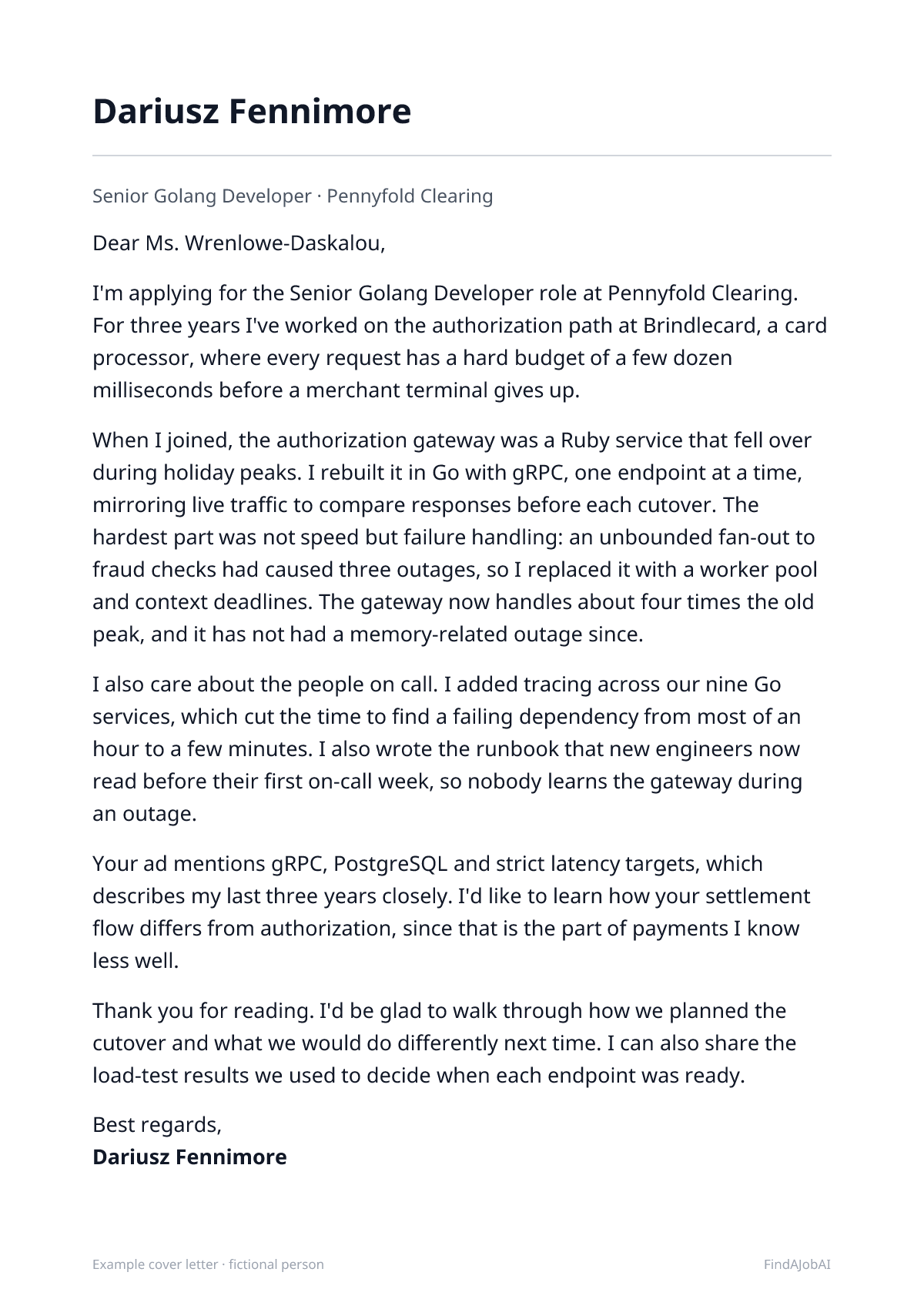
Dear Ms. Wrenlowe-Daskalou,
I'm applying for the Senior Golang Developer role at Pennyfold Clearing. For three years I've worked on the authorization path at Brindlecard, a card processor, where every request has a hard budget of a few dozen milliseconds before a merchant terminal gives up.
When I joined, the authorization gateway was a Ruby service that fell over during holiday peaks. I rebuilt it in Go with gRPC, one endpoint at a time, mirroring live traffic to compare responses before each cutover. The hardest part was not speed but failure handling: an unbounded fan-out to fraud checks had caused three outages, so I replaced it with a worker pool and context deadlines. The gateway now handles about four times the old peak, and it has not had a memory-related outage since.
I also care about the people on call. I added tracing across our nine Go services, which cut the time to find a failing dependency from most of an hour to a few minutes. I also wrote the runbook that new engineers now read before their first on-call week, so nobody learns the gateway during an outage.
Your ad mentions gRPC, PostgreSQL and strict latency targets, which describes my last three years closely. I'd like to learn how your settlement flow differs from authorization, since that is the part of payments I know less well.
Thank you for reading. I'd be glad to walk through how we planned the cutover and what we would do differently next time. I can also share the load-test results we used to decide when each endpoint was ready.
Best regards,
Dariusz Fennimore
Example 2 · Career changer
Systems administrator moving into Go development
Odalys has been a Linux systems administrator for six years and has written Go tools for her team. The ad is for a junior Go role on a platform team.
Example letter · fictional
Dear Stratawave Platform Hiring Team,
I'm writing about the Junior Golang Developer opening on Stratawave's platform team. I've spent six years as a Linux systems administrator at a regional hosting company, and over the last two I've moved much of my day-to-day work from shell scripts into Go.
The first Go tool I wrote replaced a set of Bash scripts we used to rotate TLS certificates across about 300 servers. The scripts failed quietly when a host was unreachable, and we found out when a customer's site showed a warning. My Go version checks each host concurrently with a limit of 20 connections, retries with backoff, and posts a summary to our team chat. Missed renewals went from a few a quarter to none in the year since, and two colleagues now maintain it with me.
Since then I've completed a Go course covering testing and HTTP services, written a small Prometheus exporter for our backup jobs, and started contributing fixes to an open-source CLI library. I know Go basics well; what I want now is to work with engineers who can push my code reviews further.
Your ad describes internal tools for provisioning and monitoring, which is the work I've been doing from the operations side. I already know what frustrates the people who use those tools at 3 AM, and what they need from them. I would like to build those tools properly, with tests and reviews behind them.
My GitHub is linked on my resume, and I'm happy to walk through the certificate tool's code, tests and retry logic on a call.
Kind regards,
Odalys Varnhagen-Mbeki
Example 3 · Senior or lead
Staff engineer applying to lead a monolith breakup
Wilhelmina leads Go standards at a logistics marketplace. The ad is for a staff engineer to guide a move from a monolith to Go services.
Example letter · fictional
Dear Mr. Ostrowski-Achebe,
I'm applying for the Staff Golang Engineer role at Cargoreach. For the past five years I've set backend standards at Haulmesh, a freight marketplace, where I led the move of pricing and dispatch out of a Java monolith into Go services.
Your ad says previous attempts to split the monolith stalled halfway. Ours stalled once too. The first plan carved out services by team, and we ended up with services that shared tables and had to deploy together. On the second attempt I started from data ownership: we mapped which code wrote to which tables and only extracted a service once it could own its data outright. Over fourteen months we moved six areas into gRPC services, and deploy time for those areas fell from about fifty minutes to under ten.
The part I'm proudest of is less visible. I wrote a shared Go service template with health checks, metrics, graceful shutdown and a standard error format. Eleven teams now start every service from it, and on-call engineers can find their way around a service they have never seen. When we fix a shared problem, such as a retry bug, the fix reaches every service through one library update instead of a dozen separate patches. I also review every new service's first design doc.
I haven't worked at a company with your volume of real-time tracking events, and I'd expect the event pipeline to change how we draw some service boundaries.
I'd like to hear where your last split attempt stopped, and what the team learned from it.
Sincerely,
Gudrun Ifeoma-Pastrana
All three letters, and the short version below, are fictional: the people, employers and numbers are invented. Borrow the structure, never the facts.
- Prefer to write it yourself? Use the free cover letter template.
- Check your CV against the job first: the free CV score shows the missing keywords.
Why the first letter works, paragraph by paragraph
Paragraph 1: Opening
States the domain and its hard constraint, a few dozen milliseconds per request, which tells a payments reader the writer understands why Go was chosen.
Paragraph 2: The rewrite and the failure fix
Covers a migration and, more importantly, a concurrency problem (unbounded fan-out) with a named fix and a measured result. That is the core evidence Go teams look for.
Paragraph 3: Operations paragraph
Tracing across nine services shows the writer thinks about running code, not just writing it, which matters for teams with on-call rotations.
Paragraph 4: Why this company
Mirrors the ad's stack and admits a gap (settlement) honestly, which reads as confident rather than weak.
Paragraph 5: Close
Offers a specific conversation about cutover planning, giving the interviewer an easy first question.
What the career changer's letter does differently
The career changer's letter leads with a Go tool that solved a real operations failure, with a concurrency limit and a clear result (missed renewals dropped to none). Coursework, an exporter and open-source fixes show deliberate learning, and the close turns years of operations work into an advantage for a platform team.
What the senior letter does differently
A staff-level letter talks about method and leverage: a failed first approach, a better principle (data ownership), and a template that changed how eleven teams work. The honest gap about real-time event volume shows judgment rather than weakness.
Short golang developer cover letter: an email-ready version
Many applications arrive as an email or a small text box, and a full page doesn't fit. This version runs 120 to 150 words and keeps only what a reader needs to decide whether to reply. A Go developer replies to a startup founder who posted the role on a community job board with an email address instead of a form.
Short version · email · fictional129 words
Subject: Golang Developer – Kafka ingestion and gRPC services – Teodoro Lindqvist-Amara
Hi Mr. Okonjo,
I saw your post for a Golang developer at Parcelquay. I've spent four years writing Go at a telematics company, mostly ingestion services that read vehicle events from Kafka into PostgreSQL.
My most useful project was replacing four Python cron jobs with one Go service that streams about eleven million location pings a day. Batching writes cut database load by roughly seventy percent, and the service runs in a fraction of the memory the old jobs used.
Your post mentions parcel scans arriving in bursts, which sounds very close to the problem I've been solving. My resume is attached, and I'd be glad to talk through the design and how we handled late or duplicate events. I'm available for a call any weekday.
Thanks,
Teodoro Lindqvist-Amara
The short email keeps one project with clear volume and results, then links it directly to the founder's stated problem of bursty scan data, which is all a busy founder needs to decide on a call.
Opening lines that work for golang developer cover letters
The first sentence decides whether the second gets read. Here are six openings, one for each situation you might be in. Pick the one that matches yours and swap in your own facts: every name and number below is invented.
1. You have a standout result
Last year I rebuilt a card-authorization gateway in Go that now handles four times its old peak traffic. I'd like to bring that experience to your payments platform.
2. The ad names a problem you've solved
Your ad says your ingestion service falls behind during morning spikes. I solved a similar problem at a telematics company with batching and a bounded worker pool in Go.
3. Someone referred you
Your platform lead, Ines Valcourt, and I worked on the same on-call rotation for two years. She mentioned you need someone who enjoys making Go services easier to run, which is why I'm writing.
4. You admire what they build
I've used your open-source Go rate limiter in two services, and I sent a small fix for its context handling last spring. I'd like to work on the team that maintains it.
5. You're new to the field or switching into it
After six years running Linux servers, I started writing Go tools to replace fragile shell scripts. I now want to build platform software full time.
6. You have senior scope or a specialism
I've led Go backend standards across thirty services at a freight marketplace, and I'm looking to guide a monolith breakup from its first design review.
How to write a golang developer cover letter
Five steps, in the order you'd write them. The shape stays the same for every job (a short opening, proof, a reason for this employer, a close), and what goes into each part is what changes with the role.
Find the pain the Go role is meant to fix
Go roles are often opened to solve a specific problem: throughput, a migration, or missing platform tools. Read the ad for clues such as latency targets, old languages mentioned or words like rewrite, then choose the project of yours that matches it most closely.
Lead with the problem your Go code solved
Open the main paragraph with what was failing or slow before your work, such as outages, missed jobs or a queue that kept growing. Then name the Go approach in a sentence: a worker pool, gRPC contracts, context deadlines or a rewrite from another language.
Show how you controlled concurrency
Go makes it easy to start work in parallel and hard to stop it cleanly. One sentence on the limit, timeout or cancellation you added tells a hiring manager more about your Go experience than any list of keywords or certificates.
Give one measured result
Use a figure you can defend in an interview: requests a second, p99 latency, memory per container, outages per quarter. Say how you measured it, for example with pprof, load tests or production dashboards. If you lack exact numbers, describe the before and after plainly.
Close with the operating side
Mention metrics, tracing, runbooks or on-call duty you have handled, since most Go teams run what they build. End by naming one part of their system you would want to understand first, which gives the reader a natural opening question.
Golang Developer cover letter do's and don'ts
Do
- Describe one Go service or tool, the problem it solved, and a number that changed afterward.
- Mention how you bounded or cancelled concurrent work, since that is where Go code usually fails.
- Match the ad's stack (gRPC, Kafka, Kubernetes) inside a real example rather than in a list.
Don't
- Don't write about goroutines as if using them were an achievement on its own.
- Don't claim performance gains without saying how you measured them.
- Don't call a weekend project a production service; describe plainly who uses it.
Common golang developer cover letter mistakes
Each one is easy to make and quick to fix before you send the letter.
Treating goroutines as the headline achievement
Every Go developer uses goroutines. Describe what the concurrent design solved, how you bounded it and what improved, instead of the keyword itself.
Listing the whole Go ecosystem
A paragraph of library names reads like a skills section. Keep the one or two tools that matter to your main story and leave the rest to the resume.
Performance claims with no method
Saying a service became much faster invites doubt. Name the metric, the before-and-after figures and the profiling or load-testing method you used.
Ignoring the language you came from
If you moved a service from Python, Ruby or Java, say so. Migration experience is often exactly what a Go team is hiring for.
Leaving out production support
A letter that ends at deployment misses half the job. Add one line about monitoring, incidents or on-call work so the reader sees you can run your code too.
Email subject lines for golang developer applications
Applying by email? Put the job title, any reference number and your name in the subject line.
- Senior Golang Developer application – gRPC payments gateway – Dariusz Fennimore
- Junior Golang Developer – sysadmin with Go tooling experience – Odalys Varnhagen-Mbeki
- Application: Go Engineer, Platform Team (Req. 4471) – Dariusz Fennimore
Everything for Golang Developers
- Golang Developer resume exampleA full resume, plus bullet and summary examples
- Golang Developer interview questions30 questions with sample answers
- Golang Developer job descriptionDuties, skills and requirements
- Career change cover letter: template + examples
Other cover letter examples
Golang Developer cover letter FAQ
What should I write in a golang developer cover letter?
Pick one Go service or tool you built or fixed. Explain the problem, the Go approach (for example a worker pool, gRPC or better error handling) and the measured result. Add a sentence on how you run code in production, then tie it to the ad's stack.
How do I write a golang developer cover letter with no Go job experience?
Use Go you wrote in another role, such as an operations tool or a side project, and state who uses it and what it replaced. Mention courses or open-source contributions briefly, and connect your current domain to the team's work.
Should I mention other languages in a Go cover letter?
Yes, when it explains a migration or shows range. Many Go teams moved from Python, Ruby or Java, so experience rewriting a service from one of those into Go is directly relevant.
How we built this page
The FindAJobAI team wrote the three example letters, the short email version, the opening lines and the advice for golang developer roles. The people, employers and numbers in the letters are invented; the structure, the kind of evidence and the order of the paragraphs are the parts to copy.
Once we track enough live golang developer job ads, this page also shows the skills they ask for most, counted the same way as our in-demand skills report.
Last reviewed on November 1, 2026.