Heavy Equipment Operator Cover Letter Example (2026)
By FindAJobAI Team Updated How we built this page
Superintendents hiring heavy equipment operators usually skim a letter for three things: which machines you run, how accurately you work, and whether you go home safe every day. Keep it short and plain, name your equipment, give one or two numbers and show you understand the type of work the contractor does.
Heavy Equipment Operator cover letter template
This letter as a one-page template: an opening that names the job and your strongest fact, proof that answers the ad, a reason for this employer and a short close.
After you sign up, FindAJobAI drafts your own letter for a real job from your CV in this format, and you edit it before you send it.
Example 1 · Experienced
Excavator and dozer operator applying to a larger civil contractor
Thelonius has eight years in site work and utilities with GPS grade control. The ad is for an operator on highway and subdivision projects.
Example letter · fictional
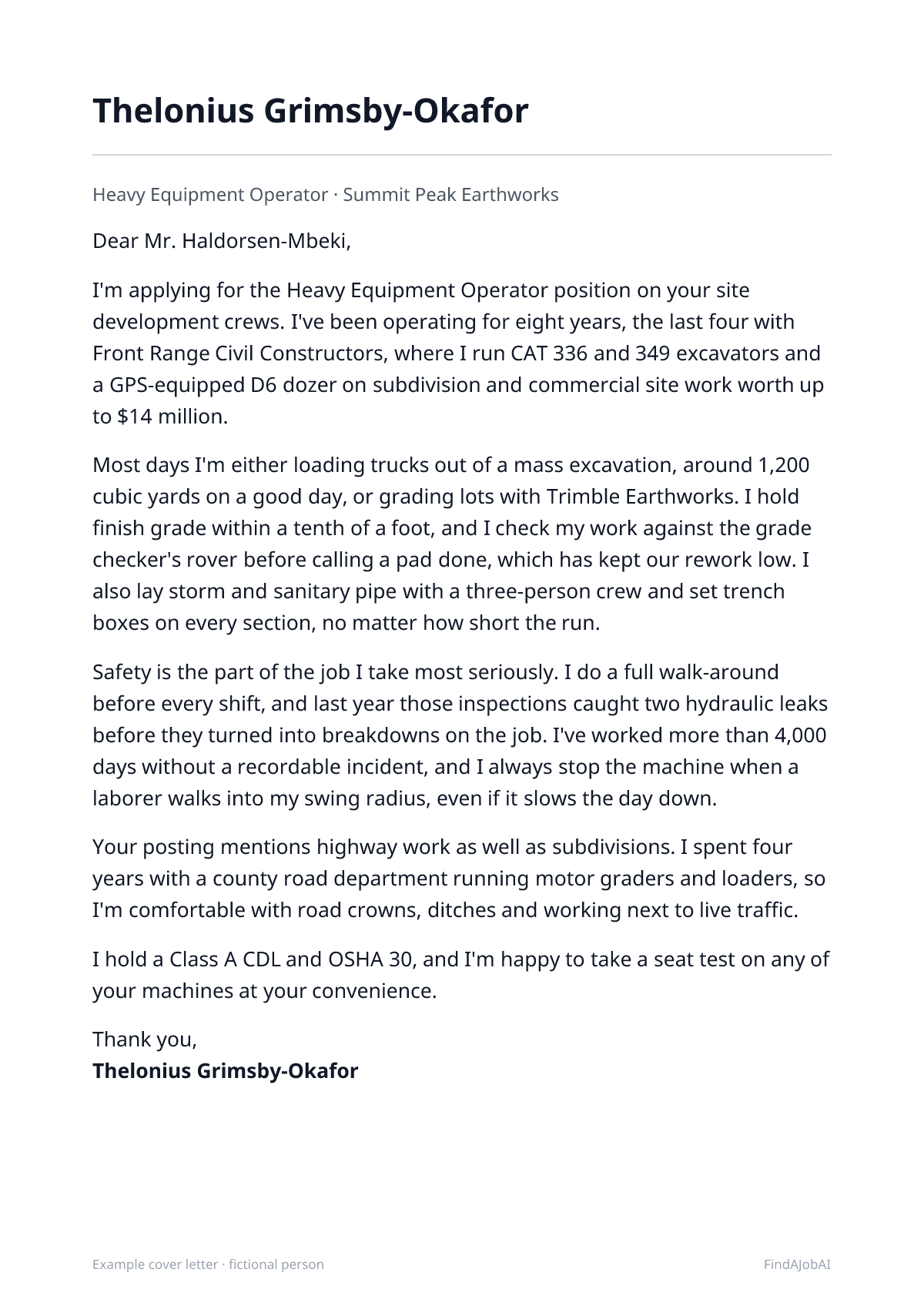
Dear Mr. Haldorsen-Mbeki,
I'm applying for the Heavy Equipment Operator position on your site development crews. I've been operating for eight years, the last four with Front Range Civil Constructors, where I run CAT 336 and 349 excavators and a GPS-equipped D6 dozer on subdivision and commercial site work worth up to $14 million.
Most days I'm either loading trucks out of a mass excavation, around 1,200 cubic yards on a good day, or grading lots with Trimble Earthworks. I hold finish grade within a tenth of a foot, and I check my work against the grade checker's rover before calling a pad done, which has kept our rework low. I also lay storm and sanitary pipe with a three-person crew and set trench boxes on every section, no matter how short the run.
Safety is the part of the job I take most seriously. I do a full walk-around before every shift, and last year those inspections caught two hydraulic leaks before they turned into breakdowns on the job. I've worked more than 4,000 days without a recordable incident, and I always stop the machine when a laborer walks into my swing radius, even if it slows the day down.
Your posting mentions highway work as well as subdivisions. I spent four years with a county road department running motor graders and loaders, so I'm comfortable with road crowns, ditches and working next to live traffic.
I hold a Class A CDL and OSHA 30, and I'm happy to take a seat test on any of your machines at your convenience.
Thank you,
Thelonius Grimsby-Okafor
Example 2 · Career changer
Army engineer veteran moving into civil construction
Cassius ran dozers and excavators as an Army combat engineer for six years. The ad is for an operator at a utility contractor.
Example letter · fictional
Dear Hiring Manager,
I'm applying for the Equipment Operator role at Bridger Utility Services. I spent six years in the Army as a horizontal construction engineer, operating dozers, excavators, loaders and graders, and I'm now looking to bring that experience into civilian utility work close to home.
In the Army, I built and repaired roads, cleared ground for base camps and dug fighting positions and drainage, often on rough ground with little survey support. I logged more than 3,000 hours of seat time across five machine types and trained eight junior soldiers on excavator basics, including daily inspections and safe loading of trucks.
I know civilian work has its own standards. Since leaving the service I completed a GPS grade control course and OSHA 30, and I've been working as a laborer on a sewer replacement job to learn trench safety, utility locates and pipe bedding the way civilian crews do it. My foreman has started having me run the backhoe for backfill on quieter days.
Your posting mentions water and sewer installation in residential neighborhoods. I'm used to working carefully in tight spaces and I understand the cost of a utility strike, so I take potholing and spotters seriously. On the sewer job I've learned to read locate marks and paint colors, and I always ask before digging near anything I'm unsure about.
Thank you for considering my application. I'm available for a seat test any day this month and can provide references from my foreman and former platoon sergeant.
Respectfully,
Cassius Wainwright-Adebayo
Example 3 · Senior or lead
Grade foreman applying for a superintendent-track role
Lucius leads crews of up to twelve on highway jobs. The ad is for a grade superintendent at a heavy civil contractor expanding into airport work.
Example letter · fictional
Dear Ms. Strathmore-Ade,
I'm applying for the Grade Superintendent position at Ironwood Heavy Civil. I've been in heavy civil work for seventeen years, the last six as grade foreman and lead operator at Wasatch Heavy Civil, leading crews of up to twelve operators and laborers on highway and interchange projects worth up to $40 million.
On our largest recent job, a 1.2 million cubic yard cut-and-fill for a freeway widening, I planned the earthwork sequence with the project engineer, matching haul routes and machine spreads to each phase. We finished the grading three weeks early, mainly because we cut down on double handling and kept scrapers moving instead of waiting on dozers.
I've also trained sixteen operators on Trimble machine control, and our finish grade rework fell by about a third once everyone was using the same checks. Our crews have gone five years and roughly 300,000 hours without a lost-time incident, which I credit to honest morning toolbox talks and to never pushing a crew past what's safe to meet a schedule.
Your company is moving into airport work, which has tighter tolerances and stricter access rules than highways. I haven't run an airport job, and I'd want to learn your quality control process and FAA requirements from day one, but my GPS and finish grade experience should transfer well.
I'd welcome a conversation about your upcoming projects and how you organize your grade crews, and I can share references from two project managers I've worked under.
Sincerely,
Lucius Fenwright-Abiodun
All three letters, and the short version below, are fictional: the people, employers and numbers are invented. Borrow the structure, never the facts.
- Prefer to write it yourself? Use the free cover letter template.
- Check your CV against the job first: the free CV score shows the missing keywords.
Why the first letter works, paragraph by paragraph
Paragraph 1: Opening
Names machines by model and the size of projects, which is exactly what a superintendent wants to know first.
Paragraph 2: Daily work and accuracy
Gives production and grade tolerance with a simple quality habit, checking against the rover before calling a pad done.
Paragraph 3: Safety
Shows real safety habits, inspections that caught leaks and stopping for people in the swing radius, plus a strong incident record.
Paragraph 4: Fit with the posting
Connects earlier road department work to the highway projects mentioned in the ad.
Paragraph 5: Close
Offers a seat test, the most practical next step in operator hiring.
What the career changer's letter does differently
The veteran's letter translates military engineering into civil terms and counts seat time by hours. It is honest that civilian standards differ and shows the steps taken to learn them, GPS training, OSHA 30 and laborer work on a sewer job.
What the senior letter does differently
The foreman's letter reports planning and leadership results, an early finish from smarter sequencing, reduced rework through training and a long safety record. It names the new area, airport work, honestly and explains why skills will transfer.
Short heavy equipment operator cover letter: an email-ready version
Many applications arrive as an email or a small text box, and a full page doesn't fit. This version runs 120 to 150 words and keeps only what a reader needs to decide whether to reply. An experienced operator texts and emails a contractor's equipment manager after a friend on the crew mentions an opening.
Short version · email · fictional124 words
Subject: Excavator Operator – 6 years utilities and site work, Class A CDL – Ignatius Barrowfield
Hello Mr. Ostrowski-Bell,
My friend Marco Reyes on your utility crew told me you're looking for an excavator operator. I've run excavators from 20 to 45 tons for six years on water, sewer and storm projects, mostly in residential streets with live utilities.
I take locates and potholing seriously, and in six years I haven't had a utility strike. I can set trench boxes, lay pipe to grade with a laser and haul my own machine with a Class A CDL when needed.
My resume is attached. I'm happy to come in for a seat test any morning this week, and I can start within two weeks of an offer. I have my own safety gear and a clean driving record.
Thanks,
Ignatius Barrowfield
The short version leads with the referral, gives machine sizes and project type, and backs up safety with a plain fact, no utility strikes in six years. It ends with an easy next step that matches how operators are actually hired.
Opening lines that work for heavy equipment operator cover letters
The first sentence decides whether the second gets read. Here are six openings, one for each situation you might be in. Pick the one that matches yours and swap in your own facts: every name and number below is invented.
1. You have a standout result
I hold finish grade within a tenth of a foot with GPS, and I've worked more than 4,000 days without a recordable incident. I'd like to bring that accuracy and care to your site development crews.
2. The ad names a problem you've solved
Your posting mentions highway and subdivision work. I've spent four years on each, running graders for a county road department and excavators and dozers for a civil contractor.
3. Someone referred you
Marco Reyes on your utility crew told me you need an excavator operator who's comfortable around live utilities in tight residential streets.
4. You admire what they build
I've driven past your crews on the interstate widening all summer, and the clean, organized way your sites run is why I'd like to work for you.
5. You're new to the field or switching into it
I spent six years running dozers and excavators as an Army engineer, and I'm ready to bring that seat time to civilian utility work.
6. You have senior scope or a specialism
As grade foreman, I sequenced a 1.2 million cubic yard cut-and-fill that finished three weeks early, and I'm ready for a superintendent role.
How to write a heavy equipment operator cover letter
Five steps, in the order you'd write them. The shape stays the same for every job (a short opening, proof, a reason for this employer, a close), and what goes into each part is what changes with the role.
Name your machines first
Superintendents scan for equipment. List the machines you run, with sizes or models, in the first paragraph, along with the types of projects you work on, such as utilities, site work or highways. That tells them right away where you'd fit on their crews.
Give one or two numbers
Cubic yards a day, linear feet of pipe or the grade tolerance you hold all help a reader judge your skill. Pick the figure that best matches the job ad, and add a short note about how you check your own work.
Show safety in action
Every applicant says they work safely. Give a real habit, such as stopping for people in your swing radius or catching defects on walk-arounds, plus your incident record if it's strong. That is far more convincing than a slogan.
List CDL and certifications
A Class A CDL, OSHA 10 or 30, NCCCO certifications and competent person training can decide between candidates. Mention them in one sentence near the end so they're easy to spot even if the reader skims the letter.
Offer a seat test
Many contractors decide after watching you run a machine. End your letter by offering a seat test and giving your availability. It shows confidence and gives the hiring manager a simple next step that fits how they already hire.
Heavy Equipment Operator cover letter do's and don'ts
Do
- Name the machines and sizes you run.
- Give one production or tolerance figure.
- Describe a safety habit, not just a slogan.
Don't
- Don't write a long letter; superintendents are busy.
- Don't claim GPS or finish grade skills you haven't used on a job.
- Don't skip your CDL and OSHA training if you have them.
Common heavy equipment operator cover letter mistakes
Each one is easy to make and quick to fix before you send the letter.
Writing "experienced on all heavy equipment"
Name specific machines and sizes. Broad claims make superintendents doubtful.
Long letters full of general statements
Keep it short and specific. Operators are hired on skill, safety and reliability.
Overstating GPS or finish grade skill
Be honest about what you've done. A seat test will show the truth quickly.
No mention of safety record
Give days or hours without incidents or a clean utility strike record if you have one.
Forgetting to mention availability
Contractors often hire quickly for the season. Say when you can start and test.
Email subject lines for heavy equipment operator applications
Applying by email? Put the job title, any reference number and your name in the subject line.
- Heavy Equipment Operator – excavator and GPS dozer, 8 years – Thelonius Grimsby-Okafor
- Equipment Operator – Army horizontal engineer, OSHA 30 – Cassius Wainwright-Adebayo
- Application: Heavy Equipment Operator, Site Development – Thelonius Grimsby-Okafor
Everything for Heavy Equipment Operators
- Heavy Equipment Operator resume exampleA full resume, plus bullet and summary examples
- Heavy Equipment Operator interview questions30 questions with sample answers
- Heavy Equipment Operator job descriptionDuties, skills and requirements
- Career change cover letter: template + examples
Other cover letter examples
Heavy Equipment Operator cover letter FAQ
Do heavy equipment operators need a cover letter?
Not always, but a short letter helps when applying to larger contractors or online. Keep it to a few paragraphs naming your machines, accuracy, safety record and certifications.
What should a heavy equipment operator cover letter include?
The machines you run, the type of projects, one production or grade figure, your safety record, CDL and OSHA training, and an offer to take a seat test.
How do I write an operator cover letter without much seat time?
Count the hours you do have by machine, describe training and any laborer or spotter work, and show how you are building skills safely.
How we built this page
The FindAJobAI team wrote the three example letters, the short email version, the opening lines and the advice for heavy equipment operator roles. The people, employers and numbers in the letters are invented; the structure, the kind of evidence and the order of the paragraphs are the parts to copy.
Once we track enough live heavy equipment operator job ads, this page also shows the skills they ask for most, counted the same way as our in-demand skills report.
Last reviewed on November 1, 2026.