Insulation Installer Cover Letter Example (2026)
By FindAJobAI Team Updated How we built this page
Insulation contractors often hire after a phone call, but builders' preferred subcontractors, weatherization agencies and larger energy companies usually want a short letter with the application. Use it to name the materials and machines you run, the kind of homes you work in, your inspection results and your safety training.
Insulation Installer cover letter template
This letter as a one-page template: an opening that names the job and your strongest fact, proof that answers the ad, a reason for this employer and a short close.
After you sign up, FindAJobAI drafts your own letter for a real job from your CV in this format, and you edit it before you send it.
Example 1 · Experienced
Experienced installer applying to a weatherization contractor
Augustin has seven years on new homes and retrofits. The contractor runs utility rebate jobs and needs installers who can hit blower door targets.
Example letter · fictional
Dear Mr. Strzelecki-Bauer,
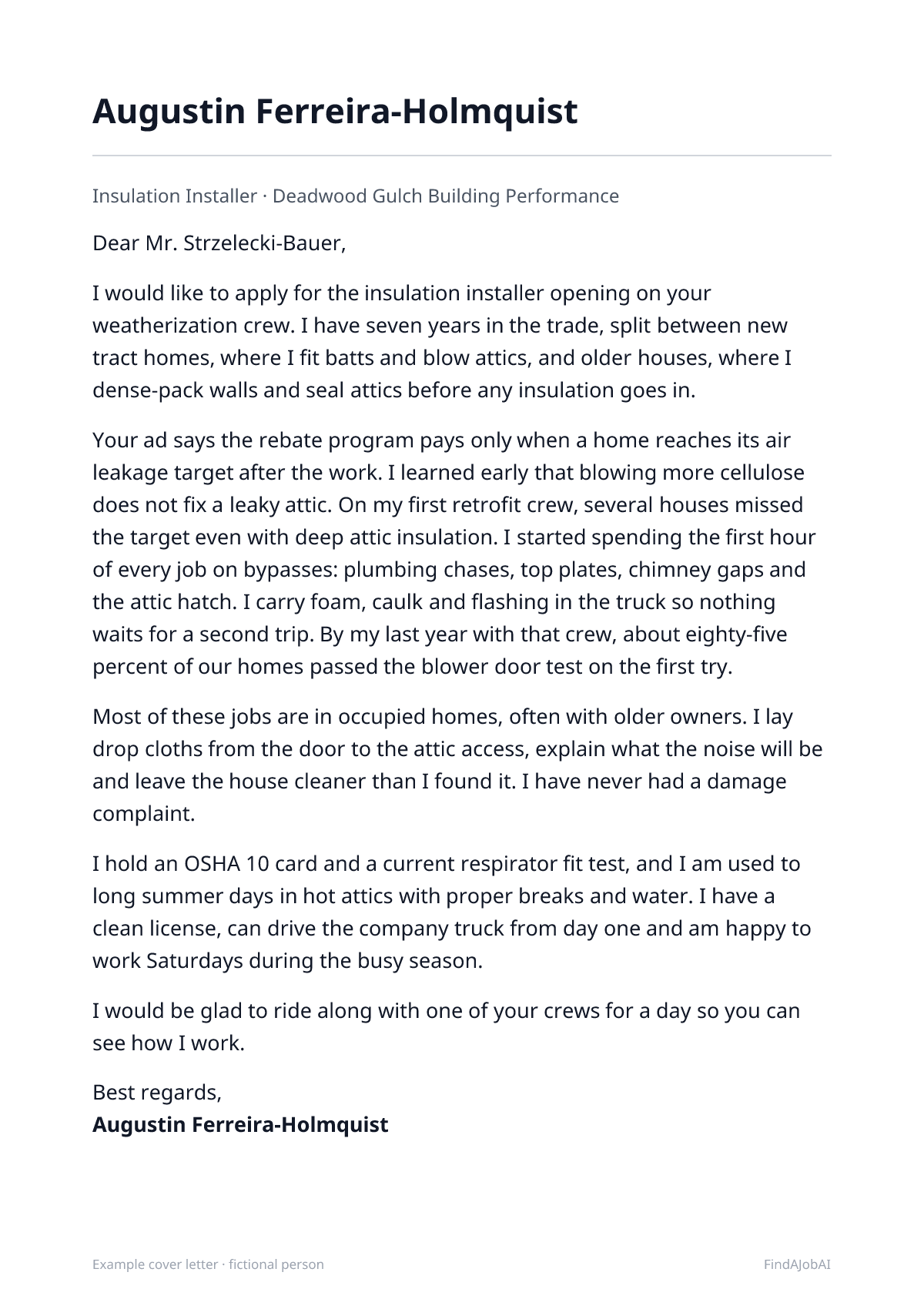
I would like to apply for the insulation installer opening on your weatherization crew. I have seven years in the trade, split between new tract homes, where I fit batts and blow attics, and older houses, where I dense-pack walls and seal attics before any insulation goes in.
Your ad says the rebate program pays only when a home reaches its air leakage target after the work. I learned early that blowing more cellulose does not fix a leaky attic. On my first retrofit crew, several houses missed the target even with deep attic insulation. I started spending the first hour of every job on bypasses: plumbing chases, top plates, chimney gaps and the attic hatch. I carry foam, caulk and flashing in the truck so nothing waits for a second trip. By my last year with that crew, about eighty-five percent of our homes passed the blower door test on the first try.
Most of these jobs are in occupied homes, often with older owners. I lay drop cloths from the door to the attic access, explain what the noise will be and leave the house cleaner than I found it. I have never had a damage complaint.
I hold an OSHA 10 card and a current respirator fit test, and I am used to long summer days in hot attics with proper breaks and water. I have a clean license, can drive the company truck from day one and am happy to work Saturdays during the busy season.
I would be glad to ride along with one of your crews for a day so you can see how I work.
Best regards,
Augustin Ferreira-Holmquist
Example 2 · Career changer
Moving crew lead switching into insulation installation
Rosalind has led moving crews for six years. She wants to start as an installer helper with a contractor that offers spray foam training.
Example letter · fictional
Dear Ms. Ludwigsen-Oduya,
I am applying for the installer helper position at Hot Springs Energy Retrofit. For six years I have worked for a household moving company, the last three as a crew lead, and I am ready to move into a trade where I can build skills that last.
Moving is hard physical work in tight spaces, which I think prepares me well for attics and crawl spaces. I have carried furniture up narrow stairs in July heat, planned how to load a truck so nothing shifts and kept a crew of four working safely through twelve-hour days. In three years as lead, my crews had no injuries that cost anyone a day of work, partly because I insisted on breaks and proper lifting even when we were behind.
Customers are another part of moving that carries over. I have worked inside hundreds of homes, protecting floors and door frames, answering nervous questions and leaving rooms tidy. I know retrofit insulation happens in people's houses too, and that a careful crew gets called back.
To prepare for the change, I finished an OSHA 10 course and passed a respirator fit test this fall. I have also spent two weekends helping a friend who installs insulation, stapling baffles and feeding a blowing machine, and I enjoyed the work. It felt like the start of something rather than another job, and I would like to learn it properly from a crew that takes training seriously.
I would welcome a working interview with one of your crews whenever it suits you. I am available on short notice and have my own boots and gloves.
Thank you for reading,
Rosalind Mbatha-Kerrigan
Example 3 · Senior or lead
Spray foam crew lead applying to run a new foam division
Bartholomew has eleven years in insulation and five leading a spray foam rig. A contractor is adding a second foam truck and needs a lead.
Example letter · fictional
Dear Mr. Zelinski-Twofeathers,
I am interested in leading your second spray foam rig. I have eleven years in insulation, the last five running a trailer rig with two helpers on pole barns, custom homes and light commercial roof decks.
Your posting says the new truck must pay for itself in its first year. In my experience, foam rigs lose money through rejected batches, off-ratio material and trips back to fix thin spots. When I took over my current rig, we were throwing away too much chemical and reworking several walls a month. I began logging temperature, pressure and yield for every set and recalibrating the proportioner on the first Monday of each month. I also started measuring thickness at ten points on each wall before we packed up. Our chemical waste dropped by about fifteen percent, and callbacks for thickness almost stopped.
Safety around isocyanates is not optional on my crew. Everyone wears supplied air when we spray indoors, we post signs and ventilate, and homeowners are kept out until the re-entry time has passed. I schedule fit tests and medical checks before anyone touches the gun.
I have trained four helpers who now spray on their own, and I enjoy explaining the chemistry in plain words so they understand why each step matters. I can also do takeoffs from plans, write clear job sheets for the office and talk with builders about schedules, so the rig is never sitting idle waiting for framing to finish.
I would be glad to walk you through my yield logs and how I would set up the new truck in its first month.
Respectfully yours,
Bartholomew Nakashima-Rourke
All three letters, and the short version below, are fictional: the people, employers and numbers are invented. Borrow the structure, never the facts.
- Prefer to write it yourself? Use the free cover letter template.
- Check your CV against the job first: the free CV score shows the missing keywords.
Why the first letter works, paragraph by paragraph
Paragraph 1: Opening
Gives years and both kinds of work, new construction and retrofit, so the reader knows the installer fits either crew.
Paragraph 2: The air sealing story
Answers the rebate program's test with a habit, the tools carried and a first-try pass rate.
Paragraph 3: Working in occupied homes
Shows respect for homeowners, which weatherization programs depend on for referrals and complaints.
Paragraph 4: Cards and practical points
Covers respirator clearance, heat and a driver's license, the questions a crew lead asks first.
Paragraph 5: Close
Offers a ride-along day, the natural next step in small trade hiring.
What the career changer's letter does differently
The career changer letter shows that moving work carries straight into insulation: heavy lifting in heat, safe crews, care inside customers' homes. A safety course, a fit test and weekends spent helping on real jobs prove the change is planned.
What the senior letter does differently
This crew lead letter links the owner's worry about a new truck's cost to measured fixes in chemical waste and callbacks. Firm habits around isocyanate safety and helpers trained to spray on their own show leadership beyond running the gun.
Short insulation installer cover letter: an email-ready version
Many applications arrive as an email or a small text box, and a full page doesn't fit. This version runs 120 to 150 words and keeps only what a reader needs to decide whether to reply. A batt and blown-in installer answers a local insulation shop's ad on a trades job board that asked applicants to reply by email.
Short version · email · fictional128 words
Subject: Insulation Installer – 5 yrs batts and blown attics, clean license – Odalys Brekke-Fontaine
Hi Mr. Haugland-Ebuka,
I saw your ad for an insulation installer at Custer Peak Insulation and would like to apply. I have five years with a residential contractor, mostly fitting wall batts on new homes and blowing fiberglass attics to the depth the inspector expects.
On a normal day our two-person crew finishes a full house of walls, and I take photos of every room before drywall so the builder has a record. Inspectors have rarely sent us back, and when they did I fixed the issue the same afternoon.
I have an OSHA 10 card, a current fit test and a clean driving record. I can start in two weeks. Would you have a few minutes for a call this week?
Thanks for your time,
Odalys Brekke-Fontaine
Shop owners reading email want to see the work, the pace and the cards quickly. These three paragraphs name batts and blown attics, a daily output, a photo habit for inspections and a start date, then ask for a call.
Opening lines that work for insulation installer cover letters
The first sentence decides whether the second gets read. Here are six openings, one for each situation you might be in. Pick the one that matches yours and swap in your own facts: every name and number below is invented.
1. You have a standout result
For seven years I have insulated new homes and older houses alike, and your weatherization crew is where I would like to bring that mix.
2. The ad names a problem you've solved
Your ad says homes must reach their air leakage target, and sealing attics before blowing is the habit I am most proud of.
3. Someone referred you
Six years of leading moving crews through heat and tight stairwells have prepared me for attic and crawl space work.
4. You admire what they build
Running a spray foam rig for five years has taught me how a foam truck earns money and how it loses it.
5. You're new to the field or switching into it
Your crew lead, Thaddeus Ojukwu-Brannigan, mentioned you need another installer and suggested I write to you directly.
6. You have senior scope or a specialism
Inspectors have sent my crew back very rarely, because I photograph every wall before the drywall truck arrives.
How to write an insulation installer cover letter
Five steps, in the order you'd write them. The shape stays the same for every job (a short opening, proof, a reason for this employer, a close), and what goes into each part is what changes with the role.
Name your materials and job types
Open by saying which materials you install, such as batts, blown fiberglass, cellulose or spray foam, and whether you work on new construction, retrofit or both. Contractors staff crews by material, so this line tells them where you could start.
Give one result an inspector would check
Describe a first-visit inspection pass rate, a blower door result or a drop in callbacks. Explain the habit behind it, such as sealing bypasses first or measuring depth, so the reader sees a method rather than luck.
Cover safety and health clearance
List your OSHA card, respirator fit test and any spray foam chemical training. Mention how you handle heat in summer attics. These are the first questions on most crews, and answering them early saves the owner a phone call.
Show care in customers' homes
For retrofit and weatherization jobs, explain how you protect floors, talk to homeowners and clean up. Programs depend on good reviews from residents, so a sentence about respect inside a home can matter as much as your output.
End with your start date and a work day
Say when you can start, whether you have a valid license and your own boots and gloves, and offer a ride-along or working interview. Keep your phone number clearly at the top, since most trade hiring moves fast by phone.
Insulation Installer cover letter do's and don'ts
Do
- Name the materials and machines you have used.
- Mention blower door or inspection results if you have them.
- List your respirator fit test and safety cards.
Don't
- Don't skip the homeowner side of retrofit work.
- Don't claim spray foam experience you only watched.
- Don't leave out your driver's license if the job needs one.
Common insulation installer cover letter mistakes
Each one is easy to make and quick to fix before you send the letter.
Writing only that you install insulation
Name the materials, machines and job types so the owner knows which crew and truck fit you best.
Leaving out respirator and fit test status
State your fit test date and any medical clearance, since foam and fiberglass work cannot start without them.
No sign of quality
Add an inspection pass rate, a blower door result or the photo and depth checks you do on every job.
Overstating spray foam skills
Separate the foam work you did alone from what you helped with, because a bad batch costs the contractor real money.
Email subject lines for insulation installer applications
Applying by email? Put the job title, any reference number and your name in the subject line.
- Insulation Installer – 7 yrs new homes and weatherization – Augustin Ferreira-Holmquist
- Installer Helper – 6 yrs moving crew lead, OSHA 10, fit tested – Rosalind Mbatha-Kerrigan
- Spray Foam Crew Lead – 11 yrs, closed and open cell – Bartholomew Nakashima-Rourke
Everything for Insulation Installers
- Insulation Installer resume exampleA full resume, plus bullet and summary examples
- Insulation Installer interview questions30 questions with sample answers
- Insulation Installer job descriptionDuties, skills and requirements
- Career change cover letter: template + examples
Other cover letter examples
Insulation Installer cover letter FAQ
Do insulation installers need a cover letter?
Small shops rarely ask for one, but weatherization agencies, energy companies and larger contractors often do. A few lines about your materials, machines and inspection results can set you apart from applicants who only fill in a form.
How do I write an insulation installer cover letter with no experience?
Point to physical work in heat or tight spaces, such as moving, roofing or warehouse jobs, and add an OSHA 10 card and a respirator fit test. Show you are careful in customers' homes and reliable about early starts.
How long should an insulation installer cover letter be?
About 260 to 320 words. Cover your materials and job types, one quality result, your safety training and your availability, then offer a working day.
How we built this page
The FindAJobAI team wrote the three example letters, the short email version, the opening lines and the advice for insulation installer roles. The people, employers and numbers in the letters are invented; the structure, the kind of evidence and the order of the paragraphs are the parts to copy.
Once we track enough live insulation installer job ads, this page also shows the skills they ask for most, counted the same way as our in-demand skills report.
Last reviewed on November 1, 2026.