Probation Officer Cover Letter Example (2026)
By FindAJobAI Team Updated How we built this page
Probation hiring panels read for two things at once: whether you can hold someone to the terms of a court order, and whether you can help them finish it. A good probation officer cover letter shows both in one supervised case, with the tool you used, the decision you made and how the supervision ended, without naming the client.
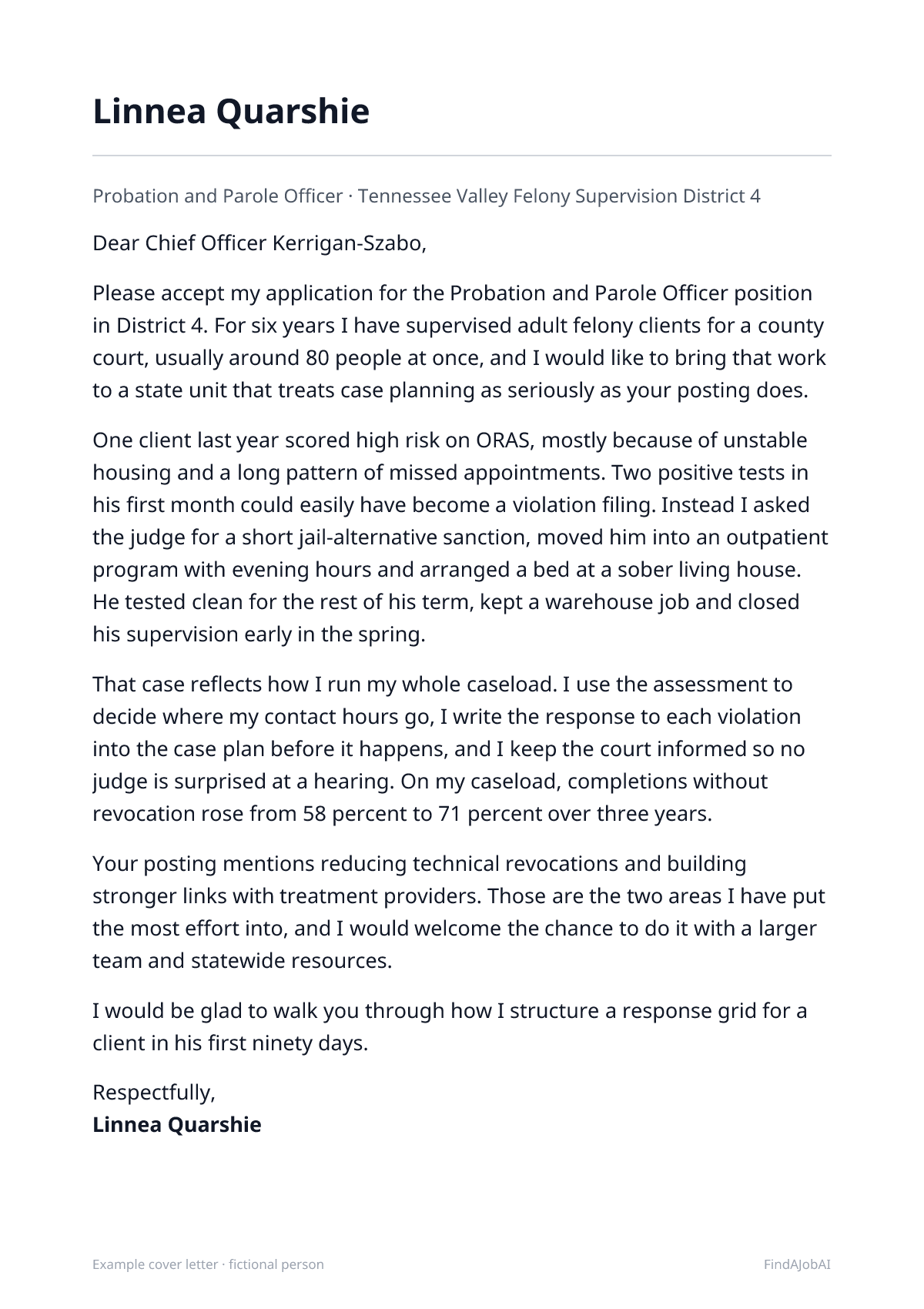
Probation Officer cover letter template
This letter as a one-page template: an opening that names the job and your strongest fact, proof that answers the ad, a reason for this employer and a short close.
After you sign up, FindAJobAI drafts your own letter for a real job from your CV in this format, and you edit it before you send it.
Example 1 · Experienced
County probation officer applying to a state felony supervision unit
Linnea supervises a mixed adult caseload for a county court. The state posting stresses ORAS case planning and fewer technical revocations.
Example letter · fictional
Dear Chief Officer Kerrigan-Szabo,
Please accept my application for the Probation and Parole Officer position in District 4. For six years I have supervised adult felony clients for a county court, usually around 80 people at once, and I would like to bring that work to a state unit that treats case planning as seriously as your posting does.
One client last year scored high risk on ORAS, mostly because of unstable housing and a long pattern of missed appointments. Two positive tests in his first month could easily have become a violation filing. Instead I asked the judge for a short jail-alternative sanction, moved him into an outpatient program with evening hours and arranged a bed at a sober living house. He tested clean for the rest of his term, kept a warehouse job and closed his supervision early in the spring.
That case reflects how I run my whole caseload. I use the assessment to decide where my contact hours go, I write the response to each violation into the case plan before it happens, and I keep the court informed so no judge is surprised at a hearing. On my caseload, completions without revocation rose from 58 percent to 71 percent over three years.
Your posting mentions reducing technical revocations and building stronger links with treatment providers. Those are the two areas I have put the most effort into, and I would welcome the chance to do it with a larger team and statewide resources.
I would be glad to walk you through how I structure a response grid for a client in his first ninety days.
Respectfully,
Linnea Quarshie
Example 2 · Career changer
Residential youth counselor moving into juvenile probation
Desmond spent five years as a counselor in a group home for court-involved teens and just finished a criminology degree.
Example letter · fictional
Dear Juvenile Services Hiring Panel,
I am writing about the Juvenile Probation Officer opening with Sumner Hollow Juvenile Court Services. Most of the teenagers I have worked with over five years as a residential counselor arrived with a probation officer already assigned, and I finished my criminology degree this year because I want to be the person holding that file.
At the group home I was the staff contact for a fifteen-year-old who had run from two earlier placements. His officer and I set a weekly check-in where he tracked his own school attendance on a simple chart, and I sent her a short written update every Friday. Attendance went from about half of school days to nearly all of them over one semester, and he completed his court-ordered program without a new charge before returning home.
From that job I bring daily practice in calming arguments before they turn physical, writing incident reports that a court later reads, and talking with parents who are angry at the system. I also completed a semester internship with a juvenile probation unit, where I joined home visits, sat in on detention hearings and helped draft two predisposition reports that the supervising officer submitted with minor edits.
Your posting asks for experience with adolescents and family engagement. I have spent five years doing both inside a residential setting and I am ready to do them with the authority and the responsibility of a caseload.
My former supervisor at the group home is listed as a reference and can describe the case above in more detail.
Kind regards,
Desmond Feyisetan
Example 3 · Senior or lead
Unit supervisor applying to manage a regional probation office
Ingeborg leads nine officers. The regional office wants a manager who can raise contact compliance and train new staff faster.
Example letter · fictional
Dear Director Pemberton-Ashe,
I am applying for the Probation Services Manager role at the Duck River regional office. I have supervised a unit of nine officers for five years, covering roughly 700 adults on felony and misdemeanor supervision, after nine years carrying caseloads of my own.
When I took over the unit, quarterly audits found that only about 84 percent of required contacts happened on time. The officers were not careless; they simply had no shared view of what was due each week. I built a plain spreadsheet dashboard that each officer opened on Monday morning, paired it with a ten-minute unit huddle, and began reviewing a sample of sixty files every quarter myself. Within a year on-time compliance stood at 96 percent and has stayed there.
Training was the other gap. New officers used to shadow whoever had time, so they learned different habits. I wrote a six-week onboarding program on risk-needs case planning, ORAS scoring and violation responses, and twenty-one officers have now completed it. Supervisors in the neighboring unit adopted the same program last year, and new officers there now reach a full caseload about a month sooner than before. I also pair each new officer with a senior colleague for their first ten field visits.
I have not yet managed a full office budget, because that is handled by our county administrator, and I would want to learn how your region allocates training and overtime funds before making promises there.
I would welcome a conversation about where your office currently loses contact hours and how new officers are brought up to speed.
Sincerely,
Ingeborg Mallinckrodt
All three letters, and the short version below, are fictional: the people, employers and numbers are invented. Borrow the structure, never the facts.
- Prefer to write it yourself? Use the free cover letter template.
- Check your CV against the job first: the free CV score shows the missing keywords.
Why the first letter works, paragraph by paragraph
Paragraph 1: Opening
States the court setting, caseload size and years, so the reader knows the applicant already carries a full felony load.
Paragraph 2: The supervised case
Shows a real decision point, a likely violation, and the proportionate response chosen instead, with the result at the end of the term.
Paragraph 3: Method
Explains how the officer uses the risk tool and plans violation responses ahead, which signals consistency across a whole caseload.
Paragraph 4: Fit with the state posting
Picks up the posting's own priorities, fewer technical revocations and treatment links, and ties them to work already done.
Paragraph 5: Close
Offers to explain a concrete method instead of a generic request for an interview, which reads as confident and practical.
What the career changer's letter does differently
The career changer builds the letter around one teenager he supported alongside a probation officer, with a clear change in attendance and a completed program. He links residential skills such as de-escalation and incident reports to probation duties, and mentions an internship that put him inside a juvenile unit.
What the senior letter does differently
The supervisor's letter reports results across a whole unit: contact compliance moving from 84 to 96 percent and an onboarding program used beyond her own team. It also names a gap, budget management, honestly instead of implying she has done everything the job involves.
Short probation officer cover letter: an email-ready version
Many applications arrive as an email or a small text box, and a full page doesn't fit. This version runs 120 to 150 words and keeps only what a reader needs to decide whether to reply. An officer replies to a pretrial services recruiter who reached out by email about an opening.
Short version · email · fictional124 words
Subject: Pretrial Services Officer – 4 years of adult supervision – Rosalind Thackeray-Moss
Hi Mr. Okonjo-Reyes,
I appreciated your note about the Pretrial Services Officer opening. I have supervised adult misdemeanor and felony clients for four years and currently manage about 70 people, many of them on GPS monitoring with court-ordered curfews and exclusion zones.
Missed court dates were the biggest problem on my caseload, so I started a reminder routine with calls two days before each hearing and a text the morning of. Over one year my missed appearance rate dropped from about one in five to roughly one in ten.
That kind of court-date work sounds central to your program. I have attached my resume, and weekday afternoons or early evenings work well for a phone conversation if that suits your schedule.
Best,
Rosalind Thackeray-Moss
The short version keeps a single result that matters most to pretrial work, missed court dates, and drops broader career history so it fits a recruiter's reply in three short paragraphs.
Opening lines that work for probation officer cover letters
The first sentence decides whether the second gets read. Here are six openings, one for each situation you might be in. Pick the one that matches yours and swap in your own facts: every name and number below is invented.
1. You have a standout result
Two positive tests in a client's first month usually mean a violation filing. I chose a treatment referral and a sober living bed instead, and he closed his supervision early.
2. The ad names a problem you've solved
Your posting asks for fewer technical revocations. Over three years, completions without revocation on my caseload rose from 58 to 71 percent.
3. Someone referred you
For five years most of the teenagers I counseled arrived with a probation officer already assigned, and I am ready to be the one holding that file.
4. You admire what they build
On-time contacts in my unit rose from 84 to 96 percent within a year after I gave officers a shared weekly view of what was due.
5. You're new to the field or switching into it
I write about ten presentence reports a month, and judges have adopted my recommendation in most of them.
6. You have senior scope or a specialism
Missed court dates were the biggest problem on my caseload until I set up a two-step reminder routine that halved them.
How to write a probation officer cover letter
Five steps, in the order you'd write them. The shape stays the same for every job (a short opening, proof, a reason for this employer, a close), and what goes into each part is what changes with the role.
Pick a case that shows a judgment call
Choose a supervised client where you had a real choice, for example filing a violation or using a lesser sanction. Describe the risk level, what you decided and why, and how the supervision ended. Panels care more about how you weigh accountability against progress than about how many contacts you logged.
Name the tools and reports you use
Mention the risk assessment you score, such as ORAS or LSI-R, and the reports you write, such as presentence investigations or violation reports. Put them inside your case story so the reader sees how you used them in practice, rather than adding a separate list that repeats your resume.
Show an outcome the agency already tracks
Probation departments measure completions, revocations, absconding and missed appointments. Tie your result to one of those numbers so the hiring manager can compare it directly with their own unit, and keep the figure honest and specific to your caseload.
Match the supervision type in the posting
Adult felony, juvenile, pretrial, drug court and domestic violence units each need different strengths. Read the posting for the population and choose experience that fits it, then mention one skill that carries over if your background is in a different unit or a related field.
End by offering to explain a method
End by offering to explain a method you use, like how you plan responses to violations or how you keep judges informed. It sounds more confident than asking for an interview and gives the panel a natural first question to open the conversation with you.
Probation Officer cover letter do's and don'ts
Do
- Describe one supervised case with the risk level, the decision you made and how the term ended.
- Name the assessment tool and the response you chose for a violation, since panels test judgment on both.
- Mention how you keep judges and treatment providers informed, which shows you work inside a system.
Don't
- Don't include names, offense details or anything else that could identify a real client.
- Don't present yourself as purely enforcement-minded or purely a helper; agencies want both sides.
- Don't list every duty from your current job; pick the one case that shows your judgment.
Common probation officer cover letter mistakes
Each one is easy to make and quick to fix before you send the letter.
Writing only about enforcement
A letter focused on arrests and violations alone suggests you may revoke too quickly. Show at least one case where you kept someone on track with a proportionate response.
Writing only about helping people
Agencies also need officers who hold the line. Include how you handled a violation or a missed condition, not just the support you offered.
Naming offenses or places that identify a client
Leave out names, offense specifics and locations. Keep the risk level, the decision and the outcome, which are the facts the reader needs.
A probation letter with no figures
Caseload size, report volume and a completion or missed appointment rate give the panel something to compare. Add at least two of them.
Ignoring the court relationship
Probation officers work for or with the court. One sentence on how you keep judges informed or how your reports are received shows you understand that link.
Email subject lines for probation officer applications
Applying by email? Put the job title, any reference number and your name in the subject line.
- Probation and Parole Officer, District 4 – adult felony supervision – Linnea Quarshie
- Juvenile Probation Officer application – residential youth counselor – Desmond Feyisetan
- Application: Probation Officer II (Posting 7731) – ORAS case planning – Linnea Quarshie
Everything for Probation Officers
- Probation Officer resume exampleA full resume, plus bullet and summary examples
- Probation Officer interview questions30 questions with sample answers
- Probation Officer job descriptionDuties, skills and requirements
- Career change cover letter: template + examples
Other cover letter examples
Probation Officer cover letter FAQ
What should a probation officer cover letter include?
One de-identified case showing a judgment call, such as how you responded to a violation, plus your caseload size and type, the risk tool you use and one outcome. Tie it to the priorities in the posting.
How do I write a probation officer cover letter with no experience?
Use an internship, a youth services job or case management work with court-involved people. Describe one person you supported, what you did and what changed, then connect those skills to supervision.
Should I mention firearms or defensive tactics training?
Only if the agency arms its officers or the posting asks for it. If so, add one sentence with the qualification and year rather than making it the focus of the letter.
How we built this page
The FindAJobAI team wrote the three example letters, the short email version, the opening lines and the advice for probation officer roles. The people, employers and numbers in the letters are invented; the structure, the kind of evidence and the order of the paragraphs are the parts to copy.
Once we track enough live probation officer job ads, this page also shows the skills they ask for most, counted the same way as our in-demand skills report.
Last reviewed on November 1, 2026.