Proofreader Cover Letter Example (2026)
By FindAJobAI Team Updated How we built this page
A proofreader cover letter is itself a proofreading test: the reader will notice any slip. Beyond being flawless, it should name the material you check, the style guide you follow and one catch or system that shows how you protect a publication from costly mistakes.
Proofreader cover letter template
This letter as a one-page template: an opening that names the job and your strongest fact, proof that answers the ad, a reason for this employer and a short close.
After you sign up, FindAJobAI drafts your own letter for a real job from your CV in this format, and you edit it before you send it.
Example 1 · Experienced
Book proofreader applying to an academic press
Rosalind proofreads trade nonfiction at a mid-size publisher. The ad asks for Chicago style, PDF markup and experience with notes and indexes.
Example letter · fictional
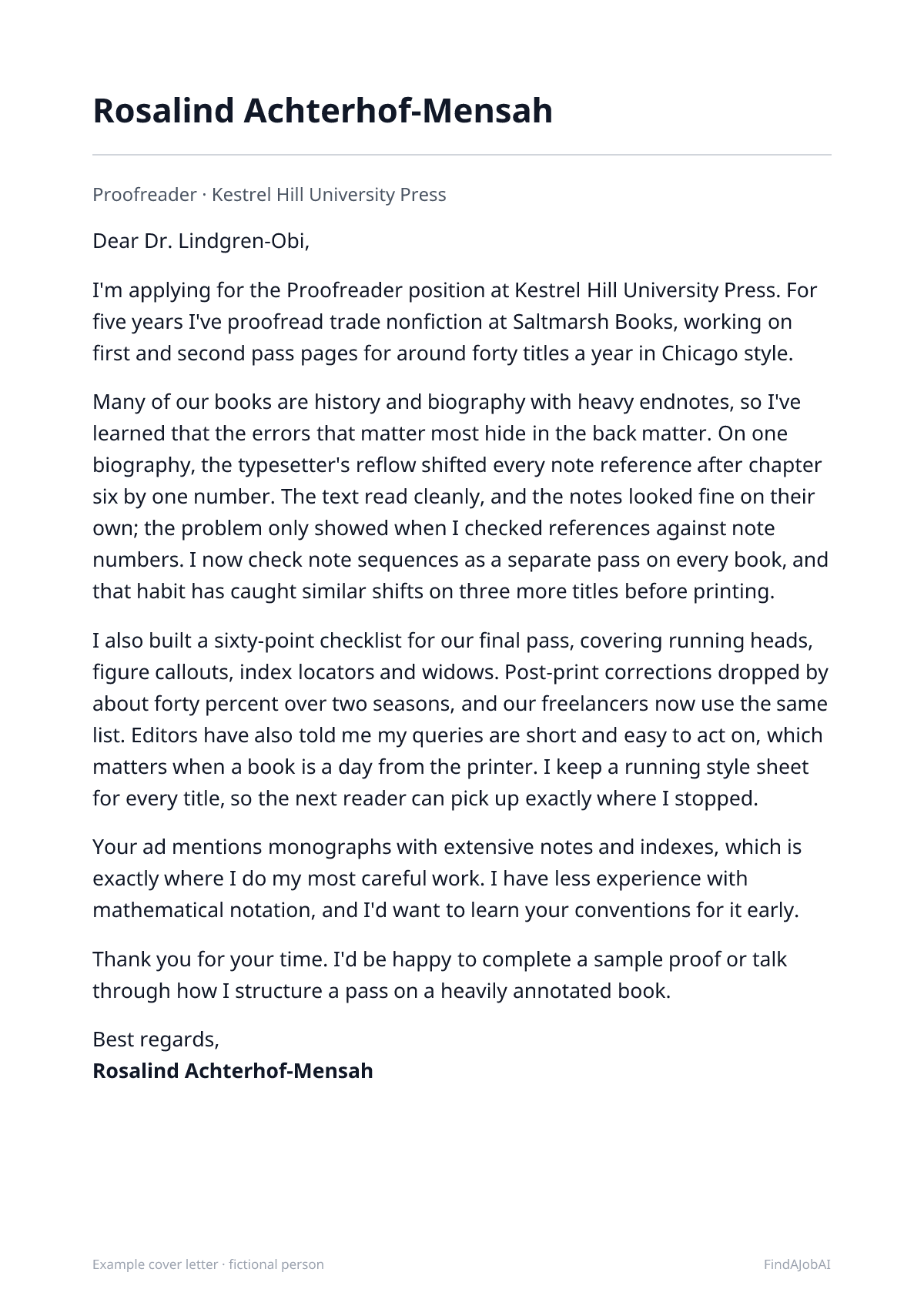
Dear Dr. Lindgren-Obi,
I'm applying for the Proofreader position at Kestrel Hill University Press. For five years I've proofread trade nonfiction at Saltmarsh Books, working on first and second pass pages for around forty titles a year in Chicago style.
Many of our books are history and biography with heavy endnotes, so I've learned that the errors that matter most hide in the back matter. On one biography, the typesetter's reflow shifted every note reference after chapter six by one number. The text read cleanly, and the notes looked fine on their own; the problem only showed when I checked references against note numbers. I now check note sequences as a separate pass on every book, and that habit has caught similar shifts on three more titles before printing.
I also built a sixty-point checklist for our final pass, covering running heads, figure callouts, index locators and widows. Post-print corrections dropped by about forty percent over two seasons, and our freelancers now use the same list. Editors have also told me my queries are short and easy to act on, which matters when a book is a day from the printer. I keep a running style sheet for every title, so the next reader can pick up exactly where I stopped.
Your ad mentions monographs with extensive notes and indexes, which is exactly where I do my most careful work. I have less experience with mathematical notation, and I'd want to learn your conventions for it early.
Thank you for your time. I'd be happy to complete a sample proof or talk through how I structure a pass on a heavily annotated book.
Best regards,
Rosalind Achterhof-Mensah
Example 2 · Career changer
Legal secretary moving into proofreading
Benedikt has spent eight years as a legal secretary checking contracts. The ad is for an entry-level proofreader at a financial printing company.
Example letter · fictional
Dear Ms. Pemberton-Adeyemi,
I'm writing about the Junior Proofreader opening at Ironvale Financial Printing. For eight years I've been a legal secretary at a commercial law firm, and the part of the job I've always done best is the final read of a document before it goes out for signature.
Contracts punish small errors. I check defined terms, cross-references, party names and figures against term sheets, often on drafts that have changed a dozen times. Last year I noticed that a purchase price in a schedule still showed an earlier figure after a late change to the main agreement. The difference was large, and the attorney thanked me in front of the client team. Catches like that are why the partners send their closing documents to me for a last check.
To make the move formal, I completed a proofreading certificate this spring, practiced Chicago and AP style on freelance jobs, and learned standard proofreading marks and Acrobat markup. I scored full marks on the certificate's timed final test. I've also proofread two short reports for a local nonprofit, checking every figure against their finance team's spreadsheet, and found three totals that did not add up. Those small jobs taught me how differently a printed page reads from a draft on screen.
Your ad describes prospectuses and fund reports where numbers must match across many pages. That cross-checking is what I've done every working day for eight years, and I'd bring the same patience to your production schedule.
I'd welcome the chance to take your proofreading test, and I can share a redacted sample of my markup.
Kind regards,
Benedikt Oyelaran-Szabo
Example 3 · Senior or lead
Quality lead applying to run proofing at a corporate communications team
Philippa leads final proofing for annual reports at an insurer. The ad is for a head of proofreading at a listed company's communications team.
Example letter · fictional
Dear Mr. Fairbanks-Oduya,
I'm applying for the Head of Proofreading role at Northvale Utilities. For six years I've led final checks on annual reports, proxy statements and investor documents at Granmoor Insurance, after eight years proofreading books and textbooks.
Your ad mentions a recent correction to a published report. We had one too, early in my time at Granmoor, caused by a table that was updated in the spreadsheet after the narrative had been approved. Nobody owned the link between the two. I introduced a figures cross-check: every number in the narrative is traced to a table, and every table to a dated source file signed off by finance. In the six reporting cycles since, we have had no corrections caused by copy errors, and the check has caught twenty-seven mismatches before release.
I also manage nine freelance proofreaders. I audit a sample of each person's pages every quarter and share the results with them, which has steadily lowered our miss rate and made it easy to see who is ready for the most sensitive documents. Each freelancer also gets a short note on their two most common misses, and repeat errors have fallen noticeably since we started those notes last year. The same notes now form part of how we onboard new freelancers each season.
I haven't run proofing for regulatory filings in the energy sector, and I would expect to spend my first weeks learning which terms and figures your regulators read most closely.
I'd be glad to hear how your current proofing process works and where your team feels the most risk.
Sincerely,
Philippa Mwangi-Holloway
All three letters, and the short version below, are fictional: the people, employers and numbers are invented. Borrow the structure, never the facts.
- Prefer to write it yourself? Use the free cover letter template.
- Check your CV against the job first: the free CV score shows the missing keywords.
Why the first letter works, paragraph by paragraph
Paragraph 1: Opening
States the material, the volume and the style guide in two sentences, which answers the three questions any proofreading manager asks first.
Paragraph 2: The catch that proves the method
Describes a subtle, structural error (shifted note numbers) and how it was found, then shows it became a routine check. That reveals method, not luck.
Paragraph 3: The system
A checklist with a measured effect on corrections shows the writer improves the process, not just individual proofs.
Paragraph 4: Why this press
Matches the ad's focus on notes and indexes and admits one honest gap, which makes the strengths more believable.
Paragraph 5: Close
Offers a sample proof, the most relevant evidence a proofreader can give, instead of a generic thank-you.
What the career changer's letter does differently
The career changer's letter uses contract checking as direct proofreading experience, with one specific catch involving a figure across documents. The certificate and timed test show deliberate preparation, and the close links legal cross-checking to the numeric consistency that financial printing demands.
What the senior letter does differently
A senior proofing letter is about controls and people: a cross-check process that closes a gap between teams, a result over several cycles, and an audit habit that develops freelancers. The honest gap about energy-sector filings shows awareness of what the new role demands.
Short proofreader cover letter: an email-ready version
Many applications arrive as an email or a small text box, and a full page doesn't fit. This version runs 120 to 150 words and keeps only what a reader needs to decide whether to reply. A freelance proofreader responds to a small marketing agency that posted on a local business forum and asked for applications by email.
Short version · email · fictional129 words
Subject: Freelance Proofreader – AP style, retail and web copy – Calloway Ferreira-Nakamura
Hello Ms. Rosenqvist,
I'm replying to your post for a freelance proofreader at Brightpaddle Studio. I've proofread marketing copy for four years, mostly web pages, emails and print ads for retail clients, in AP style and client style sheets.
Retail copy is full of prices, dates and offer terms, so I check every figure against the client brief as a separate pass. That habit caught a wrong sale end date on a printed circular last spring, which would have meant honoring a discount for an extra week.
I usually return same-day proofs for short pieces and next-day proofs for longer ones. My rates and a few redacted samples are attached, and I'd be happy to proof a trial piece first. I can start this month.
Thank you,
Calloway Ferreira-Nakamura
The short email states material, style guide and turnaround, then gives one money-relevant catch. For an agency, that answers the only questions that matter: can you work in our format, and will you protect our clients from mistakes?
Opening lines that work for proofreader cover letters
The first sentence decides whether the second gets read. Here are six openings, one for each situation you might be in. Pick the one that matches yours and swap in your own facts: every name and number below is invented.
1. You have a standout result
Last spring I caught a reflow error that shifted ninety endnote numbers in a biography just before it went to print. I'd like to bring that kind of careful pass to your monographs.
2. The ad names a problem you've solved
Your ad says your annual report needed a correction after publication. I built the figures cross-check that has kept our reports free of copy-related corrections for six cycles.
3. Someone referred you
Your production editor, Imelda Castellano, and I worked on the same textbook series for three years. She mentioned you need a proofreader comfortable with answer keys, and that is why I'm writing.
4. You admire what they build
I've read your press's history list for years, and I noticed how consistently clean its notes and indexes are. I'd like to help keep them that way.
5. You're new to the field or switching into it
For eight years I've been the person who reads every contract one last time before signature. I want to make that final read my full-time job.
6. You have senior scope or a specialism
I've led final proofing for investor documents and managed nine freelance proofreaders. I'm now looking to run proofing for a whole communications department.
How to write a proofreader cover letter
Five steps, in the order you'd write them. The shape stays the same for every job (a short opening, proof, a reason for this employer, a close), and what goes into each part is what changes with the role.
Treat the letter as a proofreading sample
Hiring managers will read your letter more closely than most. Check spelling, punctuation, names and the company's own style, such as how it writes its name. Read it aloud, print it, and leave a gap of a few hours before your final read.
Name your material and your style guide early
Proofreading varies a lot between books, legal documents, marketing and academic work. Put the material you know and the guide you use, such as Chicago, AP or a house style, in your opening paragraph so the reader can match you to the role immediately.
Tell one catch and explain how you found it
Pick an error that a quick read would miss, such as shifted references, a mismatched figure or a wrong date in fine print. Explain the method that found it and what it would have cost, so the reader sees a repeatable habit rather than a lucky find.
Show speed alongside accuracy
Most proofreading roles run on tight schedules. Add one line about volume or turnaround, such as pages per week or same-day proofs, so the reader knows your care does not come at the expense of deadlines.
Offer a test or sample
Close by offering to take the employer's proofreading test or share a redacted markup sample. It is the most persuasive evidence you can give, and it shows confidence without making claims you cannot prove in the letter.
Proofreader cover letter do's and don'ts
Do
- Proofread the letter several times, aloud and on paper; it is your first work sample.
- Name the material and the style guide you work in, using the ad's own terms.
- Describe one catch, how you found it and what it prevented.
Don't
- Don't call yourself a perfectionist or say you have an eagle eye; show the evidence instead.
- Don't blur proofreading and editing if the role is final-stage checking only.
- Don't include more than one example of a catch; one well-told story is stronger.
Common proofreader cover letter mistakes
Each one is easy to make and quick to fix before you send the letter.
A single typo or misspelled name
One slip can end a proofreading application. Check the hiring manager's name, the company name and every date twice, and have someone else read the final version.
Relying on adjectives like meticulous
Every applicant says it. Replace it with a specific catch, an audit result or a measured drop in corrections.
Describing editing when the role is proofreading
Rewriting paragraphs is not what a final-pass proofreader does. Keep examples focused on finding errors and protecting consistency late in production.
Ignoring the employer's material
A letter about novels sent to a legal printer misses the mark. Pick the example closest to what the employer publishes and say why the skills carry over.
No mention of turnaround
Accuracy alone is not enough for production teams. Add a line about the volume you handle or how quickly you return proofs.
Email subject lines for proofreader applications
Applying by email? Put the job title, any reference number and your name in the subject line.
- Proofreader application – Chicago style, notes and indexes – Rosalind Achterhof-Mensah
- Junior Proofreader – legal document checking background – Benedikt Oyelaran-Szabo
- Application: Proofreader, Production Department (Ref. 2210) – Rosalind Achterhof-Mensah
Everything for Proofreaders
- Proofreader resume exampleA full resume, plus bullet and summary examples
- Proofreader interview questions30 questions with sample answers
- Proofreader job descriptionDuties, skills and requirements
- Career change cover letter: template + examples
Other cover letter examples
Proofreader cover letter FAQ
What should I write in a proofreader cover letter?
Say what you proofread, which style guides you use and roughly how much you handle. Then describe one error you caught, how you found it and what it would have cost. Offer to take a proofreading test or share a sample.
How do I write a proofreader cover letter with no experience?
Use checking work from another role, such as contracts, reports or student papers, and describe a specific catch. Add any certificate, freelance or volunteer proofs, and offer to complete the employer's test.
How long should a proofreader cover letter be?
Keep it to one page and four or five short paragraphs. A tight, error-free letter is itself evidence of the skill, while a long one gives the reader more places to find a slip.
How we built this page
The FindAJobAI team wrote the three example letters, the short email version, the opening lines and the advice for proofreader roles. The people, employers and numbers in the letters are invented; the structure, the kind of evidence and the order of the paragraphs are the parts to copy.
Once we track enough live proofreader job ads, this page also shows the skills they ask for most, counted the same way as our in-demand skills report.
Last reviewed on November 1, 2026.