Ruby Developer Cover Letter Example (2026)
By FindAJobAI Team Updated How we built this page
Companies hiring a Ruby developer usually have a Rails application that matters to the business and needs care: new features, faster pages, a safe upgrade or a cleaner structure. A strong Ruby developer cover letter shows you have done that work in a real codebase, names the Rails tools behind it and gives a result such as response time, test runtime or an upgrade finished without incidents.
Ruby Developer cover letter template
This letter as a one-page template: an opening that names the job and your strongest fact, proof that answers the ad, a reason for this employer and a short close.
After you sign up, FindAJobAI drafts your own letter for a real job from your CV in this format, and you edit it before you send it.
Example 1 · Experienced
Rails developer applying to a marketplace with an aging monolith
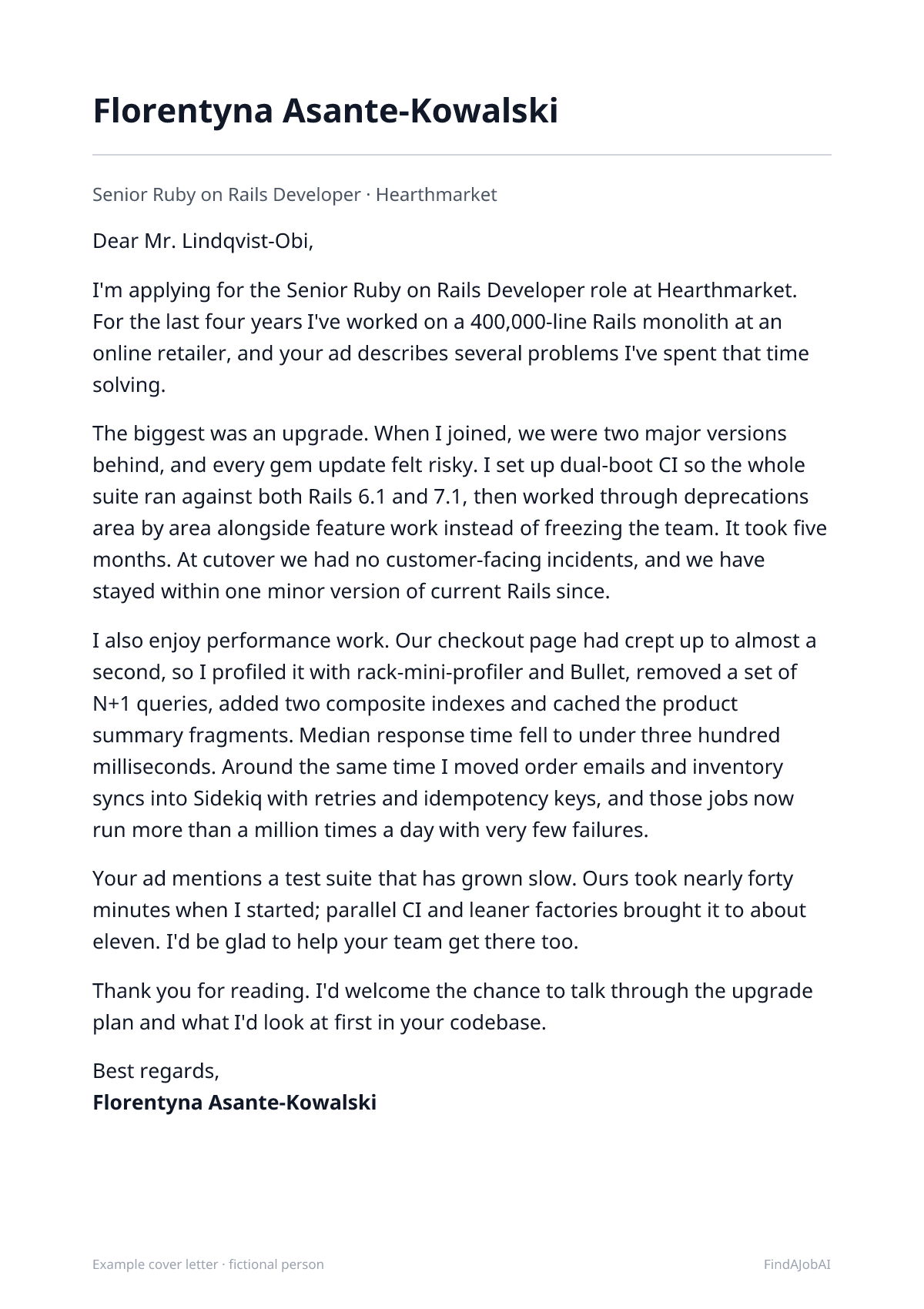
Florentyna maintains a large Rails monolith at an online retailer. The ad asks for Rails upgrades, performance work and Sidekiq experience.
Example letter · fictional
Dear Mr. Lindqvist-Obi,
I'm applying for the Senior Ruby on Rails Developer role at Hearthmarket. For the last four years I've worked on a 400,000-line Rails monolith at an online retailer, and your ad describes several problems I've spent that time solving.
The biggest was an upgrade. When I joined, we were two major versions behind, and every gem update felt risky. I set up dual-boot CI so the whole suite ran against both Rails 6.1 and 7.1, then worked through deprecations area by area alongside feature work instead of freezing the team. It took five months. At cutover we had no customer-facing incidents, and we have stayed within one minor version of current Rails since.
I also enjoy performance work. Our checkout page had crept up to almost a second, so I profiled it with rack-mini-profiler and Bullet, removed a set of N+1 queries, added two composite indexes and cached the product summary fragments. Median response time fell to under three hundred milliseconds. Around the same time I moved order emails and inventory syncs into Sidekiq with retries and idempotency keys, and those jobs now run more than a million times a day with very few failures.
Your ad mentions a test suite that has grown slow. Ours took nearly forty minutes when I started; parallel CI and leaner factories brought it to about eleven. I'd be glad to help your team get there too.
Thank you for reading. I'd welcome the chance to talk through the upgrade plan and what I'd look at first in your codebase.
Best regards,
Florentyna Asante-Kowalski
Example 2 · Career changer
PHP developer moving into Ruby on Rails
Gustavo has built Laravel apps for five years and has shipped two Rails side projects. The ad is for a mid-level Rails developer at a SaaS company.
Example letter · fictional
Dear Lanternline Engineering Team,
I'm writing about the Ruby on Rails Developer opening at Lanternline Software. I've spent five years building Laravel applications for an agency and an insurance broker, and over the past year I've moved my own projects to Rails because I enjoy how it handles the everyday work of a web app.
Laravel and Rails share many ideas, so my web fundamentals carry over directly: MVC structure, migrations, background queues and testing. The most useful thing I've built recently is a quoting tool for our insurance brokers. It replaced a spreadsheet process, cut the time to produce a quote from about twenty minutes to three, and taught me a lot about modeling messy business rules cleanly and testing them well.
To learn Rails properly, I rebuilt a smaller version of that tool in Rails 7 with Hotwire and RSpec, and I built a volunteer scheduling app for a local animal shelter that about forty volunteers use each week. I've also read through the Rails guides on ActiveRecord and caching and contributed two documentation fixes to an open-source gem I use.
I know I'll need time to learn the Ruby community's conventions and your codebase. What I bring is experience shipping business software for real users, writing tests first and working closely with non-technical colleagues, which your ad mentions as an important part of the role.
My GitHub is on my resume, and I'd be happy to walk through either Rails project on a call.
Kind regards,
Gustavo Mensah-Haugen
Example 3 · Senior or lead
Staff Rails engineer applying to organize a growing monolith
Bronwyn sets architecture for a Rails monolith with 80 developers. The ad is for a staff engineer to structure a fast-growing Rails codebase.
Example letter · fictional
Dear Ms. Okafor-Strand,
I'm applying for the Staff Rails Engineer role at Haulcrest Freight. I've worked in Rails for eleven years, and for the last five I've set architecture for a monolith that eighty developers work in every day and two million customers rely on.
Your ad says the team is debating whether to break the monolith into services. We had the same debate. Some engineers wanted to extract services right away, because changes in one area kept breaking another. Instead, I proposed we first draw boundaries inside the monolith. We organized the code into nine Rails engines and used Packwerk to make dependencies visible and enforce them in CI. Within a year, cross-team breakages fell sharply, and the two areas that truly needed to scale separately were easy to extract because their boundaries were already clean.
I also care about keeping the codebase current. We've stayed within one minor version of the latest Rails for five years by running dual-boot CI and spreading upgrade work across teams, so upgrades never stop feature delivery. I mentor six developers, and three of them have moved into senior roles.
I haven't worked on a freight or logistics product, and I'd expect your dispatch and tracking flows to have constraints I'll need to learn, especially around real-time updates and the carriers' own systems. I would spend my first weeks reading code and pairing before proposing any boundaries.
I'd like to hear which parts of the codebase cause the most cross-team friction today and where the services debate currently stands.
Sincerely,
Bronwyn Achterberg-Nkemelu
All three letters, and the short version below, are fictional: the people, employers and numbers are invented. Borrow the structure, never the facts.
- Prefer to write it yourself? Use the free cover letter template.
- Check your CV against the job first: the free CV score shows the missing keywords.
Why the first letter works, paragraph by paragraph
Paragraph 1: Opening
States the role, the size of the codebase and a direct link to the ad's problems, which tells the reader the writer has worked at similar scale.
Paragraph 2: The upgrade
A major Rails upgrade with a named method (dual boot), a realistic timeline and a clean cutover. Rails teams value this experience highly because it is hard to do well.
Paragraph 3: Performance and jobs
Concrete tools, causes and results for page speed, plus Sidekiq volume with reliability details, covering the other two skills in the ad.
Paragraph 4: Test suite offer
Answers a specific pain from the ad with a past result, which makes the letter feel written for this company.
Paragraph 5: Close
Offers to discuss the upgrade plan and first steps in their codebase, giving the interviewer a natural first topic.
What the career changer's letter does differently
The career changer's letter connects Laravel experience to Rails through shared concepts, then proves commitment with a Rails rebuild, a volunteer app with real users and small open-source contributions. He admits the learning curve and offers business software experience as his edge.
What the senior letter does differently
A staff-level letter shows judgment over enthusiasm: boundaries inside the monolith before extraction, a tool to enforce them and results in fewer breakages. Steady upgrades and mentoring show leverage across teams, and the honest gap about freight shows self-awareness.
Short Ruby developer cover letter: an email-ready version
Many applications arrive as an email or a small text box, and a full page doesn't fit. This version runs 120 to 150 words and keeps only what a reader needs to decide whether to reply. A Ruby developer replies to a startup founder who posted a Rails role on a community job board with an email address and no application form.
Short version · email · fictional121 words
Subject: Ruby on Rails Developer – Sidekiq and Stripe billing – Ambrose Nyambura-Lind
Hi Ms. Kaminski,
I saw your post for a Rails developer at Sproutledger. I've spent five years building Rails apps, most recently the billing system for a SaaS product with about eight thousand paying customers.
I built our subscription flow on Stripe webhooks with Sidekiq handling retries, so failed payments, refunds and plan changes all reconcile automatically. Support tickets about billing errors dropped to a handful a month after launch, and finance stopped reconciling payments by hand at month end.
Your post mentions moving from manual invoicing to subscriptions. I've done exactly that, including migrating existing customers onto plans, and would enjoy helping you through it. I've attached my resume and can talk whenever suits you this week.
Thanks,
Ambrose Nyambura-Lind
The short email gives one directly relevant project with a clear result and ties it to the founder's stated goal of moving to subscriptions, which is all a busy founder needs to reply.
Opening lines that work for Ruby developer cover letters
The first sentence decides whether the second gets read. Here are six openings, one for each situation you might be in. Pick the one that matches yours and swap in your own facts: every name and number below is invented.
1. You have a standout result
Last year I led a Rails 6.1 to 7.1 upgrade of a 400,000-line monolith with no customer-facing incidents. I'd like to bring that experience to your platform.
2. The ad names a problem you've solved
Your ad says your checkout pages have become slow. I cut checkout response time from about nine hundred milliseconds to under three hundred with query fixes and caching.
3. Someone referred you
Your engineering manager, Desmond Achebe-Rask, and I worked on the same Rails team for two years. He mentioned you need someone who enjoys upgrades and refactors, which is why I'm writing.
4. You admire what they build
I've used your open-source Rails gem for feature flags in two production apps and sent a small fix for its caching last spring.
5. You're new to the field or switching into it
After five years building Laravel applications, I've moved my own projects to Rails and want to work full time in Ruby.
6. You have senior scope or a specialism
I've set architecture for a Rails monolith with eighty developers, and I'm looking to help a growing team organize its codebase before it splits into services.
How to write a Ruby developer cover letter
Five steps, in the order you'd write them. The shape stays the same for every job (a short opening, proof, a reason for this employer, a close), and what goes into each part is what changes with the role.
Find the Rails problem behind the job ad
Most Ruby roles exist because a Rails app needs something: new features, better performance, an upgrade or structure. Look for clues such as version numbers, slow tests or words like monolith and legacy, then pick the project of yours that matches most closely.
Tell one story from a real codebase
Describe a change you made in an app people depended on. Explain what was wrong, the approach you took and how you kept it safe, for example with tests, dual boot or a feature flag. Real codebases impress Rails teams more than greenfield demos.
Name the Ruby tools inside the story
Mention the gems and tools that made the work possible, such as Sidekiq, RSpec, Bullet or Hotwire, as part of what you did rather than as a list. This shows practical experience and helps the letter match the skills in the ad.
Give a result you can defend
Use response times, test runtime, job volume, versions upgraded or incidents avoided. Say how you measured it, for example with a profiler, CI timings or error tracking. One solid number does more than several vague claims about clean or fast code.
Close on their codebase
End by naming something from the ad, such as a slow test suite or an upcoming upgrade, and what you would look at first. That shows you read the posting closely and gives the interviewer an easy first question to ask you.
Ruby Developer cover letter do's and don'ts
Do
- Describe one Rails change you made in a real codebase and the measured result.
- Name the Rails tools behind your work, such as Sidekiq, RSpec or Hotwire, inside the story.
- Answer one specific problem from the ad with something you have already solved.
Don't
- Don't describe Ruby as your passion without showing what you built with it.
- Don't call a page faster unless you can name the profiler and the numbers.
- Don't skip maintenance work; upgrades and refactors are what many Rails teams need most.
Common Ruby developer cover letter mistakes
Each one is easy to make and quick to fix before you send the letter.
Calling yourself a passionate Rubyist
Enthusiasm without evidence reads as filler. Replace it with one project and a result that shows how you work in Ruby.
Only describing greenfield apps
Many Rails teams need people who can improve existing code. Include upgrades, performance fixes or refactors if you have done them.
Listing gems instead of telling a story
A paragraph of library names belongs on the resume. Mention the one or two that mattered to your main result and what you did with them.
Performance claims with no numbers
Saying a page became faster invites doubt. Give the response times before and after and the tool you used to measure them.
Ignoring tests
Ruby teams rely on tests to change code safely. One line about how you test, or a suite you sped up, shows you fit that culture.
Email subject lines for Ruby developer applications
Applying by email? Put the job title, any reference number and your name in the subject line.
- Senior Rails Developer – Rails 7.1 upgrade and checkout speed – Florentyna Asante-Kowalski
- Ruby on Rails Developer – Laravel developer with 2 Rails apps shipped – Gustavo Mensah-Haugen
- Application: Staff Rails Engineer (Req. 2914) – modular monolith and upgrades
Everything for Ruby Developers
- Ruby Developer resume exampleA full resume, plus bullet and summary examples
- Ruby Developer interview questions30 questions with sample answers
- Ruby Developer job descriptionDuties, skills and requirements
- Career change cover letter: template + examples
Other cover letter examples
Ruby Developer cover letter FAQ
What should I write in a Ruby developer cover letter?
Choose one piece of Rails work, such as an upgrade, a performance fix or a feature, and explain the problem, the tools you used and the result. Link it to the company's stack or problems from the ad and close with what you would like to discuss.
How do I write a Ruby cover letter coming from another language?
Show the web fundamentals that carry over, then prove you have learned Rails with deployed projects, tests and any open-source work. Be honest about what you are still learning and highlight experience shipping software for real users.
Should I mention Rails versions in a cover letter?
Yes, when it matters to the story, such as an upgrade you led or modern features like Hotwire. Version details show you work in current Rails and help a hiring manager judge how well your experience fits their app.
How we built this page
The FindAJobAI team wrote the three example letters, the short email version, the opening lines and the advice for Ruby developer roles. The people, employers and numbers in the letters are invented; the structure, the kind of evidence and the order of the paragraphs are the parts to copy.
Once we track enough live Ruby developer job ads, this page also shows the skills they ask for most, counted the same way as our in-demand skills report.
Last reviewed on November 1, 2026.