Medical Biller Resume Example (2026)
By FindAJobAI Team Updated How we built this page
Medical biller postings ask for a familiar set of skills: claim submission through a clearinghouse, payer rules for Medicare, Medicaid and commercial plans, denial follow-up, payment posting and a working knowledge of CPT, ICD-10 and modifiers. Practice managers reading the resume want to know how many claims you push out, how many come back, and how quickly the money arrives. A medical biller resume stands out when it answers those questions with numbers instead of a list of duties.
The example below is a medical biller with six years at an orthopedic group and a rural hospital's outpatient clinics. Every bullet names the payer mix, the software or the specialty, along with the measure it moved, such as clean claim rate, denial rate or days in accounts receivable.
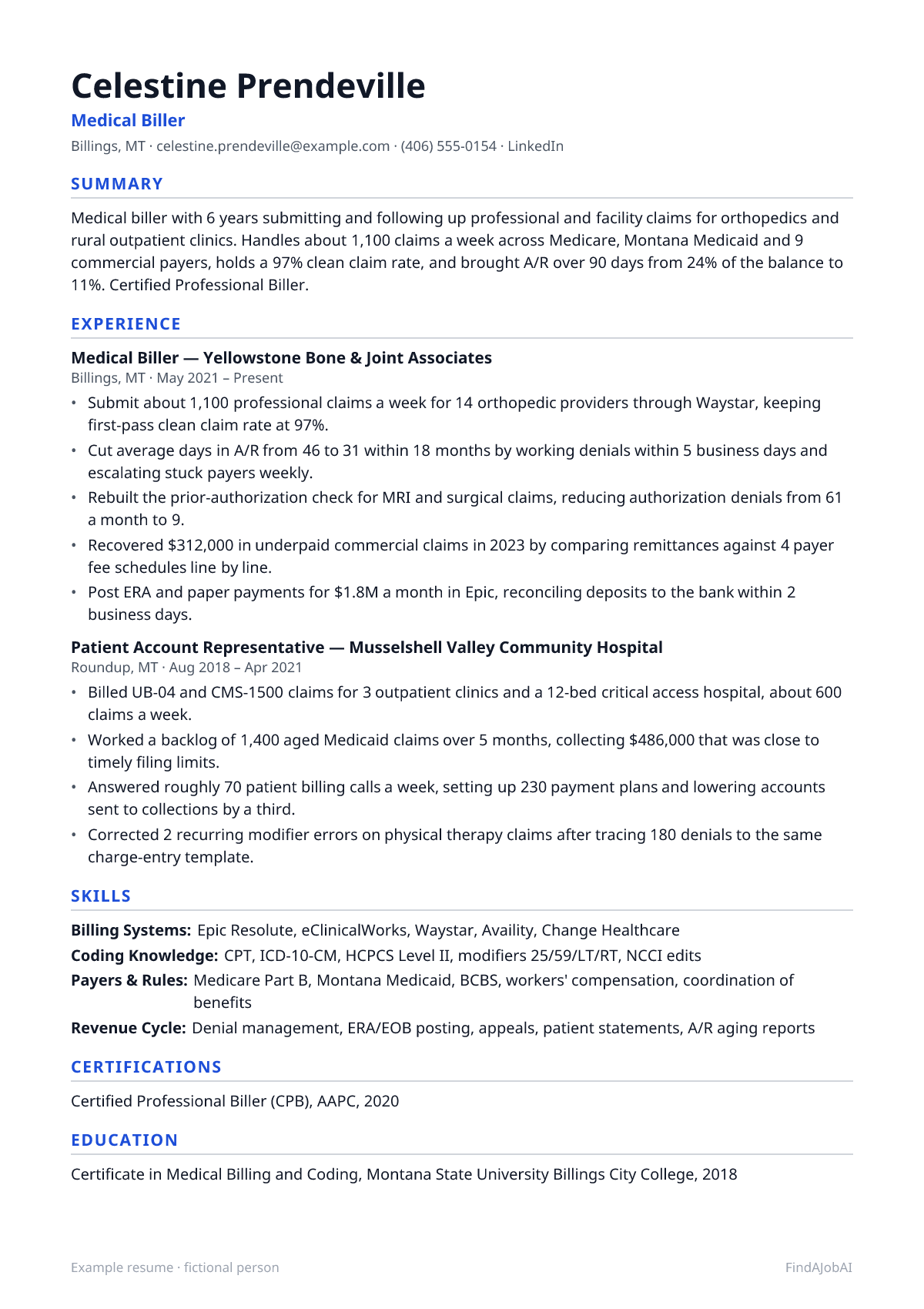
Medical Biller resume template
This example as a one-page template: one column, standard headings and plain text, the format applicant tracking systems read most reliably.
After you sign up, Create my CV builds your own resume in this same one-column layout, from your real experience.
Mid-level medical biller resume example
A complete one-page example for a fictional medical biller: every bullet pairs an action with what changed because of it.
Example resume · fictional person
Summary
Medical biller with 6 years submitting and following up professional and facility claims for orthopedics and rural outpatient clinics. Handles about 1,100 claims a week across Medicare, Montana Medicaid and 9 commercial payers, holds a 97% clean claim rate, and brought A/R over 90 days from 24% of the balance to 11%. Certified Professional Biller.
Experience
Medical Biller, Yellowstone Bone & Joint Associates
Billings, MT · May 2021 – Present
- Submit about 1,100 professional claims a week for 14 orthopedic providers through Waystar, keeping first-pass clean claim rate at 97%.
- Cut average days in A/R from 46 to 31 within 18 months by working denials within 5 business days and escalating stuck payers weekly.
- Rebuilt the prior-authorization check for MRI and surgical claims, reducing authorization denials from 61 a month to 9.
- Recovered $312,000 in underpaid commercial claims in 2023 by comparing remittances against 4 payer fee schedules line by line.
- Post ERA and paper payments for $1.8M a month in Epic, reconciling deposits to the bank within 2 business days.
Patient Account Representative, Musselshell Valley Community Hospital
Roundup, MT · Aug 2018 – Apr 2021
- Billed UB-04 and CMS-1500 claims for 3 outpatient clinics and a 12-bed critical access hospital, about 600 claims a week.
- Worked a backlog of 1,400 aged Medicaid claims over 5 months, collecting $486,000 that was close to timely filing limits.
- Answered roughly 70 patient billing calls a week, setting up 230 payment plans and lowering accounts sent to collections by a third.
- Corrected 2 recurring modifier errors on physical therapy claims after tracing 180 denials to the same charge-entry template.
Skills
- Billing Systems: Epic Resolute, eClinicalWorks, Waystar, Availity, Change Healthcare
- Coding Knowledge: CPT, ICD-10-CM, HCPCS Level II, modifiers 25/59/LT/RT, NCCI edits
- Payers & Rules: Medicare Part B, Montana Medicaid, BCBS, workers' compensation, coordination of benefits
- Revenue Cycle: Denial management, ERA/EOB posting, appeals, patient statements, A/R aging reports
Certifications
- Certified Professional Biller (CPB), AAPC, 2020
Education
- Certificate in Medical Billing and Coding, Montana State University Billings City College, 2018
Fictional example by the FindAJobAI team: the person, employers and numbers are invented. Keep the structure; use your own work and numbers you can explain in an interview.
Entry-level medical biller resume example
A front-desk coordinator moving into billing with a certificate and real insurance verification work. The resume leans on eligibility checks, copay collection and EOB reading, which are the parts of front-office work closest to a biller's day, and keeps the training section near the top.
Entry-level example resume · fictional person
Summary
Entry-level medical biller with a billing and coding certificate and 14 months as a front-desk coordinator at a family medicine clinic, verifying insurance for about 60 patients a day. Trained on eClinicalWorks and Availity, and ready to take on claim submission and denial follow-up.
Experience
Front Desk Coordinator, Sun River Family Medicine
Great Falls, MT · Sep 2024 – Present
- Verify eligibility and benefits for about 60 patients a day in Availity, flagging 8 to 10 inactive policies a week before the visit.
- Collect copays and past balances at check-in, raising time-of-service collections from about $9,000 to $14,500 a month.
- Correct demographic and insurance errors flagged by the biller, cutting registration-related rejections from 40 a month to 12.
Billing Extern, Giant Springs Physical Therapy
Great Falls, MT · Feb 2024 – May 2024
- Entered charges for 25 therapy visits a day under supervision, matching timed CPT units to the treatment minutes recorded.
- Posted 300 EOB line items and sorted 45 denials by reason code for the billing lead to work.
Skills
- Systems: eClinicalWorks, Availity, Microsoft Excel
- Billing Basics: CMS-1500, eligibility checks, EOB reading, copay collection
- Coding Basics: CPT, ICD-10-CM, common modifiers, timed therapy units
Certifications
- Certified Billing and Coding Specialist (CBCS), NHA, 2024
Training
- Medical billing and coding certificate (180 hours): CMS-1500 claim forms, CPT and ICD-10 basics, Medicare and Medicaid rules, and appeals letters.
- Practice billing lab: built and scrubbed 40 mock claims in an eClinicalWorks training account, then worked the simulated rejections to clean status.
Education
- Certificate in Medical Billing and Coding, Great Falls College, 2024
Senior medical biller resume example
A billing supervisor thirteen years in, now leading a team. The bullets move from individual claims to department measures: denial rate, cash collected, a system conversion and staff productivity, and the summary gives team size and annual charges up front.
Senior example resume · fictional person
Summary
Billing supervisor with 13 years in hospital and multi-specialty revenue cycle, leading 7 billers responsible for $64M in annual charges. Built a denial-prevention program that cut the denial rate from 11% to 5%, and led billing through an Epic conversion with no drop in monthly cash.
Experience
Billing Supervisor, Flathead Lakeside Medical Group
Kalispell, MT · Jan 2020 – Present
- Lead 7 billers handling $64M in yearly charges across 11 specialties and 70 providers.
- Built a denial-prevention program with front desk and coding leads, cutting the overall denial rate from 11% to 5% in 2 years.
- Ran billing readiness for the move from Athena to Epic, testing 900 claim scenarios so monthly cash stayed within 2% of plan.
- Introduced daily work queues sorted by dollar value and filing deadline, lifting each biller's resolved accounts from 55 to 80 a day.
- Negotiated corrected fee schedules with 3 commercial payers after an audit found $540,000 in systematic underpayment.
Senior Medical Biller, Glacier Gateway Hospital
Whitefish, MT · Mar 2015 – Dec 2019
- Billed facility claims for emergency, surgery and imaging, about 900 UB-04 claims a week.
- Wrote 60 claim scrubber edits for common Medicare errors, raising the clean claim rate from 89% to 96%.
- Trained 4 new billers on Medicare and Montana Medicaid rules, each working independently within 6 weeks.
Medical Billing Specialist, Glacier Gateway Hospital
Whitefish, MT · Jun 2012 – Feb 2015
- Worked about 250 commercial insurance follow-ups a week, appealing medical necessity denials with clinical notes attached.
- Posted $2.1M a month in payments and adjustments with month-end variance under $500.
Skills
- Systems: Epic Resolute PB and HB, athenahealth, Waystar, Availity, Excel pivot tables
- Revenue Cycle: Denial prevention, claim scrubber rules, payer contracting support, A/R aging, write-off policy
- Compliance: HIPAA, No Surprises Act estimates, Medicare billing rules, internal audits
- Leadership: Team scheduling, productivity standards, staff training, cross-department projects
Certifications
- Certified Revenue Cycle Representative (CRCR), HFMA, 2018
- Certified Professional Biller (CPB), AAPC, 2014
Education
- B.S. Health Administration, Montana State University, 2012
How to write a medical biller resume
Five steps, in the order a recruiter reads the page. The format around them stays plain for every job: one column, standard headings, newest role first.
Header: name, target title and links
Use "Medical Biller" as your headline, even if the badge said Patient Account Representative or Billing Associate, and put CPB, CBCS, CPC or CRCR next to your name so screeners and practice managers spot it straight away.
Summary: what you do and your best proof
In two or three sentences, give your specialty or setting, weekly claim volume and one revenue result such as days in A/R reduced or underpayments recovered. Skip vague claims like detail-oriented team player; a clean claim rate shows attention to detail more convincingly.
Experience: newest first, a result in every bullet
Open each bullet with the billing task, then add the volume, payer or system, then the result in dollars, days or denial counts. Mix steady-state work like posting and submission with at least one cleanup project, such as a backlog or a denial pattern you fixed.
Skills: grouped, in the ad's words
Group skills into billing systems, coding knowledge, payers and rules, and revenue cycle tasks, using exact names like Epic Resolute, Waystar, CMS-1500 and modifier 25. Leave out general office software unless the ad asks for it specifically.
Education and certifications
List your billing certificate, associate degree or bachelor's with the year, and give certifications their own line. Newer billers should add a short training block describing claim practice, mock appeals or an externship with the number of claims handled.
Skills to put on a medical biller resume
Hard skills are the tools and methods of the job; soft skills are how you work with people. Each comes with one way to prove it, because a skill named only in a list counts for little. Add the ones you really have.
Hard skills
- Claim submission (CMS-1500, UB-04)
- Give weekly claim volume, the form types and your first-pass clean claim rate in one bullet.
- Denial management and appeals
- Name a denial type you reduced, such as authorization or eligibility, with counts before and after.
- Payment posting (ERA, EOB)
- State the monthly dollars you post and how quickly you reconcile them to bank deposits.
- CPT, ICD-10 and modifiers
- Describe a modifier or code-pairing error you caught and the denials it stopped coming back.
- Medicare and Medicaid rules
- Mention timely filing, medical necessity or state Medicaid quirks you handled, with a dollar result.
- Commercial payer follow-up
- Show underpayments recovered or appeals won against named payer types, with the amount.
- Practice management systems
- Name Epic, eClinicalWorks, athenahealth or Kareo and one report or work queue you used daily.
- Clearinghouse tools
- Mention Waystar, Availity or Change Healthcare and how you cut rejections at the front end.
- Prior authorization checks
- Describe a process change that reduced authorization denials, with the monthly count.
- A/R aging and reporting
- Give days in A/R or the share of the balance over 90 days, before and after your work.
- Patient billing and payment plans
- Count the payment plans set up or calls handled, and the effect on balances sent to collections.
Soft skills
- Persistence with payers
- Describe a claim you kept chasing through reconsideration and appeal, and the amount finally paid.
- Clear patient communication
- Mention how you explained a confusing bill and how the call ended, such as a plan or payment.
- Attention to detail
- Point to a recurring error you spotted in charges or remits and how many claims it affected.
- Working with coders and clinicians
- Show a documentation or coding fix you agreed with providers and the denials it prevented.
- Time management
- Explain how you prioritised work queues by deadline or dollar value and what that did to aging.
- Confidentiality
- Mention HIPAA practices you follow when handling records, calls or payer portals, in a short line.
Medical Biller resume bullet examples: weak vs strong
The same work, written two ways. The strong version names the tool, the scope and a result; the numbers are examples, yours must be real.
Weak: Submitted insurance claims.
Strong: Sent roughly 1,100 orthopedic claims a week through Waystar while holding a 97% first-pass clean claim rate.
Gives volume, specialty, clearinghouse and the accuracy measure practice managers watch most.
Weak: Worked on denials.
Strong: Worked every denial within 5 business days and escalated stuck payers weekly, bringing days in A/R from 46 down to 31.
Connects a daily habit to a revenue result a finance lead can check.
Weak: Handled authorizations.
Strong: Redesigned the MRI and surgery prior-auth check so authorization denials fell from 61 a month to 9.
Shows the biller fixed an upstream cause instead of appealing the same denial forever.
Weak: Followed up on underpayments.
Strong: Matched remittances to 4 commercial fee schedules line by line and recovered $312,000 in underpaid claims in one year.
A dollar figure for money that would otherwise have been written off is hard to ignore.
Weak: Cleaned up old accounts.
Strong: Cleared 1,400 aged Medicaid claims in 5 months before timely filing ran out, collecting $486,000.
Shows urgency, payer knowledge and the size of the backlog in a single line.
15 more medical biller resume bullet examples
Grouped by area of the job, so you can find the ones closest to your work. Keep the shape (action, scope, result) and replace the invented numbers with your own.
Claim accuracy
- Added 25 front-end scrubber edits for missing modifiers and invalid diagnosis pairs, cutting clearinghouse rejections by about 300 a month.
- Audited 200 claims a quarter against charge tickets, finding and correcting $41,000 in missed charges in one year.
- Cleaned up 1,900 patient records with outdated insurance before a payer switch, avoiding a wave of eligibility denials.
- Kept first-pass acceptance above 96% for 3 years while claim volume grew by 40 a day.
Denials and appeals
- Won 74 of 92 medical necessity appeals in 2024 by attaching targeted clinical notes and payer policy citations.
- Tracked denials by reason code in a weekly report, which led to 2 registration fixes that removed 130 denials a month.
- Cleared a 600-claim timely filing backlog in 10 weeks, saving about $220,000 that would have been written off.
- Set up a payer-specific appeal template library of 18 letters, cutting appeal prep time from 30 minutes to 10.
Payments and A/R
- Brought the share of A/R over 120 days down from 19% to 8% in 14 months through weekly aging reviews.
- Reconciled $2.4M in monthly ERA payments with zero unexplained variance at 12 consecutive month-ends.
- Identified 3 payers paying an outdated fee schedule and recovered $96,000 after sending corrected contract rates.
- Moved 700 patient accounts onto online payment plans, lowering statements mailed by 1,500 a month.
Billing workflow and staff training
- Wrote a 22-page billing manual covering each payer's rules, cutting new-hire training from 10 weeks to 6.
- Ran monthly sessions with front-desk staff on eligibility checks, reducing registration denials from 85 a month to 30.
- Tested 400 claim scenarios during a system upgrade, catching 14 mapping errors before go-live.
Medical Biller resume summary examples
Two or three lines on what you do and your strongest proof. Start from the one closest to your level and use your own facts.
Entry-level medical biller with a billing and coding certificate and 14 months as a front-desk coordinator verifying insurance for 60 patients a day. Trained on eClinicalWorks and Availity, comfortable reading EOBs and eager to own claim follow-up.
Medical biller with 6 years in orthopedics and rural hospital billing, submitting about 1,100 claims a week at a 97% clean claim rate. Cut days in A/R from 46 to 31 and recovered $312,000 in commercial underpayments in a single year.
Billing supervisor with 13 years in multi-specialty and hospital revenue cycle, leading 7 billers across $64M in annual charges. Built the denial-prevention program that cut the denial rate from 11% to 5%, and led the billing side of an Epic conversion with no cash-flow dip.
Common medical biller resume mistakes
Each one is easy to make and quick to fix before you apply.
Listing billing duties with no volume
Submitted claims and posted payments describe every biller. Add how many claims a week, which payers, and what share went through clean on the first pass.
Mixing up coding and billing work
Practice managers want to know which part of the revenue cycle you own. Separate coding accuracy bullets from submission, follow-up and posting bullets so both are clear.
Leaving out denial and A/R results
Denial rate and days in A/R are how billing teams are judged. Even one before-and-after figure tells a reader you understand what the job is really for.
Putting patient details into billing bullets
Never name patients, specific diagnoses tied to people, or account numbers. Describe the claim type, payer and amount instead, which keeps the example useful and HIPAA-safe.
ATS tips for a medical biller resume
Applicant tracking systems turn your file into text that recruiters search, mostly for the skills and titles in the ad. They rarely reject a resume on their own; one that parses badly or misses the ad's words just doesn't come up.
- Lead with weekly or monthly claim volume and your clean claim rate; those two figures frame everything else.
- Name the payers you know well, especially Medicare, your state's Medicaid program and the largest commercial plans.
- Show at least one denial or underpayment fix with a dollar or count result.
- List the practice management system and clearinghouse by name; ads often screen for Epic, eClinicalWorks or Waystar.
- Put CPB, CPC or CRCR on its own line so recruiters can find it in seconds.
For the format itself, run the free ATS resume checklist.
Everything for Medical Billers
- Medical Biller cover letter examplesThree example letters and a short email version
- Medical Biller interview questions30 questions with sample answers
- Medical Biller job descriptionDuties, skills and requirements
- How to tailor your resume without lying
Other resume examples
Medical Biller resume FAQ
What is the difference between a medical biller and a medical coder on a resume?
A coder resume centres on assigning CPT and ICD-10 codes accurately from documentation and passing audits. A biller resume centres on getting those coded claims paid: submission, payer rules, denials, appeals and payment posting. If you do both, show each with its own bullets.
Do I need a certification to get a medical biller job?
Not always, but a CPB from AAPC or a similar credential helps you pass screening, especially with no direct billing experience. Pair it with whatever you have handled: insurance verification, charge entry or reading EOBs at a front desk.
Which metrics should a medical biller include?
Claim volume, first-pass clean claim rate, denial rate, days in accounts receivable and dollars recovered from denials or underpayments are the most useful. Use the ones you can explain in an interview and leave out any you only guessed.
How we built this page
The FindAJobAI team wrote the three example resumes, the bullets, the skills and the advice for medical biller roles. The people, employers and numbers in the examples are invented; the structure, the tools and the way each bullet is built are the parts to copy.
Once we track enough live medical biller job ads, this page also shows the skills they ask for most, counted the same way as our in-demand skills report.
Last reviewed on November 1, 2026.