Plasterer Resume Example (2026)
By FindAJobAI Team Updated How we built this page
Plastering contractors and restoration firms read a plasterer's resume for three things: which systems you can apply (veneer, three-coat gypsum, lime, exterior stucco), how much wall and ceiling you finish in a day, and whether your work holds up without cracks or callbacks. "Plastered walls and ceilings" tells them almost nothing.
The example below is a journeyman plasterer with nine years on new construction and historic homes along the Maine coast. Each bullet ties the work to a number, such as square feet per day, rooms restored or callbacks avoided, so a foreman can picture where the plasterer fits on a crew.
Plasterer resume template
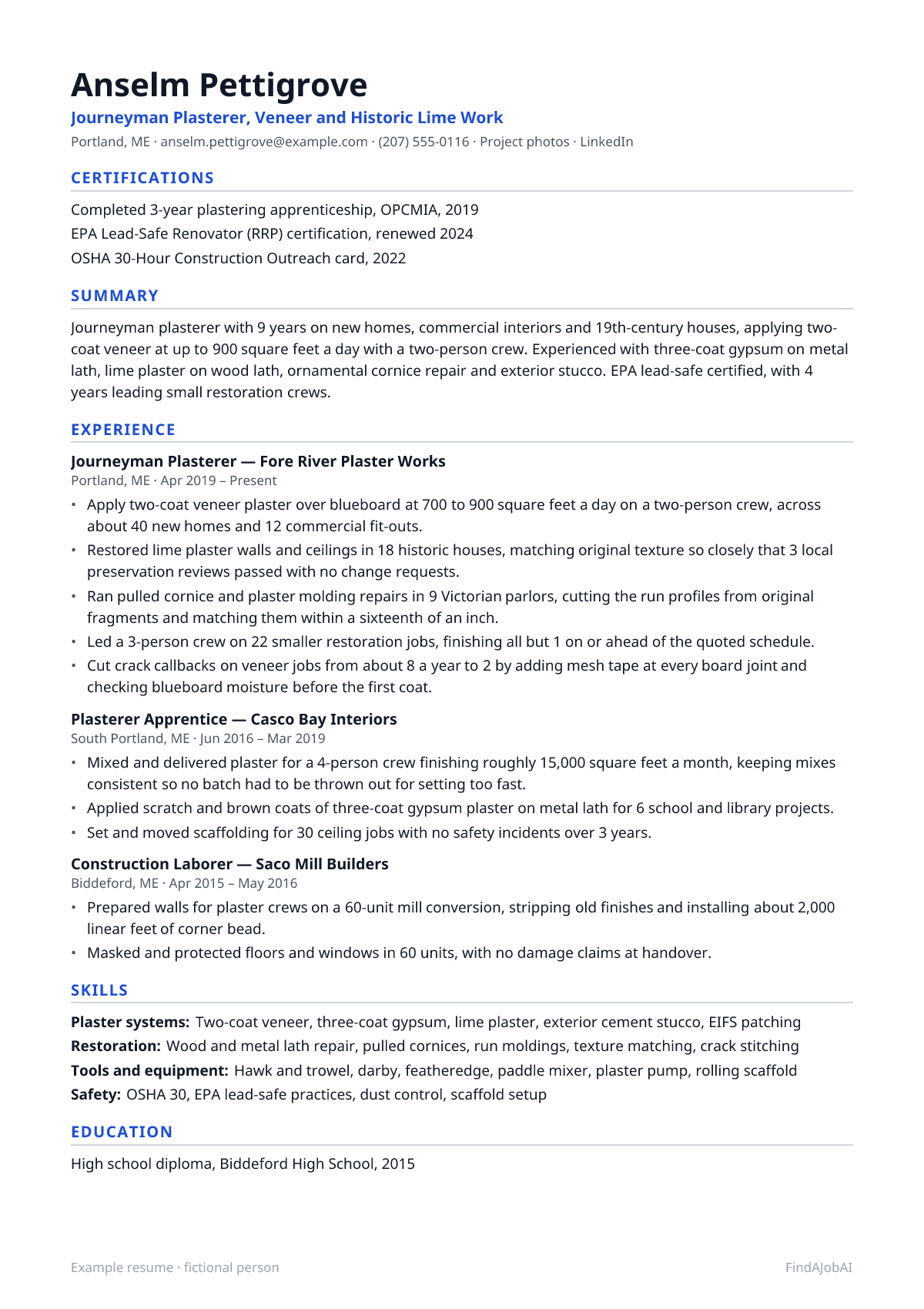
This example as a one-page template: one column, standard headings and plain text, the format applicant tracking systems read most reliably.
After you sign up, Create my CV builds your own resume in this same one-column layout, from your real experience.
Mid-level plasterer resume example
A complete one-page example for a fictional plasterer: every bullet pairs an action with what changed because of it.
Example resume · fictional person
Anselm Pettigrove
Journeyman Plasterer, Veneer and Historic Lime Work
Portland, ME · [email protected] · (207) 555-0116 · Project photos · LinkedIn
Certifications
- Completed 3-year plastering apprenticeship, OPCMIA, 2019
- EPA Lead-Safe Renovator (RRP) certification, renewed 2024
- OSHA 30-Hour Construction Outreach card, 2022
Summary
Journeyman plasterer with 9 years on new homes, commercial interiors and 19th-century houses, applying two-coat veneer at up to 900 square feet a day with a two-person crew. Experienced with three-coat gypsum on metal lath, lime plaster on wood lath, ornamental cornice repair and exterior stucco. EPA lead-safe certified, with 4 years leading small restoration crews.
Experience
Journeyman Plasterer, Fore River Plaster Works
Portland, ME · Apr 2019 – Present
- Apply two-coat veneer plaster over blueboard at 700 to 900 square feet a day on a two-person crew, across about 40 new homes and 12 commercial fit-outs.
- Restored lime plaster walls and ceilings in 18 historic houses, matching original texture so closely that 3 local preservation reviews passed with no change requests.
- Ran pulled cornice and plaster molding repairs in 9 Victorian parlors, cutting the run profiles from original fragments and matching them within a sixteenth of an inch.
- Led a 3-person crew on 22 smaller restoration jobs, finishing all but 1 on or ahead of the quoted schedule.
- Cut crack callbacks on veneer jobs from about 8 a year to 2 by adding mesh tape at every board joint and checking blueboard moisture before the first coat.
Plasterer Apprentice, Casco Bay Interiors
South Portland, ME · Jun 2016 – Mar 2019
- Mixed and delivered plaster for a 4-person crew finishing roughly 15,000 square feet a month, keeping mixes consistent so no batch had to be thrown out for setting too fast.
- Applied scratch and brown coats of three-coat gypsum plaster on metal lath for 6 school and library projects.
- Set and moved scaffolding for 30 ceiling jobs with no safety incidents over 3 years.
Construction Laborer, Saco Mill Builders
Biddeford, ME · Apr 2015 – May 2016
- Prepared walls for plaster crews on a 60-unit mill conversion, stripping old finishes and installing about 2,000 linear feet of corner bead.
- Masked and protected floors and windows in 60 units, with no damage claims at handover.
Skills
- Plaster systems: Two-coat veneer, three-coat gypsum, lime plaster, exterior cement stucco, EIFS patching
- Restoration: Wood and metal lath repair, pulled cornices, run moldings, texture matching, crack stitching
- Tools and equipment: Hawk and trowel, darby, featheredge, paddle mixer, plaster pump, rolling scaffold
- Safety: OSHA 30, EPA lead-safe practices, dust control, scaffold setup
Education
- High school diploma, Biddeford High School, 2015
Fictional example by the FindAJobAI team: the person, employers and numbers are invented. Keep the structure; use your own work and numbers you can explain in an interview.
Entry-level plasterer resume example
A second-year apprentice who has mostly mixed material and applied base coats. The bullets show reliability, safety and the finish skills he is picking up, with each claim tied to a job size or a count.
Entry-level example resume · fictional person
Summary
Second-year plastering apprentice with 2,600 logged hours, mixing material and applying scratch and brown coats for a 5-person crew. OSHA 10 certified and trained in lead-safe prep for older homes. Steady on scaffolding, early to every job, and learning veneer finish coats.
Experience
Plastering Apprentice, Merrymeeting Plaster and Stucco
Brunswick, ME · Sep 2024 – Present
- Mix and deliver plaster for a 5-person crew finishing about 12,000 square feet a month, keeping pace without a stalled trowel all season.
- Applied scratch and brown coats on 8 three-coat jobs, including 2 college dormitory renovations.
- Set up dust containment and floor protection on 15 occupied homes, with no cleanup complaints from owners.
Stone Wall and Patio Laborer, Harpswell Grounds Co.
Harpswell, ME · May 2022 – Aug 2024
- Built 20 stone and mortar garden walls with a 3-person crew, learning mortar mixing and curing.
- Ran a plate compactor and mixer on 40 patio jobs with no equipment damage.
Skills
- Plastering: Mixing gypsum and lime plaster, scratch and brown coats, corner bead, basic veneer
- Site work: Scaffold setup, dust containment, floor and window protection
- Tools: Paddle mixer, hawk and trowel, darby, featheredge
Training
- OPCMIA plastering apprenticeship, year 2 of 3, 2,600 of 4,500 hours logged
- OSHA 10-Hour Construction Outreach card, 2024
- EPA Lead-Safe Renovator (RRP) course, 2025
Education
- High school diploma, Mt. Ararat High School, 2022
Senior plasterer resume example
A plastering foreman eighteen years in who estimates, schedules and trains as much as he trowels. The bullets cover crew size, job value, restoration specialties and the apprentices he has brought through.
Senior example resume · fictional person
Hollis Quennevais
Plastering Foreman, Restoration and Commercial
Rockland, ME · [email protected] · (207) 555-0122 · Project photos · LinkedIn
Summary
Plastering foreman with 18 years on historic restoration and commercial interiors, running crews of up to 8 and estimating jobs up to 30,000 square feet. Specializes in lime plaster, pulled cornices and texture matching for preservation work, and has trained 11 apprentices through the union program.
Experience
Plastering Foreman, Penobscot Bay Restoration
Rockland, ME · Mar 2016 – Present
- Run crews of 4 to 8 plasterers across about 15 jobs a year, from sea captains' houses to a 28,000-square-foot library wing.
- Estimate and schedule plaster scopes for the company, with finished costs landing within 5% of the estimate on 26 of the last 30 jobs.
- Led lime plaster restoration of a 1850s courthouse courtroom, rebuilding 140 linear feet of cornice that the state preservation office approved on first review.
- Trained 11 apprentices, 9 of whom completed the program and now work as journeymen in the region.
- Introduced moisture checks on all lath and masonry before coating, cutting winter-season cracking callbacks from 10 a year to 3.
Journeyman Plasterer, Knox County Plaster Co.
Thomaston, ME · May 2009 – Feb 2016
- Applied veneer and three-coat systems on about 120 homes and 10 commercial projects, averaging 800 square feet of veneer a day.
- Ran ornamental work for the company, producing 35 custom ceiling medallions and run moldings from shop-made templates.
- Patched and recoated exterior stucco on 25 waterfront buildings, matching color and texture without full-wall recoats.
Plastering Apprentice, Knox County Plaster Co.
Thomaston, ME · Jun 2006 – Apr 2009
- Completed a 3-year apprenticeship covering 6 plaster and stucco systems, with no lost-time injuries.
- Mixed and pumped plaster for crews finishing about 10,000 square feet a month.
Skills
- Plaster systems: Lime plaster, three-coat gypsum, veneer, cement stucco, ornamental casting
- Leadership: Estimating, crew scheduling, apprentice training, preservation submittals
- Safety: OSHA 30, EPA lead-safe renovator, fall protection, silica dust controls
Certifications
- EPA Lead-Safe Renovator (RRP), renewed 2024
- OSHA 30-Hour Construction, 2021
Education
- High school diploma, Rockland District High School, 2006
How to write a plasterer resume
Five steps, in the order a recruiter reads the page. The format around them stays plain for every job: one column, standard headings, newest role first.
Header: name, target title and links
Use "Plasterer" or "Journeyman Plasterer" in your headline and add the specialty you want work in, such as veneer, historic lime or stucco. Include a phone number you answer during the workday, since many contractors call rather than email.
Summary: what you do and your best proof
Give your years in the trade, the plaster systems you apply, your daily output on one system and your key certifications. One sentence about restoration or ornamental work sets you apart from general interior finishers.
Experience: newest first, a result in every bullet
Start each bullet with the system or task, add the job size in square feet, rooms or buildings, then the result: on schedule, no callbacks, inspection or preservation review passed. Contractors want to picture your pace and your finish.
Skills: grouped, in the ad's words
Group skills by plaster systems, restoration, tools and safety. List each system by name and leave out ones you have only watched others apply.
Education and certifications
List your apprenticeship with the program, years and hours, then OSHA, lead-safe and scaffold training. A high school diploma is enough; put trade training above it.
Skills to put on a plasterer resume
Hard skills are the tools and methods of the job; soft skills are how you work with people. Each comes with one way to prove it, because a skill named only in a list counts for little. Add the ones you really have.
Hard skills
- Veneer plaster
- Give the square feet you finish a day on blueboard and how many coats your usual system uses.
- Three-coat gypsum plaster
- Name the lath type you worked over and the projects where you applied scratch, brown and finish coats.
- Lime plaster
- Mention historic buildings you worked in and how you matched the original mix and texture.
- Exterior stucco
- State how many buildings you coated or patched and how the finish held up through winters.
- Ornamental work
- Count the cornices, medallions or moldings you ran or cast, and say whether you made the templates.
- Lath repair
- Describe how much loose plaster you re-secured or relathed and the method you used to save original material.
- Texture matching
- Name a patch you blended into an old wall and how the owner or inspector judged the result.
- Plaster mixing
- Mention the crew size you mixed for and how you kept set times consistent in heat or cold.
- Scaffold setup
- Give the number of ceiling or exterior jobs you set scaffolding on and your safety record on them.
- Lead-safe practices
- State your RRP certification and the number of pre-1978 homes you worked in with clean clearance tests.
Soft skills
- Crew coordination
- Describe how you scheduled coats around other trades and whether the job finished on time.
- Patience with detail
- Mention a slow, careful job such as cornice matching and the result it earned from the client.
- Physical stamina
- Note the long overhead ceiling days or high daily output you keep up through a full season.
- Client care
- Explain how you protected occupied homes from dust and kept owners informed during messy work.
- Training apprentices
- Count the apprentices or helpers you trained and the skills they can now handle alone.
- Reliability
- Mention attendance, early starts or a foreman who trusted you to open and close jobs.
- Problem solving
- Describe a cracked wall or failing finish you diagnosed and how you fixed the cause, not just the surface.
Plasterer resume bullet examples: weak vs strong
The same work, written two ways. The strong version names the tool, the scope and a result; the numbers are examples, yours must be real.
Weak: Plastered walls.
Strong: Applied two-coat veneer over blueboard in a 14-room colonial, finishing 5,200 square feet in 9 working days with a single helper.
Gives the system, the size of the job and the pace.
Weak: Did restoration work.
Strong: Repaired lime plaster ceilings in a 1880s church hall, re-securing about 300 square feet of loose plaster to lath with washers and adhesive instead of tearing it out.
Names the material, the technique and the scale of the repair.
Weak: Good finish quality.
Strong: Finished 12 gallery walls to a smooth trowel finish that passed the client's raking-light inspection with 2 touch-ups across the whole job.
Turns a vague quality claim into a measured inspection result.
Weak: Worked with stucco.
Strong: Applied three-coat cement stucco to 4 waterfront cottages, adding control joints every 144 square feet so none showed cracks after 2 winters.
Shows exterior skill and a result that held up over time.
Weak: Ran crews.
Strong: Ran a 4-person crew on a 30-unit apartment renovation, scheduling coats around the drywall and paint trades so the job closed 6 days early.
Proves leadership with crew size, coordination and schedule.
Weak: Stayed safe on the job.
Strong: Set up containment and HEPA cleanup on 25 pre-1978 homes under lead-safe rules, with every clearance test passing the first time.
Safety becomes a certification in use and a clean record.
15 more plasterer resume bullet examples
Grouped by area of the job, so you can find the ones closest to your work. Keep the shape (action, scope, result) and replace the invented numbers with your own.
Interior plaster and veneer
- Applied veneer plaster to curved stair walls in 6 custom homes, holding a consistent radius that the finish carpenters trimmed without shimming.
- Finished 3,800 square feet of ceilings in a medical office in 5 days, passing the general contractor's flatness check with no skim coat needed.
- Skim-coated 22 rooms of damaged older plaster, avoiding demolition and saving the owner about 3 weeks of schedule.
- Installed 1,500 linear feet of corner bead and casing bead on a school renovation with no rework at the punch walk.
Historic and ornamental work
- Ran 80 linear feet of pulled cornice in place for a Greek Revival house, cutting the profile knife from a surviving 6-inch fragment.
- Cast and installed 14 replacement ceiling medallions from silicone molds taken off the surviving originals.
- Stabilized about 450 square feet of sagging lime ceilings with plaster washers before patching, keeping the original decorative surface.
- Matched a horsehair lime plaster mix for a museum wall patch that conservators accepted after 2 sample panels.
Exterior stucco
- Applied three-coat stucco to 7 new homes, curing each coat on schedule so none showed shrinkage cracks after the first winter.
- Repaired water-damaged stucco on 12 commercial buildings, replacing failed flashing details with the carpenters before recoating.
- Added 40 control joints to a long retaining wall facade, ending a cracking pattern that had returned every spring.
Safety, crews and site coordination
- Worked 4 years without a recordable injury while spending most days on scaffolding or ladders.
- Set up silica dust controls with vacuum-equipped tools on 20 jobs, meeting the general contractor's air monitoring limits every time.
- Coordinated plaster schedules with electricians and painters on 15 jobs so no trade waited more than a day on the crew.
- Trained 4 helpers to mix and deliver plaster, letting the crew add a second trowel hand on larger jobs.
Plasterer resume summary examples
Two or three lines on what you do and your strongest proof. Start from the one closest to your level and use your own facts.
Plastering apprentice in my second year with an OPCMIA program, mixing material and applying base coats for a 5-person crew. Comfortable on scaffolding, with OSHA 10 and a careful approach to dust and lead-safe prep. Learning veneer finish coats and lath repair on historic jobs.
Plasterer with 6 years on commercial interiors and custom homes, applying veneer and three-coat systems and patching exterior stucco. Known for flat ceilings and clean corners that need no rework before paint, and for keeping a helper busy and safe all day.
Plastering foreman with 18 years on restoration and new construction, running crews of up to 8 and estimating jobs up to 30,000 square feet. Specializes in lime plaster, ornamental cornices and matching historic textures, and trains apprentices through a union program.
Common plasterer resume mistakes
Each one is easy to make and quick to fix before you apply.
Lumping plaster in with drywall
Contractors hiring a plasterer want veneer, three-coat, lime or stucco skills by name. Separate those from taping and hanging so the screen finds them.
No daily output figures
Square feet per day on veneer or base coats is the number a foreman uses to judge your pace. Give at least one honest figure with your crew size.
Hiding historic or ornamental work
Restoration jobs pay well and need proof. Name the building type, the technique and how the result was reviewed or approved.
Leaving lead-safe training off
Most older homes need RRP-certified workers. Put the certification and its renewal year where a reader will see it first.
ATS tips for a plasterer resume
Applicant tracking systems turn your file into text that recruiters search, mostly for the skills and titles in the ad. They rarely reject a resume on their own; one that parses badly or misses the ad's words just doesn't come up.
- Name each plaster system you can apply, such as veneer, three-coat gypsum, lime or stucco, because ads and screening software search for them separately.
- Give your daily output in square feet for at least one system so a foreman can compare you with the rest of the crew.
- Put restoration work in its own bullets with the age or style of the building; historic jobs are a specialty many contractors hire for.
- List lead-safe, OSHA and scaffold training near the top, since most interior plastering in older homes requires them.
- Add a link to project photos if you have them, especially close shots of cornices, curved walls or texture matching.
For the format itself, run the free ATS resume checklist.
Everything for Plasterers
- Plasterer cover letter examplesThree example letters and a short email version
- Plasterer interview questions30 questions with sample answers
- Plasterer job descriptionDuties, skills and requirements
- How to tailor your resume without lying
Other resume examples
Plasterer resume FAQ
What is the difference between a plasterer and a drywall finisher resume?
A drywall finisher tapes and muds joints on gypsum board, while a plasterer applies full coats of plaster over lath or blueboard and often does stucco and restoration. If you've done both, lead with the plaster systems and keep taping as a supporting skill.
Should a plasterer resume include an apprenticeship?
Yes. A completed apprenticeship, with the program and year, tells contractors you have trained on several systems under supervision. If you are still an apprentice, give your current year and the hours completed.
How do I show quality on a plasterer resume?
Use results a contractor recognizes: callbacks or cracks avoided, inspections passed, finishes approved under raking light, or preservation reviews passed without changes.
Do I need photos for a plastering job application?
They are not required, but a short photo link helps a lot for restoration and ornamental work, where finish quality is hard to describe in words.
How we built this page
The FindAJobAI team wrote the three example resumes, the bullets, the skills and the advice for plasterer roles. The people, employers and numbers in the examples are invented; the structure, the tools and the way each bullet is built are the parts to copy.
Once we track enough live plasterer job ads, this page also shows the skills they ask for most, counted the same way as our in-demand skills report.
Last reviewed on November 1, 2026.