Sound Engineer Resume Example (2026)
By FindAJobAI Team Updated How we built this page
Studio owners, venue managers and post supervisors read sound engineer resumes for reliability: how many sessions or shows you run, which consoles and DAWs you know cold, whether your deliveries pass spec and what credits you can point to. “Mixed audio for various projects” proves none of that.
The example below belongs to a sound engineer with six years across a recording studio and a mid-size music venue. Every bullet gives a count, a system, a spec or a credit, so a reader can see both the volume of work and the standard it met.
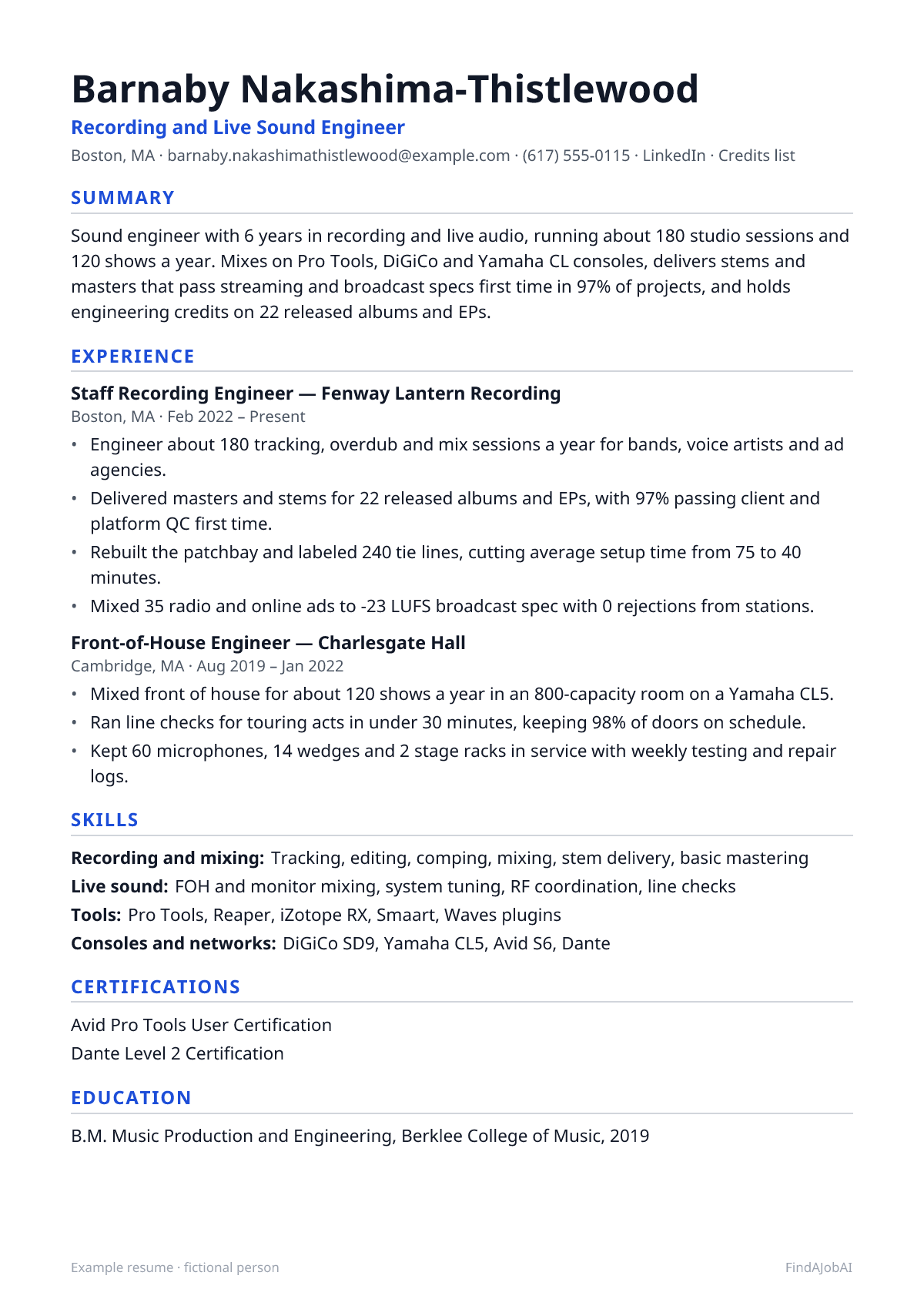
Sound Engineer resume template
This example as a one-page template: one column, standard headings and plain text, the format applicant tracking systems read most reliably.
After you sign up, Create my CV builds your own resume in this same one-column layout, from your real experience.
Mid-level sound engineer resume example
A complete one-page example for a fictional sound engineer: every bullet pairs an action with what changed because of it.
Example resume · fictional person
Barnaby Nakashima-Thistlewood
Recording and Live Sound Engineer
Boston, MA · [email protected] · (617) 555-0115 · LinkedIn · Credits list
Summary
Sound engineer with 6 years in recording and live audio, running about 180 studio sessions and 120 shows a year. Mixes on Pro Tools, DiGiCo and Yamaha CL consoles, delivers stems and masters that pass streaming and broadcast specs first time in 97% of projects, and holds engineering credits on 22 released albums and EPs.
Experience
Staff Recording Engineer, Fenway Lantern Recording
Boston, MA · Feb 2022 – Present
- Engineer about 180 tracking, overdub and mix sessions a year for bands, voice artists and ad agencies.
- Delivered masters and stems for 22 released albums and EPs, with 97% passing client and platform QC first time.
- Rebuilt the patchbay and labeled 240 tie lines, cutting average setup time from 75 to 40 minutes.
- Mixed 35 radio and online ads to -23 LUFS broadcast spec with 0 rejections from stations.
Front-of-House Engineer, Charlesgate Hall
Cambridge, MA · Aug 2019 – Jan 2022
- Mixed front of house for about 120 shows a year in an 800-capacity room on a Yamaha CL5.
- Ran line checks for touring acts in under 30 minutes, keeping 98% of doors on schedule.
- Kept 60 microphones, 14 wedges and 2 stage racks in service with weekly testing and repair logs.
Skills
- Recording and mixing: Tracking, editing, comping, mixing, stem delivery, basic mastering
- Live sound: FOH and monitor mixing, system tuning, RF coordination, line checks
- Tools: Pro Tools, Reaper, iZotope RX, Smaart, Waves plugins
- Consoles and networks: DiGiCo SD9, Yamaha CL5, Avid S6, Dante
Certifications
- Avid Pro Tools User Certification
- Dante Level 2 Certification
Education
- B.M. Music Production and Engineering, Berklee College of Music, 2019
Fictional example by the FindAJobAI team: the person, employers and numbers are invented. Keep the structure; use your own work and numbers you can explain in an interview.
Entry-level sound engineer resume example
A new graduate whose internship hours and assistant credits carry the page. Education comes first, and each bullet gives counts of sessions or shows and the gear used.
Entry-level example resume · fictional person
Seraphina Delacroix-Ferrante
Assistant Sound Engineer
Worcester, MA · [email protected] · (617) 555-0117 · LinkedIn · Portfolio
Summary
Entry-level sound engineer with an audio engineering certificate, 800 internship hours across a studio and a club, and 4 released credits as assistant engineer. Comfortable with Pro Tools editing, mic setup, stage patching and line checks, and ready for an assistant role.
Education
- Certificate in Audio Engineering, Pioneer Valley Audio Institute, 2025
Experience
Studio and Venue Intern, Blackstone Canal Sound
Worcester, MA · Sep 2024 – May 2025
- Assisted on 70 tracking and mix sessions, setting up mics and keeping track sheets current.
- Edited drums and vocals for 4 released singles, credited as assistant engineer.
- Patched stages and ran line checks for 35 club shows with 0 dead channels at doors.
Skills
- Studio: Pro Tools editing, mic placement, track sheets, session backups
- Live: Stage patching, line checks, basic FOH mixing on Yamaha TF
- Tools: Pro Tools, Reaper, iZotope RX
Audio school projects
- Recorded and mixed 6 student band projects as final coursework, each graded A.
- Courses: acoustics, signal flow, mixing, live sound reinforcement and audio for media.
Senior sound engineer resume example
A chief engineer who runs a studio team. The bullets move from running sessions to running facilities: team leadership, system design, budgets and high-profile mixes.
Senior example resume · fictional person
Evander Kowalczyk-Adeyinka
Chief Engineer
Boston, MA · [email protected] · (617) 555-0119 · LinkedIn · Credits list
Summary
Chief engineer with 14 years in recording, broadcast and touring audio, leading 5 engineers across 3 studios. Designed a 120-channel Dante network, managed $380,000 of upgrades and mixed 2 award-nominated records for independent labels.
Experience
Chief Engineer, Back Bay Ferrous Studios
Boston, MA · Mar 2018 – Present
- Lead 5 staff engineers across 3 rooms running about 700 sessions a year.
- Designed and installed a 120-channel Dante network, cutting changeover time between rooms by 60%.
- Managed $380,000 of console and monitoring upgrades, finishing within budget and 1 week early.
- Mixed 2 award-nominated albums and 40 other released records for independent labels.
Monitor Engineer, Touring, Copperline Touring Audio
Nashville, TN · Jan 2012 – Feb 2018
- Mixed monitors on 6 national tours, about 400 shows on DiGiCo and Midas consoles.
- Coordinated RF for up to 24 wireless channels per show with 0 dropouts on 3 tours.
- Trained 4 local crew members per tour leg on stage patching and in-ear setup.
Skills
- Leadership: Team scheduling, training, client management, budgets
- Systems: Dante, MADI, studio wiring, monitoring calibration, Atmos rooms
- Mixing: Album mixing, broadcast mixing, Dolby Atmos, stem delivery
- Consoles: SSL 4000, Avid S6, DiGiCo SD7, Midas Pro
Certifications
- Dante Level 3 Certification
- Dolby Atmos Music Mixing Certificate
Education
- B.S. Music Technology, Middle Tennessee State University, 2011
How to write a sound engineer resume
Five steps, in the order a recruiter reads the page. The format around them stays plain for every job: one column, standard headings, newest role first.
Header: name, target title and links
Use “Sound Engineer” with your focus, such as “Recording Engineer” or “Live Sound Engineer”, to match the ad. Add your city, LinkedIn and a link to your credits or reel.
Summary: what you do and your best proof
Open with your setting and years, then your yearly sessions or shows. Name your main consoles and DAWs and one quality result, such as specs passed or credits released.
Experience: newest first, a result in every bullet
Write each bullet as count, task and result: sessions run, shows mixed, specs met or setup time saved. “Mixed audio” alone hides both your pace and your standard.
Skills: grouped, in the ad's words
Group skills into recording, live, tools and consoles. Name exact models and versions you can run without help, and leave out gear you have only seen once.
Education and certifications
List any audio degree or certificate with the year, then certifications such as Pro Tools or Dante. Experience and credits matter more, so keep this short.
Skills to put on a sound engineer resume
Hard skills are the tools and methods of the job; soft skills are how you work with people. Each comes with one way to prove it, because a skill named only in a list counts for little. Add the ones you really have.
Hard skills
- Signal flow
- Describe a system you patched or redesigned and the time it saved.
- Microphone technique
- Name the sources you record and mics you choose for them.
- Mixing
- Give the number of mixes delivered and how they were released.
- Live console operation
- Name the consoles and the number of shows a year.
- Loudness standards
- Mention the specs you deliver to and your pass rate.
- Audio restoration
- Name the tools and the hours of audio you rescued.
- Audio networking
- Give the channel count and the protocol, such as Dante.
- RF coordination
- Say how many wireless channels you manage per show.
- System tuning
- Mention measurement tools such as Smaart and the rooms you tuned.
- Session management
- Show how you keep files, backups and track sheets organized.
- Equipment maintenance
- Give the gear count and any drop in faults.
Soft skills
- Calm under pressure
- Describe a fault you fixed during a live show or session.
- Communication
- Mention translating an artist's or director's request into a setting.
- Time management
- Show sessions or changeovers you kept on schedule.
- Critical listening
- Give an example of a problem you heard that others missed.
- Teamwork
- Describe working with stage crew, lighting or video teams.
- Looking after clients
- Mention repeat clients or bookings from referrals.
- Adaptability
- Describe a venue or room that forced a different approach.
Sound Engineer resume bullet examples: weak vs strong
The same work, written two ways. The strong version names the tool, the scope and a result; the numbers are examples, yours must be real.
Weak: Recorded bands.
Strong: Tracked 40 full-band sessions in a year, keeping each day on schedule with prepared input lists and templates.
Gives volume and shows preparation.
Weak: Did live sound.
Strong: Mixed monitors for 90 shows a year, running up to 12 in-ear mixes on a DiGiCo SD9.
Names the console and the complexity.
Weak: Mixed audio for videos.
Strong: Mixed and delivered 60 corporate videos to -16 LUFS online spec, with 0 returns for audio issues.
Adds a delivery spec and a quality result.
Weak: Fixed noisy recordings.
Strong: Cleaned up 25 hours of interview audio with iZotope RX, saving 4 scheduled re-records.
Shows the tool and what the fix saved.
Weak: Looked after studio gear.
Strong: Ran monthly maintenance on 80 cables, 30 microphones and 2 consoles, cutting session faults by about half.
Turns maintenance into a measured outcome.
Weak: Worked with artists.
Strong: Produced and engineered 3 EPs for local artists, each released on streaming services within 6 weeks.
Shows ownership and finished credits.
15 more sound engineer resume bullet examples
Grouped by area of the job, so you can find the ones closest to your work. Keep the shape (action, scope, result) and replace the invented numbers with your own.
Recording and mixing
- Tracked 25 choirs and orchestras on location with up to 32 microphones.
- Mixed 50 singles for independent artists, each delivered within 5 working days.
- Edited and comped vocals for 12 albums using Pro Tools playlists.
- Recorded 300 hours of audiobook narration to publisher specs with 99% acceptance.
Live and broadcast
- Mixed 70 corporate events a year for audiences of up to 2,000 people.
- Ran broadcast audio for 45 live-streamed concerts with 0 dropped feeds.
- Tuned PA systems in 9 venues using Smaart measurements.
- Managed 16 wireless microphones per event with clean RF on every show.
Film and TV post
- Mixed 30 short films to festival delivery specs, all accepted first time.
- Recorded and edited foley for 8 documentaries.
- Delivered 5.1 and stereo stems for 14 TV episodes to network QC standards.
- Cleaned dialogue for 20 podcast episodes a month with iZotope RX.
Gear and team
- Built a cable and microphone tracking sheet covering 150 items, cutting losses to 0 in a year.
- Trained 6 interns on signal flow, line checks and session backups.
- Cut studio setup time by 30% with standard session templates.
Sound Engineer resume summary examples
Two or three lines on what you do and your strongest proof. Start from the one closest to your level and use your own facts.
Entry-level sound engineer with an audio engineering certificate, 800 hours of studio and venue internship and 4 released credits as assistant engineer. Confident with signal flow, Pro Tools editing, mic placement and stage patching, and ready for an assistant or junior engineer role.
Sound engineer with 6 years in studio and live audio, running 180 sessions and 120 shows a year. Mixes on Pro Tools and DiGiCo, delivers to spec first time and holds 22 album and EP credits.
Chief engineer with 14 years in recording, broadcast and touring audio, leading a team of 5 engineers across 3 studios. Designed a Dante network for 120 channels, oversaw $380,000 of equipment upgrades and mixed 2 award-nominated records for independent labels.
Common sound engineer resume mistakes
Each one is easy to make and quick to fix before you apply.
Listing gear you cannot run
A long gear list invites hard questions. Name only consoles and tools you could run on a live show tomorrow.
No credits or portfolio
Employers want to hear your work. Link a credits list or short reel and say what you did on each project.
Ignoring delivery specs
Broadcasters and labels reject files that miss spec. Mention loudness targets and your first-time pass rate.
Hiding live problem solving
Shows rarely go perfectly. Give one figure that shows you keep events running, such as doors on time or zero dropouts.
ATS tips for a sound engineer resume
Applicant tracking systems turn your file into text that recruiters search, mostly for the skills and titles in the ad. They rarely reject a resume on their own; one that parses badly or misses the ad's words just doesn't come up.
- Give session, show or project counts per year so readers can judge your pace.
- Name the consoles, DAWs and networks you can run without help.
- Mention delivery specs such as LUFS targets and how often you pass QC first time.
- Link a credits list or portfolio and name a few released projects.
- Show equipment care, since reliable gear protects sessions and shows.
For the format itself, run the free ATS resume checklist.
Everything for Sound Engineers
- Sound Engineer cover letter examplesThree example letters and a short email version
- Sound Engineer interview questions30 questions with sample answers
- Sound Engineer job descriptionDuties, skills and requirements
- How to tailor your resume without lying
Other resume examples
Sound Engineer resume FAQ
What should a sound engineer resume include?
Your settings (studio, live, broadcast or post), session or show counts, consoles and DAWs, delivery specs you meet, credits and certifications. A link to a credits list or portfolio is expected.
Should I include a portfolio link on a sound engineer resume?
Yes. Link a short reel or credits list near your contact details. Keep it to a few strong examples and say what you did on each, such as tracking, mixing or live sound.
How do I write a sound engineer resume with no experience?
Lead with your training, internship hours and any assistant credits. Give numbers for sessions or shows you helped with and name the gear you used, including student, church or community events.
How we built this page
The FindAJobAI team wrote the three example resumes, the bullets, the skills and the advice for sound engineer roles. The people, employers and numbers in the examples are invented; the structure, the tools and the way each bullet is built are the parts to copy.
Once we track enough live sound engineer job ads, this page also shows the skills they ask for most, counted the same way as our in-demand skills report.
Last reviewed on November 1, 2026.