Surgeon Resume Example (2026)
By FindAJobAI Team Updated How we built this page
Surgeon resumes land on the desk of a department chair, a hospital physician recruiter or a credentialing committee. All of them assume you finished residency. What they want to see is the shape of your practice: how many operations you do a year, which procedures make up most of that number, how much is laparoscopic or robotic, what your call commitment looks like and how your outcomes compare with the benchmarks the hospital reports.
The example below is a board-certified general surgeon eight years out of training, working at a community teaching hospital with an acute care surgery service. Each bullet names a procedure group, a count and a result, so a reader can picture a week in that operating room.
Surgeon resume template
This example as a one-page template: one column, standard headings and plain text, the format applicant tracking systems read most reliably.
After you sign up, Create my CV builds your own resume in this same one-column layout, from your real experience.
Mid-level surgeon resume example
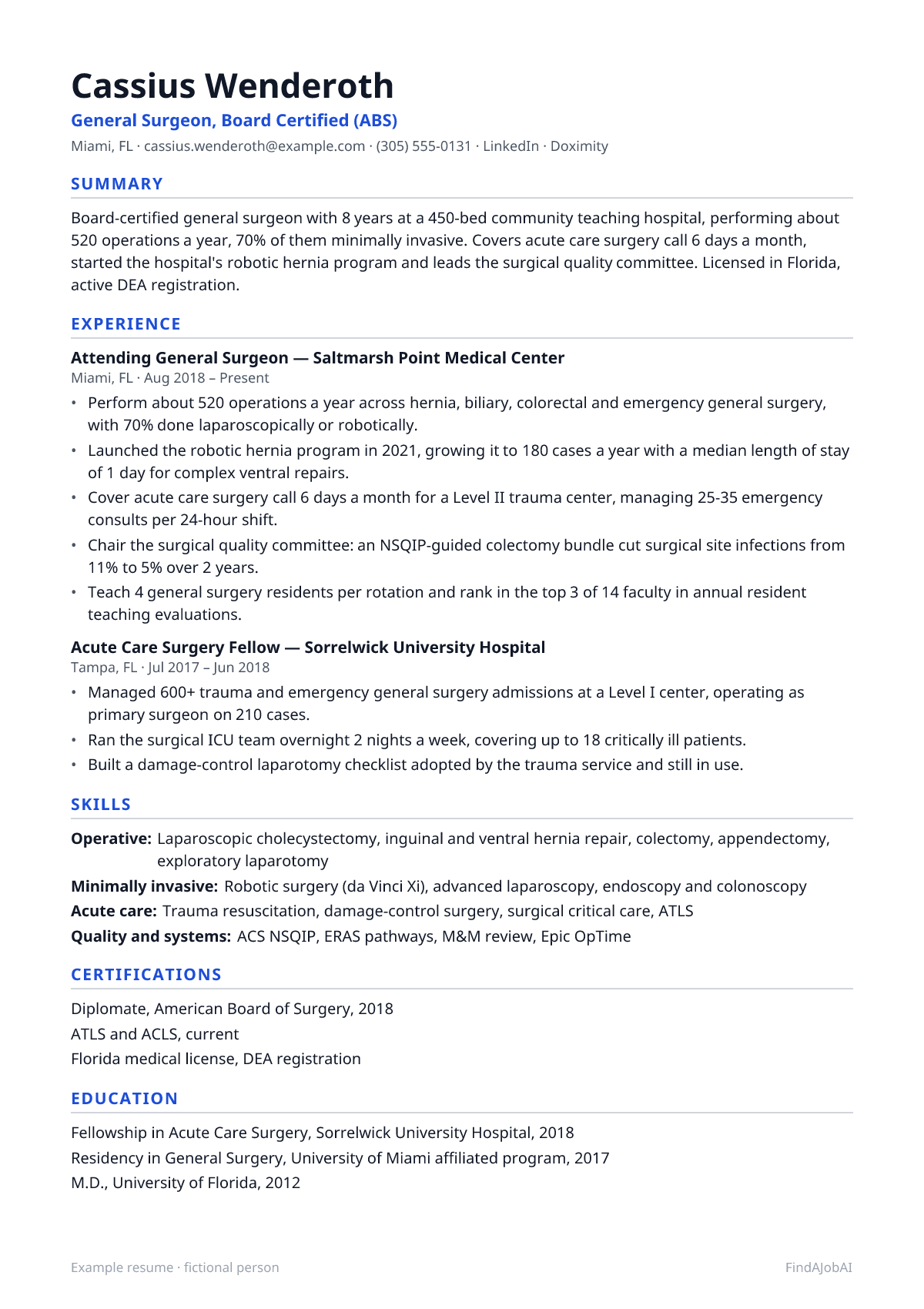
A complete one-page example for a fictional surgeon: every bullet pairs an action with what changed because of it.
Example resume · fictional person
Cassius Wenderoth
General Surgeon, Board Certified (ABS)
Miami, FL · [email protected] · (305) 555-0131 · LinkedIn · Doximity
Summary
Board-certified general surgeon with 8 years at a 450-bed community teaching hospital, performing about 520 operations a year, 70% of them minimally invasive. Covers acute care surgery call 6 days a month, started the hospital's robotic hernia program and leads the surgical quality committee. Licensed in Florida, active DEA registration.
Experience
Attending General Surgeon, Saltmarsh Point Medical Center
Miami, FL · Aug 2018 – Present
- Perform about 520 operations a year across hernia, biliary, colorectal and emergency general surgery, with 70% done laparoscopically or robotically.
- Launched the robotic hernia program in 2021, growing it to 180 cases a year with a median length of stay of 1 day for complex ventral repairs.
- Cover acute care surgery call 6 days a month for a Level II trauma center, managing 25-35 emergency consults per 24-hour shift.
- Chair the surgical quality committee: an NSQIP-guided colectomy bundle cut surgical site infections from 11% to 5% over 2 years.
- Teach 4 general surgery residents per rotation and rank in the top 3 of 14 faculty in annual resident teaching evaluations.
Acute Care Surgery Fellow, Sorrelwick University Hospital
Tampa, FL · Jul 2017 – Jun 2018
- Managed 600+ trauma and emergency general surgery admissions at a Level I center, operating as primary surgeon on 210 cases.
- Ran the surgical ICU team overnight 2 nights a week, covering up to 18 critically ill patients.
- Built a damage-control laparotomy checklist adopted by the trauma service and still in use.
Skills
- Operative: Laparoscopic cholecystectomy, inguinal and ventral hernia repair, colectomy, appendectomy, exploratory laparotomy
- Minimally invasive: Robotic surgery (da Vinci Xi), advanced laparoscopy, endoscopy and colonoscopy
- Acute care: Trauma resuscitation, damage-control surgery, surgical critical care, ATLS
- Quality and systems: ACS NSQIP, ERAS pathways, M&M review, Epic OpTime
Certifications
- Diplomate, American Board of Surgery, 2018
- ATLS and ACLS, current
- Florida medical license, DEA registration
Education
- Fellowship in Acute Care Surgery, Sorrelwick University Hospital, 2018
- Residency in General Surgery, University of Miami affiliated program, 2017
- M.D., University of Florida, 2012
Fictional example by the FindAJobAI team: the person, employers and numbers are invented. Keep the structure; use your own work and numbers you can explain in an interview.
Entry-level surgeon resume example
A chief resident applying for a first attending job. Training sits at the top because it is the main credential, and the bullets count cases by procedure instead of listing rotations.
Entry-level example resume · fictional person
Philippa Draskovich
Chief Resident, General Surgery, Board Eligible 2026
Columbus, OH · [email protected] · (305) 555-0133 · LinkedIn
Summary
Final-year general surgery resident with 1,050 logged major cases, including 160 laparoscopic cholecystectomies, 120 hernia repairs and 85 colectomies. Comfortable running an acute care service overnight. Seeking a first attending role with emergency general surgery call from August 2026.
Education
- Residency in General Surgery, Olentangy Valley University Hospital, 2026 (expected)
- M.D., Ohio State University College of Medicine, 2021
Experience
General Surgery Resident (PGY-1 to PGY-5), Olentangy Valley University Hospital
Columbus, OH · Jul 2021 – Jun 2026
- Logged 1,050 major cases as surgeon or surgeon chief, 62% of them laparoscopic or robotic.
- Ran the night acute care service as senior resident, triaging 20-30 consults per shift with 1 attending on call from home.
- Completed 140 endoscopies and 60 colonoscopies, meeting the ABS flexible endoscopy requirement in PGY-3.
- Presented 3 quality projects at regional ACS meetings, including a bile leak review of 410 cholecystectomies.
Administrative Chief Resident, Olentangy Valley University Hospital
Columbus, OH · Jul 2025 – Jun 2026
- Built the rotation and call schedule for 32 residents across 5 hospitals, keeping duty hour violations at 0 for the year.
- Started a weekly skills lab that raised the program's average FLS pass rate on the first attempt from 81% to 94%.
Skills
- Operative: Cholecystectomy, hernia repair, colectomy, appendectomy, small bowel resection
- Minimally invasive: Advanced laparoscopy, robotic console training, flexible endoscopy
- Acute care: Trauma resuscitation, surgical ICU management, ATLS
Certifications
- ABS Qualifying Exam, scheduled 2026
- FLS and FES certified
- ATLS, ACLS, current
Senior surgeon resume example
A chief of surgery whose resume reads like a department leader's: surgeon headcount, sites, block time, budget and programs built. Personal case volume moves lower and leadership bullets carry the numbers.
Senior example resume · fictional person
Aurelio Brandvold
Chief of Surgery, Hepatobiliary Surgeon
Denver, CO · [email protected] · (305) 555-0135 · LinkedIn · Doximity
Summary
Chief of surgery with 19 years of practice, leading 26 surgeons across general, vascular, thoracic and breast surgery at 2 hospitals. Owns the department budget, block time allocation and quality program, and still operates 2 days a week in hepatobiliary and pancreatic surgery.
Experience
Chief of Surgery, Coldwater Bend Health System
Denver, CO · Jan 2017 – Present
- Lead 26 surgeons and 14 advanced practice providers performing about 14,000 operations a year across 2 hospitals.
- Rebuilt block time allocation around utilization data, lifting OR use from 68% to 81% and opening 2 extra robotic days a week.
- Recruited 9 surgeons in 6 years, including the system's first fellowship-trained surgical oncologist.
- Introduced a monthly department outcomes review covering 10 NSQIP measures, moving the system from the 4th to the 2nd decile for morbidity.
Hepatobiliary and Pancreatic Surgeon, Coldwater Bend Health System
Denver, CO · Aug 2007 – Dec 2016
- Performed 60+ Whipple procedures and 90 liver resections a year as the system's main HPB referral surgeon.
- Set up a multidisciplinary pancreas tumor board that reviewed 300 cases a year with oncology and radiology.
- Trained 11 general surgery residents in open and laparoscopic liver surgery during dedicated HPB rotations.
Skills
- Leadership: Department operations, block time management, physician recruiting, budget ownership
- Clinical: Pancreaticoduodenectomy, liver resection, complex biliary reconstruction, robotic HPB surgery
- Quality: NSQIP reporting, peer review, M&M conference, Joint Commission surveys
Certifications
- Diplomate, American Board of Surgery, 2007
- Fellow, American College of Surgeons (FACS)
Education
- Fellowship in Hepatopancreatobiliary Surgery, University of Toronto, 2007
- Residency in General Surgery, Mayo Clinic, 2006
- M.D., University of Colorado, 2001
How to write a surgeon resume
Five steps, in the order a recruiter reads the page. The format around them stays plain for every job: one column, standard headings, newest role first.
Header: name, target title and links
Use "General Surgeon" or your exact specialty, such as "Colorectal Surgeon", and add board status, state licenses and DEA registration under your name.
Summary: what you do and your best proof
Name your setting, annual operative volume, main case mix, minimally invasive share and call commitment. Add one measured result from a program, pathway or committee you led.
Experience: newest first, a result in every bullet
Start each bullet with a procedure group or service, then give the count and the result. Pull numbers from your case log and quality reports rather than estimating outcomes you never measured.
Skills: grouped, in the ad's words
Group skills by operative areas, minimally invasive techniques, acute care and quality. Name the robotic platform and the documentation system you use every day.
Education and certifications
List fellowship, residency and medical school with years, then board certification and licenses. Residents put training first and add milestones like the ABS qualifying exam, FLS and FES.
Skills to put on a surgeon resume
Hard skills are the tools and methods of the job; soft skills are how you work with people. Each comes with one way to prove it, because a skill named only in a list counts for little. Add the ones you really have.
Hard skills
- General surgery
- Give your annual operative volume and the 3 or 4 procedures that make up most of it.
- Laparoscopic surgery
- State the share of your cases done laparoscopically and name the advanced procedures you perform.
- Robotic surgery
- Count your robotic cases, name the platform and list the procedure types.
- Emergency general surgery
- Give call days per month, consult volume per shift and the trauma level of the center.
- Trauma surgery
- Count trauma activations or operative trauma cases and mention ATLS status.
- Colorectal surgery
- Name colectomy volume, anastomotic leak rate and any ERAS pathway you use.
- Hernia surgery
- Separate inguinal and complex ventral repairs and give recurrence data if you track it.
- Endoscopy
- Count endoscopies and colonoscopies a year and note FES certification.
- Surgical critical care
- Mention ICU coverage, ventilator management and the number of beds you cover.
- Perioperative assessment
- Describe how you assess frail or high-risk patients and a tool you use to decide on surgery.
- Outcomes tracking
- Name NSQIP or registry measures and one result you moved with a date range.
- Surgical documentation
- Name the system (Epic OpTime, Cerner SurgiNet) and any template or order set you built.
Soft skills
- Operating decisions under pressure
- Describe an emergency where you chose between operating now, waiting or transferring.
- Consent conversations
- Mention how you explain risks and alternatives in consent conversations with frightened families.
- Team leadership in the OR
- Give an example of running a time-out or a crisis with nurses, anesthesia and techs.
- Teaching
- Count the residents or students you supervise and the skills you teach.
- Honesty after complications
- Point to how you disclose complications and bring them to M&M.
- Collaboration across specialties
- Name a tumor board, trauma team or shared pathway you work in.
- Stamina and self-care
- Show how you manage long call stretches safely, such as handoff habits or post-call rules.
Surgeon resume bullet examples: weak vs strong
The same work, written two ways. The strong version names the tool, the scope and a result; the numbers are examples, yours must be real.
Weak: Performed general surgery procedures.
Strong: Operated as primary surgeon on 480-550 cases a year, led by cholecystectomy, hernia repair and colectomy, with a 30-day readmission rate of 4.2%.
Gives yearly volume, the procedures that drive it and an outcome a chair tracks.
Weak: Experienced in robotic surgery.
Strong: Completed 400+ robotic cases since 2020, mainly ventral hernia and right colectomy, with a conversion-to-open rate under 2%.
Turns a vague skill into a case count, a case type and a safety measure.
Weak: Took trauma call.
Strong: Covered in-house trauma call 5 nights a month at a Level II center, averaging 3 operative emergencies per shift.
Shows call load and acuity, which recruiters need for scheduling.
Weak: Worked on quality improvement.
Strong: Led an ERAS pathway for elective colectomy that cut median length of stay from 6 days to 4 within 12 months.
Names the pathway, the before and after, and the time it took.
Weak: Supervised residents.
Strong: Supervised 3-5 residents per rotation and gave 8 skills-lab sessions a year on laparoscopic suturing.
Makes teaching concrete with counts and a specific skill.
Weak: Good surgical outcomes.
Strong: Kept a surgical site infection rate of 2.1% on clean-contaminated cases over 3 years, below the hospital NSQIP benchmark.
Replaces a claim with a measured outcome and a benchmark.
Weak: Helped build up the clinic.
Strong: Added a Saturday hernia clinic that raised new patient visits from 40 to 65 a month and cut wait time for consults to 9 days.
Shows business impact with numbers a practice manager understands.
15 more surgeon resume bullet examples
Grouped by area of the job, so you can find the ones closest to your work. Keep the shape (action, scope, result) and replace the invented numbers with your own.
Operative volume and case mix
- Performed 300+ laparoscopic cholecystectomies a year with a bile duct injury rate of 0 over 5 years.
- Completed 150 open and robotic ventral hernia repairs a year, with a 2-year recurrence rate of 3%.
- Operated on 95 elective and emergency colectomies a year, including 30 robotic right colectomies.
- Took 5 days of emergency general surgery call a month at a 300-bed hospital with no in-house residents.
Outcomes and patient safety
- Cut 30-day readmissions after colectomy from 14% to 8% with a discharge nurse call at 48 hours.
- Added a critical view of safety photo to every cholecystectomy record, reviewed at 12 monthly audits.
- Reduced retained surgical item near misses to 0 for 2 years after leading a count policy rewrite for 18 ORs.
- Lowered postoperative opioid prescribing by 40% with a procedure-specific prescribing guide for 9 surgeons.
Program building and OR efficiency
- Started a robotic surgery program that reached 350 cases a year across 4 specialties within 3 years.
- Cut average room turnover from 38 to 27 minutes by agreeing a parallel setup routine with nursing.
- Opened an outpatient hernia center that moved 60% of inguinal repairs to same-day discharge.
- Shortened time from ED consult to OR for appendicitis from 9 hours to 5 by adding an acute care block.
Teaching, mentoring and committees
- Directed the residency skills curriculum for 30 residents, adding 12 simulation sessions a year.
- Served 4 years on the hospital credentials committee, reviewing 70 privilege requests a year.
- Mentored 6 junior attendings through their first year of independent call.
Surgeon resume summary examples
Two or three lines on what you do and your strongest proof. Start from the one closest to your level and use your own facts.
Chief resident in general surgery finishing a 5-year program in June, with 1,050 logged major cases, including 160 laparoscopic cholecystectomies, 120 hernia repairs and 85 colectomies. Board eligible, ATLS certified, seeking a first attending role with acute care call.
General surgeon with 8 years at a community teaching hospital, performing about 520 operations a year, 70% minimally invasive. Started a robotic hernia program, covers acute care call and chairs the surgical quality committee.
Chief of surgery with 19 years of practice, leading 26 surgeons across 4 specialties at 2 hospitals. Owns the surgical budget, block time allocation and quality program, and still operates 2 days a week in hepatobiliary surgery.
Common surgeon resume mistakes
Each one is easy to make and quick to fix before you apply.
Listing every operation you can do
Give total volume and the few procedures that make up most of it, so the reader sees your real practice instead of a long menu.
Leaving out call
State call days per month and the trauma level, because many hospitals hire surgeons mainly to fill an acute care schedule.
No outcome data at all
Add one or two verified outcomes such as infection, readmission or conversion rates, with the source and the time period.
Hiding board status
Put diplomate or board-eligible status and each active license right under your name, where credentialing staff look first.
Robotic training without cases
Count the robotic cases you have done as primary console surgeon, or say plainly that you completed training and are building volume.
ATS tips for a surgeon resume
Applicant tracking systems turn your file into text that recruiters search, mostly for the skills and titles in the ad. They rarely reject a resume on their own; one that parses badly or misses the ad's words just doesn't come up.
- Put board status (diplomate or board eligible) and every active state license near your name, since credentialing staff check them before anything else.
- Give annual operative volume and the 3 or 4 procedures that make up most of it, rather than a long list of every operation you can perform.
- State your minimally invasive share and robotic case count, because many hospitals recruit specifically to grow those programs.
- Describe your call commitment in days per month and the trauma level of the center, so a recruiter can match you to their schedule.
- Use NSQIP or registry outcomes you can verify, such as infection or readmission rates, and name the time frame they cover.
For the format itself, run the free ATS resume checklist.
Everything for Surgeons
- Surgeon cover letter examplesThree example letters and a short email version
- Surgeon interview questions30 questions with sample answers
- Surgeon job descriptionDuties, skills and requirements
- How to tailor your resume without lying
Other resume examples
Surgeon resume FAQ
What should a surgeon put at the top of a resume?
Board certification or eligibility, state medical licenses and DEA registration, then a short summary with operative volume, main case mix, minimally invasive share and call coverage.
Should a surgeon resume include case logs?
Summarize them. Give total major cases and counts for the procedures that matter for the job, and keep the full ACGME or hospital case log for credentialing.
How long should a surgeon resume be?
Two pages is normal for practicing surgeons. Academic surgeons often keep a separate CV with publications, grants and presentations for faculty applications.
Can I list surgical outcomes on a resume?
Yes, if they come from a registry or hospital dashboard you can back up, such as NSQIP infection rates, readmissions or conversion rates, with the period they cover.
How we built this page
The FindAJobAI team wrote the three example resumes, the bullets, the skills and the advice for surgeon roles. The people, employers and numbers in the examples are invented; the structure, the tools and the way each bullet is built are the parts to copy.
Once we track enough live surgeon job ads, this page also shows the skills they ask for most, counted the same way as our in-demand skills report.
Last reviewed on November 1, 2026.