Surgeon Cover Letter Example (2026)
By FindAJobAI Team Updated How we built this page
Surgery departments read a cover letter to find out what you are like at two in the morning with a sick abdomen and a full board. Your boards, case log and training already sit on the CV. Use the letter to show the practice you want to build, the call you will take and one decision in or near the operating room that shows how you think.
Surgeon cover letter template
This letter as a one-page template: an opening that names the job and your strongest fact, proof that answers the ad, a reason for this employer and a short close.
After you sign up, FindAJobAI drafts your own letter for a real job from your CV in this format, and you edit it before you send it.
Example 1 · Experienced
General surgeon applying to a hospital growing its robotic program
Rosalind has seven years in a community hospital and wants a post with more robotic block time. The ad asks for acute care call too.
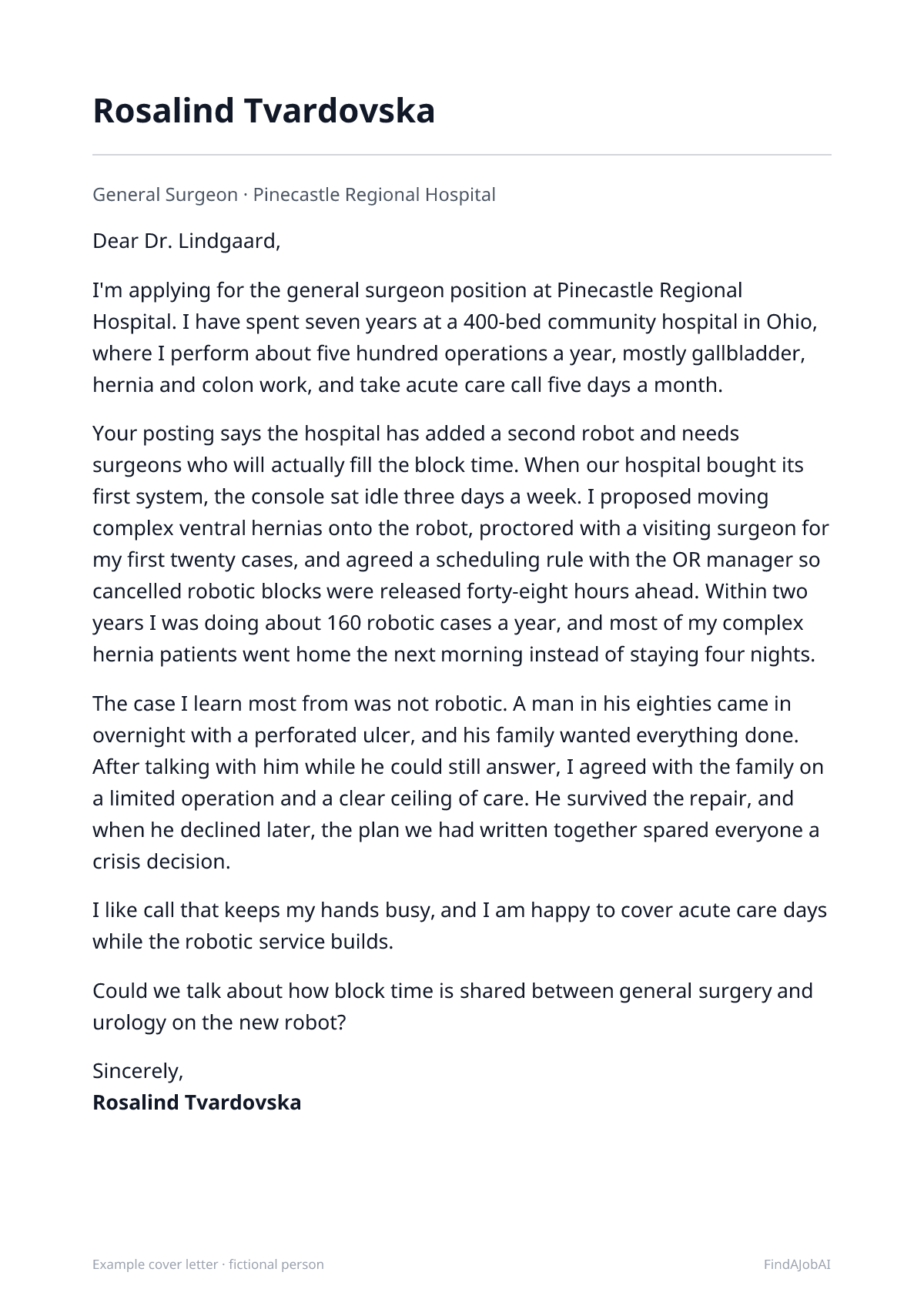
Example letter · fictional
Dear Dr. Lindgaard,
I'm applying for the general surgeon position at Pinecastle Regional Hospital. I have spent seven years at a 400-bed community hospital in Ohio, where I perform about five hundred operations a year, mostly gallbladder, hernia and colon work, and take acute care call five days a month.
Your posting says the hospital has added a second robot and needs surgeons who will actually fill the block time. When our hospital bought its first system, the console sat idle three days a week. I proposed moving complex ventral hernias onto the robot, proctored with a visiting surgeon for my first twenty cases, and agreed a scheduling rule with the OR manager so cancelled robotic blocks were released forty-eight hours ahead. Within two years I was doing about 160 robotic cases a year, and most of my complex hernia patients went home the next morning instead of staying four nights.
The case I learn most from was not robotic. A man in his eighties came in overnight with a perforated ulcer, and his family wanted everything done. After talking with him while he could still answer, I agreed with the family on a limited operation and a clear ceiling of care. He survived the repair, and when he declined later, the plan we had written together spared everyone a crisis decision.
I like call that keeps my hands busy, and I am happy to cover acute care days while the robotic service builds.
Could we talk about how block time is shared between general surgery and urology on the new robot?
Sincerely,
Rosalind Tvardovska
Example 2 · Entry level
Chief resident applying for a first attending job
Ottoline finishes general surgery residency in June. The hospital is small and wants a new graduate who will share emergency call.
Example letter · fictional
Dear Dr. Abelard-Quist,
I am writing about the general surgeon opening at Ironweed Valley Hospital. I finish a five-year residency at a university program in June, will sit the qualifying exam this summer and have logged just over a thousand major cases, including about 160 laparoscopic gallbladders and 85 colon resections.
Your advertisement is honest that the job is two surgeons sharing every emergency, with no residents and no trauma surgeon down the hall. My strongest training for that came as senior resident on nights, when I triaged twenty or more consults a shift with one attending on call from home. I learned to decide quickly which patients needed the operating room, which needed a scan first and which needed a phone call to the attending before anything else. On one of those nights a young woman's pain did not match her normal CT, and I asked my attending to come in; she had an ovarian torsion, and we saved the ovary. That night taught me to trust an exam that does not fit the scan.
I also know where my limits are as a new surgeon. I would want an experienced partner available for complex pancreatic or esophageal cases for the first year, and I would rather transfer a patient early than take on an operation I have only assisted with.
Outside the operating room I enjoy teaching. As administrative chief I ran a weekly skills lab, and I would be glad to help with nurse and student education.
I'll be visiting family near you in April and would welcome a site visit then, including a morning in clinic and an evening on call if you allow it.
Kind regards,
Ottoline Brezhinsky
Example 3 · Senior or lead
Chief of surgery applying to lead a larger department
Gideon leads a mid-size surgery department and is applying to run a system's surgical service line after a period of high turnover.
Example letter · fictional
Dear Ms. Okwuosa-Brandt,
I'm applying for the chief of surgery role at Larkspur Ferry Health System. For the past eight years I have led a department of eighteen surgeons across two hospitals, and I still operate two days a week, mainly biliary and pancreatic cases.
Your posting is direct about the challenge: six surgeons left in two years, and operating rooms run below capacity because block time sits with people who no longer use it. We had the same pattern in 2019. I rebuilt block allocation around twelve months of real use, released unused time to a shared pool each Thursday, and protected an acute care room every weekday so emergencies stopped bumping elective lists. Room use rose from about two thirds to just over eighty percent, and three surgeons who had been planning to leave told me the predictable schedule was the reason they stayed.
Recruiting followed from that. Candidates ask what their first year will look like, so we now give every new surgeon a written plan covering block time, call, proctoring and a named partner for difficult cases. We have hired seven surgeons since, and none has left. Each one also gets a quarterly review of their block use and outcomes with me, so problems surface early.
I have not yet led a department with a residency program, and I would want to learn how teaching commitments shape your schedules before changing them.
I'd value a conversation about where you are losing surgeons today and which services your board most wants to grow over the next three years.
Sincerely,
Gideon Ravenscourt
All three letters, and the short version below, are fictional: the people, employers and numbers are invented. Borrow the structure, never the facts.
- Prefer to write it yourself? Use the free cover letter template.
- Check your CV against the job first: the free CV score shows the missing keywords.
Why the first letter works, paragraph by paragraph
Paragraph 1: Opening
Gives the hospital size, annual volume, main procedures and call commitment in two sentences, which is what a chair needs to place the applicant.
Paragraph 2: Answering the ad's real need
The posting needs someone to fill robotic block time, so the writer explains how she built robotic volume before, with a scheduling rule and a length-of-stay result.
Paragraph 3: A judgment story
A high-risk emergency handled through a frank goals-of-care talk shows judgment about when and how much to operate, not only technique.
Paragraph 4: Call fit
One short sentence states she will take acute care days, which answers the second half of the ad without padding.
Paragraph 5: Close
Ends on a specific question about sharing the new robot, which invites a reply instead of a generic request for an interview.
What the entry-level letter does differently
The chief resident letter faces the hard part of the job head-on: two surgeons covering every emergency. It uses one night-call story with a clear reason for calling the attending, states case numbers plainly and names the limits the writer would keep in the first year.
What the senior letter does differently
The chief's letter is about running a department: turnover, block time, an acute care room and a recruiting plan, with use figures and retention results. It also names a gap, residency programs, instead of hiding it.
Short surgeon cover letter: an email-ready version
Many applications arrive as an email or a small text box, and a full page doesn't fit. This version runs 120 to 150 words and keeps only what a reader needs to decide whether to reply. A surgeon emails a surgery center's medical director about a part-time hernia and gallbladder role, keeping it brief for a quick read.
Short version · email · fictional128 words
Subject: General Surgeon, outpatient hernia and gallbladder cases – Wilhelmina Dravecky
Hi Dr. Moravcsik,
I'm interested in the part-time general surgeon role at Tamarack Shoals Surgery Center. I'm board certified with six years in practice, and about two thirds of my roughly 450 cases a year are outpatient inguinal hernias and laparoscopic gallbladders.
At my current hospital I moved most inguinal repairs to a same-day pathway with a local block and a nurse phone call the next morning. Same-day discharge went from under half of those patients to about nine in ten, with no rise in returns to the emergency room. Patients also liked going home to recover in their own beds.
My CV is attached, and I could visit for a morning list whenever it suits your team. I am free most Fridays this month.
Best,
Wilhelmina Dravecky
The short email keeps the outpatient share of the writer's volume and one same-day pathway result, which is what a surgery center director checks, and leaves out committee and teaching history.
Opening lines that work for surgeon cover letters
The first sentence decides whether the second gets read. Here are six openings, one for each situation you might be in. Pick the one that matches yours and swap in your own facts: every name and number below is invented.
1. You have a standout result
An elderly man with a perforated ulcer taught me more about when to operate than any robotic case, and that kind of judgment is what I'd bring to your opening.
2. The ad names a problem you've solved
Your posting says the new robot needs surgeons who will fill its block time, and filling an idle console is what I spent my last two years doing.
3. Someone referred you
Dr. Halvorsen-Pike, who proctored my first robotic colectomies, suggested I write to you about the colorectal position.
4. You admire what they build
I finish general surgery residency in June with just over a thousand major cases, and I'm looking for a hospital where shared emergency call is the core of the job.
5. You're new to the field or switching into it
Most of my week is spent on hernias, gallbladders and colons, and I'd like to bring that volume to a hospital building its outpatient surgery center.
6. You have senior scope or a specialism
After ten years as an attending, I'm applying for your vice chair role because I now enjoy fixing block schedules almost as much as operating.
How to write a surgeon cover letter
Five steps, in the order you'd write them. The shape stays the same for every job (a short opening, proof, a reason for this employer, a close), and what goes into each part is what changes with the role.
Lead with volume, case mix and call
Open with your setting, your yearly operative volume, the procedures that make up most of it and the call you take. Hospitals often recruit to fill a specific schedule or service, so these few facts decide whether the reader keeps going.
Match the posting's main need
When a posting stresses robotic growth, trauma coverage, rural practice or outpatient surgery, lead with your volume in exactly that area plus one program you started or improved. Everything else belongs in the CV and the credentialing packet.
Tell one decision about operating
Choose a moment where you decided whether, when or how much to operate. Say what you saw, what you chose and how the patient did, without identifying details. Chairs learn more from that than from any list of procedures or adjectives about your skills.
Be honest about your limits
New surgeons especially should say which complex cases they would want a partner for and when they would transfer. A clear, sensible limit reassures a chair who is about to share call with you, and it reads as maturity rather than weakness.
Close with a question about their service
Close by asking about block time, call sharing, the robotic schedule or the case mix. A pointed question proves you studied the posting, and chairs tend to answer it by proposing a visit to the hospital and the operating rooms.
Surgeon cover letter do's and don'ts
Do
- State your annual operative volume, main case mix and call commitment in the first paragraph.
- Answer the ad's main need, such as robotic growth, trauma call or a rural practice, with evidence from your own work.
- Tell one decision about whether, when or how much to operate, and give the outcome honestly.
Don't
- Don't copy your case log into the letter; choose the two or three counts this job cares about.
- Don't include details that could identify a patient, even in a short story.
- Don't criticize former partners, referring doctors or nurses when describing a hard case.
Common surgeon cover letter mistakes
Each one is easy to make and quick to fix before you send the letter.
Turning the letter into a case log
Pick the two or three counts that answer the posting and keep the full log for credentialing, where it will actually be checked.
Saying nothing about call
State how many call days you expect to take and what trauma level you are comfortable covering, since many surgical jobs exist to fill call.
A hero story with no team
Mention the anesthesia, nursing or resident colleagues in your case story, so the reader sees how you lead a room rather than a solo performance.
Claiming outcomes you cannot back up
Use registry or dashboard figures you could show a credentials committee, and say what period they cover, or describe the change without numbers.
Case stories that could identify a patient
Strip out names, dates and any unusual detail that could identify the patient. The surgical reasoning can stay exact while the person stays unknown, the same standard an M&M conference uses.
Email subject lines for surgeon applications
Applying by email? Put the job title, any reference number and your name in the subject line.
- General Surgeon application, robotic hernia and acute care call – Rosalind Tvardovska
- General Surgeon (new graduate, shared emergency call) – Ottoline Brezhinsky
- Application: Chief of Surgery – Gideon Ravenscourt
Everything for Surgeons
- Surgeon resume exampleA full resume, plus bullet and summary examples
- Surgeon interview questions30 questions with sample answers
- Surgeon job descriptionDuties, skills and requirements
- Cover letter with no experience: templates
Other cover letter examples
Surgeon cover letter FAQ
What should a surgeon cover letter include?
Your setting, annual operative volume, main procedures and call commitment, then one decision that shows your judgment and a short reason why this hospital's practice fits you.
Do surgery residents need a cover letter for attending jobs?
Most departments still request it. Keep it to your operative numbers, your board status, the call schedule you can take and a single operative decision that shows sound judgment.
How long should a surgeon cover letter be?
Keep it to a single page of four or five short paragraphs. Chairs and recruiters read quickly, so put the facts first and keep the clinical story to a single example.
How we built this page
The FindAJobAI team wrote the three example letters, the short email version, the opening lines and the advice for surgeon roles. The people, employers and numbers in the letters are invented; the structure, the kind of evidence and the order of the paragraphs are the parts to copy.
Once we track enough live surgeon job ads, this page also shows the skills they ask for most, counted the same way as our in-demand skills report.
Last reviewed on November 1, 2026.