Athletic Trainer Cover Letter Example (2026)
By FindAJobAI Team Updated How we built this page
Athletic directors and team physicians hiring an athletic trainer look for three things fast: your BOC credential and state license, proof that you can cover a full roster safely on your own, and judgment when an athlete is hurt. A strong letter tells one sideline or rehab story with a result the department already tracks, and shows you work well with coaches and physicians.
Athletic Trainer cover letter template
This letter as a one-page template: an opening that names the job and your strongest fact, proof that answers the ad, a reason for this employer and a short close.
After you sign up, FindAJobAI drafts your own letter for a real job from your CV in this format, and you edit it before you send it.
Example 1 · Experienced
College athletic trainer applying to a Division I program
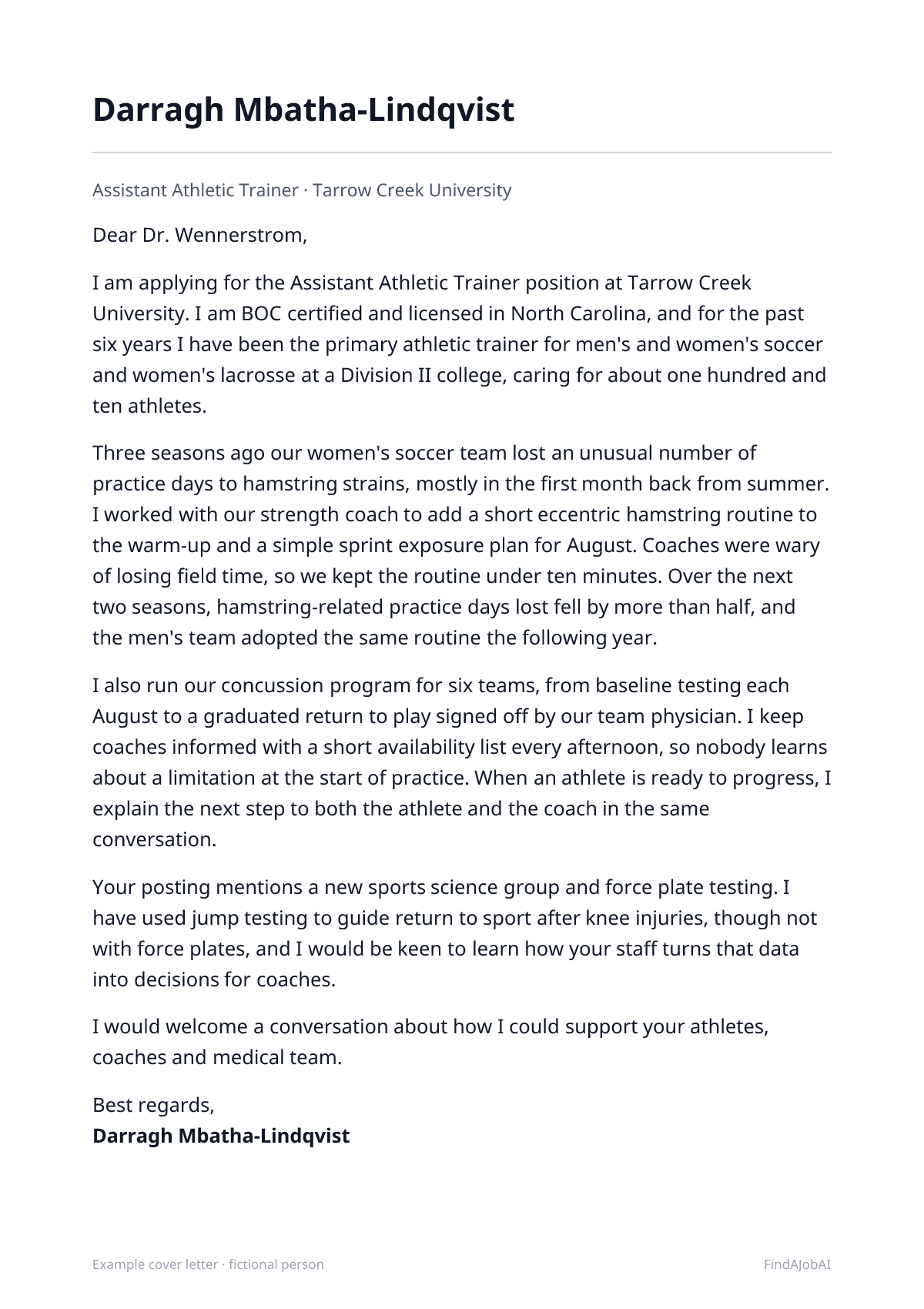
Darragh covers soccer and lacrosse at a Division II college. The ad asks for an ATC with concussion and injury prevention experience.
Example letter · fictional
Dear Dr. Wennerstrom,
I am applying for the Assistant Athletic Trainer position at Tarrow Creek University. I am BOC certified and licensed in North Carolina, and for the past six years I have been the primary athletic trainer for men's and women's soccer and women's lacrosse at a Division II college, caring for about one hundred and ten athletes.
Three seasons ago our women's soccer team lost an unusual number of practice days to hamstring strains, mostly in the first month back from summer. I worked with our strength coach to add a short eccentric hamstring routine to the warm-up and a simple sprint exposure plan for August. Coaches were wary of losing field time, so we kept the routine under ten minutes. Over the next two seasons, hamstring-related practice days lost fell by more than half, and the men's team adopted the same routine the following year.
I also run our concussion program for six teams, from baseline testing each August to a graduated return to play signed off by our team physician. I keep coaches informed with a short availability list every afternoon, so nobody learns about a limitation at the start of practice. When an athlete is ready to progress, I explain the next step to both the athlete and the coach in the same conversation.
Your posting mentions a new sports science group and force plate testing. I have used jump testing to guide return to sport after knee injuries, though not with force plates, and I would be keen to learn how your staff turns that data into decisions for coaches.
I would welcome a conversation about how I could support your athletes, coaches and medical team.
Best regards,
Darragh Mbatha-Lindqvist
Example 2 · Entry level
New graduate applying for a high school outreach position
Yesenia just passed the BOC exam after a master's program. The ad is for a clinic-employed athletic trainer placed at one high school.
Example letter · fictional
Dear Ms. Abernathy-Quayle,
I am writing to apply for the high school outreach Athletic Trainer role with Pinebluff Orthopedic Partners. I passed the BOC exam in June after finishing my master's in athletic training, and my North Carolina license was issued last week.
My most useful rotation was a full semester at a public high school with one athletic trainer for about three hundred athletes. I learned quickly that the job is as much about parents and coaches as about injuries. Many parents called after every ankle sprain, so with my preceptor's approval I wrote a one-page injury letter that went home the same day, covering what happened, what to watch for and when we would check again. Evening calls dropped noticeably, and several parents told us they finally understood the plan for their child's recovery.
During that semester I took part in two emergency drills with local EMS, practised spine motion restriction with football staff and helped manage nine concussions from baseline to physician clearance. I document in ATS, which your posting lists, and I kept my notes current every day of the rotation.
Your clinic offers mentoring from senior athletic trainers and physician rounds each week. That support matters to me in a first job, and in return I would bring careful notes, clear communication with families and a habit of asking early when I am unsure. I am also happy to cover early morning sessions and Saturday events, which I know are hard to staff.
I would be glad to talk at a time that suits you, and I can share my preceptor evaluations on request.
Kind regards,
Yesenia Kowalczuk-Ade
Example 3 · Senior or lead
Head athletic trainer applying to lead a sports medicine department
Ambrose has fourteen years in college athletics, the last five as head athletic trainer. The ad is for a director of sports medicine.
Example letter · fictional
Dear Mr. Haldane-Okafor,
I am applying for the Director of Sports Medicine role at Saltgrove State University. I have worked as a certified athletic trainer for fourteen years, the last five as head athletic trainer at a Division II university, where I lead five athletic trainers covering seventeen sports.
When I became head athletic trainer, our staff covered practices by tradition rather than by risk. Football had three athletic trainers while wrestling and women's soccer often shared one person across two venues. I reviewed two years of injury records, met each head coach and rebuilt the coverage plan around injury rates and contact level. Unstaffed high-risk practices dropped from about twenty a season to none, without adding a position. Coaches accepted the change because they could see the injury figures behind each assignment.
I also built a mental health referral pathway with our counseling center. Athletes now see a counselor within a week of a referral, and coaches have a short guide on what to say and when to call us. Our team physician and I review the pathway every spring and adjust it with the counseling staff.
Your posting mentions moving all teams to one athlete management system. I led a similar move at my university, so I know how much depends on training staff and coaches early. Your department is larger than mine, and I would want to learn from your staff and team physicians before changing any routines that already work well for them.
I would welcome the chance to discuss your plans for the department and how I could help your staff carry them out.
Sincerely,
Ambrose Oyarzun-Kell
All three letters, and the short version below, are fictional: the people, employers and numbers are invented. Borrow the structure, never the facts.
- Prefer to write it yourself? Use the free cover letter template.
- Check your CV against the job first: the free CV score shows the missing keywords.
Why the first letter works, paragraph by paragraph
Paragraph 1: Opening
Gives credential, license, level of competition, sports covered and roster size, which answers the department's first screening questions.
Paragraph 2: The prevention story
A real hamstring problem, a short routine coaches would accept and a halved figure for days lost show initiative and respect for practice time.
Paragraph 3: Concussion and communication
Baseline testing, physician sign-off and a daily availability list cover the two things athletic directors worry about most.
Paragraph 4: Honest link to the program
The writer connects jump testing to the force plates in the posting and admits the gap instead of overstating it.
Paragraph 5: Close
Short and aimed at athletes, coaches and the medical team, which mirrors how athletic trainers actually fit into a department.
What the entry-level letter does differently
The new graduate leads with the exam and license, then uses a full rotation semester to show comfort with high school athletics. The injury letter for parents shows judgment and initiative under a preceptor, and naming the clinic's documentation system makes the letter specific.
What the senior letter does differently
The senior letter shows leadership through one data-driven change in staffing and a referral pathway built with counseling. The writer admits the department is larger than the current one and offers to listen before making changes.
Short athletic trainer cover letter: an email-ready version
Many applications arrive as an email or a small text box, and a full page doesn't fit. This version runs 120 to 150 words and keeps only what a reader needs to decide whether to reply. An athletic trainer replies by email to a clinic manager who posted a part-time event coverage role for weekend tournaments.
Short version · email · fictional139 words
Subject: Part-time ATC for weekend tournaments – licensed in NC, own kit – Ingeborg Castellanos-Pike
Hi Ms. Tarrow,
I'm interested in the part-time event coverage role with Eastgate Sports Clinic. I am a BOC certified athletic trainer licensed in North Carolina, with five years at a high school and two seasons covering youth soccer and volleyball tournaments.
At tournaments I check the emergency plan with the site director before the first game, set up near the busiest fields and keep a written log of every athlete I see. Parents leave with a short note on what to watch for at home, and the organizer gets a copy of the log at the end of each day so any follow-up calls go smoothly.
I am available most weekends from March to November and have my own kit and AED. My resume, license number and two references from tournament directors are attached.
Thank you,
Ingeborg Castellanos-Pike
The short version answers the manager's practical questions first, credentials, availability and equipment, and keeps one short paragraph on how the writer runs a tournament day safely.
Opening lines that work for athletic trainer cover letters
The first sentence decides whether the second gets read. Here are six openings, one for each situation you might be in. Pick the one that matches yours and swap in your own facts: every name and number below is invented.
1. You have a standout result
Our women's soccer team used to lose a month of practice days to hamstring strains each August. A ten-minute warm-up change cut that by more than half.
2. The ad names a problem you've solved
I passed the BOC exam in June after a full semester as the second athletic trainer at a busy public high school, and your outreach role is the job I trained for.
3. Someone referred you
Your head team physician supervised my football rotation two years ago and suggested I apply when an assistant position opened.
4. You admire what they build
I tore my ACL in high school, and the athletic trainer who guided my return is the reason I chose this career.
5. You're new to the field or switching into it
For five years I have led the athletic training staff at a Division II university, and your director role describes the work I want to grow into next.
6. You have senior scope or a specialism
I cover weekend youth tournaments across the Triangle and bring my own kit, which fits the event coverage role you posted.
How to write an athletic trainer cover letter
Five steps, in the order you'd write them. The shape stays the same for every job (a short opening, proof, a reason for this employer, a close), and what goes into each part is what changes with the role.
Put your credentials and setting first
Open with your BOC credential, state license, years of practice and the level of competition you work in. Athletic directors and clinic managers screen for these first, so one or two clear sentences earn attention for the rest of the letter.
Tell one injury or prevention story
Describe a problem your athletes faced, what you noticed, what you did with coaches or the physician and what changed. Use a measure departments understand, such as days lost, injuries per season or time to return to sport.
Show emergency readiness
Mention emergency action plans you wrote, drills you ran with EMS and how you handle heat and spine injuries. These details reassure a school or clinic that their athletes are safe with you on the sideline, even when you are the only medical person there.
Credit the medical team
Explain your part in concussion and return-to-play decisions and name the physician's sign-off. This shows you understand how authority works in sports medicine, and it avoids any impression that you make clearance decisions entirely on your own.
Match the program's athletes
Read the posting for the sports, level and setting, such as high school outreach, college or professional teams. Link your experience to them with one concrete detail, then close by offering to talk about how you could help their staff.
Athletic Trainer cover letter do's and don'ts
Do
- State your BOC credential and state license in the first paragraph.
- Tell one injury or prevention story with a measure the department tracks, such as days lost.
- Show how you communicate with coaches, parents and the team physician.
Don't
- Don't claim you cleared athletes on your own; credit the physician's sign-off.
- Don't describe an athlete in a way that could identify them, even without a name.
- Don't spend the letter on your love of sport without an example of your care.
Common athletic trainer cover letter mistakes
Each one is easy to make and quick to fix before you send the letter.
Writing as if you were a personal trainer
Athletic training is a healthcare role. Lead with your credential, license and clinical work, not fitness coaching.
Hiding the BOC credential
Many readers stop if they cannot find it. Put ATC and your license in the first paragraph.
Claiming sole authority for return to play
Physicians clear athletes in most settings. Describe the protocol you ran and credit the sign-off.
Describing an athlete who could be recognized
Sport, position, school and injury together can identify someone. Use group figures or general descriptions.
Ignoring the level and setting
High school outreach, college and clinic roles need different strengths. Say which you know and how it fits.
Email subject lines for athletic trainer applications
Applying by email? Put the job title, any reference number and your name in the subject line.
- Assistant Athletic Trainer – ATC, NC licensed, college soccer – Darragh Mbatha-Lindqvist
- High school outreach ATC – new graduate, licensed in North Carolina – Yesenia Kowalczuk-Ade
- Application: Athletic Trainer, Req. 4471 – Darragh Mbatha-Lindqvist
Everything for Athletic Trainers
- Athletic Trainer resume exampleA full resume, plus bullet and summary examples
- Athletic Trainer interview questions30 questions with sample answers
- Athletic Trainer job descriptionDuties, skills and requirements
- Cover letter with no experience: templates
Other cover letter examples
Athletic Trainer cover letter FAQ
What should an athletic trainer cover letter include?
Your BOC credential and license, the sports and roster you cover, and one story about an injury or prevention program with a result. Mention how you handle emergencies and keep coaches and physicians informed.
How do I write an athletic trainer cover letter as a new graduate?
Lead with your BOC exam result and license status, then describe your strongest rotation with the sport, setting and number of athletes. Show one example of judgment you used under your preceptor.
Should I mention return-to-play results in my letter?
Yes, as group figures and without identifying anyone. Explain your part in the protocol and credit the team physician, who signs off on clearance in most settings.
How we built this page
The FindAJobAI team wrote the three example letters, the short email version, the opening lines and the advice for athletic trainer roles. The people, employers and numbers in the letters are invented; the structure, the kind of evidence and the order of the paragraphs are the parts to copy.
Once we track enough live athletic trainer job ads, this page also shows the skills they ask for most, counted the same way as our in-demand skills report.
Last reviewed on November 1, 2026.