Physical Therapist Cover Letter Example (2026)
By FindAJobAI team Updated How we built this page
Physical therapist ads usually list a setting, a patient population, and a productivity expectation, so most applicants read the same on paper. A cover letter should describe how you actually move a patient toward a goal: the evaluation you made, the plan you adjusted, and what the patient could do afterward that they couldn't before.
Physical Therapist cover letter template
This letter as a one-page template: an opening that names the job and your strongest fact, proof that answers the ad, a reason for this employer and a short close.
After you sign up, FindAJobAI drafts your own letter for a real job from your CV in this format, and you edit it before you send it.
Example 1 · Experienced
Outpatient orthopedic PT applying to a sports medicine clinic
Soren treats post-surgical and sports patients at a busy outpatient clinic. The ad asks for comfort with a full caseload and return-to-sport protocols.
Example letter · fictional
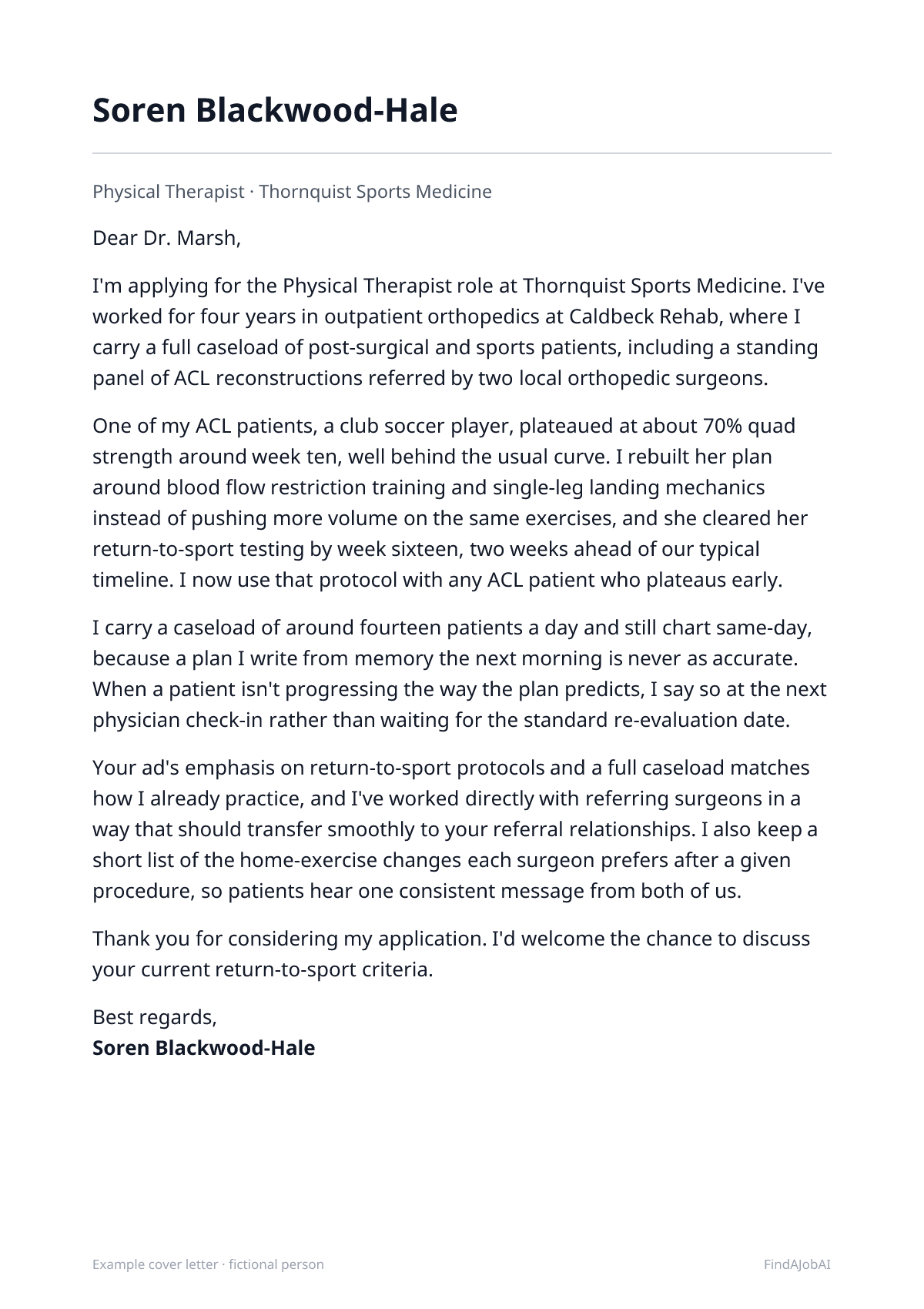
Dear Dr. Marsh,
I'm applying for the Physical Therapist role at Thornquist Sports Medicine. I've worked for four years in outpatient orthopedics at Caldbeck Rehab, where I carry a full caseload of post-surgical and sports patients, including a standing panel of ACL reconstructions referred by two local orthopedic surgeons.
One of my ACL patients, a club soccer player, plateaued at about 70% quad strength around week ten, well behind the usual curve. I rebuilt her plan around blood flow restriction training and single-leg landing mechanics instead of pushing more volume on the same exercises, and she cleared her return-to-sport testing by week sixteen, two weeks ahead of our typical timeline. I now use that protocol with any ACL patient who plateaus early.
I carry a caseload of around fourteen patients a day and still chart same-day, because a plan I write from memory the next morning is never as accurate. When a patient isn't progressing the way the plan predicts, I say so at the next physician check-in rather than waiting for the standard re-evaluation date.
Your ad's emphasis on return-to-sport protocols and a full caseload matches how I already practice, and I've worked directly with referring surgeons in a way that should transfer smoothly to your referral relationships. I also keep a short list of the home-exercise changes each surgeon prefers after a given procedure, so patients hear one consistent message from both of us.
Thank you for considering my application. I'd welcome the chance to discuss your current return-to-sport criteria.
Best regards,
Soren Blackwood-Hale
Example 2 · Career changer
Physical therapy aide finishing her DPT and applying for her first PT role
Yevgenia has worked as an aide for three years while completing her doctorate. The ad is an entry-level opening at an outpatient clinic.
Example letter · fictional
Dear Hiring Manager,
I'm applying for the Physical Therapist role at Alderbrook Rehabilitation. I've worked as a physical therapy aide for three years at Hollenbeck Outpatient while completing my Doctor of Physical Therapy, and I'll finish my clinical rotations and sit for my licensure exam this June.
As an aide, I set up and ran exercises for most of the clinic's patients under supervision, which meant I watched how different therapists adjusted plans when a patient wasn't progressing. During my final clinical rotation, I managed my own caseload of eight patients, including a total knee replacement patient who was afraid to bear weight; I slowed the plan to smaller range-of-motion gains with more frequent reassurance, and she reached full weight-bearing only a week behind the standard timeline instead of stalling out entirely.
My supervising clinical instructor noted that I was unusually comfortable explaining a plan to a nervous patient, which I think comes from three years of being the person who actually walks patients through their exercises, not just the plan on paper. I've also helped run the clinic's Tuesday balance class for older adults, so I'm used to explaining one exercise three different ways until it clicks.
I don't yet have the pattern recognition that comes from years of independent caseloads, and I'd expect my first months to lean on your senior therapists for the harder calls, the same way I leaned on them as an aide.
Thank you for your time. I'd welcome the opportunity to discuss how my aide experience would carry into this role.
Sincerely,
Yevgenia Dubrovsky
Example 3 · Senior or lead
Clinic director applying to lead a growing outpatient practice
Alaric runs a six-therapist outpatient clinic and is applying to direct a larger practice expanding into a second location.
Example letter · fictional
Dear Ms. Oyelaran,
I'm applying for the Clinic Director role at Marrowfield Physical Therapy. For the past three years I've directed a six-therapist outpatient clinic at Hallowmere Rehab, and before that I spent seven years as a staff and then senior PT. I'd like to bring that experience to a practice that's opening a second location.
Your ad mentions that no-show rates have been climbing as your patient volume grows, which was the first problem I tackled at Hallowmere. I moved our scheduling to same-day confirmation texts and built a short script for front-desk staff to use when patients called to reschedule, which brought our no-show rate down from around one in five visits to roughly one in twelve within two quarters, without adding any new intake steps.
Clinical quality still comes first in a director role; it's just measured differently. When two of my therapists had conflicting approaches to post-op rotator cuff protocols, I pulled our outcomes data and found one approach was getting patients back to full range of motion about three weeks faster, standardized the clinic around it, and our average discharge satisfaction score rose over the following year.
I haven't opened a new location before, and I haven't yet managed a practice with more than one site reporting to me, so at Marrowfield I'd expect to lean on your existing systems and your other director while I learned the operational side of a second site.
I'd welcome a conversation about which metrics you're watching most closely as you open the second location, and where you'd want a new director to focus first.
Sincerely,
Alaric Thistlewood
All three letters, and the short version below, are fictional: the people, employers and numbers are invented. Borrow the structure, never the facts.
- Prefer to write it yourself? Use the free cover letter template.
- Check your CV against the job first: the free CV score shows the missing keywords.
Why the first letter works, paragraph by paragraph
Paragraph 1: Opening
Names the setting, the patient population, and a specific referral relationship, which tells the reader exactly what kind of caseload he's used to.
Paragraph 2: The plan that changed an outcome
A specific plateau, the change in approach (blood flow restriction, landing mechanics), and the measurable result (cleared testing two weeks early) show clinical reasoning, not just a list of modalities.
Paragraph 3: Caseload and documentation habits
Same-day charting and proactively flagging a patient's slow progress are concrete, checkable habits that matter as much to a hiring manager as clinical skill.
Paragraph 4: Why this clinic
Matches the ad's specific language (return-to-sport protocols, full caseload) instead of praising the clinic in general terms.
Paragraph 5: Close
Asks a specific clinical question about their return-to-sport criteria, which signals genuine interest in how this clinic practices.
What the career changer's letter does differently
The career changer's letter leans on real patient contact from her aide role rather than coursework, and names one patient she managed independently during a clinical rotation, with a specific result. She addresses the experience gap directly in the fourth paragraph instead of letting the reader wonder about it, which reads as more trustworthy than a letter that only lists her coursework and GPA.
What the senior letter does differently
A clinic director letter reports operational habits at the level of a practice, not a single patient: a no-show rate brought down with a concrete scheduling fix, and a protocol standardized across therapists using the clinic's own outcomes data. The gap (never opened a new location) is stated plainly, which reads as more credible for a role expanding into unfamiliar territory.
Short physical therapist cover letter: an email-ready version
Many applications arrive as an email or a small text box, and a full page doesn't fit. This version runs 120 to 150 words and keeps only what a reader needs to decide whether to reply. A physical therapist answers a home health agency's short application question by email after being told the online portal was down.
Short version · email · fictional123 words
Subject: Physical Therapist application – home health, fall prevention – Branwen Castellane
Hello Mr. Osei-Baffour,
I'm applying for the Physical Therapist role at Hollowmere Home Health. I've spent three years in home health, currently managing a caseload of around eleven patients a week across a rural service area.
My most useful project was building a short home fall-risk checklist after noticing several of my patients had hazards their plans never addressed, like loose stair rails and poor lighting. Using it during evaluations cut fall-related readmissions on my caseload by about half over one year.
Home health rewards therapists who notice what a clinic visit would miss, and that checklist came directly from fourteen years of being in patients' actual homes. My resume is attached, and I'm glad to share the checklist itself.
Best,
Branwen Castellane
A short-form question forces one example, so this version keeps the fall-risk checklist and its measurable effect (fewer readmissions) instead of listing every home health duty. The offer to share the checklist itself is a small, concrete next step rather than a general offer to talk more.
Opening lines that work for physical therapist cover letters
The first sentence decides whether the second gets read. Here are six openings, one for each situation you might be in. Pick the one that matches yours and swap in your own facts: every name and number below is invented.
1. You have a standout result
Last year I built a short fall-risk checklist for home visits after noticing hazards that standard plans never addressed, and fall-related readmissions on my caseload dropped by about half. I'd like to bring that same attention to detail to your home health team.
2. The ad names a problem you've solved
Your ad mentions rising no-show rates as your clinic grows. At my current clinic I built a same-day confirmation process that brought ours down substantially within two quarters, without adding new intake steps.
3. Someone referred you
Your senior PT, Marguerite Okonkwo-Lindqvist, supervised one of my clinical rotations and suggested I apply, which is what prompted this letter.
4. You admire what they build
I've referred two family members to your clinic over the past few years, and the way your therapists explained each phase of recovery is exactly the kind of practice I'd like to be part of.
5. You're new to the field or switching into it
I spent three years as a physical therapy aide before finishing my Doctor of Physical Therapy this spring, and the patient I managed independently during my final clinical rotation is still the work I'm proudest of.
6. You have senior scope or a specialism
As director of a six-therapist outpatient clinic, I cut our no-show rate by more than half and standardized our rotator cuff protocol using our own outcomes data. I'm ready to bring that to a larger practice.
How to write a physical therapist cover letter
Five steps, in the order you'd write them. The shape stays the same for every job (a short opening, proof, a reason for this employer, a close), and what goes into each part is what changes with the role.
Match your example to the ad's setting and population
Outpatient orthopedic, home health, pediatric, and inpatient ads reward different stories. A sports medicine ad wants a return-to-sport example; a home health ad wants a safety or independence example. Pick the patient story that matches before writing anything else.
Open with the functional outcome, not your title
State what the patient could do afterward that they couldn't before, in one or two sentences, before describing your role in detail. A reader who sees a concrete result in your first paragraph will keep reading to see how you got there.
Describe the plan change, not just the diagnosis
Naming a diagnosis (ACL reconstruction, total knee replacement) isn't enough; say what you changed in the plan when the standard approach wasn't working, and why. That's the clinical reasoning a hiring manager is actually trying to evaluate.
Name a caseload or documentation habit the ad implies
If the ad mentions productivity, same-day charting, or a specific caseload size, address it directly with your own numbers. A habit like charting the same day you see a patient is a small, concrete detail that builds trust quickly.
Show how you communicate with patients or referring providers
One sentence on how you explain a plan to a nervous or skeptical patient, or how you update a referring physician. Close with a question about the employer's current protocols or criteria, so the reader sees what you'd engage with first.
Physical Therapist cover letter do's and don'ts
Do
- Describe one patient's plan, what changed in your approach, and the functional result, using a timeframe or measurable milestone the reader can picture.
- Mention the setting and population the ad names, such as outpatient orthopedics, pediatrics, or home health, inside a real example rather than as a list of settings you've worked in.
- Say something concrete about documentation or caseload habits; productivity and accurate charting are often what a clinic actually evaluates day to day.
Don't
- Don't say you're "passionate about helping patients reach their goals"; show it with one patient's plateau and how you changed course.
- Don't list every modality or certification you hold; name the one you used in the example you're telling.
- Don't share identifying patient details; describe the diagnosis type and outcome without names or dates that could identify someone.
Common physical therapist cover letter mistakes
Each one is easy to make and quick to fix before you send the letter.
Listing modalities instead of one patient story
'Skilled in manual therapy, dry needling, and therapeutic exercise' reads like a certificate list. Pick the one patient most relevant to this ad and describe the plan and result in detail instead.
Naming identifying patient details
Even without a full name, enough identifying detail can be a problem a reader will notice. Describe the diagnosis type, the general timeline, and the outcome without anything that could identify the patient.
Writing 'passionate about patients' instead of showing it
Every applicant writes this sentence. Replace it with the one plateau you addressed, the plan you changed, and what the patient could do afterward that they couldn't before.
Treating school or rotations as the main qualification
Once you've practiced for a few years, leading with school honors signals you have nothing more recent to point to. Lead with a patient or project from your actual caseload instead.
Ignoring the experience gap when moving into practice
An aide or tech finishing a doctorate who avoids mentioning the transition looks like they're hoping nobody notices. Name it directly and point to the independent patient work that makes the move credible.
Email subject lines for physical therapist applications
Applying by email? Put the job title, any reference number and your name in the subject line.
- Physical Therapist application – outpatient orthopedics, return-to-sport – Soren Blackwood-Hale
- Physical Therapist application – DPT candidate, 3 years as PT aide – Yevgenia Dubrovsky
- Application: Physical Therapist, Outpatient Ortho (Req. 3391) – Soren Blackwood-Hale
Everything for Physical Therapists
- Physical Therapist resume exampleA full resume, plus bullet and summary examples
- Physical Therapist interview questions30 questions with sample answers
- Physical Therapist job descriptionDuties, skills and requirements
- Career change cover letter: template + examples
Other cover letter examples
Physical Therapist cover letter FAQ
What should I write in a physical therapist cover letter?
Describe one patient whose plan you adjusted, what you changed, and the functional outcome, in a sentence or two. Then add a line about your caseload size or documentation habits. Licensure and certifications belong on your resume, not repeated in prose.
How do I write a physical therapist cover letter with no experience yet?
Use a patient you managed during a clinical rotation, or patient contact from an aide or tech role, naming what you adjusted and the result. Address the experience gap directly in one sentence instead of avoiding it.
Should a physical therapist cover letter mention caseload size?
Yes, if the ad mentions productivity expectations or a specific setting. A number like patients seen per day, stated plainly, tells a hiring manager you already know the pace of the job.
How long should a physical therapist cover letter be?
One page, four to five paragraphs. A letter built around one real patient and a clear result will stand out more than one that restates every clinical skill already listed on the resume.
How we built this page
The FindAJobAI team wrote the three example letters, the short email version, the opening lines and the advice for physical therapist roles. The people, employers and numbers in the letters are invented; the structure, the kind of evidence and the order of the paragraphs are the parts to copy.
Once we track enough live physical therapist job ads, this page also shows the skills they ask for most, counted the same way as our in-demand skills report.
Last reviewed on November 1, 2026.