Business Intelligence Analyst Cover Letter Example (2026)
By FindAJobAI team Updated How we built this page
Business intelligence analyst ads usually ask for a data warehouse, a BI tool and 'stakeholder management' in the same three lines, which makes most applicants sound interchangeable. The cover letter is where you show the dashboard that replaced a meeting, the report that got cut because nobody opened it, and the decision your numbers actually changed.
Business Intelligence Analyst cover letter template
This letter as a one-page template: an opening that names the job and your strongest fact, proof that answers the ad, a reason for this employer and a short close.
After you sign up, FindAJobAI drafts your own letter for a real job from your CV in this format, and you edit it before you send it.
Example 1 · Experienced
Retail BI analyst applying to a grocery chain's central analytics team
Darius owns the sales and inventory reporting for a regional grocery chain. The ad stresses consolidating reports and working with store-level managers.
Example letter · fictional
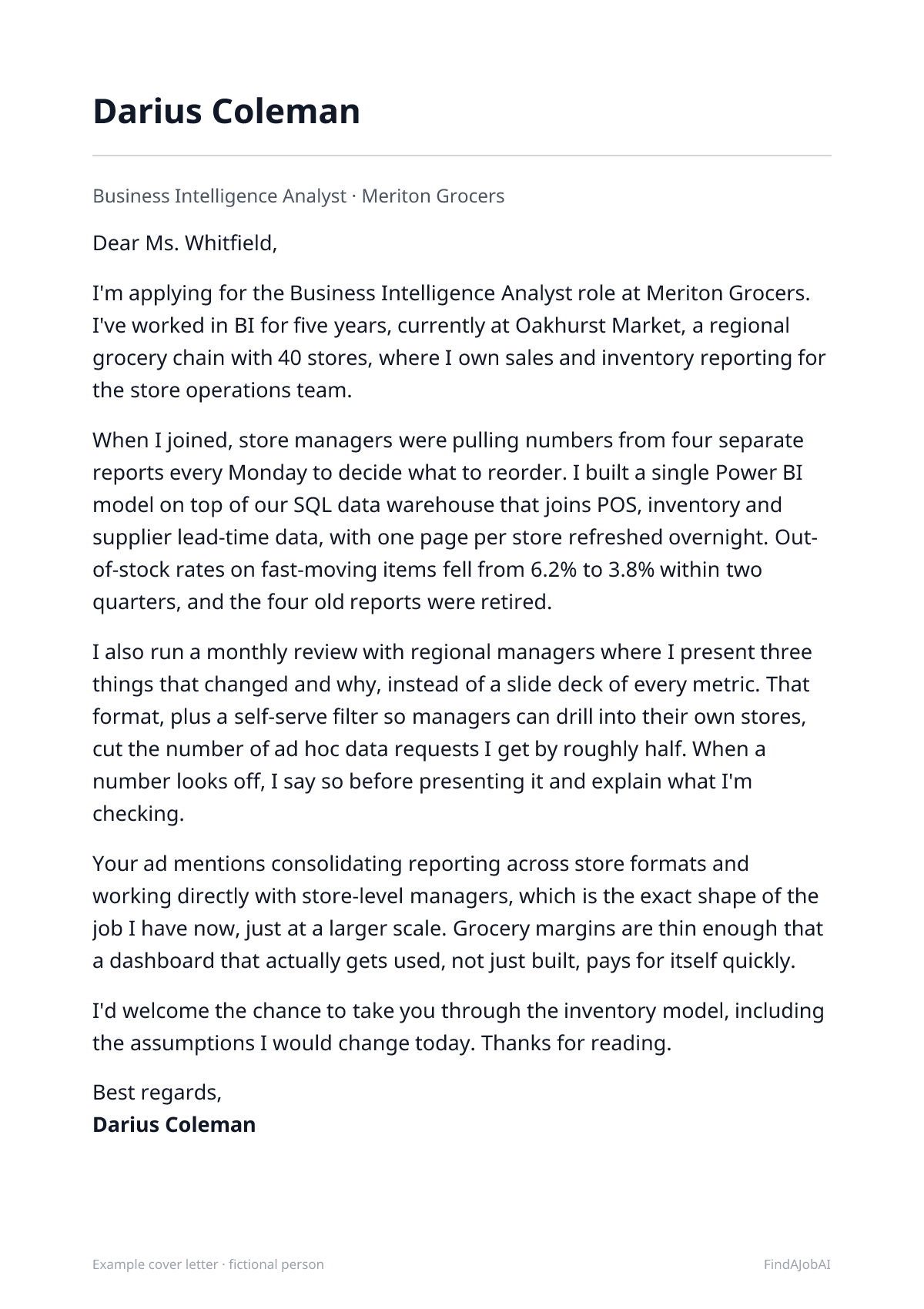
Dear Ms. Whitfield,
I'm applying for the Business Intelligence Analyst role at Meriton Grocers. I've worked in BI for five years, currently at Oakhurst Market, a regional grocery chain with 40 stores, where I own sales and inventory reporting for the store operations team.
When I joined, store managers were pulling numbers from four separate reports every Monday to decide what to reorder. I built a single Power BI model on top of our SQL data warehouse that joins POS, inventory and supplier lead-time data, with one page per store refreshed overnight. Out-of-stock rates on fast-moving items fell from 6.2% to 3.8% within two quarters, and the four old reports were retired.
I also run a monthly review with regional managers where I present three things that changed and why, instead of a slide deck of every metric. That format, plus a self-serve filter so managers can drill into their own stores, cut the number of ad hoc data requests I get by roughly half. When a number looks off, I say so before presenting it and explain what I'm checking.
Your ad mentions consolidating reporting across store formats and working directly with store-level managers, which is the exact shape of the job I have now, just at a larger scale. Grocery margins are thin enough that a dashboard that actually gets used, not just built, pays for itself quickly.
I'd welcome the chance to take you through the inventory model, including the assumptions I would change today. Thanks for reading.
Best regards,
Darius Coleman
Example 2 · Career changer
Warehouse operations supervisor moving into business intelligence
Natalie solved a scheduling problem with SQL and Power BI before holding an analyst title. The ad wants supply chain reporting and cross-team dashboards.
Example letter · fictional
Dear Hiring Manager,
I'm applying for the Junior Business Intelligence Analyst role at Vantrell Logistics. For four years I've supervised shifts at a 200-person distribution warehouse, and the most useful skill I picked up there was pulling and modeling our own numbers instead of waiting on head office for reports. I'm now ready to do that work full time, in a role built around it.
Two years ago our overtime costs kept rising and nobody could point to why. I exported shift and order-volume data from our warehouse management system, taught myself SQL to join it with payroll data, and built a Power BI dashboard showing labor cost against order volume by hour. It showed we were overstaffed early in the morning and short during the afternoon surge. After the schedule was rebuilt around it, overtime fell from 18% to 11% of labor hours, and the dashboard is now checked weekly by three shift leads.
Since then I've earned a Microsoft Power BI certification, finished a SQL course, and built two portfolio projects on public datasets, one of them an analysis of supply chain delays. I work in Excel, SQL and Power BI every day, and I'm learning DAX so my measures stay flexible instead of hardcoded.
Your posting mentions supply chain reporting and dashboards used across teams, which matches both the subject matter I already understand and the kind of practical, operator-built reporting I've done. I'd bring the analysis skills plus a working knowledge of what's realistic on a warehouse floor.
My portfolio is linked on my resume. If useful, I can walk you through the supply chain delay analysis and the questions it answered.
Kind regards,
Natalie Ferreira
Example 3 · Senior or lead
BI team lead applying to unify reporting across three business units
Simone leads three BI analysts at a manufacturer. The ad is for a lead to consolidate reporting across divisions that each run their own numbers.
Example letter · fictional
Dear Mr. Agyeman,
I'm applying for the BI Team Lead role at Castleford Manufacturing. For the past two years I've led a team of three BI analysts at Hallowick Industries, where we support finance, operations and sales across two divisions, and before that I spent five years as a senior BI analyst.
Your ad says each division runs its own spreadsheets and the numbers don't match in the monthly leadership review. Hallowick had the same issue when I joined. I built a single governed data model in SQL Server with one set of agreed metric definitions, signed off by each division's finance lead, and migrated both divisions' reporting onto it over five months. Our 60-plus legacy spreadsheets dropped to 18 dashboards, and the leadership meeting stopped opening with a 20-minute argument over whose revenue number was correct.
The clearest result came from operations: a plant manager believed late shipments were driven by supplier delays, but my dashboard showed 70% of late shipments came from orders changed after the production schedule was locked. Operations changed their change-order cutoff, and on-time shipment rate rose from 81% to 92% over the following quarter.
I've hired two of my three analysts and run a monthly session where each presents a project to the wider team, which has surfaced two reporting errors before they reached leadership. I haven't yet consolidated reporting across more than two divisions or managed a BI budget directly, and at Castleford I'd want to scope that migration carefully with your finance and IT leads before committing to a timeline.
I'd welcome a conversation about which of your three divisions has the most urgent reporting gap, and what's made past consolidation attempts stall.
Sincerely,
Simone Dupree
All three letters, and the short version below, are fictional: the people, employers and numbers are invented. Borrow the structure, never the facts.
- Prefer to write it yourself? Use the free cover letter template.
- Check your CV against the job first: the free CV score shows the missing keywords.
Why the first letter works, paragraph by paragraph
Paragraph 1: Opening
Names the exact team served (store operations) and the scale of the business (40 stores), which tells a BI hiring manager this person has handled real organizational complexity, not a single spreadsheet.
Paragraph 2: The report that replaced a decision process
A clear before state (four manual reports), the fix (one Power BI model on a SQL warehouse), and a measured business result (out-of-stock rate), which is what BI roles are ultimately judged on.
Paragraph 3: Working with stakeholders
Replacing a full metric deck with three highlighted changes, and cutting ad hoc requests in half, are concrete signs the writer understands that BI succeeds when people actually use the output.
Paragraph 4: Why this company
Mirrors the ad's specific language (consolidating reporting, store-level managers) and adds an honest reason the industry fits (thin margins reward used dashboards).
Paragraph 5: Close
Offers a concrete next step, walking through the inventory model, instead of a generic thank-you.
What the career changer's letter does differently
Natalie's letter begins with an operational cost problem she solved with self-taught SQL and Power BI before any BI title existed, and gives a measured result: overtime down from 18% to 11% of labor hours. A certification and a portfolio show the skills are now formal, and the letter ties warehouse experience to the company's own reporting need.
What the senior letter does differently
A BI team lead letter reports organizational habits, not just one analysis: one governed metric model, 60-plus spreadsheets cut to 18, and a leadership meeting that stopped disputing numbers. The shipment example shows the writer's dashboard changing an operational decision, and the gap, never consolidating more than two divisions, is named honestly.
Short business intelligence analyst cover letter: an email-ready version
Many applications arrive as an email or a small text box, and a full page doesn't fit. This version runs 120 to 150 words and keeps only what a reader needs to decide whether to reply. A BI analyst answers a healthcare network's short application question, sent as an email because the recruiter asked for a note alongside the formal application.
Short version · email · fictional127 words
Subject: BI Analyst (SQL, Power BI) – patient scheduling reporting – Felix Burman
Hello Ms. Okonjo,
I'm applying for the Business Intelligence Analyst role at Ashgrove Health Network. I have four years of SQL and Power BI experience building reporting for a multi-clinic dental group, where I'm the analyst clinic managers contact directly.
My most useful project was a no-show analysis: a single clinic location accounted for 45% of all missed appointments. We added a confirmation call step for that location only, and no-shows there fell from 19% to 12% over the next quarter, freeing roughly 400 appointment slots a year.
Scheduling efficiency matters even more in a larger health network, and I'd like to bring that same approach to your team. My resume is attached, and I can share the no-show model with clinic names removed.
Best,
Felix Burman
A short application question forces a single example, so this version keeps one finding and its concrete yield (about 400 freed appointment slots a year). Offering an anonymized version of the model signals care about confidentiality without being asked.
Opening lines that work for business intelligence analyst cover letters
The first sentence decides whether the second gets read. Here are six openings, one for each situation you might be in. Pick the one that matches yours and swap in your own facts: every name and number below is invented.
1. You have a standout result
A no-show analysis I ran last year found that one clinic location caused 45% of missed appointments; after we changed its confirmation process, no-shows there fell from 19% to 12%. I'd like to apply that same approach to your scheduling data.
2. The ad names a problem you've solved
Each division runs its own spreadsheets and the numbers don't match, according to your ad. At my current company I consolidated two divisions onto one governed data model and cut 60-plus spreadsheets down to 18 dashboards.
3. Someone referred you
Your finance director, Rosalind Achebe, has worked with my dashboards for two years on monthly close reporting. She mentioned you need someone who can unify reporting across teams, which prompted this application.
4. You admire what they build
I've used your gym chain's app for three years, and the way it shows class capacity made me curious about the reporting behind it. I'd like to help your team build on that work.
5. You're new to the field or switching into it
Four years of supervising warehouse shifts taught me where the overtime was going, and I taught myself SQL and Power BI to prove it. Business intelligence is where I want to spend my days finding answers like that.
6. You have senior scope or a specialism
As the analyst who wrote the metric definitions my company's leadership team still argues by, I'm now looking for a role where I can set that standard across more than one department.
How to write a business intelligence analyst cover letter
Five steps, in the order you'd write them. The shape stays the same for every job (a short opening, proof, a reason for this employer, a close), and what goes into each part is what changes with the role.
Identify which business function this BI role serves
BI analyst ads vary by audience: finance, operations, sales or a cross-functional consolidation role. Read for the specific pain point named, mismatched numbers, manual reports, slow refreshes, and pick a project of yours that solved a similar problem for a similar audience.
Open with the reporting problem, not the dashboard
Say what decision was hard to make or what process was manual, in one or two sentences, before describing the dashboard you built. The tool is the delivery mechanism; the reader wants to know what it fixed first.
Quantify the business result, not the reporting output
Tie one project to a business metric that moved: cost, error rate, time saved, a rate that improved. Avoid counting dashboards or reports built. If the end result is hard to measure, describe what the stakeholder started or stopped doing because of your work.
Name your data stack inside a specific build
Work SQL Server, Power BI, Tableau or your data warehouse into the story of what you consolidated or modeled. Mention how many sources you joined and one messy part you handled, such as mismatched store IDs or inconsistent date formats.
Show how your reporting gets used, not just built
One sentence on adoption: how often stakeholders check it, what meeting or spreadsheet it replaced, or how you handle a number that looks wrong before presenting it. Close by naming a reporting gap you'd want to look at first in their business.
Business Intelligence Analyst cover letter do's and don'ts
Do
- Name the decision or process a report changed, and the metric that moved, not just the report's existence.
- Mention the warehouse and BI tool the ad names (SQL Server, Power BI, Tableau, Looker) inside a real example.
- Show how often stakeholders actually use your work, and what manual process or meeting it replaced.
Don't
- Don't call yourself a "data-driven storyteller"; show it with one dashboard that changed a decision.
- Don't count reports built; one dashboard that's checked weekly beats ten that nobody opens.
- Don't share your current employer's actual revenue or cost figures; use percentages or rounded, anonymized numbers.
Common business intelligence analyst cover letter mistakes
Each one is easy to make and quick to fix before you send the letter.
Describing dashboards built, not decisions changed
'Built 15 dashboards in Power BI' describes output, not value. Say what a stakeholder decided differently because of one dashboard, and what that decision was worth in their terms.
Giving a percentage with no baseline or cause
'Reduced reporting errors by 30 percent' is hard to trust without the starting point, the period, and what you changed. Give the before state, the fix, and the after state so the claim can be checked.
Naming every BI tool you've ever opened
Listing Power BI, Tableau, Looker, Qlik and Excel together implies shallow use of each. Name the tool the ad uses and the one you know best, then describe the size and difficulty of what you built in it.
Skipping how the data warehouse or sources were consolidated
A letter that only discusses the dashboard, not where the data came from, misses what senior BI roles actually manage: joining messy, disconnected sources into one trustworthy model. Name the sources and how you reconciled them.
Claiming 'strong communicator' with no evidence
Most candidates lean on a line just like it. Replace it with a concrete example: a one-page summary that replaced a 20-tab workbook, or a meeting you shortened because your report answered the question before it was asked.
Email subject lines for business intelligence analyst applications
Applying by email? Put the job title, any reference number and your name in the subject line.
- Business Intelligence Analyst application – store operations reporting – Darius Coleman
- Junior BI Analyst – warehouse supervisor with SQL and Power BI portfolio – Natalie Ferreira
- Application: BI Analyst, Supply Chain (Req. 3071) – Darius Coleman
Everything for Business Intelligence Analysts
- Business Intelligence Analyst resume exampleA full resume, plus bullet and summary examples
- Business Intelligence Analyst interview questions30 questions with sample answers
- Business Intelligence Analyst job descriptionDuties, skills and requirements
- Career change cover letter: template + examples
Other cover letter examples
Business Intelligence Analyst cover letter FAQ
What should I write in a business intelligence analyst cover letter?
One dashboard or report that changed a decision: the manual process it replaced, the data warehouse and tool you used, and the result in the business's own metric. Then a sentence on how often stakeholders actually use it. Your SQL and BI tool list belongs on your resume.
How do I write a BI analyst cover letter with no direct BI experience?
Use a reporting or scheduling problem you solved in another operational role, then add a certification (Power BI, Tableau) and a portfolio project on a public dataset. Name the tools used and the result for each.
What's the difference between a BI analyst and a data analyst cover letter?
A BI analyst letter should lean more on data warehouse and reporting infrastructure, consolidating sources, refresh schedules, self-serve dashboards, while a data analyst letter can lean more on one-off analysis. If your work covers both, pick whichever matches the ad's emphasis.
How we built this page
The FindAJobAI team wrote the three example letters, the short email version, the opening lines and the advice for business intelligence analyst roles. The people, employers and numbers in the letters are invented; the structure, the kind of evidence and the order of the paragraphs are the parts to copy.
Once we track enough live business intelligence analyst job ads, this page also shows the skills they ask for most, counted the same way as our in-demand skills report.
Last reviewed on November 1, 2026.