Clinical Research Coordinator Cover Letter Example (2026)
By FindAJobAI team Updated How we built this page
Clinical research coordinator ads ask for protocol adherence, enrollment and regulatory documentation in nearly the same sentence every time. A cover letter earns a read when it names a specific protocol, a specific problem with a visit schedule or an audit, and what you did about it, not just that you're 'detail-oriented and organized.'
Clinical Research Coordinator cover letter template
This letter as a one-page template: an opening that names the job and your strongest fact, proof that answers the ad, a reason for this employer and a short close.
After you sign up, FindAJobAI drafts your own letter for a real job from your CV in this format, and you edit it before you send it.
Example 1 · Experienced
Oncology trial coordinator applying to a larger cancer center
Tessa coordinates three active oncology trials at a community hospital. The ad asks for experience with multi-site protocols and sponsor audits.
Example letter · fictional
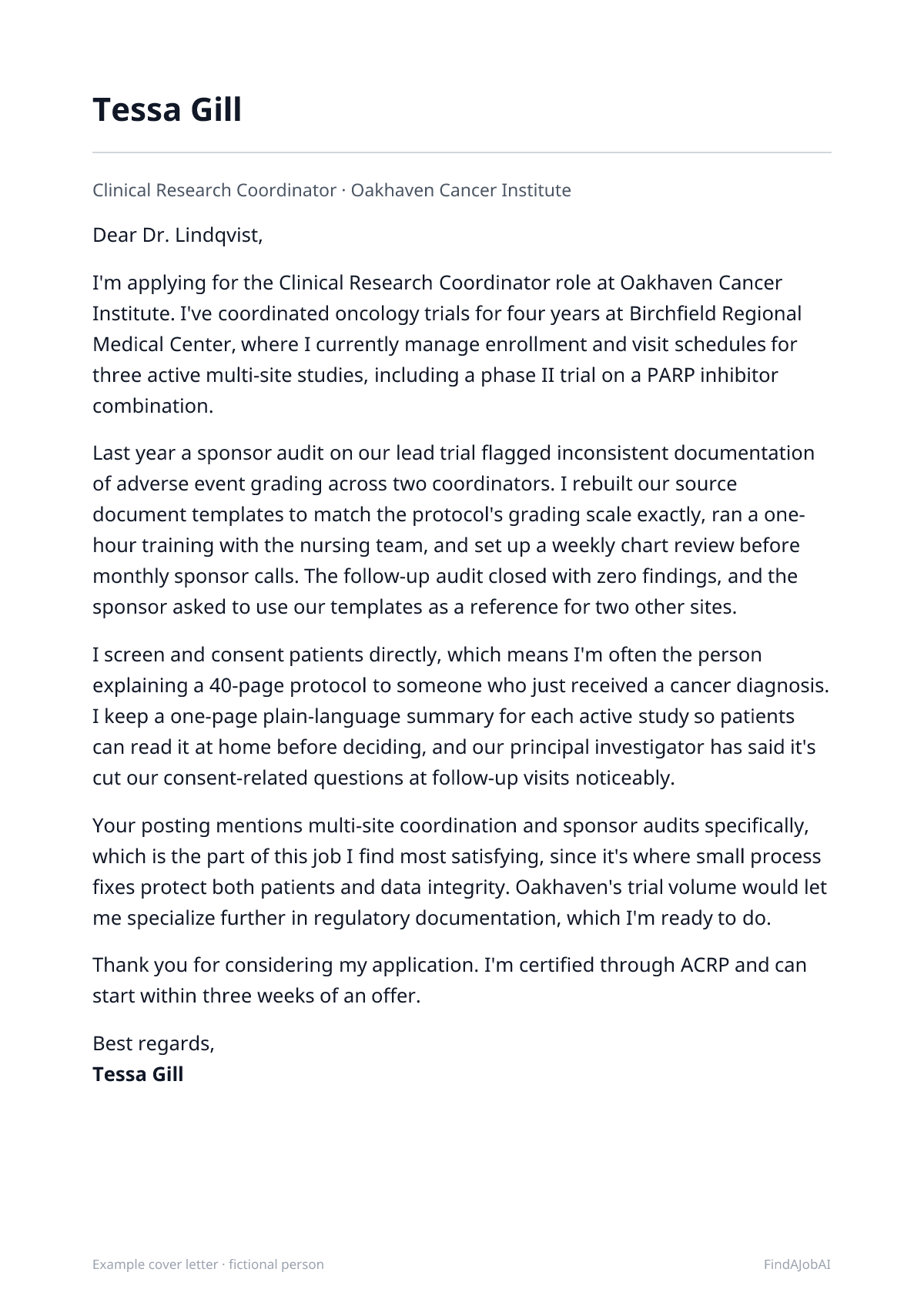
Dear Dr. Lindqvist,
I'm applying for the Clinical Research Coordinator role at Oakhaven Cancer Institute. I've coordinated oncology trials for four years at Birchfield Regional Medical Center, where I currently manage enrollment and visit schedules for three active multi-site studies, including a phase II trial on a PARP inhibitor combination.
Last year a sponsor audit on our lead trial flagged inconsistent documentation of adverse event grading across two coordinators. I rebuilt our source document templates to match the protocol's grading scale exactly, ran a one-hour training with the nursing team, and set up a weekly chart review before monthly sponsor calls. The follow-up audit closed with zero findings, and the sponsor asked to use our templates as a reference for two other sites.
I screen and consent patients directly, which means I'm often the person explaining a 40-page protocol to someone who just received a cancer diagnosis. I keep a one-page plain-language summary for each active study so patients can read it at home before deciding, and our principal investigator has said it's cut our consent-related questions at follow-up visits noticeably.
Your posting mentions multi-site coordination and sponsor audits specifically, which is the part of this job I find most satisfying, since it's where small process fixes protect both patients and data integrity. Oakhaven's trial volume would let me specialize further in regulatory documentation, which I'm ready to do.
Thank you for considering my application. I'm certified through ACRP and can start within three weeks of an offer.
Best regards,
Tessa Gill
Example 2 · Career changer
Certified nursing assistant moving into clinical research
Cameron has worked bedside for five years and shadowed a research team. The ad is entry-level and mentions working with a cardiology PI.
Example letter · fictional
Dear Hiring Manager,
I'm applying for the Clinical Research Coordinator I role at Marrow Creek Heart Institute. I've worked as a certified nursing assistant on a cardiac step-down unit for five years, and over the past year I've shadowed our hospital's research team on two heart failure trials to learn the coordinator side of patient care.
During that shadowing, I helped a coordinator catch a scheduling gap: three patients were due for a protocol-required echocardiogram within a window that our clinic's standard booking process couldn't reliably meet. I built a simple tracking sheet flagging each patient's visit window five days out, and we haven't missed a window since. The lead coordinator had me start pulling vitals and drawing labs for visits under her supervision.
Bedside work has taught me to read patients accurately, which matters in research when someone agrees to a study mostly to please their care team. I've sat in on four consent conversations and have a clear sense of what a patient needs explained twice. I'm completing an ACRP coordinator certification course now and expect to finish it before I'd start.
Your posting mentions working closely with a cardiology PI on enrollment for a heart failure trial. I already know this patient population from the floor, and I'd bring both that clinical judgment and the documentation habits I've been building deliberately over the past year.
Thank you for your time. I'd welcome the chance to discuss how my bedside experience would transfer to this role.
Sincerely,
Cameron Reinhardt
Example 3 · Senior or lead
Lead coordinator applying to build a research department from scratch
Jamie has led a four-coordinator team at a teaching hospital. The ad is for a first-ever Lead Research Coordinator at a growing outpatient clinic.
Example letter · fictional
Dear Ms. Castellanos,
I'm applying for the Lead Clinical Research Coordinator role at Thornbury Outpatient Specialists. For the past three years I've led a team of four coordinators at Ashgrove University Hospital, running trials across endocrinology and rheumatology, and before that I spent six years coordinating independently. I'd like to build a research function from its first stage.
Your ad notes that Thornbury has run occasional investigator-initiated studies but has no dedicated research infrastructure yet. Ashgrove had a similar gap when I joined: four coordinators each kept their own binder system, and a sponsor audit in my second year found three studies with no consistent delegation-of-authority log. I built one shared SOP manual, standardized our source documents across studies, and set up a monthly internal file review before any sponsor visit. Our next two audits closed with no major findings, and our site's enrollment-to-screen-failure ratio improved enough that two sponsors asked us to open additional arms.
Research earns a clinic's trust through patients who aren't harmed by convenience and investigators who aren't buried in paperwork. When a rheumatology PI was missing enrollment targets, I found that most eligible patients were being identified too late in their visit for proper screening; I set up a pre-visit chart flag for the scheduling team, and enrollment for that study caught up within two quarters.
I've trained six coordinators from entry level and built our current onboarding checklist. I haven't yet set up a research budget or billing compliance process from zero, since Ashgrove had that infrastructure before I arrived, and at Thornbury I'd expect to build it carefully alongside your finance and compliance staff.
I'd welcome a conversation about which studies you most want to bring in-house first, and what your physicians currently find hardest about the idea of research at Thornbury.
Sincerely,
Jamie Oliveira
All three letters, and the short version below, are fictional: the people, employers and numbers are invented. Borrow the structure, never the facts.
- Prefer to write it yourself? Use the free cover letter template.
- Check your CV against the job first: the free CV score shows the missing keywords.
Why the first letter works, paragraph by paragraph
Paragraph 1: Opening
Names the current employer's trial volume and a specific study (a PARP inhibitor combination trial), which tells the reader the writer works at a comparable level of complexity, not just 'in research' generally.
Paragraph 2: The audit fix
A real problem (inconsistent adverse event documentation), the fix (rebuilt templates, training, weekly review) and the outcome (a clean follow-up audit other sites now reference) shows regulatory judgment, which is the core fear in hiring a coordinator.
Paragraph 3: Patient-facing judgment
Consent is a clinical and ethical skill, not paperwork. The plain-language summary detail shows the writer treats it that way, with a specific effect on follow-up questions.
Paragraph 4: Why this company
Mirrors the ad's own language (multi-site coordination, sponsor audits) and gives a specific, plausible reason the move makes sense for the writer's growth.
Paragraph 5: Close
States certification and availability plainly, which research sites need to plan around for IRB and sponsor onboarding timelines.
What the career changer's letter does differently
The career changer's letter stays honest about the boundary: shadowing and supervised tasks, not independent coordination. It uses one concrete catch (the echocardiogram window) to show initiative, names an in-progress certification, and links bedside consent instincts directly to what the ad's cardiology trial needs.
What the senior letter does differently
The lead coordinator's letter reports institutional habits rather than one study: a shared SOP manual, a delegation-log fix after an audit finding, and an enrollment-to-screen-failure ratio that improved. It names a decision that changed an investigator's workflow, and states plainly where the writer's experience has a gap (budget and billing compliance) rather than overclaiming.
Short clinical research coordinator cover letter: an email-ready version
Many applications arrive as an email or a small text box, and a full page doesn't fit. This version runs 120 to 150 words and keeps only what a reader needs to decide whether to reply. A coordinator answers a pediatrics clinic's short online application form by email because their upload tool was down.
Short version · email · fictional133 words
Subject: Clinical Research Coordinator application – pediatrics, IRB experience – Saoirse Devenney
Hello Mx. Okoye,
I'm applying for the Clinical Research Coordinator role at Hollin Pediatric Partners. I have three years of experience coordinating pediatric asthma and allergy trials at a children's hospital, where I manage enrollment, visit scheduling and IRB continuing reviews independently.
My most useful project was rebuilding our consent process for school-age children: I added an age-appropriate assent script alongside the parent consent form, and our IRB cited it as a model during our last continuing review. Enrollment in that study rose from nine to twenty-two patients over six months, partly because families trusted the clearer explanation.
Pediatric research requires patience most adult studies don't, and I'd like to bring that specifically to your team. My resume is attached, and I'm glad to share the assent script on request.
Best,
Saoirse Devenney
A short application keeps one concrete process fix (the age-appropriate assent script) and its enrollment effect, since pediatric research lives or dies on family trust. Offering the script on request signals substance without padding the email with it.
Opening lines that work for clinical research coordinator cover letters
The first sentence decides whether the second gets read. Here are six openings, one for each situation you might be in. Pick the one that matches yours and swap in your own facts: every name and number below is invented.
1. You have a standout result
An assent script I wrote for school-age patients helped our enrollment more than double over six months, and your ad's focus on pediatric trials is exactly the population I'd like to keep working with.
2. The ad names a problem you've solved
Your ad mentions coordinators juggling screening across three studies at once. At my current site I built a shared screening calendar that cut our missed-window rate for protocol visits, and I'd bring that same system here.
3. Someone referred you
Your principal investigator, Dr. Osei Boatemaa, has worked with me on two prior studies from the coordinator side. She mentioned you need someone comfortable running sponsor audits independently, which is what prompted this application.
4. You admire what they build
I've been a participant in a long-running cohort study through your health system for six years, and the coordinators' care for detail during my own visits is part of why I'm applying to do that work myself.
5. You're new to the field or switching into it
I spent four years as a medical assistant drawing labs and rooming patients before I started shadowing our research team to learn protocol coordination. I'm ready to do that work directly now.
6. You have senior scope or a specialism
As lead coordinator for an endocrinology research team for seven years, I built the SOP manual our site still audits against. I'm looking for a role setting up research infrastructure from its earliest stage.
How to write a clinical research coordinator cover letter
Five steps, in the order you'd write them. The shape stays the same for every job (a short opening, proof, a reason for this employer, a close), and what goes into each part is what changes with the role.
Name the therapeutic area and study type from the ad
Coordinator work differs sharply between oncology, pediatrics, cardiology or device trials, and between industry-sponsored and investigator-initiated studies. Read the ad for both, then choose an example from your own background that matches, even if the condition differs slightly.
Open with a problem you solved, not your job title history
State what went wrong in enrollment, documentation or an audit, and what you changed about it. A reader scanning for judgment finds it faster in a problem-and-fix sentence than in a list of prior employers and dates, which belongs on the resume.
Show one number that reflects patient or data safety
An enrollment count, a screen-failure rate, an audit outcome or a time-to-consent figure works well if it's tied to something you changed. Avoid counting tasks completed, such as visits conducted; show what improved because you were there.
Address consent and patient communication directly
Coordinators spend real time explaining protocols to people making hard decisions. One sentence about how you handle a consent conversation, such as a plain-language summary or an assent script, tells a reader more about your judgment than any system you've used.
State certification status and availability plainly
Name your ACRP or SOCRA certification status, including in progress with an expected date, and your available start date if you have one. Sites plan sponsor and IRB onboarding around this, so stating it clearly, even briefly, removes a question from the first interview.
Clinical Research Coordinator cover letter do's and don'ts
Do
- Name a specific protocol, therapeutic area or study phase rather than saying 'clinical trials' generally.
- Describe one documentation, enrollment or audit problem you solved, and how you know it worked.
- Mention any certification (ACRP, SOCRA) and its status plainly, including in-progress with an expected date.
Don't
- Don't say you're 'passionate about advancing medicine'; describe one study and one patient-facing decision.
- Don't list every system you've touched (CTMS, EDC, IRB portals) without tying one to a problem you solved in it.
- Don't share identifiable patient details or sponsor names from active studies; describe the process instead.
Common clinical research coordinator cover letter mistakes
Each one is easy to make and quick to fix before you send the letter.
Writing generally about 'passion for advancing medicine'
Every applicant writes this. Replace it with one study you worked on and one decision you made in it, such as a consent process you improved or a documentation gap you caught before an audit did.
Naming every system with no example
Naming Veeva, REDCap, OnCore and an IRB portal in a row shows exposure, not skill. Pick the one most relevant to the ad and describe a specific task you did in it, such as building a tracking report or fixing a data entry error pattern.
Treating patient consent as paperwork
Describing consent only as 'obtaining signatures' undersells the job's hardest skill. Describe how you explain risk or handle a patient's hesitation, since this is often what a PI actually watches for in a coordinator.
Omitting certification or license status
Leaving out whether you're ACRP or SOCRA certified, or a CNA, RN or MA license status, forces the reader to guess or ask. State it in one clause, with a date if it's in progress.
Sharing identifiable study or patient details
Naming a sponsor, drug code or patient detail from an active study can violate confidentiality agreements. Describe the process or problem generically enough to protect the study while still showing what you did.
Email subject lines for clinical research coordinator applications
Applying by email? Put the job title, any reference number and your name in the subject line.
- Clinical Research Coordinator application – oncology, multi-site trials – Tessa Gill
- Clinical Research Coordinator I – CNA transitioning into research – Cameron Reinhardt
- Application: Clinical Research Coordinator, Cardiology (Req. 2217) – Tessa Gill
Everything for Clinical Research Coordinators
- Clinical Research Coordinator resume exampleA full resume, plus bullet and summary examples
- Clinical Research Coordinator interview questions30 questions with sample answers
- Clinical Research Coordinator job descriptionDuties, skills and requirements
- Career change cover letter: template + examples
Other cover letter examples
Clinical Research Coordinator cover letter FAQ
What should I write in a clinical research coordinator cover letter?
Name a specific study or therapeutic area, then one problem you solved in enrollment, documentation or an audit, and how you confirmed it worked. Close with your certification status. Your software list belongs on your resume.
How do I write a clinical research coordinator cover letter with no research experience?
Use direct patient care experience, such as bedside work or medical assisting, and describe one example of careful documentation or a scheduling problem you solved. Name any coursework or certification in progress and connect your clinical judgment to the study population in the ad.
Should I mention GCP or ACRP certification in the letter?
Yes, in one short sentence stating whether it's current, and if not, when you expect to complete it. Sites often need this for sponsor and IRB onboarding, so stating it plainly saves a question later.
How long should a clinical research coordinator cover letter be?
Four to five short paragraphs is enough: who you are, one specific problem you solved, your patient-facing judgment, and why this study or site fits you. Save protocol lists and full certification history for your resume.
How we built this page
The FindAJobAI team wrote the three example letters, the short email version, the opening lines and the advice for clinical research coordinator roles. The people, employers and numbers in the letters are invented; the structure, the kind of evidence and the order of the paragraphs are the parts to copy.
Once we track enough live clinical research coordinator job ads, this page also shows the skills they ask for most, counted the same way as our in-demand skills report.
Last reviewed on November 1, 2026.