Detective Cover Letter Example (2026)
By FindAJobAI Team Updated How we built this page
Promotion boards and hiring commanders read detective cover letters for judgment and follow-through. Name your years of service and unit, give a figure such as arrests charged or cases cleared, and describe one investigation where careful work changed the outcome. Keep every case detail general. These cover letter examples show how to do that at three career stages.
Detective cover letter template
This letter as a one-page template: an opening that names the job and your strongest fact, proof that answers the ad, a reason for this employer and a short close.
After you sign up, FindAJobAI drafts your own letter for a real job from your CV in this format, and you edit it before you send it.
Example 1 · Experienced
Patrol officer applying for a detective assignment
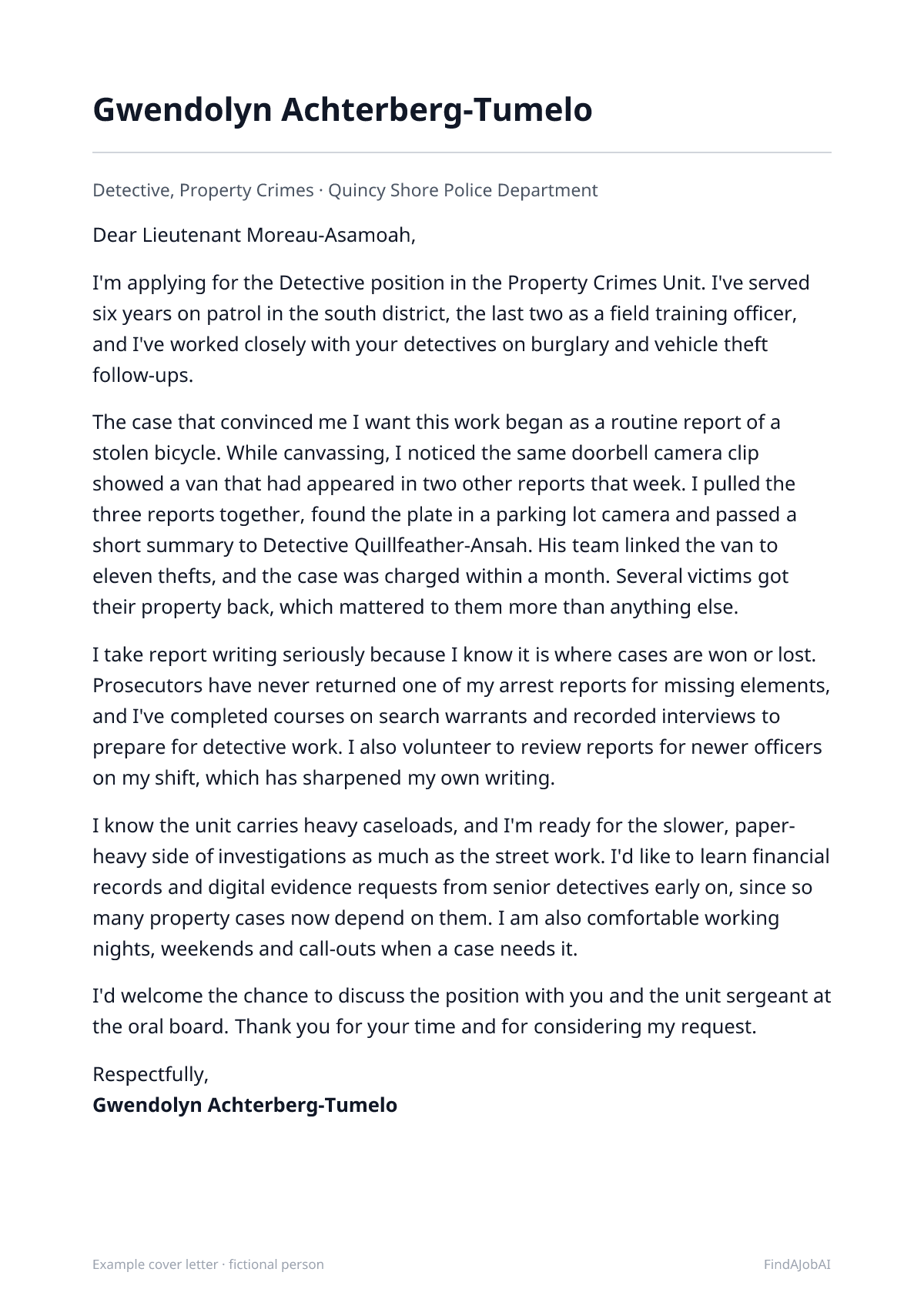
Gwendolyn has six years on patrol and often follows up on property cases. The posting is for a detective in her department's property crimes unit.
Example letter · fictional
Dear Lieutenant Moreau-Asamoah,
I'm applying for the Detective position in the Property Crimes Unit. I've served six years on patrol in the south district, the last two as a field training officer, and I've worked closely with your detectives on burglary and vehicle theft follow-ups.
The case that convinced me I want this work began as a routine report of a stolen bicycle. While canvassing, I noticed the same doorbell camera clip showed a van that had appeared in two other reports that week. I pulled the three reports together, found the plate in a parking lot camera and passed a short summary to Detective Quillfeather-Ansah. His team linked the van to eleven thefts, and the case was charged within a month. Several victims got their property back, which mattered to them more than anything else.
I take report writing seriously because I know it is where cases are won or lost. Prosecutors have never returned one of my arrest reports for missing elements, and I've completed courses on search warrants and recorded interviews to prepare for detective work. I also volunteer to review reports for newer officers on my shift, which has sharpened my own writing.
I know the unit carries heavy caseloads, and I'm ready for the slower, paper-heavy side of investigations as much as the street work. I'd like to learn financial records and digital evidence requests from senior detectives early on, since so many property cases now depend on them. I am also comfortable working nights, weekends and call-outs when a case needs it.
I'd welcome the chance to discuss the position with you and the unit sergeant at the oral board. Thank you for your time and for considering my request.
Respectfully,
Gwendolyn Achterberg-Tumelo
Example 2 · Career changer
Military criminal investigator moving to a city police department
Marguerite spent eight years as a military criminal investigator. The posting is for a lateral detective with investigative experience.
Example letter · fictional
Dear Captain Delacourt-Ingersoll,
I'm writing to apply for the lateral Detective position at Cape Ann Regional Police. For eight years I served as a criminal investigator in the Army, handling theft, fraud, assault and drug cases on two bases, and I left the service this summer.
Military investigations use the same building blocks as civilian work: interviews, evidence, warrants and close coordination with prosecutors. On my last assignment, I led a fraud case involving false travel claims. I traced payments across several accounts, interviewed fifteen witnesses and wrote the case file that supported charges against four people, all of whom were later convicted. I also recovered most of the money through the finance office, working closely with auditors.
I've testified at courts-martial and administrative hearings and know how defense counsel test an investigator's notes. That experience made me careful about recording every step, from evidence collection to how a statement was taken. I still keep notes in the same disciplined format, with times and sources for every entry.
I'm aware of what I still need to learn. I have not worked under state criminal law, and civilian victims and communities differ from a base population. I've started the state's lateral certification program and would value time with an experienced partner while I learn your procedures and the courts. I am fully prepared to start on any shift and take on whatever cases the bureau needs most.
I would welcome the chance to meet with you and discuss how my experience could support your investigations bureau. Thank you for your consideration.
Respectfully,
Marguerite Okonjo-Strathallan
Example 3 · Senior or lead
Experienced detective applying for a sergeant role in special victims
Leander has twelve years as a detective, mostly in special victims work. The posting is for a detective sergeant to supervise the special victims squad.
Example letter · fictional
Dear Major Castellano-Ibekwe,
I'm applying for the Detective Sergeant position supervising the Special Victims Squad. I've been a detective for twelve years, the last eight investigating sexual assault, child abuse and domestic violence cases, and I've served as acting sergeant during two long vacancies.
Special victims cases depend on trust as much as evidence. Several years ago our squad lost many cases because victims stopped responding after the first interview. I worked with two advocate agencies to set up a joint first contact, where an advocate meets the victim with the detective and stays involved. Victims stayed engaged far more often, and prosecutors told us our cases had become noticeably stronger. The joint first contact is now standard practice across our office.
As acting sergeant, I reviewed every case file weekly and introduced a simple checklist for forensic interview scheduling and evidence requests. It cut delays that had frustrated prosecutors and helped newer detectives know what to do next without waiting for me. Average time from report to forensic interview also fell during that period, and victims spent less time waiting for the next step in their cases.
Supervising the squad permanently would bring challenges I have only handled briefly, including performance reviews and the strain this work puts on detectives over time. I would start by meeting each detective individually, reviewing caseloads with you and making sure wellness resources are used rather than only offered. I would also meet the advocate agencies and prosecutors we rely on.
I would welcome the opportunity to discuss the squad's priorities and how I could support them. I appreciate your time and consideration.
Respectfully,
Leander Fairweather-Obiora
All three letters, and the short version below, are fictional: the people, employers and numbers are invented. Borrow the structure, never the facts.
- Prefer to write it yourself? Use the free cover letter template.
- Check your CV against the job first: the free CV score shows the missing keywords.
Why the first letter works, paragraph by paragraph
Paragraph 1: Opening
States years of service, district, training role and existing work with detectives, which places the applicant immediately.
Paragraph 2: Case story
Shows initiative and pattern spotting on a small case that grew into a charged series, without sharing any identifying details.
Paragraph 3: Report writing
Proves the skill detectives rely on most, with a concrete record and relevant training.
Paragraph 4: Realistic expectations
Shows the applicant understands caseloads and paperwork and names the skills they want to build first.
Paragraph 5: Close
Refers to the oral board, which fits how most departments select detectives.
What the career changer's letter does differently
The career changer's letter maps military investigations onto civilian detective work through interviews, financial tracing and testimony. It is honest about state law and community differences and shows steps already taken to close those gaps.
What the senior letter does differently
A sergeant letter moves from personal cases to squad results: a partnership that kept victims engaged, a review routine that cut delays and a realistic view of supervising detectives in demanding work.
Short detective cover letter: an email-ready version
Many applications arrive as an email or a small text box, and a full page doesn't fit. This version runs 120 to 150 words and keeps only what a reader needs to decide whether to reply. A fraud detective emails a bank's investigations manager who posted a senior investigator opening and asked for a short note with a resume.
Short version · email · fictional128 words
Subject: Senior Fraud Investigator – detective, 7 years financial crimes – Rosalind Kettleborough-Adjei
Dear Ms. Pemberton-Uzoaga,
I'm writing about the Senior Fraud Investigator opening on your financial crimes team. For seven years I've been a detective in a city financial crimes unit, investigating elder fraud, check schemes and account takeovers.
Much of my work starts with bank records. Last year I traced funds from a romance scam through nine accounts, which led to charges and the return of most of the victims' money. I write clear case summaries that prosecutors and compliance teams can act on, and I am comfortable presenting findings to internal teams.
I hold the Certified Fraud Examiner credential. My resume is attached, and I'd be glad to talk at a time that suits you. I am available for a call any weekday afternoon.
Kind regards,
Rosalind Kettleborough-Adjei
The short version suits a bank investigations manager: unit and case types first, one tracing example with an outcome, then the CFE credential and a simple next step.
Opening lines that work for detective cover letters
The first sentence decides whether the second gets read. Here are six openings, one for each situation you might be in. Pick the one that matches yours and swap in your own facts: every name and number below is invented.
1. You have a standout result
After six years on patrol and two as a field training officer, I'm ready to carry a property crimes caseload in your unit.
2. The ad names a problem you've solved
Your posting asks for detectives who can build cases from records. Linking three small theft reports into an eleven-case series is the work I'm proudest of.
3. Someone referred you
Detective Sergeant Ilse Waverley-Nkemelu encouraged me to apply after I assisted her squad on a burglary pattern last year.
4. You admire what they build
Eight years as a military criminal investigator have prepared me for the interviews, evidence work and testimony your detectives handle.
5. You're new to the field or switching into it
As a special victims detective who has served twice as acting sergeant, I'm ready to lead the squad permanently.
6. You have senior scope or a specialism
Your department's focus on elder fraud is the area where I most want to put my financial records experience to work.
How to write a detective cover letter
Five steps, in the order you'd write them. The shape stays the same for every job (a short opening, proof, a reason for this employer, a close), and what goes into each part is what changes with the role.
State service and assignments
Open with your years of service, current assignment and any roles such as field training officer or task force member. Boards can then judge your readiness at once and compare you fairly with other candidates for the same assignment.
Tell one case in general terms
Choose an investigation where your judgment changed the outcome, such as spotting a pattern or finding key evidence. Describe it without names, dates or case numbers, and focus on what you noticed and did at each step.
Prove you can write
Detectives are judged by the quality of their case files. Mention your report record with prosecutors, warrants written or courses completed, because strong writing is the clearest sign you will build cases that hold up in court.
Show you understand the job
Acknowledge heavy caseloads, paperwork, night call-outs and long days in court. Boards want people who know detective work is slower and more detailed than patrol, and who are ready for both sides of it every week.
Close toward the oral board
Most departments select detectives through a test and an oral board. End by welcoming that step or a meeting with the unit commander, and keep the tone respectful and direct throughout the letter and in the board itself.
Detective cover letter do's and don'ts
Do
- Name your years of service, unit and any field training or task force roles.
- Give one figure, such as arrests charged, cases cleared or warrants written.
- Describe one investigation in general terms that shows your judgment.
Don't
- Don't include names, case numbers or details from open investigations.
- Don't exaggerate your role in cases that other detectives led.
- Don't complain about your sergeant, shift or department in the letter.
Common detective cover letter mistakes
Each one is easy to make and quick to fix before you send the letter.
Telling war stories
Dramatic arrests impress less than careful follow-up. Choose a case that shows investigation, not only action.
Naming people or open cases
Never include names, case numbers or anything from open cases. Describe the type and scale of the case only.
Claiming other detectives' work
Boards often know the cases. Be exact about your role and credit the team where it is due.
Ignoring the paperwork
Show that you value report writing and court preparation, not only street work, since both decide case outcomes.
Email subject lines for detective applications
Applying by email? Put the job title, any reference number and your name in the subject line.
- Detective, Property Crimes – 6 years patrol and FTO – Gwendolyn Achterberg-Tumelo
- Lateral Detective – 8 years military criminal investigations – Marguerite Okonjo-Strathallan
- Detective Sergeant, Special Victims – 12 years investigations – Leander Fairweather-Obiora
Everything for Detectives
- Detective resume exampleA full resume, plus bullet and summary examples
- Detective interview questions30 questions with sample answers
- Detective job descriptionDuties, skills and requirements
- Career change cover letter: template + examples
Other cover letter examples
Detective cover letter FAQ
What should a detective cover letter include?
Your years of service, assignments, a figure such as cases cleared or arrests charged, one investigation that shows your judgment, and your training. Keep case details general and the letter to one page.
Do I need a cover letter for a detective promotion?
Many departments ask for a letter of interest with the application. Even when optional, a short letter helps the board understand your investigative work and why you want the assignment.
How do I write a detective cover letter from the military or private sector?
Map your investigative work onto police tasks: interviews, evidence, warrants and testimony. Be clear about state law or certification you still need and the steps you are taking.
How we built this page
The FindAJobAI team wrote the three example letters, the short email version, the opening lines and the advice for detective roles. The people, employers and numbers in the letters are invented; the structure, the kind of evidence and the order of the paragraphs are the parts to copy.
Once we track enough live detective job ads, this page also shows the skills they ask for most, counted the same way as our in-demand skills report.
Last reviewed on November 1, 2026.