Electrician Cover Letter Example (2026)
By FindAJobAI team Updated How we built this page
Electrician job ads mostly list a license level and a type of work, commercial, residential, or industrial, so most applicants read the same on paper. The cover letter is where you name the panels you've worked on, the problems you found that others missed, and whether you can run a job or just work one.
Electrician cover letter template
This letter as a one-page template: an opening that names the job and your strongest fact, proof that answers the ad, a reason for this employer and a short close.
After you sign up, FindAJobAI drafts your own letter for a real job from your CV in this format, and you edit it before you send it.
Example 1 · Experienced
Commercial electrician applying to a growing contractor
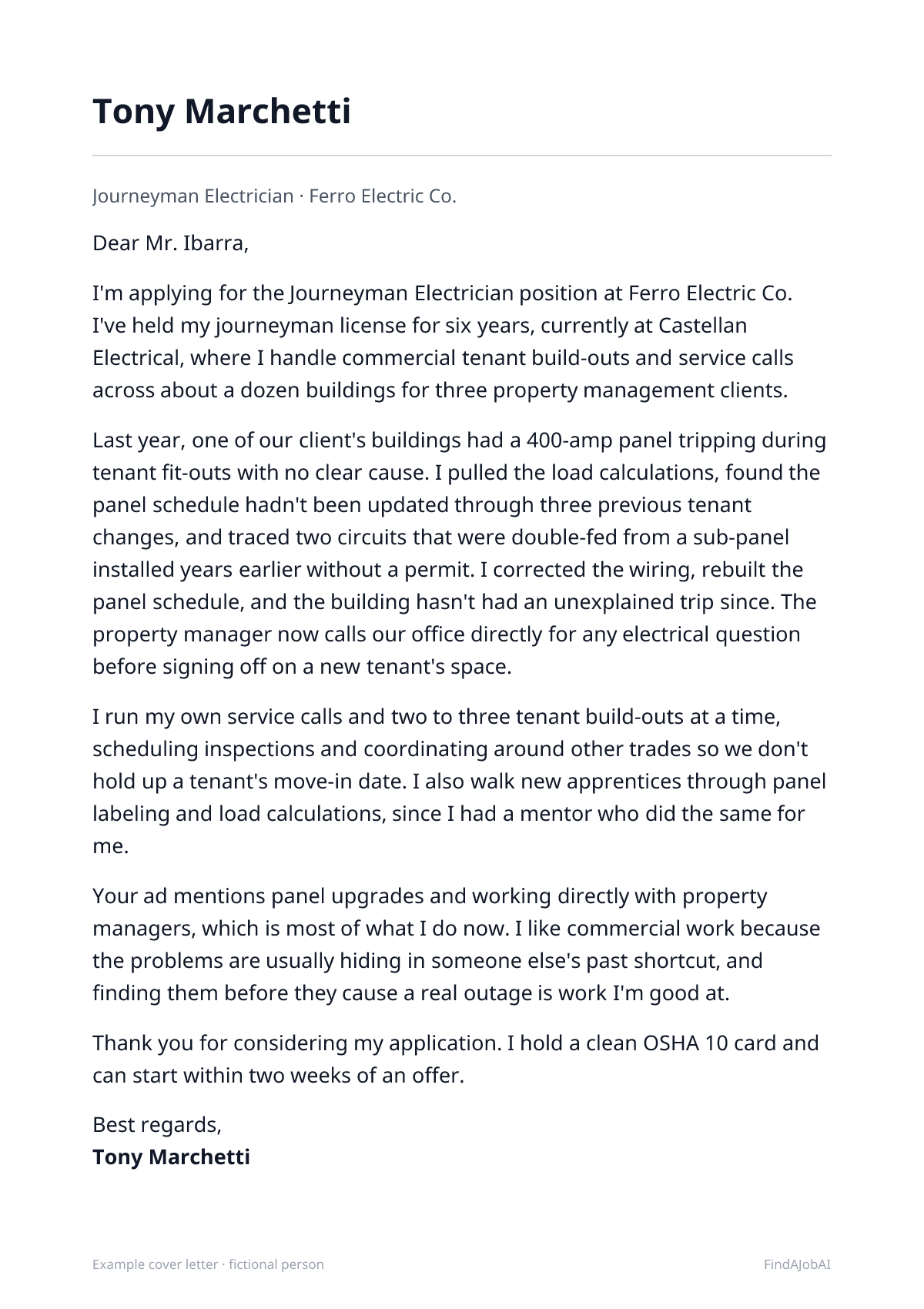
Tony is a licensed journeyman doing tenant build-outs and service work. The ad asks for panel upgrade experience and direct work with property managers.
Example letter · fictional
Dear Mr. Ibarra,
I'm applying for the Journeyman Electrician position at Ferro Electric Co. I've held my journeyman license for six years, currently at Castellan Electrical, where I handle commercial tenant build-outs and service calls across about a dozen buildings for three property management clients.
Last year, one of our client's buildings had a 400-amp panel tripping during tenant fit-outs with no clear cause. I pulled the load calculations, found the panel schedule hadn't been updated through three previous tenant changes, and traced two circuits that were double-fed from a sub-panel installed years earlier without a permit. I corrected the wiring, rebuilt the panel schedule, and the building hasn't had an unexplained trip since. The property manager now calls our office directly for any electrical question before signing off on a new tenant's space.
I run my own service calls and two to three tenant build-outs at a time, scheduling inspections and coordinating around other trades so we don't hold up a tenant's move-in date. I also walk new apprentices through panel labeling and load calculations, since I had a mentor who did the same for me.
Your ad mentions panel upgrades and working directly with property managers, which is most of what I do now. I like commercial work because the problems are usually hiding in someone else's past shortcut, and finding them before they cause a real outage is work I'm good at.
Thank you for considering my application. I hold a clean OSHA 10 card and can start within two weeks of an offer.
Best regards,
Tony Marchetti
Example 2 · Career changer
HVAC technician moving into electrical work as a second-year apprentice
Darnell wired HVAC controls for years before starting an electrical apprenticeship. The ad is for a second-year apprentice on residential new construction.
Example letter · fictional
Dear Hiring Manager,
I'm applying for the Electrical Apprentice position at Renwick Builders. For six years I worked as an HVAC technician, and for the last two years I've also been enrolled in an electrical apprenticeship program, now entering my second year with about 1,400 hours of on-the-job training logged.
As an HVAC tech, I wired low-voltage control circuits and 240-volt disconnects on nearly every installation, and I was often the one other techs asked when a control board wouldn't communicate with a thermostat. That work is what pushed me to go after a full electrical license instead of staying in HVAC. One winter I traced a recurring no-heat call to a miswired common on the thermostat cable that two earlier visits had missed, and the customer's callbacks stopped.
In my apprenticeship, I've worked under a journeyman on residential rough-in for new construction, running and stapling NM cable, setting boxes to code height, and wiring panels under supervision for six single-family homes. My instructor has had me demonstrate proper grounding and bonding to the rest of my class twice.
Your posting is for residential new construction, which is exactly the rough-in and panel work I've been doing in my apprenticeship, and six years of reading equipment wiring diagrams under time pressure on service calls taught me to work carefully without slowing a job down. I also keep a pocket log of every inspection I've attended, with the inspector's notes, so I repeat a correction only once.
Thank you for your time. I have my OSHA 10 card and apprenticeship hour log available, and I'd welcome the chance to talk.
Sincerely,
Darnell Price
Example 3 · Senior or lead
Lead electrician applying to run crews for an industrial contractor
Simone has run a four-person crew for three years. The ad is for a lead electrician who will also handle permitting and train apprentices on industrial sites.
Example letter · fictional
Dear Mr. Nakamura,
I'm applying for the Lead Electrician role at Harrowgate Industrial Services. For the last three years I've led a four-person crew at Brennan Mechanical, mostly on manufacturing plant upgrades, and before that I worked six years as a journeyman on industrial sites. I'm ready to lead crews on larger jobs with direct permitting responsibility.
Your ad mentions permit delays holding up industrial jobs. At Brennan, our crews used to lose a day or more waiting on inspections because permits were pulled late or missing required documentation. I started pulling permits the day a job was scheduled instead of the day it started, and built a one-page checklist of what each jurisdiction we work in requires. Permit-related delays on my crew's jobs dropped from an average of two per month to less than one per quarter.
On a plant upgrade last year, a client's maintenance team assumed a recurring breaker trip was a bad breaker. I traced it to a motor that had been rewired out of phase during a previous repair, years before I arrived. Catching it before we replaced the breaker again saved the client an unnecessary part and a second shutdown, and the plant manager now has us review any electrical repair before it's closed out.
I've trained six apprentices to journeyman status over the past three years, rotating them through panel work, troubleshooting, and permitting so none of them leave my crew knowing only one part of the job. I haven't managed a crew larger than four, and at Harrowgate I'd want to learn how your eight-person crews are structured before leading one.
I'd welcome a conversation about which jurisdictions give your crews the most permitting trouble, and where you'd want a lead electrician to start.
Sincerely,
Simone Castellano
All three letters, and the short version below, are fictional: the people, employers and numbers are invented. Borrow the structure, never the facts.
- Prefer to write it yourself? Use the free cover letter template.
- Check your CV against the job first: the free CV score shows the missing keywords.
Why the first letter works, paragraph by paragraph
Paragraph 1: Opening
States the license level, years held, and the specific kind of work (tenant build-outs and service calls) along with the scale (a dozen buildings, three clients), which tells the reader exactly what experience is being offered.
Paragraph 2: The problem he found
A specific technical problem (an outdated panel schedule and an unpermitted double-fed circuit), what he did to fix it, and the lasting result: no further trips, and a property manager who now calls him directly.
Paragraph 3: Running the job
Shows he manages his own schedule and coordinates with other trades, plus a mentoring detail, both signs he can be trusted with a job site, not just a task list.
Paragraph 4: Why this company
Mirrors the ad's stated focus and adds a genuine reason the work suits him, finding other people's past shortcuts, without overstating it.
Paragraph 5: Close
Includes two concrete, checkable facts, an OSHA 10 card and immediate availability, that a contractor can act on right away.
What the career changer's letter does differently
The career changer's letter uses six years of adjacent electrical work from HVAC, not just interest in the trade, and backs it with specific apprenticeship hours and hands-on rough-in experience. It names a concrete technical habit, reading wiring diagrams under time pressure, that transfers directly to the new ad's residential new construction work.
What the senior letter does differently
A lead electrician letter shows judgment across a crew's whole job cycle, not one circuit: permit delays cut from two a month to under one a quarter, a diagnosis that saved a client an unnecessary repair, and six apprentices trained to journeyman status. It names a real gap, never leading a crew larger than four, rather than implying full readiness for an eight-person crew.
Short electrician cover letter: an email-ready version
Many applications arrive as an email or a small text box, and a full page doesn't fit. This version runs 120 to 150 words and keeps only what a reader needs to decide whether to reply. An electrician answers a contractor's short online application question, 'Why are you a fit for this job?', sent as an email because the online form kept timing out.
Short version · email · fictional121 words
Subject: Residential Electrician application – panel upgrades and service calls – Felix Okafor
Hello Ms. Petrova,
I'm applying for the Residential Electrician position at Dunmore Electric. I've held my journeyman license for four years, most recently doing panel upgrades and service calls for a residential contractor.
Last year I diagnosed a recurring breaker trip at a client's home that two prior visits from another company had missed. It turned out to be a loose neutral connection in the main panel, not the appliance everyone had blamed, and the fix took under an hour once I found it.
I like the diagnostic side of residential work, and your posting's focus on panel upgrades matches most of what I already do. My resume is attached, and I'd welcome the chance to talk further.
Best,
Felix Okafor
The short version keeps one diagnostic story that shows judgment, cutting the crew leadership and mentoring detail a longer letter could include. It still names the license level and a concrete technical detail, the loose neutral connection, instead of a vague claim of skill.
Opening lines that work for electrician cover letters
The first sentence decides whether the second gets read. Here are six openings, one for each situation you might be in. Pick the one that matches yours and swap in your own facts: every name and number below is invented.
1. You have a standout result
Last year I traced a recurring breaker trip to a loose neutral connection that two previous electricians had missed. I'd like to bring that kind of troubleshooting to your service team.
2. The ad names a problem you've solved
Your ad mentions permit delays slowing jobs down. On my current crew, I rebuilt how we pull permits and cut our delays from two a month to less than one a quarter.
3. Someone referred you
Your foreman, Darius Holt, and I worked together on a plant shutdown two years ago, and he mentioned your opening, knowing I'm looking for a role leading crews on industrial sites.
4. You admire what they build
I've had work done on my own house by your company twice, and the way your electricians explained what they found made me want to apply here myself.
5. You're new to the field or switching into it
I spent six years as an HVAC technician wiring control circuits before entering an electrical apprenticeship, and that hands-on troubleshooting is what pushed me toward a full electrical license.
6. You have senior scope or a specialism
As a lead electrician for three years, I trained six apprentices to journeyman status and cut my crew's permit delays by more than half. I'm ready to lead larger crews on industrial jobs.
How to write an electrician cover letter
Five steps, in the order you'd write them. The shape stays the same for every job (a short opening, proof, a reason for this employer, a close), and what goes into each part is what changes with the role.
Open with your license level, years, and the type of work in the ad
State your exact license status (apprentice, journeyman, master) and whether your experience is residential, commercial, or industrial, matching the ad's focus. A contractor scanning applications needs this in the first sentence to know you're a real fit.
Describe one problem you diagnosed, not just tasks performed
Pick a specific fault you traced, what caused it, and what you did differently than whoever looked at it before. A clear diagnostic story shows judgment, which separates an electrician who can run a job from one who follows a checklist.
Name the scale and type of jobs you've handled
Mention the number of buildings, homes, or sites, the size of panels or services you've worked on, and whether you've worked alone or run a crew. This tells the reader what size of job they can hand you on day one.
Reference your safety certifications and code knowledge directly
Name your OSHA 10/30 card or site-specific safety training, and mention a code requirement or inspection detail relevant to the ad's type of work. Pair it with the job you used it on rather than listing it alone.
Close with your availability and one concrete offer
State when you can start, since many electrician roles need to be filled quickly, and offer something specific, like your apprenticeship hour log or a permit checklist, rather than a generic thank-you. A named offer gives the reader an easy reason to reply.
Electrician cover letter do's and don'ts
Do
- Name your license level, years held, and the specific type of work (residential, commercial, industrial) the ad is asking for.
- Describe one problem you diagnosed or fixed, what caused it, and what happened afterward, not just a list of tasks performed.
- Mention safety certifications (OSHA 10/30) and your availability to start, since contractors often need to fill a role quickly.
Don't
- Don't write that you're a 'hard worker who takes pride in the job'; describe one job that shows it instead.
- Don't list every tool or brand of equipment you've used; name the ones relevant to the type of work in the ad.
- Don't guess at your license status; state your exact level (apprentice, journeyman, master) and any exam you're scheduled for.
Common electrician cover letter mistakes
Each one is easy to make and quick to fix before you send the letter.
Calling yourself a 'hard worker' instead of showing one job
'I take pride in my work and show up on time' tells the reader nothing they can check. Replace it with one job, one problem, and what you did about it.
Leaving out your exact license status
A vague mention of 'electrical experience' makes a contractor guess whether you can work unsupervised. State your license level clearly, and if you're an apprentice, state your year and hours logged.
Listing every tool and brand you've used
A long list of meters, benders, and brand names reads as filler. Name the ones relevant to the ad's type of work, attached to what you used them for.
Describing only tasks, not problems solved
'Installed panels and ran conduit' describes a job description, not your judgment. Add one situation where something wasn't straightforward and how you figured it out.
Skipping safety certifications entirely
Many industrial and commercial sites require an OSHA 10 or 30 card before they'll let you on site. Mention yours once, with the type of site or job it applied to.
Email subject lines for electrician applications
Applying by email? Put the job title, any reference number and your name in the subject line.
- Journeyman Electrician application – commercial tenant build-outs – Tony Marchetti
- Electrical Apprentice – 2nd year, HVAC background, residential rough-in – Darnell Price
- Application: Industrial Electrician, 2nd Shift (Req. 3340) – Tony Marchetti
Everything for Electricians
- Electrician jobs967 open roles, updated hourly
- Electrician salary in the United StatesAdvertised pay in real job ads
- Electrician resume exampleA full resume, plus bullet and summary examples
- Electrician interview questions30 questions with sample answers
- Electrician job descriptionDuties, skills and requirements
- Career change cover letter: template + examples
Other cover letter examples
Electrician cover letter FAQ
What should I write in an electrician cover letter?
Your license level and the type of work the ad names, one problem you diagnosed or a job you ran, and the result. Mention safety certifications and your availability to start; your tools and license number belong on the resume.
How do I write an electrician cover letter with no license yet?
Lead with your apprenticeship hours and the specific tasks you've done under supervision, such as rough-in, panel work, or troubleshooting. Adjacent trade experience, like HVAC or low-voltage wiring, counts if you describe what you actually wired.
Should an electrician cover letter mention safety certifications?
Yes, briefly, especially an OSHA 10 or 30 card or a specific safety training relevant to the job site, such as confined space or arc flash. Name the certification once rather than listing every safety course you've taken.
How we built this page
The FindAJobAI team wrote the three example letters, the short email version, the opening lines and the advice for electrician roles. The people, employers and numbers in the letters are invented; the structure, the kind of evidence and the order of the paragraphs are the parts to copy.
Once we track enough live electrician job ads, this page also shows the skills they ask for most, counted the same way as our in-demand skills report.
Last reviewed on November 1, 2026.