ESL Teacher Cover Letter Example (2026)
By FindAJobAI Team Updated How we built this page
An ESL cover letter has to show a principal or program director three things fast: the learners you have taught, the framework you used to measure them, and how you work with the teachers and families around those students. One real student group with a level change does more than a paragraph about loving languages.
ESL Teacher cover letter template
This letter as a one-page template: an opening that names the job and your strongest fact, proof that answers the ad, a reason for this employer and a short close.
After you sign up, FindAJobAI drafts your own letter for a real job from your CV in this format, and you edit it before you send it.
Example 1 · Experienced
Middle school ESL teacher applying to a district with a growing newcomer population
Delphine has taught English learners in grades 6-8 for five years. The posting asks for co-teaching experience and a newcomer program.
Example letter · fictional
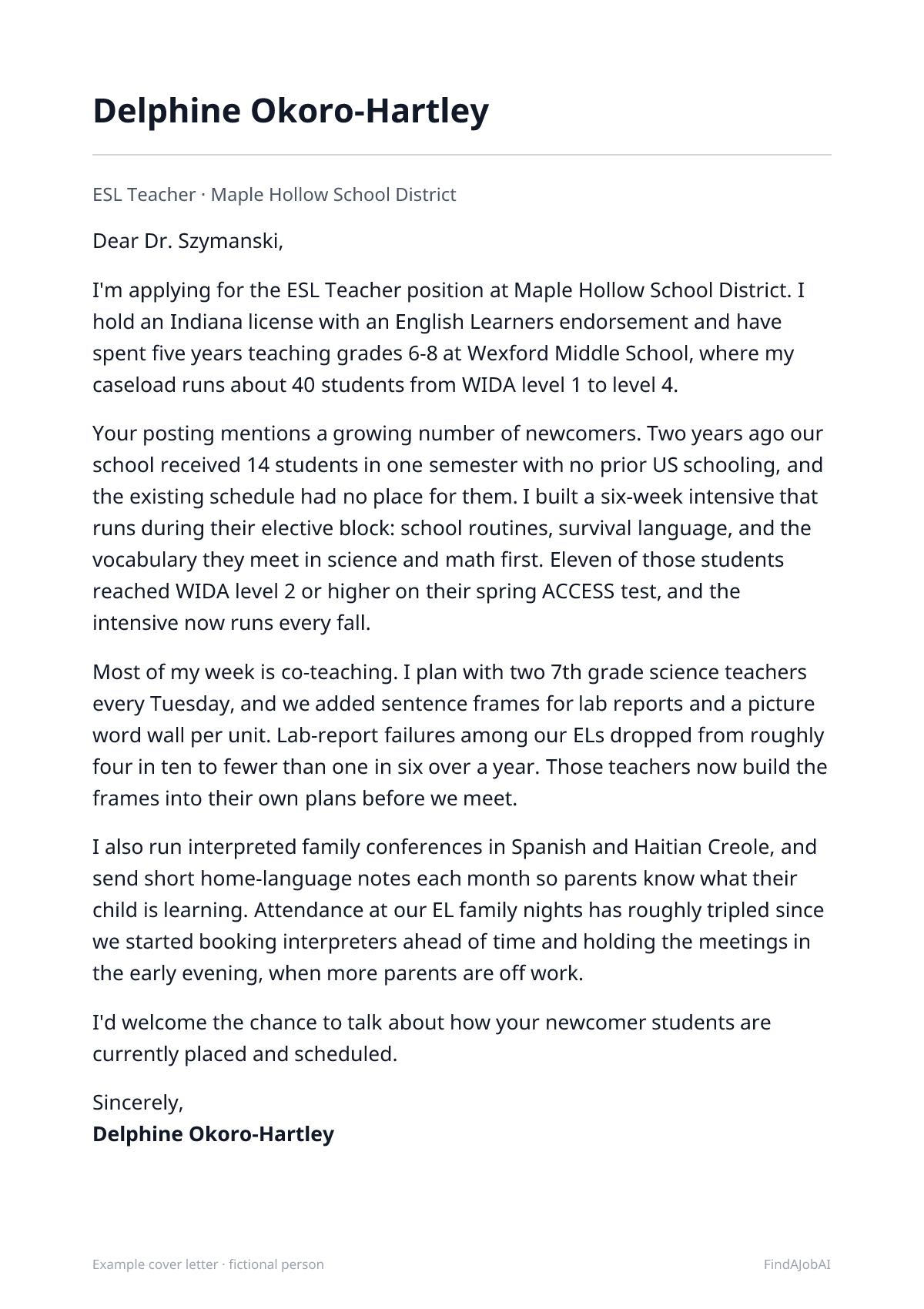
Dear Dr. Szymanski,
I'm applying for the ESL Teacher position at Maple Hollow School District. I hold an Indiana license with an English Learners endorsement and have spent five years teaching grades 6-8 at Wexford Middle School, where my caseload runs about 40 students from WIDA level 1 to level 4.
Your posting mentions a growing number of newcomers. Two years ago our school received 14 students in one semester with no prior US schooling, and the existing schedule had no place for them. I built a six-week intensive that runs during their elective block: school routines, survival language, and the vocabulary they meet in science and math first. Eleven of those students reached WIDA level 2 or higher on their spring ACCESS test, and the intensive now runs every fall.
Most of my week is co-teaching. I plan with two 7th grade science teachers every Tuesday, and we added sentence frames for lab reports and a picture word wall per unit. Lab-report failures among our ELs dropped from roughly four in ten to fewer than one in six over a year. Those teachers now build the frames into their own plans before we meet.
I also run interpreted family conferences in Spanish and Haitian Creole, and send short home-language notes each month so parents know what their child is learning. Attendance at our EL family nights has roughly tripled since we started booking interpreters ahead of time and holding the meetings in the early evening, when more parents are off work.
I'd welcome the chance to talk about how your newcomer students are currently placed and scheduled.
Sincerely,
Delphine Okoro-Hartley
Example 2 · Career changer
English teacher returning from Japan to a US adult education program
Corwin taught English in Japan for four years and holds CELTA but no US license. The posting is for an adult ESL instructor in a community college program.
Example letter · fictional
Dear Ms. Ferreira-Lund,
I'm applying for the Adult ESL Instructor role in Bluestem Community College's continuing education program. I've just returned from four years teaching English in Osaka, mostly to working adults, and adult learners are the group I want to keep teaching.
At Kitahama Language Academy I taught evening classes of 8 to 12 adults at CEFR A2 to B2, many of them nurses and factory supervisors who needed English for specific tasks. I wrote a short course on phone calls and incident reports for one manufacturing client after their supervisors told me what went wrong on real calls. Nine of the eleven supervisors in that group passed the company's internal B1 speaking check at the end of the course.
I know your program reports progress on CASAS rather than CEFR, and I've already worked through the CASAS reading and listening sample materials so I understand the score ranges and what an educational functioning level gain means for your funding. I hold CELTA with a Pass A and I'm comfortable placing students with a short oral and reading interview.
Your posting also mentions workforce English. That's the work I enjoyed most in Osaka: lessons built around the actual language of a learner's job, practiced until it came out under pressure. I'd be glad to build similar units with your employer partners, starting from the phone calls, forms and safety language their staff actually use each week.
I'd be glad to share a sample unit and talk through how I'd adapt it to your learners. I can also observe a class first if that helps.
Best regards,
Corwin Abernathy-Sato
Example 3 · Senior or lead
Experienced ESL teacher applying to lead an English learner program
Anneliese has taught ESL for eleven years and leads a team of four at her school. The posting is for an EL program coordinator overseeing six schools.
Example letter · fictional
Dear Superintendent Halvorsen,
I'm applying for the English Learner Program Coordinator role at Cedar Fork Unified. I've taught ESL for eleven years, the last four as lead ESL teacher at Brightwater High School, where I schedule and support four ESL teachers serving about 180 students.
Your posting says reclassification rates vary widely between schools. We had the same pattern inside one building: students with similar starting scores exited at very different rates depending on their counselor and schedule. I set up a shared progress tracker with fall and spring checks for every EL, and a monthly meeting where ESL teachers and counselors review students who are close to exit criteria. Over three years the share of our ELs reclassified within four years rose from about a third to just over half. Counselors now use the tracker during scheduling, so students near exit are placed in classes that build the academic writing they still need.
I also coach. Each semester I run a SIOP planning cycle with a few content teachers: one planning session, an observation, and a short debrief. Two of those teachers now lead the cycle in their own departments. I'd bring the same cycle to Cedar Fork, starting with the schools where English learners are concentrated in a few content classes and teachers have asked for help.
I haven't written a Title III plan myself, though I've contributed the high school section twice and know the reporting calendar. I'd want to work closely with your federal programs office during the first cycle.
I'd welcome a conversation about which schools you see as the priority and what data you already collect on English learners.
Respectfully yours,
Anneliese Groenewald
All three letters, and the short version below, are fictional: the people, employers and numbers are invented. Borrow the structure, never the facts.
- Prefer to write it yourself? Use the free cover letter template.
- Check your CV against the job first: the free CV score shows the missing keywords.
Why the first letter works, paragraph by paragraph
Paragraph 1: Opening
States the license and endorsement, the grade band and the size and range of the caseload in two sentences, which answers the screening questions before they are asked.
Paragraph 2: The newcomer program
Answers the posting's main need with a program the writer built, including the problem that prompted it and a WIDA result for the first cohort.
Paragraph 3: Co-teaching evidence
A fixed planning day, two concrete scaffolds and a drop in lab-report failures show collaboration as a habit with outcomes, not a buzzword.
Paragraph 4: Families
Naming the languages and the monthly notes gives the reader a concrete picture of family outreach in one short paragraph.
Paragraph 5: Close
Asks about the district's current newcomer placement, which invites a working conversation instead of a polite formality.
What the career changer's letter does differently
The returning teacher's letter faces the obvious gap, no US license and a different assessment framework, by showing he has already studied CASAS and understands why the program reports on it. A workplace course with a real pass count ties his overseas work to the posting's workforce English focus.
What the senior letter does differently
A program-level letter reports a system the writer built, a progress tracker and a monthly review with counselors, and the change in reclassification it supported. The gap, no Title III plan written alone, is stated plainly with what she has done instead.
Short ESL teacher cover letter: an email-ready version
Many applications arrive as an email or a small text box, and a full page doesn't fit. This version runs 120 to 150 words and keeps only what a reader needs to decide whether to reply. An ESL teacher replies to a principal who posted a midyear opening on a regional education jobs board.
Short version · email · fictional141 words
Subject: Midyear ESL Teacher opening – K-5 licensed, available in January – Teodoro Vukovic
Hello Principal Ashdown,
I'm writing about the midyear ESL Teacher opening at Willowmere Elementary. I hold a Wisconsin ESL license for grades K-12 and can start in January.
For three years I've taught K-5 English learners in pull-out and push-in blocks at a school of similar size, with a caseload of about 30 students. Last spring 21 of them moved up at least one WIDA composite level, and I co-plan reading units with the second and third grade teams each week. I also keep short running notes on each child's speaking and writing so classroom teachers can see progress between tests.
Joining midyear means meeting students who already have routines, so I'd start by reviewing each child's screener and ACCESS history with their classroom teacher and meeting families in the first two weeks. My resume is attached.
Thank you,
Teodoro Vukovic
The availability date sits in the first paragraph because a midyear vacancy is about timing. One caseload result and a sentence on how he'd start midyear give the principal enough to call.
Opening lines that work for ESL teacher cover letters
The first sentence decides whether the second gets read. Here are six openings, one for each situation you might be in. Pick the one that matches yours and swap in your own facts: every name and number below is invented.
1. You have a standout result
Last spring 31 of my 44 English learners moved up at least one WIDA level, and I'd like to bring the routines behind that result to your middle school.
2. The ad names a problem you've solved
Your posting mentions a new newcomer center. Two years ago I built a six-week newcomer intensive that our school now runs every fall.
3. Someone referred you
I taught adults in a workforce English program for three years and want to bring that focus on job language to your continuing education classes.
4. You admire what they build
Your ELL coordinator, Ms. Ruiz-Bennett, observed my co-taught science class at a regional training last month and suggested I apply.
5. You're new to the field or switching into it
After four years teaching English in Seoul, I've completed my state ESL endorsement and want to teach English learners in a public school at home.
6. You have senior scope or a specialism
I lead four ESL teachers at a large high school and want a role where building the English learner program across schools is the main job.
How to write an ESL teacher cover letter
Five steps, in the order you'd write them. The shape stays the same for every job (a short opening, proof, a reason for this employer, a close), and what goes into each part is what changes with the role.
Find the framework and setting in the posting
K-12 schools usually report on WIDA or a state test such as ELPAC, adult programs on CASAS or BEST Plus, and language schools on CEFR or exam bands. Pick the example from your experience that matches that setting and measure it the same way.
Lead with your learners, not your passion
Name the age group, proficiency range and caseload size in the first paragraph. A reader screening many letters wants to know quickly whether your students resemble theirs. If you've taught several groups, lead with the one closest to the posting.
Show one program or routine with a result
A newcomer intensive, a vocabulary routine shared with content teachers or an exam course with a pass count is concrete evidence. Explain briefly why you built it and what changed afterward. Keep it to one example told well.
Cover collaboration and families
Most ESL roles involve co-teaching, consulting with classroom teachers or working with families who speak other languages. One or two sentences with a schedule or a language list are enough. Mention the languages you worked with and how often you met with teachers.
Handle licensing gaps directly
If you trained abroad or hold CELTA rather than a state endorsement, say what you hold and how you are meeting the requirement. Hiding it only delays the question until the interview. Give a date if you expect to finish a requirement.
ESL Teacher cover letter do's and don'ts
Do
- Name the framework the employer uses, such as WIDA, CASAS or CEFR, and report one result in it.
- Describe how you work with content teachers or program staff, with a schedule and a concrete scaffold.
- Mention family or community outreach with the languages involved, if the role serves families.
Don't
- Don't open with how much you love languages or travel; open with the learners you have taught.
- Don't present a TEFL certificate as equal to a state license for a public school role.
- Don't describe students by nationality stereotypes; describe their level, needs and progress.
Common ESL teacher cover letter mistakes
Each one is easy to make and quick to fix before you send the letter.
Opening with a travel story
A year abroad is background, not a qualification. Start with the learners you taught and a measurable result, then mention the setting.
Using the wrong assessment language
Talking only about CEFR to a US school district, or only WIDA to an adult program, suggests you haven't read the posting. Match their framework or translate your results into it.
Leaving out co-teaching
Principals often hire ESL teachers to support content classes. If you have co-taught, name the subject and one scaffold you added.
Claiming fluency you don't have
Families and interviewers will test it. State your real level in each language and how you use it.
Writing a generic teaching letter
A letter that could fit any classroom role misses what makes ESL different: proficiency levels, language objectives and support for newcomers. Name at least one of these specifically.
Email subject lines for ESL teacher applications
Applying by email? Put the job title, any reference number and your name in the subject line.
- ESL Teacher application – grades 6-8, newcomer program and co-teaching – Delphine Okoro-Hartley
- Adult ESL Instructor application – CELTA, workforce English – Corwin Abernathy-Sato
- Application: English Learner Teacher, Elementary (Posting 4471) – Delphine Okoro-Hartley
Everything for ESL Teachers
- ESL Teacher resume exampleA full resume, plus bullet and summary examples
- ESL Teacher interview questions30 questions with sample answers
- ESL Teacher job descriptionDuties, skills and requirements
- Career change cover letter: template + examples
Other cover letter examples
ESL Teacher cover letter FAQ
What should I include in an ESL teacher cover letter?
Your license or certificate, the learners you have taught and at what proficiency levels, one result measured on the employer's framework, and how you work with content teachers or families. Keep classroom method details for the interview.
How do I write an ESL cover letter with experience only abroad?
Describe the age group, CEFR band, class size and setting abroad, then show you understand the new employer's framework and licensing rules. If you lack a required license, say what you hold and how you plan to meet the requirement.
Should I mention the languages I speak?
Yes, if they help with families or the role is bilingual. State your real level, and make clear that your instruction is in English unless the posting asks for something else.
How we built this page
The FindAJobAI team wrote the three example letters, the short email version, the opening lines and the advice for ESL teacher roles. The people, employers and numbers in the letters are invented; the structure, the kind of evidence and the order of the paragraphs are the parts to copy.
Once we track enough live ESL teacher job ads, this page also shows the skills they ask for most, counted the same way as our in-demand skills report.
Last reviewed on November 1, 2026.