Tutor Cover Letter Example (2026)
By FindAJobAI team Updated How we built this page
Tutoring ads usually ask for a subject and a grade range, so applicants look similar until a parent or center director reads further. The cover letter is where you show how you actually explain a stuck concept, and what changed for a real student once you did.
Tutor cover letter template
This letter as a one-page template: an opening that names the job and your strongest fact, proof that answers the ad, a reason for this employer and a short close.
After you sign up, FindAJobAI drafts your own letter for a real job from your CV in this format, and you edit it before you send it.
Example 1 · Experienced
Private math tutor applying to a learning center
Idris tutors algebra and geometry independently and wants steadier hours at a center. The ad asks about raising test scores.
Example letter · fictional
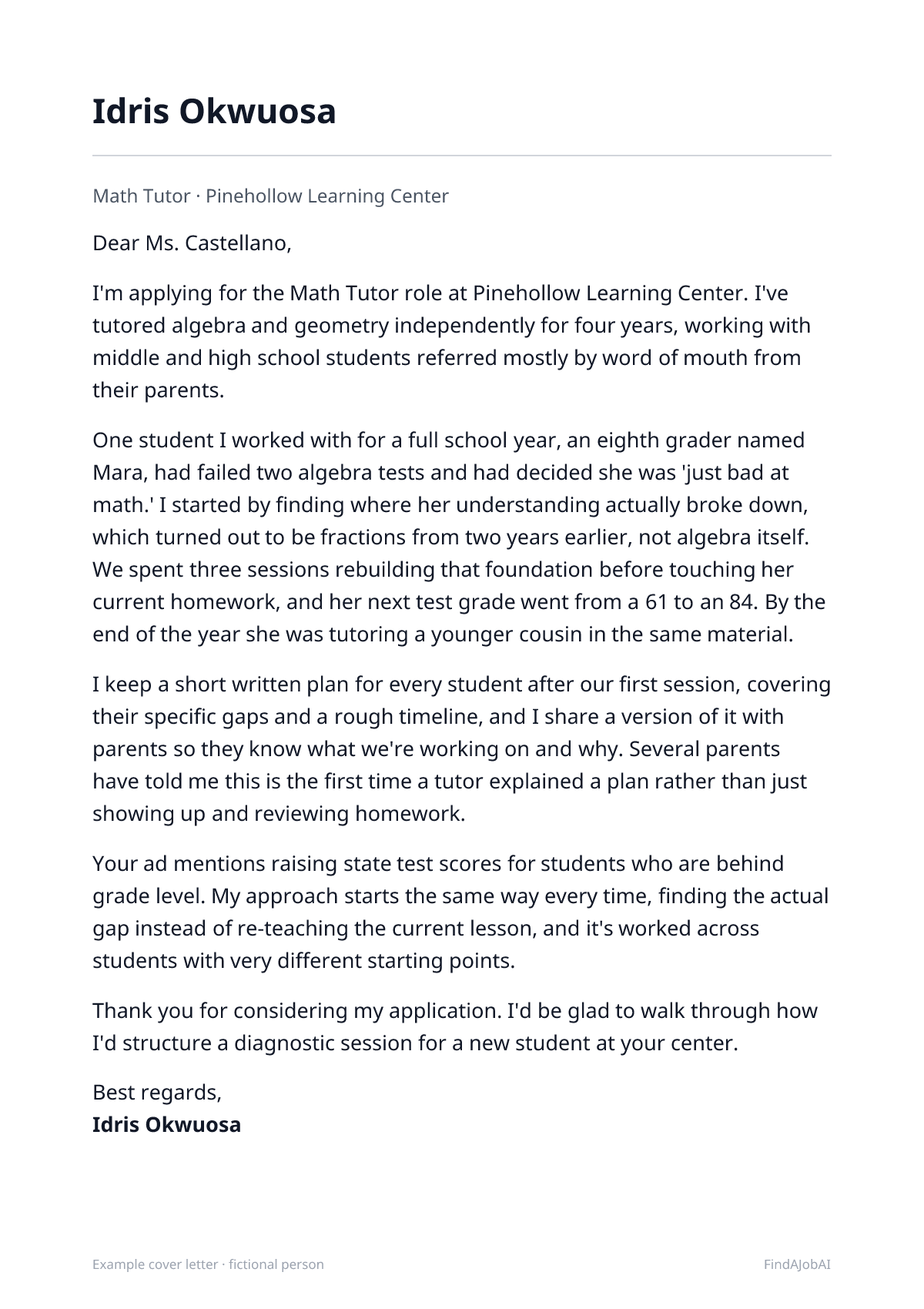
Dear Ms. Castellano,
I'm applying for the Math Tutor role at Pinehollow Learning Center. I've tutored algebra and geometry independently for four years, working with middle and high school students referred mostly by word of mouth from their parents.
One student I worked with for a full school year, an eighth grader named Mara, had failed two algebra tests and had decided she was 'just bad at math.' I started by finding where her understanding actually broke down, which turned out to be fractions from two years earlier, not algebra itself. We spent three sessions rebuilding that foundation before touching her current homework, and her next test grade went from a 61 to an 84. By the end of the year she was tutoring a younger cousin in the same material.
I keep a short written plan for every student after our first session, covering their specific gaps and a rough timeline, and I share a version of it with parents so they know what we're working on and why. Several parents have told me this is the first time a tutor explained a plan rather than just showing up and reviewing homework.
Your ad mentions raising state test scores for students who are behind grade level. My approach starts the same way every time, finding the actual gap instead of re-teaching the current lesson, and it's worked across students with very different starting points.
Thank you for considering my application. I'd be glad to walk through how I'd structure a diagnostic session for a new student at your center.
Best regards,
Idris Okwuosa
Example 2 · Career changer
Bartender moving into tutoring with a teaching certificate in progress
Wren tutored a coworker's child informally and is completing a tutoring certificate. The ad wants patience with reluctant readers.
Example letter · fictional
Dear Hiring Manager,
I'm applying for the Reading Tutor role at Birchlight Family Resource Center. For six years I've worked as a bartender, a job built on reading people and staying patient under pressure, and for the past year I've been tutoring a coworker's ten-year-old son, Dash, who was two reading levels behind and hated being asked to read aloud.
Dash wouldn't touch a book that looked 'too babyish' or 'too hard,' so I spent our first few sessions just finding graphic novels and short nonfiction about things he already liked, skateboarding and sharks, with no pressure to finish. Once he was reading for fun, we moved to tracking his own reading log and sounding out unfamiliar words together instead of me jumping in. He's now at grade level and asked for his own library card, which his mother says never would have happened a year ago.
I'm currently completing a tutoring certificate through Marrowgate Community College, with a module specifically on phonics-based reading intervention, which I'm applying directly to how I work with Dash now. I keep a short list of books sorted by reading level and interest, which Dash helped me build.
Your posting mentions reluctant readers, which is exactly the problem I solved with Dash: not a skills gap alone, but a motivation gap that skill-building alone doesn't fix. I'd bring that same patience along with the structure I'm now learning formally.
Thank you for your time. I'm glad to share more about how the certificate program is going or to meet the families I'd be working with.
Kind regards,
Wren Castellanos
Example 3 · Senior or lead
Lead tutor applying to oversee a center's tutoring staff
Branwen leads eight tutors at a learning center. The ad is for a lead who trains tutors and standardizes session plans.
Example letter · fictional
Dear Mr. Falkenrath,
I'm applying for the Lead Tutor role at Hartwell Learning Collective. For the past two years I've led a team of eight tutors at Juniper Grove Tutoring, and before that I tutored math and science independently for five years.
Your ad mentions inconsistent session quality across tutors and a need for standardized planning, which is the exact problem I was asked to fix at Juniper Grove. Sessions varied widely because new tutors were improvising structure on the spot. I built a short diagnostic template every tutor uses in a first session, plus a shared bank of explanation methods for common sticking points like fraction word problems and balancing chemical equations. Parent complaints about inconsistent sessions dropped off within a semester, and three of my newer tutors now train the next round of hires using the same materials.
I still tutor six hours a week myself, mostly students who've struggled with two or more previous tutors, because staying close to the actual work keeps my coaching useful rather than theoretical. One ninth grader had been through two tutors before me and still couldn't factor quadratics; I found she'd never fully understood distributing a negative sign, a gap from years earlier. Once we fixed that, factoring clicked within two sessions, and she moved from a low C to a B+ by the end of the term.
I haven't yet managed a tutoring staff across multiple physical locations, which I understand this role involves, and I'd want to learn your current scheduling and communication system closely before suggesting changes.
I'd welcome a conversation about where your session quality varies most and how your tutor training is currently structured.
Sincerely,
Branwen Oduya
All three letters, and the short version below, are fictional: the people, employers and numbers are invented. Borrow the structure, never the facts.
- Prefer to write it yourself? Use the free cover letter template.
- Check your CV against the job first: the free CV score shows the missing keywords.
Why the first letter works, paragraph by paragraph
Paragraph 1: Opening
States the subjects and grade range the writer already tutors, and that referrals came from parents, a quiet signal of trust before any story is told.
Paragraph 2: The student who improved
Names a real problem (a wrong belief about her own ability), the actual method (finding the fraction gap first) and a specific score change, which is more convincing than a general claim of skill.
Paragraph 3: Communicating with parents
A written plan and parent feedback show professionalism beyond the tutoring session itself, which matters to a center that answers to parents directly.
Paragraph 4: Why this employer
Responds directly to the ad's own stated goal, raising test scores for students behind grade level, instead of restating a general strength.
Paragraph 5: Close
Offers a concrete, relevant next step, a diagnostic session walkthrough, rather than a generic thank-you.
What the career changer's letter does differently
The career changer's letter leads with informal tutoring already done for a real child, names the specific problem (motivation, not just skill) and result, and treats the in-progress certificate as the formal piece being added to proven patience from bartending and a year of hands-on reading work.
What the senior letter does differently
A lead tutor letter reports a staff's habits, not just one student: a shared diagnostic template, an explanation bank for common sticking points, and parent complaints that dropped off after training changed. It still proves the writer tutors difficult cases personally, and names the one gap, multi-location management, honestly.
Short tutor cover letter: an email-ready version
Many applications arrive as an email or a small text box, and a full page doesn't fit. This version runs 120 to 150 words and keeps only what a reader needs to decide whether to reply. A tutor answers a family resource center's short online form, sent as an email after the application portal timed out.
Short version · email · fictional123 words
Subject: Tutor application – math and reading, grades 3-8 – Niamh Osei
Hello Mr. Delacroix,
I'm applying for the Tutor role at Larchmont Youth Center. I've tutored math and reading for three years, mostly with students in grades three through eight who are behind their current grade level.
My usual first step is a short diagnostic to find where a student's understanding actually breaks down, rather than re-teaching whatever they're currently stuck on. One fifth grader I worked with moved from failing to passing his math unit tests within a semester once we found and fixed a gap in multiplication from two years earlier.
I keep parents updated with a short plan after each student's first session. My resume is attached, and I'm glad to meet the families I'd be working with.
Best,
Niamh Osei
The short version keeps the diagnostic approach and one measurable student outcome, since both answer what a youth center cares about most, and drops the staff-leadership details that wouldn't apply to a single tutoring role.
Opening lines that work for tutor cover letters
The first sentence decides whether the second gets read. Here are six openings, one for each situation you might be in. Pick the one that matches yours and swap in your own facts: every name and number below is invented.
1. You have a standout result
Last year I helped a student move from a 61 to an 84 on her algebra tests by finding a fraction gap two years behind her current material. I'd like to bring that same diagnostic approach to your students.
2. The ad names a problem you've solved
Your ad mentions students who are behind grade level. My usual first step is finding exactly where understanding broke down rather than re-teaching the current lesson, which has worked across very different starting points.
3. Someone referred you
Your program director, Fennimore Blackwood, worked with me for a year through a local literacy nonprofit. He mentioned you're looking for someone who explains plans clearly to parents, which prompted this application.
4. You admire what they build
My own child attended your program two years ago, and the way your tutors tracked his progress stuck with me; I'd like to bring that same structure to your team as a tutor rather than a parent.
5. You're new to the field or switching into it
I spent six years bartending, which taught me patience under pressure, then tutored a coworker's son through two reading levels using graphic novels he actually wanted to read. I'd like to keep doing that work formally.
6. You have senior scope or a specialism
As lead tutor for an eight-person team, I built a shared diagnostic template that cut inconsistent sessions and parent complaints. I'm now looking for a center where I can build that same structure from an earlier stage.
How to write a tutor cover letter
Five steps, in the order you'd write them. The shape stays the same for every job (a short opening, proof, a reason for this employer, a close), and what goes into each part is what changes with the role.
Open with one student, not your subject list
Skip restating every subject you tutor and start with one specific student's problem and how it resolved. A reader who sees a real result in your first sentence trusts the rest of the letter more than a list of qualifications would earn.
Match the grade range and subject the ad names
Elementary reading, high school chemistry, and test prep each call for different methods and patience levels. Read the ad closely for its actual grade range and subject, then choose the story from your experience that answers it most directly.
Describe your actual method, not just the outcome
Say what you did differently, such as finding an earlier gap before tackling current material, or using a student's own interests to build reading motivation. The method is what a center or parent is actually hiring, since outcomes alone can sound lucky.
Show how you work with parents or guardians
Mention a habit like a written session plan or regular progress updates. Most tutoring jobs answer to parents directly, so a hiring manager wants to know you can communicate clearly with them, not just with the student.
End with a specific, actionable step
Offer something specific, like walking through how you'd run a first diagnostic session, rather than a generic thank-you. If you're newer to tutoring, mention any certificate in progress and your availability for a trial session.
Tutor cover letter do's and don'ts
Do
- Tell one student's story: the specific problem, what you tried, and how it changed, with a grade or habit as evidence.
- Name the subject and grade range the ad asks for, and match your example story to it if you can.
- Mention how you communicate with parents or guardians, since most tutoring jobs answer to them directly.
- If you're newer, use informal tutoring, coaching, or mentoring experience and name any certificate in progress.
Don't
- Don't say you're "passionate about helping kids learn"; show it with one student and one real change.
- Don't list every subject you could technically tutor; focus on the one or two the ad actually asks for.
- Don't share a student's full name or identifying school details; keep examples anonymized or first-name only.
Common tutor cover letter mistakes
Each one is easy to make and quick to fix before you send the letter.
Listing every subject you could technically tutor
A long list suggests shallow familiarity with each one. Focus on the one or two subjects the ad actually asks for, and go deep with a real example in those instead.
Claiming a love of teaching without proof
"I love helping kids learn" is what every applicant writes. Replace it with one student's specific problem, your method, and the change that followed.
Mentioning a student by name
Using a real last name or naming a specific school can raise privacy concerns for families and centers. Use a first name only, or describe the student generically, such as "a seventh grader."
Ignoring how you work with parents
A letter focused only on the student misses half the job in most tutoring roles. Mention a specific habit, like a written plan or regular check-ins, that shows you communicate with the people paying for the service.
Treating a score change as proof with no method behind it
A grade that moved from a C to a B means little without knowing what changed. Name the actual method, such as finding an earlier gap or building reading motivation first, so the result is believable rather than coincidental.
Email subject lines for tutor applications
Applying by email? Put the job title, any reference number and your name in the subject line.
- Math Tutor application – diagnostic approach to test scores – Idris Okwuosa
- Reading Tutor – reluctant readers and phonics certificate in progress – Wren Castellanos
- Application: Tutor, After-School Program (Req. 3310) – Idris Okwuosa
Everything for Tutors
- Tutor resume exampleA full resume, plus bullet and summary examples
- Tutor interview questions30 questions with sample answers
- Tutor job descriptionDuties, skills and requirements
- Career change cover letter: template + examples
Other cover letter examples
Tutor cover letter FAQ
What should I write in a tutor cover letter?
One student's story: the specific problem, the method you used, and how it changed, with a grade, level, or habit as evidence. Then a sentence on how you communicate with parents or guardians, since most tutoring jobs answer to them directly.
How do I write a tutor cover letter with no formal experience?
Use informal tutoring, mentoring, or coaching you've already done, such as helping a relative's child or a coworker's student, and name any certificate or training you're completing. Describe one real change you helped bring about.
Should I mention test scores in a tutor cover letter?
Only if the ad asks about them or you have a specific, honest example. A single student's before-and-after score with context is more convincing than a general claim about raising grades.
How we built this page
The FindAJobAI team wrote the three example letters, the short email version, the opening lines and the advice for tutor roles. The people, employers and numbers in the letters are invented; the structure, the kind of evidence and the order of the paragraphs are the parts to copy.
Once we track enough live tutor job ads, this page also shows the skills they ask for most, counted the same way as our in-demand skills report.
Last reviewed on November 1, 2026.