Lawyer Cover Letter Example (2026)
By FindAJobAI team Updated How we built this page
Lawyer job ads mostly ask for a bar license, a practice area and a few years of matters. A cover letter can't repeat the resume; it has to show how you reason through a problem and work with a client or a partner. Name a matter, what you had to decide, and what happened because of your judgment.
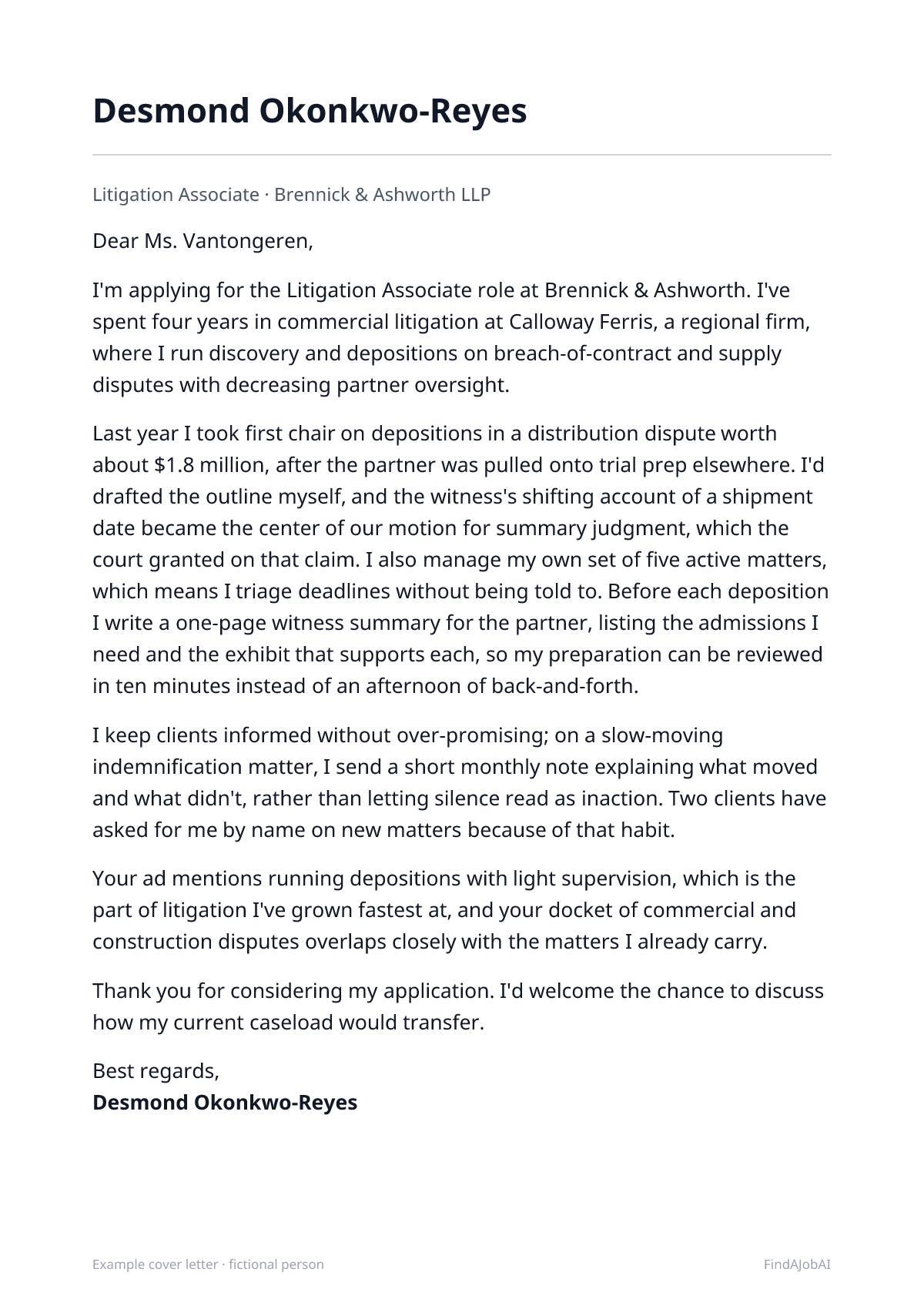
Lawyer cover letter template
This letter as a one-page template: an opening that names the job and your strongest fact, proof that answers the ad, a reason for this employer and a short close.
After you sign up, FindAJobAI drafts your own letter for a real job from your CV in this format, and you edit it before you send it.
Example 1 · Experienced
Litigation associate applying to a mid-size firm
Desmond handles commercial disputes at a regional firm. The ad asks for someone who can run a deposition with light supervision.
Example letter · fictional
Dear Ms. Vantongeren,
I'm applying for the Litigation Associate role at Brennick & Ashworth. I've spent four years in commercial litigation at Calloway Ferris, a regional firm, where I run discovery and depositions on breach-of-contract and supply disputes with decreasing partner oversight.
Last year I took first chair on depositions in a distribution dispute worth about $1.8 million, after the partner was pulled onto trial prep elsewhere. I'd drafted the outline myself, and the witness's shifting account of a shipment date became the center of our motion for summary judgment, which the court granted on that claim. I also manage my own set of five active matters, which means I triage deadlines without being told to. Before each deposition I write a one-page witness summary for the partner, listing the admissions I need and the exhibit that supports each, so my preparation can be reviewed in ten minutes instead of an afternoon of back-and-forth.
I keep clients informed without over-promising; on a slow-moving indemnification matter, I send a short monthly note explaining what moved and what didn't, rather than letting silence read as inaction. Two clients have asked for me by name on new matters because of that habit.
Your ad mentions running depositions with light supervision, which is the part of litigation I've grown fastest at, and your docket of commercial and construction disputes overlaps closely with the matters I already carry.
Thank you for considering my application. I'd welcome the chance to discuss how my current caseload would transfer.
Best regards,
Desmond Okonkwo-Reyes
Example 2 · Career changer
Litigation paralegal moving into practice as an associate
Latoya passed the bar while working full time and ran a motion to compel largely on her own. The ad is an entry-level associate opening.
Example letter · fictional
Dear Hiring Committee,
I'm applying for the Associate Attorney role at Sorrelfield Law Group. I spent five years as a litigation paralegal at Harcourt Dunmore, and I passed the bar this spring after studying around that job, so I'm applying for my first role as a licensed attorney.
As a paralegal I did more legal analysis than the title suggests. On a vendor dispute, the supervising attorney was out for six weeks, and I drafted the motion to compel discovery myself, including the argument section, which he filed with minor edits after the court's deadline nearly passed. The motion was granted, and the opposing side produced the documents that later settled the case.
I also built the firm's current privilege-log template after our old one caused a dispute over an inadvertent waiver, and associates across three practice groups still use it. That work taught me how much litigation turns on organization that nobody notices until it's missing. I also sat in on client intake calls and wrote the first summary memo for the supervising attorney, which taught me to separate what a client said from what the documents show.
Your posting is for a role that develops new associates through direct casework rather than a formal training track, which matches how I've learned so far, by doing the work and having it checked. I'm used to my drafts coming back covered in red ink, and I've learned to ask what each edit was for so the same mistake never shows up in my next filing.
Thank you for your time. I'd welcome a conversation about where I could contribute from day one.
Sincerely,
Latoya Yamamoto
Example 3 · Senior or lead
Senior counsel applying to lead a growing in-house legal team
Fenwick built the legal function at a logistics company and now wants to lead a larger in-house team at a manufacturer.
Example letter · fictional
Dear Mr. Castellanos,
I'm applying for the Senior Counsel role at Marrowstone Industrial. For the past four years I've been the first and only in-house lawyer at Daltrey Logistics, where I built the legal function from a single contracts folder into a working department, and before that I was a mid-level associate at a regional firm for six years.
Your ad says the legal team is still routed through outside counsel for routine vendor and customer contracts, which was exactly Daltrey's problem when I arrived. I built a tiered contract playbook so operations could close standard vendor agreements without legal review, reserved my own time for the contracts above a set risk threshold, and cut outside counsel spend on contracts work by roughly 60% over two years.
Legal earns trust by being fast on the routine and careful on the rare. When a customer tried to terminate a multi-year shipping contract early, I found a cure provision the sales team had missed, negotiated a reduced exit fee instead of a full loss, and the saved revenue was worth more than my entire legal budget that year. I now train new account managers on the clauses that matter most in our contracts.
I've never managed another attorney directly, and Daltrey never needed outside litigation support, so I'd be learning how to build a team and vet litigation counsel at the same time I was ramping up on your industry.
I'd welcome a conversation about which contracts or disputes currently take up the most of your team's time, and how you're thinking about the first hire under this role.
Sincerely,
Fenwick Adeyemi-Lassiter
All three letters, and the short version below, are fictional: the people, employers and numbers are invented. Borrow the structure, never the facts.
- Prefer to write it yourself? Use the free cover letter template.
- Check your CV against the job first: the free CV score shows the missing keywords.
Why the first letter works, paragraph by paragraph
Paragraph 1: Opening
Names the practice area, the firm type, and the specific skill (running depositions with less oversight) that signals readiness for more responsibility.
Paragraph 2: The matter that shows judgment
A dollar figure, a first-chair moment, and the outcome of the motion built on it give the reader something concrete to evaluate, not just 'strong litigation skills.'
Paragraph 3: Working with clients
The monthly note on a slow matter shows judgment about communication, and clients asking for him by name is evidence a partner can check.
Paragraph 4: Why this firm
Matches the ad's specific ask (light supervision on depositions) to the matters he already handles, rather than praising the firm generically.
Paragraph 5: Close
Offers to discuss how his caseload would transfer, which signals he's thinking about the firm's workload, not just his own move.
What the career changer's letter does differently
The career changer's letter leads with a single piece of unsupervised legal work (a motion to compel drafted and filed under deadline pressure) and its result, rather than years of paralegal duties. The privilege-log detail shows institutional impact beyond her own docket, and the closing line about how she's learned addresses the experience gap directly instead of hiding it.
What the senior letter does differently
A senior counsel letter reports the shape of a legal function: a contract playbook, a specific cost reduction, and one dispute where catching a missed clause outweighed the legal budget. The gaps (no direct reports managed, no litigation experience) are named plainly instead of implied away, which reads as more credible for a first leadership hire.
Short lawyer cover letter: an email-ready version
Many applications arrive as an email or a small text box, and a full page doesn't fit. This version runs 120 to 150 words and keeps only what a reader needs to decide whether to reply. A lawyer answers a startup's short-form 'why you' application question by email after a recruiter asked for a quick note instead of a full letter.
Short version · email · fictional126 words
Subject: Corporate Counsel application – SaaS contracts and vendor negotiation – Odalys Pemberton
Hello Mr. Achterberg,
I'm applying for the Corporate Counsel role at Ferrowind Energy. I've spent three years as in-house counsel at a SaaS company, handling customer and vendor contracts for a legal team of two.
My most useful project was rebuilding our customer contract templates after a renewal clause started causing disputes almost every quarter. The rewrite cut contract disputes nearly to zero and shortened our average contract turnaround from twelve days to four. I'm available for a call this week.
Energy contracts carry more regulatory weight than SaaS ones, and I'd like to bring that same template discipline to a team facing more complex agreements. My resume is attached, and I can walk through the template project in more detail if useful.
Best,
Odalys Pemberton
A short-form question forces one example, so this version keeps the template rewrite and both of its measurable effects (disputes and turnaround time) instead of listing contract types handled. The closing line names the one real gap, regulatory complexity, rather than pretending it doesn't exist.
Opening lines that work for lawyer cover letters
The first sentence decides whether the second gets read. Here are six openings, one for each situation you might be in. Pick the one that matches yours and swap in your own facts: every name and number below is invented.
1. You have a standout result
Last year I rewrote our standard customer contract template after it caused a dispute almost every quarter, and disputes under the new version dropped to nearly zero. I'd like to bring that same discipline to your contracts.
2. The ad names a problem you've solved
Outside counsel spend on routine matters is a line item your ad flags directly. At my current company I built a playbook that let operations close standard contracts without legal review, and our outside counsel spend on that work fell by more than half.
3. Someone referred you
Your general counsel, Rosalind Achebe-Finch, supervised my clerkship two summers ago and suggested I apply, which is what prompted this letter.
4. You admire what they build
I've followed your company's work on municipal water contracts for over a year, and the regulatory complexity in that docket is exactly the kind of problem I'd like to work on next.
5. You're new to the field or switching into it
I spent six years as a paralegal before I was admitted to the bar this spring, and the motion I drafted and filed largely on my own, while the supervising attorney was out, is still the work I'm proudest of.
6. You have senior scope or a specialism
As the first in-house lawyer at a logistics company, I built the contract function from nothing and cut outside counsel spend on routine work by more than half. I'm ready to build the next one.
How to write a lawyer cover letter
Five steps, in the order you'd write them. The shape stays the same for every job (a short opening, proof, a reason for this employer, a close), and what goes into each part is what changes with the role.
Match your example to the ad's practice area
Litigation, transactional, and in-house ads reward different stories. A litigation ad wants a motion or deposition; a transactional ad wants a negotiated deal term; an in-house ad wants a process you built. Pick the matter that matches before writing anything else.
Open with the outcome of a matter, not your title
Say what was at stake and how it ended before you explain your part. A resolved dispute or a signed deal near the top gives a busy partner a reason to read on, and the details of your own contribution can follow.
Quantify what a reader can verify
A dollar figure, a stage of litigation reached, or a turnaround time changed are easier to trust than 'successfully resolved.' If you can't share a number because of confidentiality, describe the stage the matter reached and what the client did next.
Name the procedure or document, not just the skill
Depositions, motions to compel, indemnification clauses, or cure provisions are more convincing than 'strong litigation skills' or 'contract expertise.' Attach the specific document or procedure to the one matter you're describing. A reader remembers a named document long after forgetting an adjective.
Show how you communicate with clients or partners
One sentence on how you keep a client informed, manage a partner's expectations, or explain risk to a non-lawyer. Close with a question about the employer's current docket or contracts, so the reader sees what you'd pick up first.
Lawyer cover letter do's and don'ts
Do
- Name a matter, your role in it, and the outcome, using a dollar figure or stage of litigation the reader can picture.
- Mention the practice area and any specific procedure the ad names, such as depositions, motions, or client counseling, inside a real example.
- Say how you handle client communication; responsiveness and managing expectations are often what partners actually evaluate.
Don't
- Don't say you have "strong analytical and communication skills"; show it with one motion, deposition, or negotiation.
- Don't disclose confidential client details or case names you're not authorized to share; describe the dispute type and result instead.
- Don't list every class you took in law school; one matter you actually worked on outweighs a transcript.
Common lawyer cover letter mistakes
Each one is easy to make and quick to fix before you send the letter.
Listing practice areas instead of one matter
'Experienced in contracts, litigation, and compliance' reads like a bar card. Pick the one matter most relevant to this ad and describe your specific role and the result in detail instead.
Naming confidential clients or case details
Even if impressive, naming a client without authorization is a judgment problem a reader will notice immediately. Describe the dispute type, the general stakes, and the outcome without identifying details.
Using unverifiable adjectives instead of outcomes
'Highly effective negotiator' says nothing a reader can check. Describe one negotiation, what the other side wanted, and what you actually got, in plain terms.
Treating law school as the main qualification
After a few years in practice, opening with law school honors suggests nothing newer is worth mentioning. Open with a matter you've handled since graduating instead.
Ignoring the experience gap for a career change
A paralegal or clerk stepping into a first associate seat gains nothing by skipping the change. Say it plainly in one sentence, then point to the unsupervised drafting or argument that makes the move believable.
Email subject lines for lawyer applications
Applying by email? Put the job title, any reference number and your name in the subject line.
- Litigation Associate application – commercial disputes – Desmond Okonkwo-Reyes
- Associate Attorney application – newly licensed, 5 years as litigation paralegal – Latoya Yamamoto
- Application: Associate, Commercial Litigation (Req. 2217) – Desmond Okonkwo-Reyes
Everything for Lawyers
- Lawyer resume exampleA full resume, plus bullet and summary examples
- Lawyer interview questions30 questions with sample answers
- Lawyer job descriptionDuties, skills and requirements
- Career change cover letter: template + examples
Other cover letter examples
Lawyer cover letter FAQ
What should I write in a lawyer cover letter?
Describe one matter you worked on, what you did in it, and how it ended, in two sentences at most. Then add a line on how you keep clients or partners informed. Your bar admission and practice areas are already on the resume, so spend the letter on judgment.
How do I write a lawyer cover letter with no attorney experience?
Use substantive legal work from a paralegal, clerkship, or law school clinic role, naming what you drafted or argued and what came of it. Address the experience gap directly in one sentence rather than avoiding it.
Should a lawyer cover letter name specific cases?
Only if you're authorized to and the case is public record. Otherwise describe the dispute type, the amount at issue in general terms, and the result, without naming the client or opposing party.
How long should a lawyer cover letter be?
One page, four to five paragraphs. Firms read many of these; a letter that gets to one concrete matter quickly reads better than one that lists every skill on the resume again.
How we built this page
The FindAJobAI team wrote the three example letters, the short email version, the opening lines and the advice for lawyer roles. The people, employers and numbers in the letters are invented; the structure, the kind of evidence and the order of the paragraphs are the parts to copy.
Once we track enough live lawyer job ads, this page also shows the skills they ask for most, counted the same way as our in-demand skills report.
Last reviewed on November 1, 2026.